






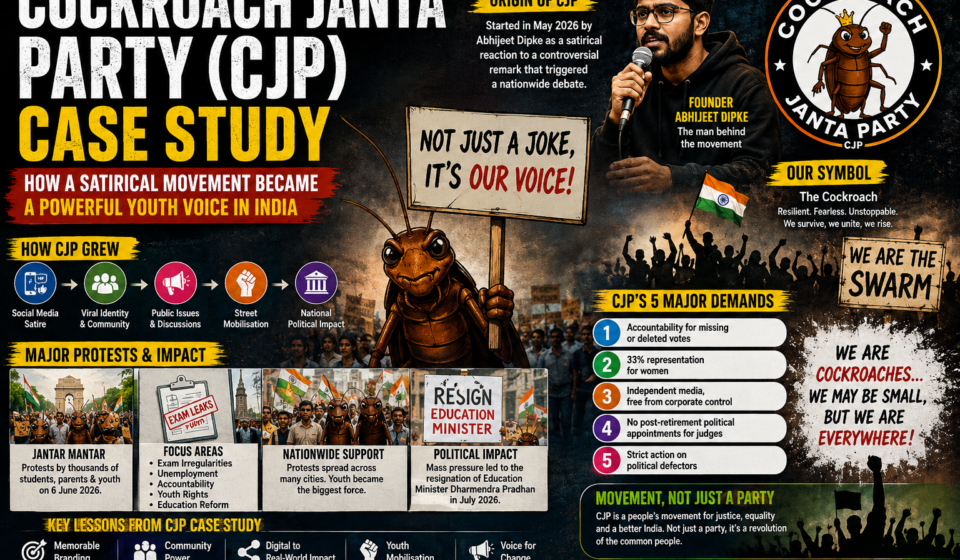
Cockroach Janta Party Case Study: How a Satirical Online Movement Became a Major Youth Campaign in India – 2026

Important spelling note: The movement is commonly referred to as the Cockroach Janta Party (CJP) or Cockroach Janata Party (CJP). The abbreviation CPJ is sometimes used informally or as a typing variation, but CJP is the abbreviation used in the movement’s public-facing material and media coverage.
Introduction: What Is the Cockroach Janta Party?
The Cockroach Janta Party (CJP) is one of the most unusual political and civic movements to emerge in India in 2026.
Unlike a traditional political organisation that begins with an established party structure, senior politicians, offices, election machinery and a conventional manifesto, the Cockroach Janta Party emerged from social media, satire, youth frustration and a controversial public debate.
The movement was initially created as a satirical idea by Abhijeet Dipke in May 2026. According to media reports, Dipke posted an invitation on social media on May 16 asking people to join what he called the Cockroach Janta Party. The idea reportedly attracted thousands of responses within a short period and subsequently developed into a much larger youth-oriented campaign.
What makes the CJP case study particularly interesting is the speed with which the movement moved through several stages:
Social media joke → viral identity → online community → political commentary → street mobilisation → nationwide protests → national political attention.
That transformation makes the Cockroach Janta Party case study important not only for political researchers but also for students of digital marketing, social media strategy, public relations, branding, youth engagement and online community building.
The movement also demonstrates how a highly unusual brand identity can become powerful when it connects with an existing public emotion.
Cockroach Janta Party Case Study at a Glance
| Category | Case Study |
|---|---|
| Name | Cockroach Janta Party / Cockroach Janata Party |
| Common abbreviation | CJP |
| Origin | India |
| Emergence | May 2026 |
| Founder associated with launch | Abhijeet Dipke |
| Initial format | Satirical social-media movement |
| Major audience | Youth, students, unemployed people and digitally active citizens |
| Major themes | Employment, examination issues, accountability, governance and youth concerns |
| Major mobilisation point | Jantar Mantar, New Delhi |
| Political style | Satire + digital activism + protest |
| Key digital advantage | Memorable identity and highly shareable messaging |
| Registration status | Public sources describe the movement as unregistered rather than an established Election Commission-recognised political party |
| Core lesson | Digital identity can accelerate civic mobilisation when connected to genuine public concerns |
The movement’s own websites contain varying presentations of its identity, while some explicitly describe it as satire rather than a registered political party. Therefore, readers should distinguish between the CJP movement, its websites, and a formally registered political party.
How Did the Cockroach Janta Party Start?
The origins of the Cockroach Janta Party are closely connected to a controversy involving a remark attributed to Chief Justice of India Surya Kant during a Supreme Court proceeding.
According to multiple reports, the controversy around the use of the word “cockroach” became the catalyst for the creation of an online movement.
However, there is an important qualification.
The Chief Justice later disputed the way the remark was represented publicly, saying that his words had been presented in a misleading manner. Therefore, the origin story should not be reduced to the claim that the CJI simply “called India’s youth cockroaches.” The exact context and interpretation of the court observation became part of the controversy itself.
For a serious Cockroach Janta Party case study, this distinction is important.
A responsible analysis should separate:
- What was said in court.
- How the remark was reported or interpreted.
- How social media reacted.
- How Abhijeet Dipke transformed the controversy into a political-satirical identity.
- How the resulting movement later developed independently around broader public issues.
The Founder of Cockroach Janta Party
The person most closely associated with the creation of the Cockroach Janta Party is Abhijeet Dipke.
Media reports describe Dipke as a young founder who initially launched the idea as satire.
A LiveMint interview reported that Dipke was based in Boston and that the original social-media invitation was intended as satire before the response became much larger than expected.
This is one of the most important lessons from the CJP case study:
The founder did not initially create a conventional political machine.
Instead, he created:
A name + a joke + a symbol + a social-media invitation.
The audience supplied the momentum.
That is fundamentally different from traditional political organisation building.
The First Growth Phase: From Joke to Viral Movement
The initial growth of CJP demonstrates a classic digital-network effect.
A conventional organisation may spend months or years building:
- Membership
- Brand recognition
- Local offices
- Public relations teams
- Volunteer networks
- Fundraising systems
- Political messaging
CJP initially relied on something much simpler:
A highly memorable concept.
The phrase “Cockroach Janta Party” is unusual.
It is:
- Easy to remember
- Visually distinctive
- Humorous
- Emotionally provocative
- Highly suitable for memes
- Easy to turn into a symbol
- Different from conventional political branding
This unusual positioning helped the movement stand out in a crowded social-media environment.
Why the Name “Cockroach” Became a Powerful Brand
From a conventional branding perspective, “cockroach” sounds like a terrible political brand.
But that is precisely why it became memorable.
Traditional political branding frequently uses concepts such as:
- Development
- Justice
- Progress
- Democracy
- Unity
- Change
- Revolution
CJP used a word associated with survival and resilience.
The movement’s own public messaging repeatedly uses the idea that cockroaches survive attempts to eliminate them. Some CJP websites explicitly frame the cockroach as a symbol of resilience and persistence.
This created a powerful psychological transformation:
Insult → identity
Instead of rejecting the label, the movement embraced it.
That is a classic example of reframing in communication strategy.
The Psychology Behind CJP Branding
The CJP identity can be understood through several psychological principles.
1. Reframing
A negative label is transformed into a positive identity.
Instead of:
“You are a cockroach.”
The movement’s symbolic response becomes:
“We are cockroaches—and we survive.”
This changes the emotional meaning of the word.
2. Group Identity
People who identify with the movement can use the symbol as a collective identity.
A person doesn’t simply support a political issue.
They can say:
“I am part of the swarm.”
That is much stronger from a community-building perspective.
3. Memetic Potential
A cockroach is visually simple.
It can easily become:
- A meme
- A logo
- A sticker
- A poster
- A social-media avatar
- A protest mask
- A hashtag
- A cartoon
- A T-shirt design
This makes the concept highly adaptable to digital culture.
From Satire to Serious Issues
The most important transition in the CJP case study occurred when the movement started addressing issues beyond the original controversy.
The movement increasingly focused on issues affecting students and young people, particularly examination irregularities, employment concerns and accountability.
India Today reported that CJP supporters, students, parents and young professionals gathered at Jantar Mantar in New Delhi on June 6, 2026, in a major on-ground mobilisation. The protest focused on alleged irregularities in examinations and recruitment tests and included a demand for the resignation of Union Education Minister Dharmendra Pradhan.
This was a critical turning point.
The movement was no longer simply an internet joke.
It had become a real-world mobilisation platform.
The Jantar Mantar Protest
Jantar Mantar became an important physical location in the CJP story.
According to India Today, supporters appeared wearing cockroach masks and carrying books, flowers and the national flag during the June mobilisation.
This demonstrates another important communication principle:
Digital identity can be transferred into physical-world symbolism.
Online:
Cockroach emoji 🪳
Offline:
Cockroach masks + posters + slogans + public gatherings
The same visual identity connected digital followers with physical protest participants.
Why the CJP Symbol Worked So Well
A successful movement needs recognisable symbols.
Examples from political history include:
- Flags
- Colours
- Animals
- Hand signs
- Slogans
- Logos
- Songs
CJP developed a distinctive symbolic language around the cockroach.
This gave supporters an easy way to communicate group identity without needing lengthy explanations.
A photograph of a crowd wearing cockroach masks can communicate the movement’s identity immediately.
That is extremely valuable in the age of social-media news.
The Role of Youth in the Cockroach Janta Party
Youth participation became one of the central features of the movement.
The CJP story developed at a time when young Indians were already discussing:
- Unemployment
- Competitive examinations
- Paper leaks
- Education costs
- Career uncertainty
- Government recruitment
- Private-sector employment
- Social inequality
- Political accountability
The movement therefore found an audience that already had unresolved concerns.
This is an important distinction.
The movement did not create every problem it discussed.
Instead, it created a new identity through which existing frustrations could be expressed.
The Unemployment Connection
Youth unemployment and underemployment have become major subjects in India’s public debate.
The CJP narrative connected its humorous identity to the frustrations of people who felt excluded from economic opportunities.
This helped the movement move from satire toward a broader political narrative.
The central communication formula became:
Humour + frustration + identity + accountability
That combination can be extremely powerful on social media.
Examination Issues and the Expansion of CJP
Education and examination-related controversies helped accelerate the movement.
The CJP campaign increasingly focused on alleged examination irregularities and demanded accountability.
Reuters reported in July that the movement had escalated protests over leaked national medical entrance examination papers and that large numbers of young people had participated in demonstrations in Delhi and other cities.
This transformed CJP from a symbolic protest into an organisation capable of mobilising people around specific policy concerns.
CJP and the Education Minister Controversy
One of the most consequential developments in the movement’s history was its campaign against Union Education Minister Dharmendra Pradhan.
CJP protesters demanded his resignation over alleged examination failures and irregularities.
By July 2026, major international and Indian media were reporting that the education minister had resigned following weeks of youth-led protests.
Al Jazeera reported that the resignation came after 36 days of youth-led protests over examination leaks and that CJP supporters celebrated the development as a major victory.
Reuters likewise reported that the movement had escalated its campaign and that government representatives had discussed its demands.
However, a responsible case study should avoid claiming that CJP alone caused the resignation.
Political decisions generally result from multiple factors, including:
- Public pressure
- Opposition pressure
- Administrative failures
- Media coverage
- Legal proceedings
- Policy controversies
- Internal political calculations
- Public protests
Therefore, the more accurate conclusion is:
CJP became an important component of a wider public mobilisation that placed substantial political pressure on the government.
Why This Is an Important Political Case Study
The CJP story provides a fascinating example of bottom-up political communication.
Traditional model:
Party → Leadership → Message → Supporters
CJP’s early model was closer to:
Issue → Meme → Community → Identity → Protest → Political pressure
That reversal is significant.
The audience did not simply consume political communication.
The audience became part of the communication itself.
CJP Digital Marketing Case Study
From a digital marketing perspective, the movement demonstrates several powerful principles.
1. Strong Brand Name
The name was immediately distinguishable.
2. Strong Visual Identity
The cockroach became an instantly recognisable symbol.
3. Emotional Storytelling
The movement transformed an insulting or controversial term into a narrative about resilience.
4. Community Participation
Supporters could identify themselves as part of a collective.
5. User-Generated Content
Memes, posts, images and protest material allowed supporters to participate in spreading the message.
6. News Amplification
Once mainstream media began covering the movement, its reach expanded beyond its original social-media audience.
The Viral Loop Behind CJP
The movement can be analysed using a simple viral-growth model:
Step 1: Controversy
A controversial public event creates attention.
↓
Step 2: Memorable Brand
A new identity gives the attention a name.
↓
Step 3: Social Sharing
People share the concept because it is unusual.
↓
Step 4: Community
People begin identifying with the movement.
↓
Step 5: Issue Formation
The community focuses on specific grievances.
↓
Step 6: Offline Mobilisation
Supporters gather physically.
↓
Step 7: Media Coverage
Mainstream media reports the movement.
↓
Step 8: Greater Awareness
More people discover the movement.
↓
Step 9: Political Pressure
Government institutions must respond to the growing public debate.
This is one of the strongest lessons from the Cockroach Janta Party case study.
The Power of Humour in Political Communication
Humour can lower the barrier to political participation.
Someone who may not share a serious political article might share a political meme.
Someone who might ignore a conventional political slogan may respond to an absurd party name.
CJP effectively used humour as an entry point.
The deeper political message could then be introduced after the audience had become curious.
Why Satire Can Be Powerful
Satire can:
- Simplify complicated issues
- Reduce psychological distance
- Increase shareability
- Encourage discussion
- Attract younger audiences
- Make political criticism memorable
- Create community identity
But satire also carries risks.
If the audience cannot distinguish satire from factual political claims, misinformation can spread.
That is why CJP’s status and claims should be checked against reliable reporting and official sources.
The Difference Between CJP and a Conventional Political Party
A conventional political party generally requires:
- Formal organisational structure
- Membership framework
- Constitution
- Financial records
- Political candidates
- Election strategy
- Offices
- Local committees
- Legal compliance
- Election Commission procedures where applicable
CJP’s public-facing identity has instead largely been described as a movement or satirical platform.
One CJP website explicitly states that it is not a registered political party, is not contesting elections and is not affiliated with a real political organisation.
Another CJP-related source similarly described the movement as unregistered with the Election Commission.
Therefore, people searching for “Is Cockroach Janta Party a registered political party?” should not assume that the word “party” automatically means formal registration.
Why CJP’s Registration Status Matters
Registration status matters because a political movement and a legally recognised political party are not necessarily the same thing.
A movement can:
- Protest
- Publish opinions
- Organise supporters
- Campaign around issues
- Use social media
- Conduct civic activities
without automatically becoming a registered electoral political party.
For accurate research, readers should verify registration information through authoritative Election Commission sources rather than relying solely on websites using the CJP name.
Multiple Websites and the CJP Information Problem
An interesting digital phenomenon has emerged around CJP itself.
Search results show multiple websites using names such as:
- Cockroach Janta Party
- Cockroach Janata Party
- CJP India
- CJP Party
- Cockroach Janta Party Official Website
Some describe themselves as official.
Others explicitly describe themselves as fan projects or satire websites.
For example, one website explicitly identifies itself as a fan-built creative project and says that it is not affiliated with any real political organisation.
Another describes itself as an independent satirical civic platform.
This creates an important SEO and information-verification lesson:
A website calling itself “official” does not automatically establish legal or institutional authenticity.
Users should verify important claims through:
- Election Commission records
- Government documents
- Court records
- Established news organisations
- Direct statements from verified representatives
CJP and Social Media
Social media played a central role in the movement’s development.
The original concept was born online, and the movement later faced disputes over the availability of its social-media accounts.
The Indian Express reported in May that the original X handle associated with the platform was withheld following government concerns described as related to national security, while the founder alleged a broader crackdown on social-media accounts.
Later reports indicated continuing disputes concerning CJP’s social-media presence.
These events highlight another lesson:
Digital movements depend heavily on platform infrastructure.
A social-media account can provide:
- Audience
- Distribution
- Community
- Visibility
- Real-time communication
But the platform itself is controlled by rules, governments and technology companies.
Therefore, movements that rely exclusively on one platform face significant strategic risk.
The Website Takedown Controversy
In May 2026, reports emerged that the Cockroach Janta Party’s website had been taken down.
LiveMint reported that the founder publicly reacted to the website’s removal and described the development as another challenge to the movement.
Whether one agrees with CJP’s political message or not, the episode is useful for understanding the relationship between:
Political speech + internet infrastructure + government authority + platform governance.
CJP’s Resilience Strategy
The movement’s cockroach symbolism became particularly relevant here.
The basic narrative was:
You cannot eliminate a resilient movement simply by removing one account or one website.
This is an example of what can be called distributed identity.
If the movement exists simultaneously across:
- X
- Websites
- YouTube
- News coverage
- Offline protests
- Supporter-created content
then removing one channel does not necessarily remove the overall identity.
The Importance of Community Ownership
Another key lesson is that CJP’s identity became bigger than its original founder.
When thousands of people participate in a movement, the founder’s role changes.
The founder may create the initial idea.
But the community creates:
- Memes
- Discussions
- Slogans
- Local campaigns
- News stories
- Protest images
- Public narratives
This is similar to open-source software communities and internet subcultures.
CJP and Youth Political Participation
The CJP case raises an important question:
Can young people participate in politics without starting as conventional politicians?
The movement suggests that they can participate through:
- Digital activism
- Satire
- Public debate
- Protest
- Community organisation
- Issue campaigns
- Social media
This can lower the barrier to civic participation.
The Role of Protest in the CJP Strategy
The movement eventually moved from online activity into physical demonstrations.
Reuters reported that thousands gathered in Delhi and other Indian cities during the July escalation, with police intervention reported in some locations.
This illustrates the importance of combining:
Digital mobilisation
with
Physical mobilisation.
Online visibility can generate awareness.
Offline participation can generate political pressure.
The combination can be much stronger than either channel alone.
CJP and Jantar Mantar
Jantar Mantar became one of the most visible physical locations associated with the movement.
The site is historically associated with public demonstrations in New Delhi.
CJP’s presence there helped convert a digital identity into a recognisable physical political campaign.
Media photographs of supporters wearing distinctive masks and carrying protest materials further amplified the visual identity.
What Made the CJP Campaign Shareable?
A successful social-media campaign generally needs content that people can understand quickly.
CJP had several characteristics that increased shareability:
Short name
Cockroach Janta Party.
Strong symbol
Cockroach.
Simple message
Resilience and public frustration.
Emotional trigger
Perceived disrespect and dissatisfaction.
Humour
Political satire.
Youth relevance
Employment and examination concerns.
Visual content
Masks, posters and memes.
Conflict
A movement challenging established institutions naturally generates discussion.
CJP’s Five-Demand Framework
Public CJP-related websites describe a set of five major demands, although the precise presentation varies between sites.
Among the recurring themes are:
- Accountability over allegedly missing or deleted votes.
- Greater representation for women.
- Greater independence of the media from billionaire or corporate influence.
- Opposition to post-retirement political appointments for judges.
- Restrictions on political defectors.
Some CJP websites describe these as the movement’s core demands.
Because multiple unofficial or independently operated CJP websites exist, readers should verify the latest version of any manifesto or demand list before treating it as an authoritative organisational document.
From Five Demands to Broader Public Issues
An interesting aspect of the movement is that its agenda expanded beyond the original satire.
The movement began to touch broader subjects including:
- Education
- Employment
- Examination integrity
- Political accountability
- Media independence
- Democratic representation
- Institutional accountability
This expansion helped CJP appeal to people with different grievances.
The CJP Case Study as a Startup-Style Growth Story
Although CJP is a political/civic movement rather than a conventional business, its growth can be analysed using startup principles.
Phase 1: MVP
The first social-media post was effectively a minimum viable product.
There was:
- A name
- A concept
- A founder
- A social account
- A call to join
Phase 2: Product-Market Fit
People responded.
The initial idea attracted significantly more interest than expected.
This indicated that the message resonated with a particular audience.
Phase 3: Community Growth
Members began participating.
Phase 4: Brand Expansion
The movement developed:
- Visual identity
- Slogans
- Online channels
- Public demands
- Protest activity
Phase 5: Offline Expansion
The movement began organising physical protests.
Phase 6: Mainstream Recognition
Major media organisations began reporting extensively on the movement.
Phase 7: Political Impact
The movement became part of a wider political conversation.
This resembles the growth pattern of a viral digital startup, except that the “product” is a political identity and civic community.
SWOT Analysis of Cockroach Janta Party
Strengths
1. Highly Memorable Branding
The name is almost impossible to confuse with conventional political branding.
2. Youth Appeal
Humour and internet culture make the movement attractive to digitally active young audiences.
3. Low Initial Cost
A movement can begin online without requiring a large physical infrastructure.
4. Strong Symbol
The cockroach creates a recognisable visual identity.
5. Emotional Connection
The movement connects to feelings of frustration, exclusion and resilience.
6. Media Attention
The unusual story itself creates news value.
Weaknesses
1. Lack of Conventional Structure
A decentralised movement can struggle with leadership, accountability and decision-making.
2. Identity Confusion
Multiple websites and online entities using similar CJP branding can create confusion.
3. Satire Can Be Misunderstood
Humour may make it difficult to distinguish serious policy positions from parody.
4. Registration Issues
An online movement is not automatically a registered political party.
5. Leadership Dependence
The founder’s public identity can become closely associated with the movement.
Opportunities
1. Youth Civic Engagement
CJP can potentially create new forms of youth participation.
2. Digital Democracy
Online issue voting and community discussion can encourage civic engagement.
3. National Expansion
The movement could potentially build local chapters if it develops a formal structure.
4. Policy Advocacy
Specific issue campaigns can create pressure for reforms.
5. Digital Education
The movement can educate young people about democratic institutions and civic processes.
Threats
1. Platform Restrictions
Social-media accounts can be restricted or removed.
2. Misinformation
Rapidly spreading political content can contain unverified claims.
3. Legal Challenges
Political and civic movements can face legal scrutiny.
4. Internal Fragmentation
Large online communities can split into competing groups.
5. Loss of Public Attention
Viral movements can lose momentum once the original controversy fades.
What Businesses Can Learn From the CJP Case Study
The Cockroach Janta Party is also a fascinating case study in brand marketing.
Businesses can learn several lessons without copying the political content.
Lesson 1: Be Memorable
A generic brand is difficult to remember.
A distinctive concept can dramatically increase recognition.
Lesson 2: Own Your Story
CJP transformed a controversial label into its own identity.
Brands can similarly reframe negative perceptions.
Lesson 3: Create Community, Not Just Followers
A follower consumes content.
A community member participates.
The difference is enormous.
Lesson 4: Build a Symbol
A strong symbol can communicate faster than a paragraph.
Lesson 5: Use Multiple Distribution Channels
Do not depend entirely on one social-media platform.
Build an independent website, email database and community infrastructure.
What Digital Marketers Can Learn From CJP
From an SEO and digital-marketing perspective, CJP demonstrates the power of entity-based search demand.
Once a new term becomes popular, people start searching:
- What is CJP?
- What is Cockroach Janta Party?
- Who founded CJP?
- Is CJP a real political party?
- Is CJP registered?
- What are CJP demands?
- Why is it called Cockroach Janta Party?
- What happened to CJP?
- CJP latest news
- CJP protest
- CJP founder
- CJP manifesto
Each question becomes a potential search topic.
This creates a topic cluster.
How to Build an SEO Topic Cluster Around CJP
A website wanting to rank for the subject could create supporting articles such as:
- What Is Cockroach Janta Party?
- Cockroach Janta Party Founder
- Cockroach Janta Party History
- Cockroach Janta Party Case Study
- Cockroach Janta Party Manifesto
- Cockroach Janta Party Five Demands
- Is Cockroach Janta Party Registered?
- CJP Latest News
- Cockroach Janta Party Protest
- CJP Jantar Mantar Protest
- Cockroach Janta Party and Youth
- Cockroach Janta Party and Education
- Cockroach Janta Party and Employment
- CJP Digital Marketing Strategy
- CJP Social Media Strategy
- Cockroach Janta Party Founder Abhijeet Dipke
- CJP Political Movement Explained
- Cockroach Janta Party Timeline
- CJP SWOT Analysis
- Lessons From Cockroach Janta Party
This creates topical depth rather than relying on one article.
Important SEO Warning: No Article Can Guarantee Instant Google Ranking
It is important to clarify one thing for anyone publishing this article.
There is no legitimate SEO method that guarantees instant first-page Google ranking.
Google rankings depend on many factors, including:
- Search intent
- Content quality
- Originality
- Topical authority
- Website reputation
- Competition
- Internal linking
- External references
- Technical SEO
- Page experience
- Crawling and indexing
- User behaviour
- Query freshness
For a rapidly developing subject such as CJP, however, publishing accurate, original and timely content can provide an opportunity to appear for emerging long-tail searches.
Recommended SEO Title
Cockroach Janta Party Case Study: Founder, History, Movement, Protests, Demands & Political Impact
Recommended Meta Description
Read this detailed Cockroach Janta Party case study covering CJP founder Abhijeet Dipke, its origin, youth movement, digital strategy, protests, five demands, political impact, challenges and future.
Recommended URL Slug
cockroach-janta-party-case-study
Recommended H1
Cockroach Janta Party Case Study: From Viral Satire to Youth Political Movement
Recommended Featured Snippet Answer
What is the Cockroach Janta Party?
The Cockroach Janta Party (CJP) is a youth-oriented political and civic movement that emerged in India in May 2026. It began as a satirical social-media initiative associated with founder Abhijeet Dipke and later developed into a broader campaign focused on youth concerns, examination issues, accountability and governance. Media reports documented its transition from online activity to large public protests, including mobilisation at Jantar Mantar in New Delhi.
Cockroach Janta Party Timeline
May 2026 — Beginning
The CJP concept emerged online following controversy surrounding a “cockroach” remark attributed to the Chief Justice of India.
Abhijeet Dipke launched the movement on social media.
May 2026 — Rapid Online Growth
The movement attracted thousands of people online, reportedly far exceeding the expectations associated with the original satirical post.
May 2026 — Social Media Controversy
The movement experienced disputes involving its online accounts and website.
The Indian Express reported that its original X handle was withheld following government concerns described as related to national security.
June 2026 — Jantar Mantar Mobilisation
CJP supporters, students, parents and young professionals participated in a major protest at Jantar Mantar.
The campaign increasingly focused on examination-related concerns and political accountability.
July 2026 — Nationwide Attention
The movement expanded its protests and received significant national and international media coverage.
Reuters reported large gatherings and escalating protests.
July 25, 2026 — Education Minister Resignation
Major media outlets reported the resignation of Union Education Minister Dharmendra Pradhan following weeks of protests over examination issues.
CJP supporters viewed the development as a major victory, although it would be inaccurate to attribute the resignation exclusively to CJP without considering the broader political context.
August 2026 — Continued Public Debate
The movement remains part of an ongoing national conversation around youth, education, political accountability and the role of digital movements.
Recent reporting has also described continuing activity by CJP-linked individuals and supporters.
What Is the Biggest Lesson From the CJP Case Study?
The biggest lesson is not simply that a political movement became popular.
The deeper lesson is:
A powerful identity can turn scattered frustration into organised attention.
Before the movement:
Thousands of individuals had individual frustrations.
After the movement:
Those frustrations could be expressed through a shared identity.
That is the fundamental mechanism behind the movement’s growth.
Why the Cockroach Symbol Is So Important
The cockroach represents:
Survival
Persistence
Adaptation
Resilience
Resistance
The movement turned those characteristics into a political metaphor.
This is an example of symbolic branding.
A successful symbol allows an audience to communicate a complex idea quickly.
Is Cockroach Janta Party a Real Political Party?
This question requires careful wording.
The CJP movement has been widely covered as a political or civic movement, but public CJP sources have described it as unregistered and/or satirical rather than a conventional registered political party.
Therefore, it is more accurate to describe CJP as a political movement or civic campaign unless and until an authoritative source establishes formal political-party registration.
Is Cockroach Janta Party Satirical?
Yes, satire is a major part of the movement’s identity.
Several CJP-related websites explicitly describe the movement as satire or a satirical civic platform.
However, the movement’s later protests addressed serious issues.
This creates an interesting hybrid:
Satirical branding + serious political grievances.
Why CJP Is a Unique Case Study in Indian Politics
The movement combines several modern political trends:
- Internet culture
- Meme culture
- Youth activism
- Political satire
- Social-media mobilisation
- Offline protest
- Issue-based campaigning
- Digital community building
- News amplification
Traditional political movements generally develop through formal organisations.
CJP demonstrates how a movement can emerge from digital culture first.
CJP Case Study: Traditional Politics vs Digital Politics
| Traditional Political Model | CJP-Style Digital Model |
|---|---|
| Party office | Website/social media |
| Senior leadership | Founder + online community |
| Printed posters | Memes + digital graphics |
| Membership drives | Online sign-ups |
| Political rallies | Viral mobilisation |
| Formal speeches | Short-form content |
| Party newspaper | Social media |
| Central messaging | Community-generated content |
| Long-term campaign | Rapid issue response |
| Conventional branding | Satirical branding |
This does not mean one model will replace the other.
Instead, it shows how digital tools can accelerate political communication.
Future of the Cockroach Janta Party
The future of CJP depends on whether the movement can convert viral attention into sustainable civic organisation.
There are several possible paths.
Scenario 1: Remain a Satirical Movement
CJP could remain primarily an internet-based satire and civic-awareness project.
Scenario 2: Become a Formal Political Organisation
The movement could eventually seek formal political recognition, subject to legal requirements and organisational decisions.
Scenario 3: Become a Youth Pressure Group
It could operate as a pressure group focused on specific issues without contesting elections.
Scenario 4: Become a Digital Civic Platform
The movement could focus on issue reporting, public voting, civic complaints and awareness.
Scenario 5: Fragment
Like many internet movements, CJP could experience internal divisions if different groups disagree about leadership, policy or strategy.
The future therefore remains uncertain.
Long-Term Challenges for CJP
If the movement continues growing, several questions become important:
Who makes decisions?
A large community needs governance.
Who controls the brand?
Multiple websites already use CJP-related names.
Who verifies information?
Political movements need reliable fact-checking.
How is funding handled?
Financial transparency becomes increasingly important as a movement grows.
What is the legal status?
A movement must distinguish itself from a registered political party unless it obtains formal recognition.
How does it select leaders?
Decentralisation can create accountability problems.
How does it avoid misinformation?
Viral content can spread faster than verification.
These questions will determine whether CJP remains a viral phenomenon or develops into a durable institution.
Final Analysis of the Cockroach Janta Party Case Study
The Cockroach Janta Party case study is a remarkable example of how modern political communication can develop in the digital age.
It began with an unconventional name and a satirical social-media idea.
The concept gained attention because it was:
- Strange
- Memorable
- Humorous
- Emotionally provocative
- Visually distinctive
- Easy to share
But branding alone does not explain the movement’s later growth.
The movement found a connection with broader concerns surrounding:
- Youth unemployment
- Education
- Examination integrity
- Recruitment
- Political accountability
- Institutional trust
That connection allowed a joke to become a movement.
The transition from online satire to physical protest is the most important part of the case study.
CJP supporters moved from:
Posting → sharing → joining → organising → protesting.
The Jantar Mantar mobilisation demonstrated that online communities can sometimes translate digital attention into real-world participation.
Later reporting on the nationwide protests showed that the movement had become part of a much broader political debate.
The reported resignation of Education Minister Dharmendra Pradhan after weeks of protests gave the movement an important symbolic victory, although responsible analysis should avoid claiming that one organisation alone caused a complex political outcome.
Conclusion
The Cockroach Janta Party (CJP) is an important 2026 case study in digital political communication, youth mobilisation and satirical branding.
Its story demonstrates that political movements no longer necessarily need to begin with a traditional office, large organisation or established political dynasty.
In the digital era, a movement can begin with:
One person.
One idea.
One social-media post.
One memorable identity.
And if that identity connects with genuine public concerns, it can grow far beyond its original intention.
The most important lesson from the CJP case study is therefore not the unusual word “cockroach.”
The real lesson is resilience, identity and community mobilisation.
A movement becomes powerful when people stop seeing themselves as isolated individuals and start seeing themselves as part of a shared story.
That is what makes the Cockroach Janta Party case study particularly relevant for researchers, political analysts, digital marketers, students, entrepreneurs and anyone interested in understanding how social media can transform a small idea into a national public conversation.
Frequently Asked Questions About Cockroach Janta Party
1. What is Cockroach Janta Party?
Cockroach Janta Party, commonly abbreviated as CJP, is a youth-oriented political and civic movement that emerged in India in 2026.
2. Who founded Cockroach Janta Party?
Abhijeet Dipke is widely reported as the founder associated with the launch of the movement.
3. When was Cockroach Janta Party founded?
The movement emerged online in May 2026, with media reports identifying May 16 as the date associated with its launch.
4. What does CJP stand for?
CJP commonly stands for Cockroach Janta Party or Cockroach Janata Party.
5. Is CJP the same as CPJ?
The movement is commonly abbreviated CJP. “CPJ” can occur as an informal spelling or typing variation.
6. Is Cockroach Janta Party registered with the Election Commission?
Public sources associated with the movement describe it as unregistered rather than a conventional registered political party.
7. Is Cockroach Janta Party satire?
Yes. CJP-related websites describe the movement as satirical or a satirical civic platform.
8. Why is it called Cockroach Janta Party?
The cockroach became a symbol of resilience after the controversy surrounding a “cockroach” remark associated with a Supreme Court hearing. The movement subsequently adopted the term as part of its identity.
9. What does the cockroach symbol represent?
It represents resilience, persistence, survival and the idea that a movement cannot easily be eliminated.
10. What issues does CJP focus on?
The movement has addressed youth concerns, education, examination irregularities, employment, accountability and broader political issues.
11. Did CJP organise protests?
Yes. Major protests associated with CJP were reported at Jantar Mantar and other locations.
12. What was the Jantar Mantar protest?
It was a major mobilisation involving students, parents and young professionals focused on examination-related concerns and political accountability.
13. Did the CJP movement become a national movement?
It developed from an online initiative into a movement receiving national and international media attention and organising protests in multiple locations.
14. What happened to the Education Minister?
Major media outlets reported that Union Education Minister Dharmendra Pradhan resigned after weeks of protests over examination-related issues. CJP supporters presented the resignation as a victory, although the broader political circumstances should also be considered.
15. Is CJP a traditional political party?
Public CJP sources describe it primarily as a movement or satirical platform rather than a conventional registered political party.
16. Is CJP a youth movement?
It has been widely described as a youth-oriented movement, with students and young professionals playing a significant role in its mobilisation.
17. What makes CJP different?
Its combination of satire, unusual branding, online community building and physical protest makes it different from traditional political organisations.
18. Why is CJP important for digital marketing?
The movement demonstrates how memorable branding, emotional storytelling, community participation and shareable content can rapidly expand awareness.
19. Can CJP become a formal political party?
That would depend on the movement’s future organisational decisions and compliance with applicable legal and electoral requirements.
20. What is the biggest lesson from the CJP case study?
The biggest lesson is that a memorable digital identity can transform scattered public frustration into a coordinated community when it connects with issues that people genuinely care about.
SEO Keyword Bank for Cockroach Janta Party Article
Cockroach Janta Party, Cockroach Janata Party, Cockroach Janta Party case study, CJP case study, CJP India, Cockroach Janta Party India, Cockroach Janta Party founder, Abhijeet Dipke, CJP founder Abhijeet Dipke, Cockroach Janta Party history, Cockroach Janta Party story, Cockroach Janta Party explained, what is Cockroach Janta Party, what is CJP, CJP meaning, Cockroach Janta Party meaning, Cockroach Janta Party latest news, CJP latest news, Cockroach Janta Party protest, CJP protest, Cockroach Janta Party Jantar Mantar, CJP Jantar Mantar protest, Cockroach Janta Party manifesto, CJP manifesto, Cockroach Janta Party five demands, CJP five demands, Cockroach Janta Party youth movement, CJP youth movement, Cockroach Janta Party political movement, CJP political movement, Cockroach Janta Party education protest, CJP education protest, Cockroach Janta Party unemployment, CJP unemployment, Cockroach Janta Party examination protest, CJP exam protest, Cockroach Janta Party social media strategy, CJP digital strategy, Cockroach Janta Party digital marketing, CJP digital marketing case study, Cockroach Janta Party viral movement, CJP viral movement, Cockroach Janta Party founder story, CJP founder story, Cockroach Janta Party India news, Cockroach Janata Party India news, CJP India latest update, Cockroach Janta Party registered or not, is Cockroach Janta Party registered, CJP Election Commission registration, Cockroach Janta Party ECI registration, CJP registration status, Cockroach Janta Party satire, CJP satire, Cockroach Janta Party movement 2026, CJP 2026, Cockroach Janta Party protest 2026, Cockroach Janta Party education minister, CJP education minister, Cockroach Janta Party Dharmendra Pradhan, CJP Dharmendra Pradhan, Cockroach Janta Party case study India, youth political movement India 2026, digital political movement India, viral political movement India, political satire India, youth activism India, social media political movement India.
Suggested SEO Tags
Cockroach Janta Party, Cockroach Janata Party, CJP, CJP India, Cockroach Janta Party Case Study, Cockroach Janta Party Founder, Abhijeet Dipke, CJP Founder, Cockroach Janta Party News, CJP News, Cockroach Janta Party Protest, CJP Protest, Cockroach Janta Party Movement, CJP Movement, Cockroach Janta Party 2026, Youth Movement India, Political Movement India, Political Satire India, CJP Jantar Mantar, Cockroach Janta Party Education Protest, CJP Education Protest, Cockroach Janta Party Manifesto, CJP Manifesto, Cockroach Janta Party Five Demands, CJP Five Demands, Digital Political Movement, Youth Activism India, Social Media Movement, Indian Politics 2026, Political Case Study, Digital Marketing Case Study, Viral Movement Case Study
Source Note
This article is written as a case study and not as an endorsement of CJP or any political party. Because CJP-related websites include both movement-affiliated pages and independent/fan/satirical projects, claims about official status, membership numbers, manifestos or organisational structure should be independently verified. Recent reporting from Reuters, India Today, The Indian Express, LiveMint, Al Jazeera and other outlets was used to cross-check the movement’s development and major events.