




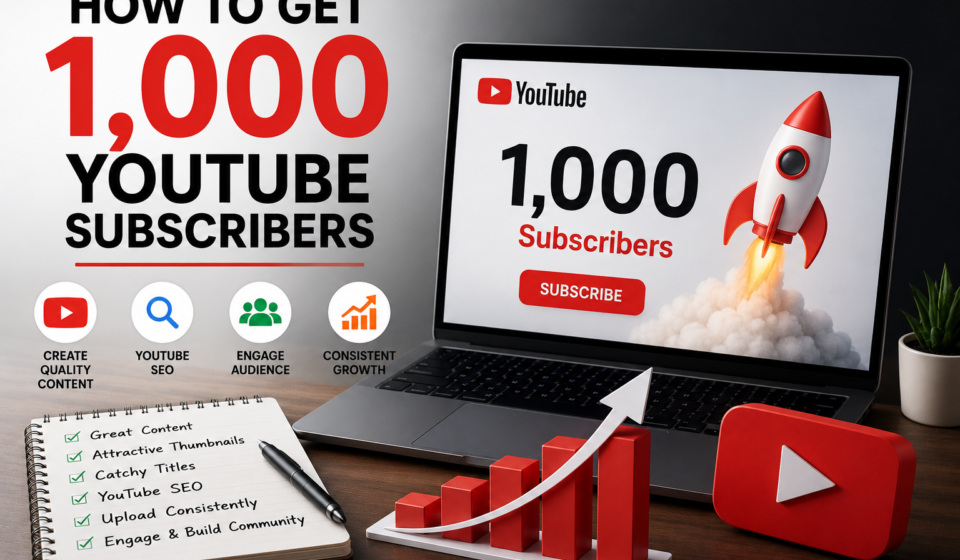

Learn how to get 1000 YouTube subscribers organically without buying subscribers. Discover YouTube SEO, Shorts, long-form videos, thumbnails, titles, watch time, audience retention, content strategy and a practical 90-day growth plan.
Important: No legitimate strategy can guarantee 1,000 genuine YouTube subscribers instantly or guarantee a Google first-page ranking. This guide focuses on sustainable, organic YouTube growth.
How to Get 1000 YouTube Subscribers: The Ultimate 2026 Guide
Getting your first 1,000 YouTube subscribers is a major milestone for any YouTube creator.
Whether you are starting a new channel, building a personal brand, promoting a business, teaching online, creating entertainment videos or trying to turn YouTube into a source of income, reaching your first 1,000 subscribers can feel challenging.
Many new creators ask:
How can I get 1,000 subscribers on YouTube for free?
The answer isn’t a secret subscriber generator.
It isn’t a bot.
It isn’t buying subscribers.
And it isn’t simply uploading hundreds of random videos.
A successful YouTube channel is built by consistently creating videos that a specific audience wants to click, watch and return to.
A strong YouTube growth strategy combines:
- YouTube SEO
- Keyword research
- Strong video titles
- Attractive thumbnails
- YouTube Shorts
- Long-form videos
- Audience retention
- Watch time
- Consistent publishing
- Storytelling
- Strong introductions
- Calls to action
- Playlists
- Community engagement
- Analytics
- Content experimentation
- Cross-platform promotion
The real goal should not simply be:
1,000 subscribers
It should be:
1,000 real viewers who genuinely want more of your content.
Can You Really Get 1,000 YouTube Subscribers for Free?
Yes.
You can grow a YouTube channel organically without purchasing subscribers or paying for subscriber packages.
However, “free” does not mean “without effort.”
You still invest:
- Time
- Research
- Video production
- Editing
- Thumbnail design
- Writing
- Learning
- Audience research
- Promotion
- Consistency
Organic YouTube growth is essentially an exchange of value for attention.
You create something useful, entertaining, educational or interesting.
A viewer discovers it.
They watch.
They enjoy or benefit from it.
They decide to subscribe because they want to see more.
Why Your First 1,000 YouTube Subscribers Are Important
The first 1,000 subscribers can provide a foundation for your channel.
At 1,000 subscribers, you have demonstrated that you can attract a meaningful audience.
More importantly, reaching 1,000 subscribers teaches you how YouTube works.
You learn:
- Which topics attract viewers
- Which thumbnails get clicks
- Which titles perform
- Which videos retain viewers
- Which audiences respond
- Which formats generate subscribers
- Which videos should be repeated
- Which topics should be avoided
The knowledge you gain while reaching 1,000 subscribers can become more valuable than the number itself.
Don’t Buy 1,000 YouTube Subscribers
One of the biggest mistakes beginners make is searching for:
“Buy 1,000 YouTube subscribers cheap.”
It may look like a shortcut.
But purchased subscribers are generally not the audience you actually want.
They may not:
- Watch your videos
- Like your content
- Comment
- Share
- Return to your channel
- Become customers
- Watch future uploads
YouTube growth is much more valuable when subscribers come from genuine interest.
Why Real YouTube Subscribers Are Better
Imagine two channels.
Channel A
10,000 subscribers
Very few views
Low engagement
Little returning audience
Channel B
1,000 subscribers
Strong viewer interest
Regular comments
High returning viewers
For many creators, Channel B has a healthier audience.
The objective should therefore be:
Real subscribers + real viewers + real engagement.
How YouTube Growth Actually Works
A simple YouTube growth funnel looks like this:
Topic
↓
Video Impression
↓
Thumbnail + Title
↓
Click
↓
Watch
↓
Viewer Satisfaction
↓
Subscribe
↓
Return to Channel
↓
Become Regular Viewer
This means subscriber growth is connected to several things—not simply the Subscribe button.
Step 1: Choose a Clear YouTube Niche
The first step to getting 1,000 subscribers is choosing a clear topic.
Examples include:
- Digital marketing
- SEO
- Technology
- Education
- Business
- Entrepreneurship
- Real estate
- Gaming
- Fitness
- Cooking
- Travel
- Finance education
- Motivation
- News
- Entertainment
- Product reviews
- Tutorials
- Photography
- Beauty
- Fashion
- DIY
- Home improvement
You don’t necessarily need to talk about only one tiny subject.
But viewers should understand what your channel generally provides.
Why a YouTube Niche Matters
Imagine a viewer discovers your video:
“How to Rank Your Website on Google.”
They visit your channel.
They see:
- SEO tutorials
- Keyword research
- Google ranking tips
- Website optimization
- Content marketing
They immediately understand your expertise.
Now imagine the channel contains:
- SEO
- Cricket
- Cooking
- Gaming
- Travel
- Random comedy
- Cars
- Politics
The viewer may not understand what they should expect from future videos.
Clarity makes subscription easier.
Step 2: Identify Your Target Audience
Ask:
Who am I making videos for?
For example:
Beginners learning digital marketing
or:
Small business owners who want more online customers
or:
Students learning SEO
or:
People looking for property investment information
Once you know your audience, video ideas become much easier.
Step 3: Solve a Specific Problem
People frequently use YouTube to find solutions.
Examples:
- How to create a website
- How to edit videos
- How to learn SEO
- How to grow Instagram
- How to install CCTV
- How to start a business
- How to cook a particular dish
- How to repair something
Therefore, ask:
What problem does my video solve?
Step 4: Find Topics People Actually Want
A common mistake is creating videos only because you personally find the subject interesting.
Instead, combine:
Your expertise
Audience demand
Search/discovery potential
Strong content angle
This creates stronger video opportunities.
Step 5: Use YouTube Keyword Research
Keyword research can help you understand what people are searching for.
For example, instead of creating a vague video titled:
“YouTube Tips”
you could create a specific video such as:
“How to Get Your First 1,000 YouTube Subscribers: 15 Proven Strategies”
Specific topics communicate a clear benefit.
Step 6: Target Long-Tail Keywords
Broad keywords are often highly competitive.
Instead of:
YouTube
try topics such as:
- How to get 1,000 YouTube subscribers
- How to grow a YouTube channel from zero
- YouTube SEO for beginners
- How to get subscribers from YouTube Shorts
- How to make YouTube videos for beginners
- How to create a YouTube thumbnail
- How to increase YouTube views organically
Long-tail topics can give you more specific content opportunities.
Step 7: Create Powerful YouTube Titles
Your title is one of the first things potential viewers see.
A strong title should communicate:
- Topic
- Benefit
- Curiosity
- Specificity
Examples:
Weak
YouTube Tips
Better
How to Grow Your YouTube Channel
Stronger
How to Get Your First 1,000 YouTube Subscribers
The title should accurately represent the video.
Don’t use misleading clickbait.
Step 8: Create Better YouTube Thumbnails
Your thumbnail should make the video understandable at a glance.
Good thumbnail principles include:
- One clear idea
- Strong visual hierarchy
- Readable text
- Relevant imagery
- Contrast
- Emotion where appropriate
- Consistent branding
Don’t overcrowd the thumbnail with paragraphs of text.
Step 9: Use Thumbnail + Title Together
Your thumbnail and title should complement each other.
For example:
Title:
How I Grew My YouTube Channel From 0 to 1,000 Subscribers
Thumbnail:
0 → 1K
The thumbnail creates visual curiosity while the title explains the context.
Step 10: Hook Viewers Immediately
The first few seconds of a video are extremely important.
Don’t spend the beginning of every video saying:
“Hello everyone, welcome back to my channel…”
Instead, quickly communicate why the viewer should continue watching.
For example:
“In this video, I’m going to show you the exact content strategy you can use to work toward your first 1,000 YouTube subscribers.”
Then deliver the value.
Step 11: Don’t Waste the Introduction
A long introduction can reduce viewer interest.
A better structure is:
Hook
What will the viewer learn?
Context
Why does it matter?
Value
Start teaching.
For example:
“If your channel has fewer than 100 subscribers, stop trying to make videos for everyone. In this video, I’ll show you how choosing one audience can make your content strategy much easier.”
Step 12: Create Valuable Long-Form Videos
Long-form videos can allow you to explain subjects deeply.
Examples:
- Tutorials
- Complete guides
- Case studies
- Reviews
- Interviews
- Educational lessons
- Documentary-style videos
- How-to videos
The goal isn’t simply to make a video long.
The goal is to make it valuable for as long as the viewer needs.
Step 13: Use YouTube Shorts
YouTube Shorts can be an effective discovery format.
Short videos can introduce your channel to viewers who may never have encountered your long-form content.
A Shorts strategy could include:
- Quick tips
- Facts
- Tutorials
- Mistakes
- Mini case studies
- Reactions
- Educational clips
- Short stories
- Before-and-after content
Step 14: Turn Shorts Into Long-Form Viewers
Don’t treat Shorts and long-form content as completely separate worlds.
For example:
Short
“3 SEO mistakes beginners make.”
Then:
Long Video
“Complete SEO Guide for Beginners.”
The Short creates curiosity.
The long-form video provides depth.
Step 15: Create Content Series
Series can make viewers want to return.
Examples:
SEO Course
Part 1
Part 2
Part 3
Part 4
Part 5
Or:
Road to 1,000 Subscribers
Day 1
Day 7
Day 15
Day 30
Day 60
A series can also make content planning easier.
Step 16: Create Playlists
Organize related videos into playlists.
For example:
YouTube SEO Course
- What is SEO?
- Keyword Research
- On-Page SEO
- Technical SEO
- Link Building
- SEO Analytics
Playlists can make it easier for viewers to discover related videos.
Step 17: Create Evergreen YouTube Content
Evergreen content can continue attracting viewers over time.
Examples:
- How-to tutorials
- Beginner guides
- Educational videos
- FAQs
- Software tutorials
- Problem-solving videos
- Complete guides
For example:
“How to Create a YouTube Channel”
may remain useful for a long time, although platform features can change.
Step 18: Create Trending Content Carefully
Trending topics can generate attention.
But don’t chase every trend.
Ask:
Does this trend make sense for my audience?
If yes, create a relevant version.
If not, skip it.
Step 19: Create Educational Videos
Educational channels can grow by consistently answering audience questions.
Examples:
SEO Channel
“What Is Keyword Research?”
Digital Marketing Channel
“How Does Google Ads Work?”
Technology Channel
“How to Secure Your Wi-Fi Network.”
Business Channel
“How to Generate Leads Online.”
Step 20: Create Entertainment Videos
Entertainment doesn’t necessarily mean comedy.
It can include:
- Stories
- Challenges
- Experiments
- Reactions
- Reviews
- Travel
- Interesting experiences
- Behind-the-scenes content
The important thing is to create something your audience wants to watch.
Step 21: Use Storytelling
Information becomes more interesting when presented as a story.
Instead of:
“Here are five YouTube mistakes.”
Try:
“When I started my first YouTube channel, I made these five mistakes—and they cost me months of growth.”
Then explain the lessons.
Step 22: Create Before-and-After Videos
Transformation videos can be compelling.
Examples:
- Before vs after editing
- Before vs after website redesign
- Before vs after SEO
- Before vs after room design
- Before vs after video thumbnail
- Before vs after channel optimization
Use genuine examples.
Step 23: Create Case Studies
Case studies can demonstrate real-world strategies.
Structure:
Starting Point
What was the situation?
Problem
What wasn’t working?
Strategy
What did you change?
Implementation
What steps were taken?
Result
What happened?
Lesson
What can viewers learn?
Avoid inventing statistics.
Step 24: Ask Viewers to Subscribe—But Give Them a Reason
Don’t repeatedly say:
“Please subscribe.”
Instead, explain the benefit.
For example:
“If you’re learning digital marketing, subscribe because I publish practical SEO and social media tutorials every week.”
That gives the viewer a reason.
Step 25: Use Calls to Action Strategically
Examples:
Subscribe CTA
“Subscribe for weekly SEO tutorials.”
Comment CTA
“What is the biggest challenge you’re facing with YouTube?”
Like CTA
“If this tutorial helped you, consider liking the video.”
Next Video CTA
“Watch the next video to learn how to find keywords.”
Step 26: Build a Content Funnel
A YouTube channel can use a simple funnel:
Short/Discovery Video
↓
Main Video
↓
Related Video
↓
Playlist
↓
Subscribe
This encourages viewers to explore more of your content.
Step 27: Create Related Videos
If one video performs well, create related videos.
For example:
Video 1
How to Get 1,000 YouTube Subscribers
Then create:
Video 2
How to Get More YouTube Views
Video 3
YouTube SEO for Beginners
Video 4
How to Create Better YouTube Thumbnails
Video 5
How to Write YouTube Titles
This creates a content cluster.
Step 28: Study Your YouTube Analytics
Analytics can tell you what is happening.
Pay attention to metrics such as:
- Views
- Impressions
- Click-through rate
- Audience retention
- Watch time
- Traffic sources
- Returning viewers
- Subscribers gained
- Engagement
Use these numbers to improve your next videos.
Step 29: Identify Videos That Generate Subscribers
Not every video generates subscribers equally.
Suppose:
Video A
50,000 views
50 subscribers
Video B
10,000 views
300 subscribers
If your objective is subscriber growth, Video B may provide a valuable lesson.
Study:
- Topic
- Title
- Thumbnail
- Length
- Audience
- Hook
- Structure
Then create related content.
Step 30: Improve Audience Retention
A viewer who leaves immediately cannot experience the value of the rest of your video.
Improve retention by:
- Starting quickly
- Removing unnecessary introductions
- Changing visuals
- Using examples
- Telling stories
- Creating curiosity
- Maintaining momentum
- Avoiding repetition
Step 31: Don’t Make Videos Longer Just for Watch Time
A 30-minute video isn’t automatically better than a 5-minute video.
If the topic needs five minutes, make a five-minute video.
If the topic needs 30 minutes, make a 30-minute video.
The goal should be:
Maximum useful value—not maximum duration.
Step 32: Improve Your Audio
Viewers may forgive average video quality.
Poor audio is often much harder to tolerate.
Consider:
- Clear microphone
- Reduced background noise
- Balanced volume
- Good recording environment
You don’t need the most expensive equipment to begin.
Step 33: Improve Lighting
Good lighting makes videos easier to watch.
You can start with:
- Natural window light
- Affordable LED lighting
- Simple soft lighting
Focus on a clean, clear image.
Step 34: Improve Your Editing
Editing should support the content.
You can use:
- Jump cuts
- Screen recordings
- B-roll
- Text overlays
- Zooms
- Graphics
- Demonstrations
- Examples
Don’t add effects simply because they look impressive.
Step 35: Create Strong Video Openings
Examples:
Tutorial
“By the end of this video, you’ll know exactly how to create your first YouTube thumbnail.”
List Video
“Here are seven mistakes stopping small channels from growing.”
Case Study
“Let’s break down exactly what changed this channel’s performance.”
Step 36: Create Content for Beginners
Beginners represent a huge potential audience.
Examples:
- YouTube for beginners
- SEO for beginners
- Digital marketing for beginners
- Video editing for beginners
- Photography for beginners
Beginner content can also create opportunities for entire series.
Step 37: Create Advanced Content
Once your audience grows, create deeper content.
Examples:
- Advanced SEO
- Advanced analytics
- Detailed case studies
- Expert interviews
- Strategy breakdowns
- Experiments
This can help retain experienced viewers.
Step 38: Create FAQ Videos
Frequently asked questions are excellent YouTube topics.
Examples:
- How many videos should I upload?
- How do I get subscribers?
- How do YouTube Shorts work?
- How do YouTube thumbnails work?
- How do I improve watch time?
- How do I find YouTube keywords?
- Why are my videos not getting views?
Step 39: Use YouTube Search Intent
Before creating a video, understand what the viewer actually wants.
For example:
Search:
“How to edit a YouTube video”
The viewer probably wants a tutorial.
Don’t give them a 20-minute motivational speech.
Give them the tutorial.
Matching search intent can improve viewer satisfaction.
Step 40: Create Content Around One Main Keyword
For SEO-focused videos, choose a primary topic.
For example:
Primary keyword: YouTube SEO for beginners
Related terms:
- YouTube SEO
- YouTube keywords
- YouTube ranking
- YouTube video optimization
- YouTube channel SEO
Use language naturally.
Don’t stuff keywords repeatedly.
Step 41: Optimize Your Video Description
A useful YouTube description can include:
- What the video is about
- Important points
- Relevant keywords naturally
- Chapters when appropriate
- Links to relevant resources
- Related videos
- Calls to action
The description should be useful to viewers, not just written for search engines.
Step 42: Use Video Chapters
For longer educational videos, chapters can make navigation easier.
Example:
00:00 Introduction
01:20 Choosing a niche
04:15 Keyword research
08:30 Thumbnail strategy
12:10 YouTube Shorts
16:40 Analytics
This can improve the viewer experience.
Step 43: Create a Consistent Publishing Schedule
You don’t need to upload every day.
For example:
Option A
1 long video + 3 Shorts weekly.
Option B
2 long videos + 2 Shorts weekly.
Option C
1 long video weekly.
Choose a schedule that you can maintain without sacrificing quality.
Step 44: Create a 30-Day YouTube Challenge
A simple 30-day plan could look like:
Week 1
- Choose niche
- Research audience
- Create channel branding
- Develop 20 video ideas
Week 2
- Publish long-form video
- Publish Shorts
- Improve thumbnails
- Study competitors
Week 3
- Create related content
- Test new hooks
- Improve titles
- Engage with comments
Week 4
- Study analytics
- Identify best videos
- Create follow-up content
- Improve strategy
Step 45: Create a 90-Day Roadmap to 1,000 Subscribers
There is no guarantee that 90 days will produce 1,000 subscribers.
However, a 90-day system can help you build consistent momentum.
Days 1–30: Foundation
Focus on:
- Niche
- Audience
- Branding
- Keyword research
- Video ideas
- Thumbnails
- Titles
- Publishing consistency
Days 31–60: Optimization
Study:
- Which topics perform?
- Which videos generate subscribers?
- Which thumbnails get clicks?
- Where do viewers leave?
- Which videos bring returning viewers?
Then improve.
Days 61–90: Scaling
Create more of your successful formats.
Focus on:
- Related videos
- Content series
- Shorts
- Long-form content
- Collaborations
- Playlists
- Cross-platform promotion
46: Promote Your YouTube Channel on Other Platforms
If you already have an audience elsewhere, use it.
You can promote your videos through:
- Website
- Blog
- Email newsletter
- Relevant communities
- Podcasts
- Other legitimate channels
Don’t spam unrelated communities.
47: Turn Blog Articles Into YouTube Videos
If you already publish articles, you can transform them into videos.
For example:
Article
How to Get 1,000 YouTube Subscribers
can become:
Video 1
How to Get Your First 100 Subscribers
Video 2
How to Get 1,000 YouTube Subscribers
Video 3
YouTube SEO Tips
Video 4
How to Create YouTube Thumbnails
Video 5
How to Get Views on YouTube
This creates a complete content ecosystem.
48: Turn YouTube Videos Into Blog Articles
The process works in reverse too.
One video can become:
- Blog article
- Social post
- Instagram Reel
- YouTube Short
- Facebook post
- LinkedIn post
- Newsletter
This is called content repurposing.
49: Use Community Posts
As your channel gains access to relevant community features, use them to interact with your audience.
You can ask:
- What video should I make next?
- Which topic is confusing?
- Which thumbnail do you prefer?
- What should I explain next?
This can turn viewers into participants.
50: Collaborate With Other YouTubers
Collaboration can introduce your channel to a relevant audience.
Possible formats:
- Interviews
- Tutorials
- Challenges
- Expert discussions
- Joint livestreams
- Case studies
- Q&A
Choose collaborators whose audience overlaps with yours.
51: Don’t Copy Other YouTubers
Study successful channels.
Learn:
- Topic selection
- Video structure
- Thumbnails
- Titles
- Storytelling
- Editing
But don’t simply copy their videos.
Develop your own voice and perspective.
52: Create a Recognizable Brand
Your channel should eventually develop a recognizable identity.
Consider consistent:
- Logo
- Thumbnail style
- Intro style
- Fonts
- Visual language
- Voice
- Topic positioning
Brand consistency can make your channel easier to remember.
53: Make Your Channel Page Clear
A new visitor should quickly understand:
What is this channel?
Who is it for?
What will I learn or experience?
Why should I subscribe?
Your channel banner, description and featured content should communicate this clearly.
54: Create a Channel Trailer
A short channel introduction can explain:
- Who you are
- What your channel covers
- What viewers can expect
Keep it focused on the viewer rather than only your biography.
55: Create Subscriber-Focused Content
Some videos are excellent for views.
Other videos are excellent for converting viewers into subscribers.
A strong subscriber-focused video might be:
- Complete guide
- Series introduction
- Beginner roadmap
- Resource list
- Industry tutorial
- Deep case study
The viewer should leave thinking:
“I want more content like this.”
56: Use Strong End Screens and Related Videos
At the end of a video, direct viewers to another relevant video.
For example:
Video 1:
How to Find YouTube Keywords
↓
Video 2:
How to Write YouTube Titles
↓
Video 3:
How to Create YouTube Thumbnails
This creates a content journey.
57: Build a YouTube Content Cluster
Choose one broad subject and cover it from multiple angles.
For example:
YouTube Growth
- YouTube SEO
- YouTube keywords
- YouTube thumbnails
- YouTube titles
- YouTube Shorts
- YouTube analytics
- YouTube watch time
- YouTube subscribers
This creates topical depth.
58: Track Subscribers Per Video
Create a simple spreadsheet.
Track:
| Video | Views | Subscribers Gained | Watch Time | Retention |
|---|---|---|---|---|
| Video 1 | 5,000 | 120 | — | — |
| Video 2 | 2,000 | 180 | — | — |
| Video 3 | 10,000 | 200 | — | — |
You can then identify which topics attract subscribers.
59: Don’t Judge a Video Too Quickly
Some videos may take time to find their audience.
Don’t automatically delete a video because it doesn’t perform immediately.
Instead, learn from it.
Ask:
- Was the topic strong?
- Was the thumbnail clear?
- Was the title specific?
- Did the introduction work?
- Was the video useful?
60: Make Better Videos Instead of Simply More Videos
Uploading 100 low-quality videos isn’t necessarily better than creating 20 highly useful videos.
Prioritize:
Quality + Relevance + Consistency
61: How to Get 1,000 YouTube Subscribers Through Shorts
A Shorts strategy could include:
Monday
Quick tip
Tuesday
Common mistake
Wednesday
Mini tutorial
Thursday
Interesting fact
Friday
Myth vs fact
Saturday
Behind the scenes
Sunday
Clip from long-form video
Then study which Shorts generate subscribers.
62: How to Get 1,000 YouTube Subscribers Through Long Videos
Long-form content can focus on:
- Tutorials
- Complete guides
- Reviews
- Comparisons
- Interviews
- Case studies
- Educational courses
The key is to provide enough value to justify the viewer’s time.
63: How to Get 1,000 YouTube Subscribers for a Business
Businesses should focus on content that demonstrates expertise.
For example, a CCTV company could create:
- CCTV buying guide
- Security camera comparison
- Installation tutorial
- Night vision explanation
- Home security tips
- Office security guide
- Shop security mistakes
A real estate company could create:
- Property buying guides
- Investment education
- Local market information
- Home tours
- Property FAQs
- Construction updates
Educational content can build trust before the customer contacts the business.
64: How to Get 1,000 YouTube Subscribers for a Personal Brand
A personal brand can combine:
- Expertise
- Personality
- Stories
- Opinions
- Tutorials
- Experiences
- Behind-the-scenes content
People may subscribe because they trust both your knowledge and your personality.
65: How to Get 1,000 YouTube Subscribers for an Educational Channel
Educational channels can build growth through structured learning.
For example:
Digital Marketing Course
Part 1 — Introduction
Part 2 — SEO
Part 3 — Keyword Research
Part 4 — Content Marketing
Part 5 — Social Media Marketing
Part 6 — Analytics
A structured course gives viewers a reason to watch multiple videos.
66: How to Get 1,000 Subscribers From YouTube Search
Create videos answering specific questions.
For example:
How to Create a YouTube Channel
How to Upload a YouTube Short
How to Create a YouTube Thumbnail
How to Write a YouTube Description
How to Find YouTube Keywords
Search-focused content can attract viewers with clear intent.
67: How to Get 1,000 Subscribers From Suggested Videos
Suggested traffic can come from viewers watching related content.
To increase the chances of your videos being relevant to viewers:
- Create related topics
- Build content clusters
- Use clear titles
- Make videos that satisfy the same audience
- Link related videos
- Build playlists
68: How to Get 1,000 Subscribers From Browse Traffic
Browse traffic can expose your videos to viewers through YouTube surfaces such as the homepage.
Strong packaging matters:
Thumbnail + Title + Topic
If people repeatedly choose your content when it is presented to them, you create more opportunities for growth.
69: 100 YouTube Video Ideas to Help Grow a Channel
- Beginner guide
- Complete tutorial
- Common mistakes
- Top 10 tips
- Top 5 tools
- Free tools
- Paid vs free
- Beginner mistakes
- Expert tips
- Step-by-step tutorial
- FAQ
- Case study
- Before and after
- Comparison
- Product review
- Product demonstration
- Industry news
- Future trends
- Myths vs facts
- Common misconceptions
- How-to tutorial
- Ultimate guide
- Checklist
- Resources
- Templates
- Interview
- Expert interview
- Reaction video
- Challenge
- Experiment
- Results
- Lessons learned
- Failure story
- Success story
- Behind the scenes
- Day in the life
- Q&A
- Answering comments
- Viewer questions
- Top mistakes
- Best practices
- Worst practices
- Do this, not that
- Tools I use
- Software tutorial
- Mobile tutorial
- Computer tutorial
- Beginner course
- Advanced course
- Industry secrets
- Quick tips
- Shorts compilation
- Long-form guide
- Storytelling video
- Personal experience
- Business lesson
- Marketing lesson
- SEO tutorial
- Social media tutorial
- YouTube tutorial
- Website tutorial
- Content marketing guide
- Digital marketing guide
- Entrepreneurship tips
- Productivity tips
- Motivation
- Inspirational story
- Industry statistics
- Data analysis
- Trend analysis
- A vs B
- Cost breakdown
- Buying guide
- Service comparison
- Strategy breakdown
- Campaign analysis
- Channel analysis
- Competitor analysis
- Thumbnail analysis
- Title analysis
- SEO analysis
- Growth experiment
- 30-day challenge
- 90-day challenge
- Subscriber update
- Channel transformation
- New creator mistakes
- Creator equipment guide
- Editing tutorial
- Lighting tutorial
- Audio tutorial
- YouTube Shorts tutorial
- YouTube analytics tutorial
- YouTube monetization education
- Content planning
- Content calendar
- Script writing guide
- Thumbnail tutorial
- YouTube SEO course
- Road to 1,000 subscribers
A Practical 90-Day YouTube Growth Plan
Month 1 — Build
Week 1
- Select niche
- Define audience
- Create channel branding
- Research 50 topics
Week 2
- Create first videos
- Build thumbnail templates
- Optimize titles
- Publish consistently
Week 3
- Start Shorts
- Create related videos
- Respond to comments
- Analyze initial performance
Week 4
- Identify strongest topics
- Improve thumbnails
- Improve hooks
- Create follow-up videos
Month 2 — Optimize
Focus on:
- Best-performing topics
- Better titles
- Better thumbnails
- Audience retention
- Subscriber conversion
- Related content
- Playlists
- Shorts
Don’t simply repeat the exact same video.
Repeat the successful idea from a new angle.
Month 3 — Scale
Focus on:
- Content series
- Collaborations
- Long-form videos
- Shorts
- Search-friendly topics
- Cross-platform promotion
- Analytics
- Returning viewers
The objective is to build momentum rather than chase one viral video.
Common Mistakes New YouTubers Make
1. Buying Subscribers
Avoid artificial growth.
2. Uploading Random Videos
Choose a recognizable content direction.
3. Weak Thumbnails
Your video may never get clicked.
4. Weak Titles
Make the value clear.
5. Long Introductions
Get to the point.
6. Poor Audio
Viewers may leave.
7. No Audience Research
Create for real people.
8. Ignoring Analytics
You lose valuable feedback.
9. Copying Competitors
Build your own identity.
10. Giving Up Too Early
YouTube growth often requires experimentation.
Frequently Asked Questions About Getting 1,000 YouTube Subscribers
1. How can I get 1,000 YouTube subscribers?
Create valuable content for a specific audience, optimize your videos for discovery, publish consistently and build relationships with viewers.
2. Can I get 1,000 YouTube subscribers for free?
Yes. Organic subscriber growth doesn’t require purchasing subscribers.
3. How fast can I reach 1,000 subscribers?
There is no universal timeline. Some channels grow quickly, while others require many months or longer.
4. Can I get 1,000 subscribers in 30 days?
It is possible for some channels, but there is no legitimate guarantee.
5. Should I buy YouTube subscribers?
If you want a genuine audience, purchasing subscribers is generally not a good strategy.
6. Can YouTube Shorts help me get subscribers?
Yes. Shorts can introduce your content to new viewers and can contribute to subscriber growth.
7. Are long videos better than Shorts?
Neither format is automatically better. They serve different purposes and can work together.
8. How many videos should I upload each week?
Choose a sustainable schedule. Quality and consistency are more important than an arbitrary upload number.
9. How important are YouTube thumbnails?
Very important. Thumbnails help communicate what a viewer can expect and can influence whether they choose your video.
10. How important are YouTube titles?
Titles are important because they communicate the video’s topic and value.
11. Does YouTube SEO help?
Search-oriented optimization can make videos easier to understand and discover for relevant queries.
12. Should I use keywords in my YouTube videos?
Use relevant keywords naturally in titles, descriptions and the actual content where appropriate.
13. How can I get more YouTube views?
Create videos around topics people care about, improve packaging, satisfy viewer intent and build a library of related content.
14. Why are my videos getting views but no subscribers?
Your videos may attract viewers who don’t yet understand why they should follow the channel. Improve channel positioning and subscriber CTAs.
15. Why do my videos have no views?
Possible causes include weak topic selection, limited discovery, poor packaging or an audience mismatch.
16. How can I increase YouTube watch time?
Create useful videos that maintain viewer interest and avoid unnecessary content.
17. How can I improve audience retention?
Improve your opening, remove unnecessary sections, use visual changes and maintain a clear narrative.
18. Should every video ask viewers to subscribe?
A natural, relevant subscription CTA can be useful, but avoid repeatedly interrupting the video.
19. Can a new YouTube channel become successful?
Yes. New channels can grow when they consistently deliver content that viewers value.
20. What is the best way to get the first 100 subscribers?
Start with a clear niche, create useful content and actively share your videos with relevant audiences.
21. How do I go from 100 to 1,000 subscribers?
Analyze what works, create related content and improve your video packaging and audience retention.
22. How do I get YouTube subscribers without asking friends?
Build discoverable content through YouTube search, Shorts, recommendations, collaborations and audience-focused videos.
23. Can one viral video get 1,000 subscribers?
It can, depending on the video’s reach and subscriber conversion, but viral growth cannot be guaranteed.
24. Should I focus on views or subscribers?
Both matter, but the most important objective is building an audience that repeatedly watches your content.
25. Is 1,000 subscribers enough to build a successful channel?
It can be an important milestone, but channel success depends on your goals, audience engagement, content quality and business model.
Final YouTube 1,000 Subscriber Checklist
Before publishing your next video, ask:
Channel
- Is my niche clear?
- Is my target audience defined?
- Does my channel branding look professional?
- Is my channel description useful?
Video
- Does the topic solve a problem?
- Is the title clear?
- Is the thumbnail attractive?
- Does the introduction get to the point?
- Does the video deliver what the title promises?
SEO
- Did I research the topic?
- Is the main keyword relevant?
- Is the title natural?
- Is the description useful?
- Are related videos easy to find?
Audience
- Did I provide real value?
- Did I encourage discussion?
- Did I respond to comments?
- Did I give viewers a reason to return?
Analytics
- How many people clicked?
- How long did they watch?
- Where did viewers leave?
- How many subscribers did the video generate?
- What should I improve next time?
Conclusion: How to Get 1,000 YouTube Subscribers Organically
Getting 1,000 YouTube subscribers isn’t about finding a secret website that delivers free subscribers.
It isn’t about buying followers.
It isn’t about using bots.
It isn’t about uploading hundreds of random videos.
The sustainable approach is to build a channel that people genuinely want to watch.
The formula is simple:
Choose a niche
↓
Understand your audience
↓
Research valuable topics
↓
Create useful videos
↓
Write strong titles
↓
Design attractive thumbnails
↓
Hook viewers quickly
↓
Use YouTube SEO
↓
Publish Shorts and long-form content
↓
Improve audience retention
↓
Study analytics
↓
Create more of what works
↓
Build a community
Your first goal can be:
10 subscribers
Then:
100 subscribers
Then:
500 subscribers
Then:
1,000 subscribers
But don’t stop there.
The real achievement isn’t simply reaching 1,000 people.
It is creating a channel that 1,000 people genuinely want to return to.
Build the audience, don’t buy the number.
SEO Tags
how to get 1000 YouTube subscribers, how to get 1000 subscribers on YouTube, how to get 1000 YouTube subscribers fast, how to get 1000 YouTube subscribers for free, get 1000 subscribers YouTube, first 1000 YouTube subscribers, YouTube subscribers free, free YouTube subscribers, real YouTube subscribers, organic YouTube growth, YouTube growth strategy 2026, YouTube SEO, YouTube SEO tips, YouTube channel growth, how to grow YouTube channel, YouTube Shorts subscribers, YouTube Shorts growth, how to increase YouTube subscribers, how to get YouTube views, YouTube marketing strategy, YouTube content strategy, YouTube thumbnail tips, YouTube title tips, YouTube keywords, YouTube keyword research, YouTube audience retention, YouTube watch time, YouTube analytics, YouTube growth tips for beginners, YouTube channel SEO, grow YouTube channel organically, YouTube subscribers without buying, YouTube subscribers without ads, how to promote YouTube channel, YouTube video ideas, YouTube content ideas, YouTube channel marketing, YouTube creator tips, road to 1000 YouTube subscribers, how to reach 1000 YouTube subscribers, 1000 subscribers on YouTube organically
