

 Watch
Watch
 CASUAL WEAR
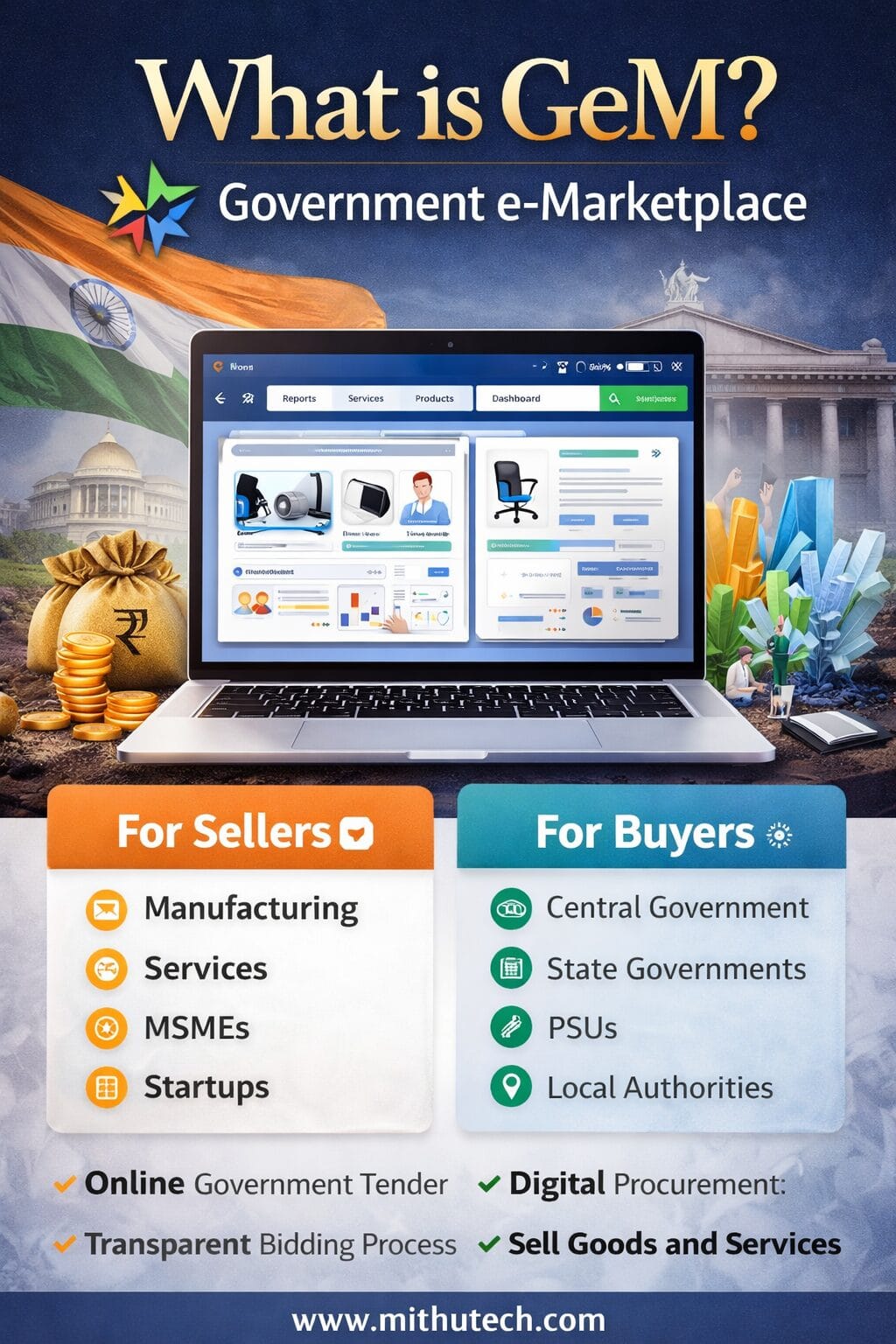
What is GeM Portal? Learn everything about Government e-Marketplace (GeM), how GeM tenders work, registration process, benefits, eligibility, and how sellers and buyers can use GeM for government procurement in India.
Introduction: Understanding GeM Government Tender System
In recent years, the Government of India has taken major steps toward digital transparency, efficiency, and accountability in public procurement. One of the most impactful initiatives in this direction is GeM – Government e-Marketplace.
If you are a business owner, MSME, startup, service provider, or supplier, understanding what GeM is and how GeM government tenders work can open massive opportunities to sell directly to government departments across India.
This article explains GeM meaning, full form, purpose, features, benefits, registration, and how GeM tenders function, in a simple yet professional manner.
What is GeM? (GeM Meaning & Full Form)
GeM stands for Government e-Marketplace.
GeM is an online government portal launched by the Government of India to facilitate public procurement of goods and services by central and state government departments, PSUs, autonomous bodies, and local authorities.
In simple words,
👉 GeM is an official digital platform where government buyers purchase products and services directly from registered sellers through transparent online bidding and ordering.
Who Launched GeM and When?
- Launched by: Ministry of Commerce & Industry, Government of India
- Launch Date: 9 August 2016
- Operated by: GeM Special Purpose Vehicle (SPV), a 100% government-owned company
GeM was created to replace manual tendering processes, reduce corruption, and ensure fair competition.
What is a GeM Government Tender?
A GeM tender is an online procurement process conducted through the GeM portal where government buyers invite sellers to supply goods or services at competitive prices.
Depending on the value and requirement, procurement on GeM can be done through:
- Direct Purchase
- L1 Purchase
- Bidding
- Reverse Auction
All these processes are fully digital and rule-based.
Objectives of GeM Portal
The main objectives of GeM include:
- Transparency in government purchases
- Faster procurement process
- Elimination of middlemen
- Promotion of MSMEs and startups
- Cost-effective buying for government
- Ease of doing business
Who Can Use the GeM Portal?
GeM Buyers
- Central Government Ministries
- State Government Departments
- Public Sector Undertakings (PSUs)
- Autonomous bodies
- Local authorities
GeM Sellers
- Manufacturers
- Traders
- Service providers
- MSMEs
- Startups
- Individual proprietors
What Can Be Sold on GeM?
GeM supports a wide range of categories, including:
Goods
- Electronics & IT products
- Office furniture & stationery
- CCTV cameras & security equipment
- Electrical items
- Machinery & tools
- Medical equipment
Services
- Manpower services
- Security services
- Housekeeping
- IT services
- Transport & logistics
- AMC & maintenance services
Key Features of GeM Portal
1. End-to-End Online Procurement
From product listing to payment, everything happens online.
2. Transparent Pricing
Buyers can compare prices, specifications, and seller ratings.
3. Multiple Procurement Modes
Direct purchase, bidding, and reverse auction options.
4. Seller Rating System
Performance-based seller evaluation improves trust.
5. Timely Payments
Payments are processed through PFMS, ensuring faster settlements.
GeM Procurement Methods Explained
1. Direct Purchase
- For orders up to ₹50,000
- Buyer selects the lowest-priced seller
- No bidding required
2. L1 Purchase
- For purchases between ₹50,000 and ₹5 lakh
- Seller with lowest price (L1) is selected
3. Bidding
- For higher-value procurements
- Sellers compete by submitting bids
4. Reverse Auction
- Sellers continuously lower prices
- Ensures best value for government
Benefits of GeM for Sellers
- Access to nationwide government buyers
- No tender fees in many categories
- Transparent and fair competition
- Faster payment cycle
- Increased business credibility
- MSME & startup-friendly policies
Benefits of GeM for Government Buyers
- Reduced procurement time
- Competitive pricing
- Quality assurance
- Digital audit trail
- Compliance with GFR rules
How to Register on GeM Portal (Seller)
Basic Requirements
- PAN card
- Aadhaar (linked with mobile)
- Bank account details
- GST (if applicable)
- Business address
Registration Steps
- Visit official GeM portal
- Sign up as Seller
- Complete Aadhaar & PAN verification
- Add business details
- Upload product/service listings
Is GeM Mandatory for Government Purchases?
Yes, as per General Financial Rules (GFR) 2017, government departments are encouraged and, in many cases, required to procure goods and services through the GeM portal.
GeM and MSMEs: Special Advantages
GeM strongly supports MSMEs by offering:
- Purchase preference
- Relaxed turnover criteria
- Startup exemptions
- Dedicated MSME categories
GeM Payment System Explained
- Payments are processed via Public Financial Management System (PFMS)
- Direct transfer to seller’s bank account
- Reduced payment delays
- Transparent transaction records
Common Challenges on GeM Portal
- High competition
- Price-based selection pressure
- Strict compliance requirements
- Product specification accuracy
However, with correct strategy and quality service, sellers can build long-term success.
Why GeM is Important for Businesses Today
GeM has transformed government procurement into a digital, fair, and growth-oriented ecosystem. For businesses, especially MSMEs, startups, and service providers, GeM offers a reliable gateway to stable and large-volume government orders.
Conclusion: Is GeM Worth It?
Absolutely.
If you aim to work with government departments, GeM is no longer optional—it is essential. With proper understanding, competitive pricing, and consistent performance, GeM can become a powerful revenue channel for your business.
Below are 50 SEO-optimized FAQs with clear, accurate answers about GeM (Government e-Marketplace) government tenders. This section is ready to publish on your website or blog and is structured to support Google featured snippets and long-tail keyword rankings.
GeM Government Tender – Frequently Asked Questions (FAQs)
1. What is GeM?
GeM stands for Government e-Marketplace, an official online portal for government procurement of goods and services in India.
2. What is the full form of GeM?
The full form of GeM is Government e-Marketplace.
3. Who launched the GeM portal?
GeM was launched by the Ministry of Commerce and Industry, Government of India.
4. When was GeM launched?
GeM was launched on 9 August 2016.
5. What is a GeM government tender?
A GeM tender is a digital procurement process where government buyers invite registered sellers to supply goods or services through the GeM portal.
6. Is GeM mandatory for government purchases?
Yes, as per GFR 2017, most government procurements must be done through the GeM portal.
7. Who can register as a seller on GeM?
Manufacturers, traders, service providers, MSMEs, startups, and individual proprietors can register as sellers.
8. Who can buy through the GeM portal?
Central and state government departments, PSUs, autonomous bodies, and local authorities can buy through GeM.
9. Is GeM registration free?
Yes, GeM registration is completely free for sellers and buyers.
10. What documents are required for GeM seller registration?
PAN card, Aadhaar, bank details, business address, and GST (if applicable) are required.
11. Is GST mandatory for selling on GeM?
GST is mandatory for taxable goods and services, but exempted categories may not require GST.
12. Can individuals sell on GeM?
Yes, individual proprietors can sell on GeM after completing verification.
13. What products can be sold on GeM?
Electronics, CCTV cameras, office items, machinery, medical equipment, and more.
14. What services can be offered on GeM?
Manpower, security services, housekeeping, IT services, transport, and maintenance services.
15. What is direct purchase on GeM?
Direct purchase is allowed for orders up to ₹50,000 without bidding.
16. What is L1 purchase on GeM?
L1 purchase is where the lowest-priced seller is selected for orders between ₹50,000 and ₹5 lakh.
17. What is bidding on GeM?
Bidding allows multiple sellers to submit price quotes for higher-value government orders.
18. What is reverse auction on GeM?
Reverse auction is a competitive process where sellers reduce prices in real time.
19. How are sellers selected on GeM?
Sellers are selected based on price, specifications, seller rating, and compliance.
20. What is seller rating on GeM?
Seller rating reflects performance based on delivery, quality, and buyer feedback.
21. How does payment work on GeM?
Payments are processed through PFMS and credited directly to the seller’s bank account.
22. How long does GeM payment take?
Payments are usually released within 10 to 20 working days after acceptance.
23. Is there any security deposit on GeM?
Some bids may require Bid Security or Performance Security depending on tender value.
24. Can MSMEs get benefits on GeM?
Yes, MSMEs receive purchase preference and relaxed eligibility criteria.
25. Are startups allowed on GeM?
Yes, startups registered with DPIIT are eligible to sell on GeM.
26. Can a seller participate in multiple GeM bids?
Yes, sellers can participate in unlimited bids based on eligibility.
27. Is GeM available for state governments?
Yes, both central and state government departments use GeM.
28. Can services be bid without experience?
Some categories allow exemptions for startups and MSMEs.
29. What is BOQ in GeM tenders?
BOQ stands for Bill of Quantity, which details required items and quantities.
30. Can bids be modified after submission?
No, bids cannot be edited once submitted.
31. How to check GeM tenders online?
Tenders can be viewed by logging into the GeM portal dashboard.
32. Is offline tendering allowed on GeM?
No, the entire process is online.
33. What happens if delivery is delayed?
Delayed delivery may result in penalties or negative seller ratings.
34. Can orders be cancelled on GeM?
Yes, under defined rules and conditions.
35. What is GeM SPV?
GeM SPV is a government-owned company managing the GeM portal.
36. Is GeM safe and legal?
Yes, GeM is a fully authorized and secure government platform.
37. Can foreign companies sell on GeM?
Only Indian-registered entities are allowed to sell.
38. How is quality ensured on GeM?
Through specifications, certifications, inspections, and buyer feedback.
39. Can sellers list branded products on GeM?
Yes, authorized sellers can list branded products.
40. What is the role of OEM on GeM?
OEMs verify product authenticity and authorize sellers.
41. Is training available for GeM sellers?
Yes, GeM conducts online and offline training programs.
42. Can GeM account be suspended?
Yes, for policy violations or poor performance.
43. Is GeM beneficial for small businesses?
Yes, GeM provides equal opportunity and nationwide market access.
44. Can service contracts be renewed on GeM?
Yes, as per portal guidelines.
45. What is the maximum order value on GeM?
There is no fixed upper limit; it depends on procurement mode.
46. Are tenders audited on GeM?
Yes, all transactions are digitally recorded and auditable.
47. Does GeM support Make in India?
Yes, GeM promotes local manufacturers and products.
48. Can GeM be used for emergency procurement?
Yes, under special conditions.
49. What is the biggest advantage of GeM?
Transparency, speed, and fair competition.
50. Is GeM the future of government procurement in India?
Yes, GeM is central to India’s digital procurement ecosystem.
[…] how to register on the GeM Portal (Government e-Marketplace) step by step in 2026. This detailed guide explains seller registration, […]