

 Watch
Watch
 CASUAL WEAR
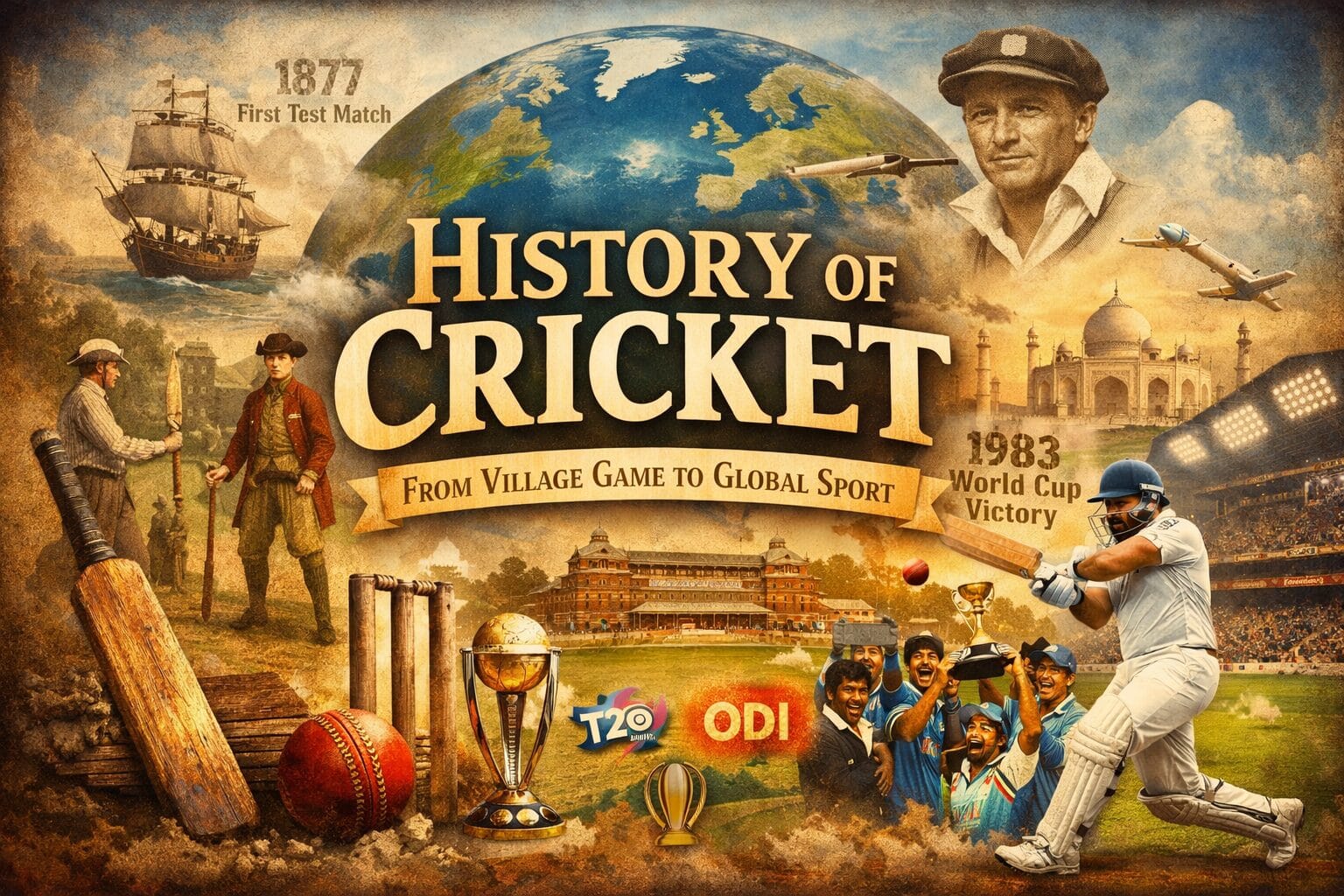
Discover the complete history of cricket from its origin in England to modern T20 leagues and World Cups. Explore cricket’s evolution, formats, legends, and global impact.
Introduction: The Timeless Journey of Cricket
Cricket is not just a sport; it is an emotion shared by billions across continents. From village fields to world-class stadiums filled with roaring fans, cricket has evolved into one of the most celebrated sports globally. Today, nations pause during major matches, rivalries define generations, and players become global icons.
Understanding the history of cricket reveals how a simple bat-and-ball pastime transformed into an international sporting phenomenon influencing culture, economy, and entertainment worldwide.
Origin of Cricket: Where It All Began
The origins of cricket trace back to 16th-century England, where children in rural communities played a primitive version of the game using wooden sticks and balls made from wool or leather.
Historians believe cricket began in southeastern England, particularly in Kent and Sussex regions. The earliest known written reference to cricket dates back to 1598, confirming the sport’s existence during the Tudor era.
Initially, cricket was played mainly by shepherds and farmers as a recreational activity. Over time, adults adopted the game, turning it into organized competition.
Cricket in the 17th Century: Rise of Organized Play
By the 1600s, cricket had moved beyond village entertainment. Gambling became associated with matches, leading wealthy patrons to sponsor teams.
Key developments during this period included:
- Formation of local cricket teams
- Introduction of structured matches
- Development of early rules
- Growing spectator interest
Cricket soon became popular among English nobility, giving it social recognition and financial backing.

18th Century: Cricket Becomes England’s National Sport
The 18th century marked cricket’s transformation into a professional sport.
The establishment of the Marylebone Cricket Club (MCC) in 1787 became a historic milestone. MCC created standardized laws that shaped modern cricket rules still followed today.
Important innovations included:
- Defined pitch length (22 yards)
- Introduction of straight bat technique
- Standardized scoring system
- Professional players emergence
Cricket grounds like Lord’s became iconic centers of the sport.
Expansion of Cricket Across the British Empire
As the British Empire expanded, cricket traveled worldwide through soldiers, traders, and administrators.
Cricket spread to:
- India
- Australia
- South Africa
- West Indies
- New Zealand
- Pakistan
- Sri Lanka
Colonial influence played a major role in cricket becoming an international sport. Interestingly, many former colonies later became dominant cricketing nations.
The First International Cricket Match (1844)
The first officially recognized international cricket match occurred in 1844 between the United States and Canada.
Though cricket later declined in the USA, this historic event marked the beginning of international competition.
Birth of Test Cricket (1877)
Modern international cricket officially began in 1877 when England faced Australia in the first Test match at Melbourne.
This match introduced the longest format of cricket — Test Cricket, played over five days and considered the ultimate examination of skill, patience, and strategy.
The Ashes: Cricket’s Oldest Rivalry
One of cricket’s greatest traditions began in 1882 after Australia defeated England at The Oval.
A mock obituary declared English cricket dead, leading to the creation of The Ashes, the legendary Test rivalry between England and Australia that continues today.
Formation of International Cricket Governance
In 1909, the International Cricket Council (ICC) was formed to regulate international cricket.
Initially including England, Australia, and South Africa, the ICC now governs cricket worldwide, organizing global tournaments and maintaining playing standards.
Cricket in India: From Colonial Sport to National Passion
Cricket arrived in India during British rule in the 18th century. The first Indian cricket club was established in Bombay by the Parsi community.
After independence, India rapidly rose as a cricket powerhouse.
A turning point came when India won the 1983 Cricket World Cup, inspiring millions and transforming cricket into the country’s most popular sport.
Today, India represents cricket’s largest fan base and commercial market.
Evolution of Cricket Formats
1. Test Cricket
- Introduced in 1877
- Played over five days
- Focus on endurance and technique
2. One Day Internationals (ODIs)
The first ODI was played in 1971 after a Test match was abandoned due to rain.
Limited overs cricket brought faster gameplay and television appeal.
The first Cricket World Cup was held in 1975, revolutionizing global cricket viewership.
3. T20 Cricket Revolution
The shortest format, T20 cricket, emerged in 2003 in England.
Its explosive popularity led to leagues such as the Indian Premier League (IPL), blending sports with entertainment and massive commercial success.
T20 cricket reshaped strategies, fitness standards, and fan engagement worldwide.
Technological Advancements in Cricket
Modern cricket integrates advanced technology:
- Decision Review System (DRS)
- Hawk-Eye ball tracking
- UltraEdge sound detection
- Smart analytics & performance data
Technology has improved fairness and viewer experience significantly.
Women’s Cricket: Rapid Global Growth
Women’s cricket has grown dramatically in recent decades.
Major ICC tournaments and professional leagues have elevated the sport’s visibility, inspiring young athletes globally and promoting gender equality in sports.
Cricket Legends Who Shaped History
Several players transformed cricket across eras:
- Sir Don Bradman – unmatched batting average
- Sachin Tendulkar – global cricket icon
- Viv Richards – aggressive dominance
- Wasim Akram – swing bowling legend
- Muttiah Muralitharan – highest wicket-taker
These legends shaped techniques, inspiration, and cricket culture worldwide.
Cricket’s Economic and Cultural Impact
Cricket today influences:
- Broadcasting industries
- Digital media platforms
- Sponsorship markets
- Tourism and stadium economies
Major tournaments generate billions in revenue while uniting fans across languages and cultures.
Modern Era: Cricket in the Digital Age
Streaming platforms, fantasy leagues, and social media have transformed how fans experience cricket.
Real-time analytics, global broadcasting, and mobile accessibility have made cricket more interactive than ever before.
Future of Cricket
The future of cricket looks promising with:
- Olympic inclusion discussions
- Expansion into new countries
- Growth of franchise leagues
- AI-driven performance analytics
- Increased women’s participation
Cricket continues evolving while maintaining its historic traditions.
Conclusion
The history of cricket reflects centuries of transformation — from rural England fields to packed international stadiums watched by billions. Its journey showcases resilience, innovation, and cultural unity.
Cricket is more than runs and wickets; it is heritage, passion, and a global language connecting generations.
As technology advances and new audiences emerge, cricket’s legacy continues to grow stronger, ensuring the sport remains timeless for future generations.
SEO Keywords (High Ranking)
history of cricket
origin of cricket
cricket evolution timeline
when cricket started
test cricket history
odi cricket history
t20 cricket history
cricket world cup history
international cricket development
cricket rules evolution
100 Frequently Asked Questions (FAQ) About the History of Cricket
(Google Featured Snippet + FAQ Schema Optimized Section)

General History of Cricket FAQs
1. What is the history of cricket?
Cricket originated in England during the 16th century and gradually evolved into an international sport played worldwide.
2. Where was cricket invented?
Cricket was invented in southeastern England.
3. When did cricket start?
Cricket began around the late 1500s.
4. Who invented cricket?
There is no single inventor; it evolved naturally among rural English communities.
5. Why is cricket called cricket?
The name likely comes from Old English or Dutch words meaning stick or staff.
6. Which country started cricket?
England started cricket.
7. When was cricket first recorded?
The first written record appeared in 1598.
8. How did cricket become popular?
British colonial expansion spread cricket worldwide.
9. Which organization controls cricket globally?
The International Cricket Council governs world cricket.
10. What was cricket originally played with?
Wooden bats and handmade balls.
Early Development FAQs
11. Was cricket first played by children?
Yes, children initially played early forms of cricket.
12. When did adults start playing cricket?
During the 17th century.
13. When were cricket rules created?
Formal laws were introduced in the 18th century.
14. Who created cricket laws?
The Marylebone Cricket Club standardized the laws.
15. What is MCC in cricket?
MCC is the historic body responsible for cricket rules.
16. When was MCC formed?
17. Why is Lord’s famous?
It is known as the Home of Cricket.
18. When did professional cricket begin?
In the 1700s.
19. Was gambling linked to early cricket?
Yes, betting helped popularize matches.
20. How were early matches organized?
Village and county competitions.
International Cricket FAQs
21. When was the first international cricket match played?
In 1844.
22. Which teams played the first international match?
USA and Canada.
23. When did Test cricket begin?
24. Who played the first Test match?
England and Australia.
25. What is Test cricket?
The longest format played over five days.
26. Why is Test cricket important?
It tests skill, patience, and endurance.
27. What is The Ashes?
A historic Test rivalry between England and Australia.
28. When did The Ashes start?
29. Why are they called The Ashes?
After England’s symbolic cricket “death” announcement.
30. Who manages international tournaments?
ICC organizes global events.
Cricket in India FAQs
31. When did cricket come to India?
In the 18th century.
32. Who introduced cricket in India?
British sailors and colonists.
33. Which community first played cricket in India?
The Parsi community.
34. When did India play its first Test match?
35. When did India win its first World Cup?
During the 1983 Cricket World Cup.
36. Why is cricket popular in India?
Historic victories and mass fan culture.
37. Which league made cricket commercial in India?
The Indian Premier League.
38. When did IPL start?
39. Is India the biggest cricket market?
Yes, economically and viewership-wise.
40. How many fans follow cricket in India?
Hundreds of millions.
Cricket Formats FAQs
41. What are cricket formats?
Test, ODI, and T20.
42. What is ODI cricket?
50-over limited format.
43. When was the first ODI played?
44. Why were ODIs introduced?
To shorten match duration.
45. What is T20 cricket?
20-over fast-paced format.
46. When did T20 cricket start?
Early 2000s.
47. Which format is most popular today?
T20 cricket.
48. Which format is traditional?
Test cricket.
49. Which format attracts young audiences?
T20.
50. Which format lasts five days?
Test matches.
Cricket Legends FAQs
51. Who is the greatest batsman in history?
Many consider Sir Don Bradman.
52. Who is called the God of Cricket?
Sachin Tendulkar.
53. Who revolutionized fast bowling?
Wasim Akram.
54. Who has most wickets in cricket history?
Muttiah Muralitharan.
55. Who is a famous all-rounder?
Jacques Kallis.
56. Why are legends important?
They influence playing styles.
57. Which player changed batting aggression?
Viv Richards.
58. Who inspired modern cricket fans?
Sachin Tendulkar.
59. Who dominated early cricket?
Don Bradman.
60. Are cricket legends still influential?
Yes, globally.
Technology & Modern Cricket FAQs
61. What is DRS?
Decision Review System.
62. What is Hawk-Eye?
Ball tracking technology.
63. Why is technology used?
To reduce umpiring errors.
64. When was DRS introduced?
Late 2000s.
65. Does technology improve fairness?
Yes.
66. What is UltraEdge?
Sound detection system.
67. Are analytics used in cricket?
Yes extensively.
68. How has TV changed cricket?
Increased popularity.
69. Is streaming important today?
Yes for global audiences.
70. Do players use performance data?
Yes for strategy.
Women’s Cricket FAQs
71. When did women’s cricket begin?
18th century unofficially.
72. Is women’s cricket growing?
Rapidly worldwide.
73. Who governs women’s cricket?
ICC.
74. Are women’s leagues popular?
Increasing every year.
75. Do women play World Cups?
Yes regularly.
76. Is pay improving?
Gradually increasing.
77. Are women matches televised?
Yes globally.
78. Is youth participation rising?
Yes significantly.
79. Are female cricketers global icons?
Yes today.
80. Future of women’s cricket?
Highly promising.
Future & Global Impact FAQs
81. Will cricket enter Olympics?
Discussions are ongoing.
82. Which countries are new to cricket?
USA and European nations.
83. Is cricket expanding globally?
Yes rapidly.
84. What drives cricket revenue?
Broadcasting rights.
85. Are franchise leagues growing?
Yes worldwide.
86. Is cricket a billion-dollar sport?
Yes.
87. How many ICC members exist?
100+ nations.
88. What makes cricket unique?
Multiple formats.
89. Why do fans love cricket?
Strategy and emotion.
90. Is cricket culturally important?
Extremely in many countries.
Interesting Cricket Facts FAQs
91. What is the pitch length?
22 yards.
92. How many players per team?
11 players.
93. What is a wicket?
Dismissal or stumps.
94. Who bats first?
Decided by toss.
95. What is an over?
Six deliveries.
96. What is a century?
100 runs by a batter.
97. What is a hat-trick?
Three wickets in three balls.
98. Longest cricket format?
Test cricket.
99. Fastest-growing format?
T20 cricket.
100. Why is cricket called a gentleman’s game?
Due to its tradition of sportsmanship.