

 Watch
Watch
 CASUAL WEAR
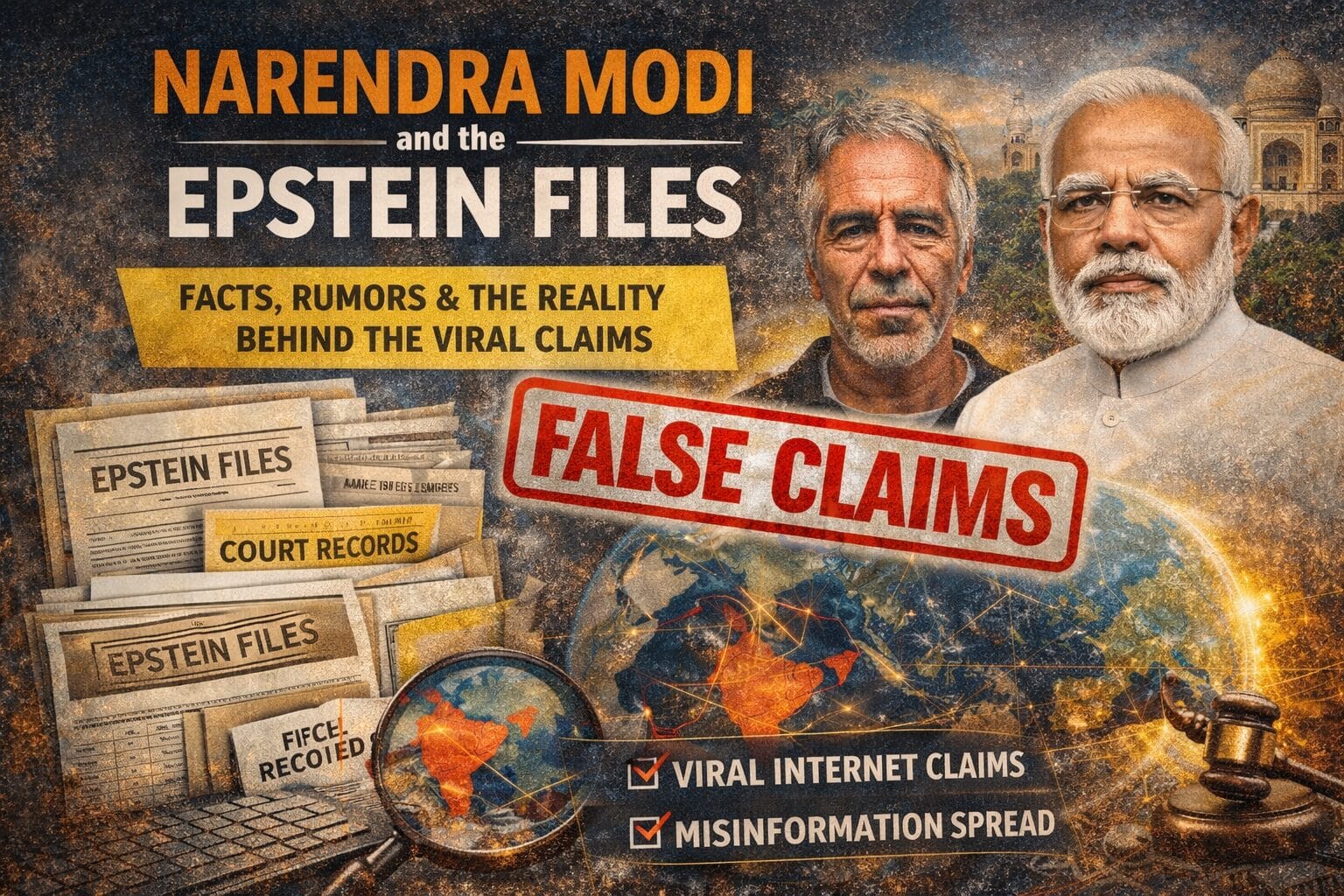
A clear, fact-checked explanation of whether India’s Prime Minister Narendra Modi has any connection to the Epstein files. Learn what the documents actually contain, how misinformation spread online, and why legal evidence matters more than viral speculation.
Introduction: Why This Question Went Viral
In the age of social media, large document releases often generate confusion. When court records connected to Jeffrey Epstein were partially unsealed, thousands of names — from business leaders to academics — appeared in various contexts such as contacts, meetings, or references.
Soon after, internet searches began trending around the world asking:
“Is Narendra Modi mentioned in the Epstein files?”
“What is the connection between Modi and Epstein?”
This article explains the verified facts, legal context, and the difference between speculation and documented evidence.
The Short Answer
There is no verified evidence, court record, or investigative finding showing that Narendra Modi had any connection to Jeffrey Epstein or his criminal activities.
No criminal complaint
No witness testimony
No official document
No court filing
has established such a link.
The viral discussions originated from misinformation cycles — not from judicial findings.
Understanding What the Epstein Files Actually Are
Before examining claims, it is essential to understand what the files contain.
The Epstein files include:
- civil court depositions
- contact directories
- travel records
- investigative exhibits
- legal motions
- settlement agreements
These documents list thousands of individuals worldwide — but courts repeatedly clarify:
A name appearing in documents does not equal involvement in wrongdoing.
Many names appeared because Epstein interacted socially with influential communities globally.
Where the Modi Rumor Started
The claim emerged primarily from three online patterns:
1. Misinterpreted Name Lists
Large public document dumps circulated online without legal context. Users assumed every global leader must appear somewhere in the data.
2. Edited Social Media Graphics
Fabricated images and screenshots spread across platforms, often lacking verifiable sources.
3. Algorithmic Amplification
Once a rumor gains engagement, search engines and social feeds automatically promote related queries, making speculation appear credible.

Checking Official Records
Researchers, journalists, and legal analysts reviewed:
- federal court filings
- unsealed civil records
- deposition transcripts
- flight logs
- contact books
Narendra Modi’s name does not appear as part of any verified investigative allegation or legal reference related to Epstein’s crimes.
Why Global Leaders Are Often Targeted by Viral Lists
High-profile figures frequently become part of internet speculation because:
- They are globally recognizable
- Their names increase engagement
- Algorithms promote controversial content
- False associations spread faster than corrections
This phenomenon is called “reputation piggybacking” — attaching a famous name to trending topics for visibility.
Difference Between Evidence and Online Claims
| Online Claim | Legal Standard |
|---|---|
| Screenshot or viral post | Not admissible evidence |
| Unverified list | Requires source authentication |
| Anonymous blog | No legal credibility |
| Court document | Verified record |
| Testimony under oath | Judicial evidence |
No verified legal evidence links India’s Prime Minister to Epstein.
India’s Official Position in Global Investigations
India has participated in international anti-trafficking cooperation frameworks, but:
- No Indian government inquiry has implicated national leadership
- No diplomatic communication suggested involvement
- No international agency has issued allegations
The country was not identified as an operational center of Epstein’s crimes.
How Misinformation Spreads During High-Profile Cases
Large scandals create an information vacuum. When people seek answers quickly, inaccurate explanations often fill the gap.
Typical pattern:
- Partial documents released
- Online speculation begins
- Fake lists circulate
- Influencers repeat claims
- Search engines detect trend
- Rumor appears factual
This cycle occurred in many countries, not only India.
Legal Responsibility Requires Proof
For a person to be legally connected to a criminal case, investigators must establish:
- communication related to criminal conduct
- witness testimony
- corroborating evidence
- prosecutorial charges
- court determination
None of these conditions exist regarding Narendra Modi and the Epstein investigation.
Why Responsible Reporting Matters
Incorrect associations can cause:
- diplomatic confusion
- public mistrust
- reputational harm
- distraction from victims’ justice
Courts rely on verified facts, not trending narratives.
The Real Global Lesson from the Epstein Case
The importance of the Epstein documents lies in exposing systemic failures — not in creating unsupported accusations.
Key lessons:
- transparency is essential
- victims must be protected
- influence should not block investigations
- evidence must guide conclusions
Attaching unrelated individuals undermines those goals.

Conclusion
After reviewing court records, investigative material, and credible reporting:
There is no factual or legal connection between Narendra Modi and the Epstein files.
The claim originated from online speculation rather than documented evidence.
The case demonstrates a broader modern challenge:
In the digital era, information spreads instantly — but verification still requires patience.
Understanding this difference protects both justice and truth.
Frequently Asked Questions (FAQ) — Narendra Modi & Epstein Files Fact Check
1. Is Narendra Modi named in the Epstein files?
No verified court document or official investigative record lists him in connection with the case.
2. Did investigators accuse Narendra Modi of any wrongdoing?
No law-enforcement agency has made such an allegation.
3. Are there criminal charges linking him to Epstein?
No criminal charges exist.
4. Did Epstein ever meet Narendra Modi?
There is no confirmed public record of any meeting.
5. Why did this rumor appear online?
Because large document releases often trigger speculation and viral misinformation.
6. Are social media screenshots reliable evidence?
No. They require verification from primary legal sources.
7. What documents are considered reliable?
Court filings, sworn testimony, and official investigative records.
8. Was India an operational center in the Epstein case?
No official investigation concluded that.
9. Did Indian authorities investigate Modi in relation to Epstein?
No.
10. Do flight logs include Narendra Modi?
No verified flight record shows his presence.
11. What are the Epstein flight logs?
Passenger records of Epstein’s private aircraft.
12. Does appearing in a contact book prove involvement?
No. It only indicates contact information existed.
13. Did Modi appear in the contact book?
No verified record confirms that.
14. Why do famous leaders get included in rumors?
High public recognition increases viral engagement.
15. Did any court testimony mention him?
No credible testimony has done so.
16. Are edited images proof?
No. Images can be fabricated or altered.
17. What is misinformation?
False or misleading information presented as fact.
18. How does misinformation spread quickly?
Through shares, reposts, and algorithmic amplification.
19. Did journalists confirm a connection?
Reputable reporting has not confirmed any link.
20. What is legal evidence?
Material accepted in court under rules of law.
21. What is an allegation?
A claim that requires proof.
22. What is a conviction?
A court-established finding of guilt.
23. Are allegations equal to guilt?
No.
24. Did any victim name Narendra Modi?
No verified testimony has done so.
25. What role did India play in the investigation?
Cooperation frameworks only; no direct involvement.
26. Are viral lists trustworthy?
They must be verified before acceptance.
27. Why do people believe viral claims?
Repetition often creates perceived credibility.
28. Did any international agency issue a notice?
No.
29. Was any diplomatic communication released?
No confirmed document indicates such.
30. What is a primary source?
An original official document or direct evidence.
31. What is a secondary source?
An interpretation or commentary about the original material.
32. Should readers rely on primary sources?
Yes, whenever possible.
33. Can search trends make rumors look real?
Yes, popularity does not equal truth.
34. Did fact-checking organizations verify the claim?
They have found no supporting evidence.
35. Why is careful verification important?
It prevents reputational harm and confusion.
36. Did the Epstein investigation involve many countries?
Yes, due to international associations.
37. Does global association imply participation?
No.
38. Can public figures be falsely linked to scandals?
Yes, frequently in viral controversies.
39. What legal standard connects someone to a crime?
Evidence, corroboration, and formal charges.

40. Were such standards met here?
No.
41. What should readers check before believing a claim?
Source credibility and official documentation.
42. Can edited documents circulate widely?
Yes, especially during major news events.
43. Are rumors harmful?
They can damage trust and reputations.
44. Did any verified list include Modi?
No credible list has done so.
45. Why do conspiracy narratives emerge?
Information gaps create speculation.
46. Are courts influenced by online trends?
No, courts rely on admissible evidence.
47. Can international politics affect rumors?
Yes, public interest increases discussion volume.
48. What is the main verified conclusion?
No factual connection exists.
49. How should readers approach such topics?
With skepticism and verification.
50. What is the final takeaway?
Evidence matters more than viral speculation.
Pros and Cons of Discussing Claims About Narendra Modi in Relation to the Epstein Files
Public conversations around high-profile names in major investigations often create both constructive outcomes and serious risks. Evaluating them carefully helps maintain factual understanding and responsible discourse.
Advantages (Pros)
1. Encourages Fact-Checking Culture
When viral claims circulate, people begin searching for primary documents and reliable sources. This promotes media literacy and awareness about verifying information.
2. Strengthens Public Demand for Transparency
Public curiosity pushes institutions and journalists to clarify records, publish verified data, and correct misinformation quickly.
3. Improves Understanding of Legal Evidence
The discussion helps audiences learn the difference between:
- allegation
- association
- documented evidence
- judicial finding
4. Promotes Responsible Journalism
News organizations become more cautious about publishing unverified claims, improving reporting standards.
5. Builds Awareness About Misinformation
The controversy becomes an example of how viral narratives form without factual support, helping readers recognize manipulation tactics online.
6. Reinforces Importance of Due Process
It reminds the public that guilt must be determined in court, not through social media discussions.
7. Encourages Digital Accountability Platforms
Fact-checking portals and independent verification groups gain importance and public trust.
Disadvantages (Cons)
1. Reputational Harm Without Evidence
Linking a public figure to a criminal case without proof can damage credibility and public confidence.
2. Spread of False Information
Unverified posts can travel faster than corrections, creating long-lasting misconceptions.
3. Political Polarization
Supporters and critics may interpret rumors emotionally rather than factually, increasing social division.
4. Distraction From Real Victims
Attention shifts from victims and legal proceedings to unrelated personalities.
5. Erosion of Trust in Media
Frequent exposure to conflicting claims makes audiences unsure what to believe.
6. Diplomatic Sensitivity
International rumors involving national leaders may create unnecessary political tension.
7. Trial by Public Opinion
Public debate may attempt to judge individuals outside legal procedures, undermining fairness.
Balanced Perspective
Discussing such claims can improve awareness and transparency — only when based on verified information.
Without evidence, the discussion risks harming reputations and confusing the public.
Responsible communication requires:
- reliance on official records
- clear distinction between rumor and fact
- respect for due process
Final Insight
The real value of these discussions lies in strengthening critical thinking and verification habits. Public interest should encourage truth-seeking, not replace legal proof.