



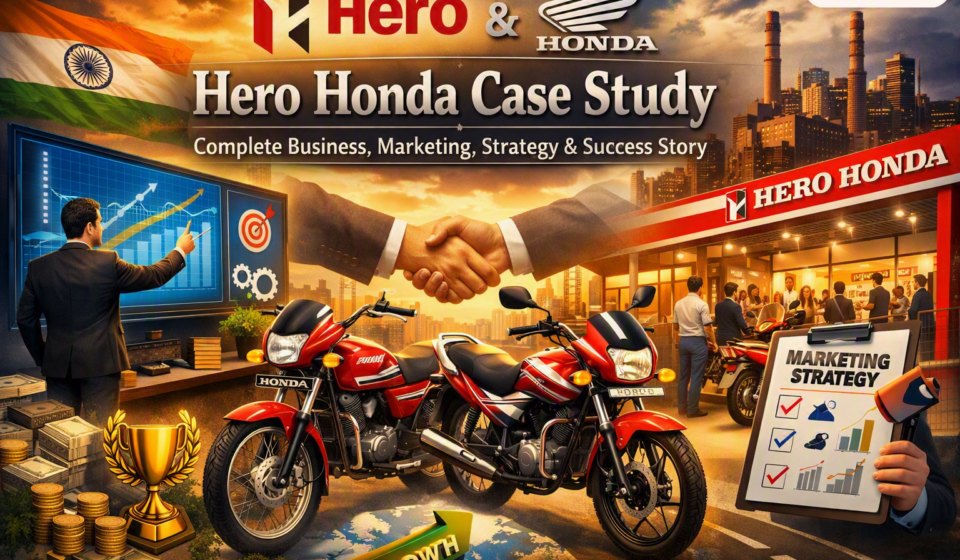
Hero Honda Case Study: Success Story, Business Strategy, Marketing Strategy, SWOT Analysis & Lessons – 2026

Read a detailed Hero Honda case study covering the Hero Honda joint venture, business model, marketing strategy, distribution network, product strategy, reasons for success, Honda separation, Hero MotoCorp transformation and key business lessons.
Hero Honda Case Study: How a Historic Joint Venture Built India’s Two-Wheeler Giant
The Hero Honda case study is one of the most interesting business cases in the history of India’s automobile industry.
It combines:
- International technology
- Indian entrepreneurship
- Joint-venture management
- Mass-market pricing
- Rural distribution
- Brand building
- Product localization
- Customer understanding
- Manufacturing efficiency
- Supply-chain development
- Long-term strategic planning
The story began in the 1980s when India’s Hero Group joined hands with Japan’s Honda Motor Co. to establish Hero Honda Motors.
The partnership eventually created one of the world’s most successful motorcycle businesses.
Honda itself describes Hero Honda as one of its most successful businesses globally. Hero Honda was established in 1984, began operations in 1985, and combined Honda’s technology and products with Hero’s strengths in marketing, development and sales-network expansion.
The partnership later ended, but the business lessons created during those 26-plus years remain highly relevant to entrepreneurs, management students, marketers and companies.
Hero Honda Case Study at a Glance
| Category | Details |
|---|---|
| Company | Hero Honda Motors Ltd. |
| Formation | 1984 |
| Operations began | 1985 |
| Indian Partner | Hero Group |
| Japanese Partner | Honda Motor Co. |
| Industry | Two-wheelers |
| Initial focus | Motorcycles |
| Major early model | CD100 |
| Famous model | Splendor |
| Major manufacturing location | Dharuhera, Haryana |
| Partnership period | 1984–2010 |
| Honda stake before separation | 26% |
| Successor | Hero MotoCorp |
| Key strength | Technology + Indian distribution and marketing |
| Major market | India |
| Business lesson | Localization + technology + distribution + affordability |
Honda’s official history confirms that the joint venture was established in 1984 and began production of the CD100 at Dharuhera in 1985.
What Was Hero Honda?
Hero Honda Motors Limited was an Indian-Japanese joint venture between the Hero Group and Honda Motor Co.
The partnership brought together two very different but complementary strengths.
Hero brought:
- Indian market knowledge
- Distribution capabilities
- Local business relationships
- Marketing understanding
- Entrepreneurial experience
- Knowledge of Indian consumers
- Strong bicycle-market experience
Honda brought:
- Motorcycle technology
- Engineering expertise
- Product development
- Manufacturing know-how
- Japanese quality systems
- International experience
The combination created a powerful business model.
In simple terms:
Honda brought technology, while Hero brought deep knowledge of the Indian market.
This complementary relationship is one of the most important reasons the Hero Honda case study remains relevant today.
Background of Hero Group
To understand the Hero Honda success story, it is necessary to understand Hero’s history.
The Munjal family established itself in bicycle manufacturing and related components before entering the motorcycle industry.
Hero’s corporate history states that Hero Cycles was established in 1956 and that Hero joined hands with Honda in 1984 to establish Hero Honda Motor Ltd.
By the time Hero entered the motorcycle business with Honda, it already possessed experience in:
- Manufacturing
- Distribution
- Indian consumers
- Bicycle retail
- Supply chains
- Vendor relationships
- Mass-market products
That background became extremely valuable.
Why Did Hero and Honda Join Hands?
The Indian automobile market was very different from today’s market.
Motorcycles were not yet as dominant as they later became.
Consumers were highly price-sensitive.
Fuel economy was extremely important.
Reliability mattered.
After-sales service was important.
And distribution beyond major cities was critical.
Honda wanted access to the growing Indian market.
Hero wanted to enter motorcycle manufacturing with advanced technology.
Therefore, the partnership created a mutually beneficial opportunity.
The Hero Honda Joint Venture
Hero Honda was established in 1984.
Honda invested 26%, while the Indian partners also held 26%, with the remaining shares publicly held at the time of the 2010 restructuring announcement.
Production began in 1985.
The first major manufacturing plant was established at Dharuhera, Haryana.
The first motorcycle was the CD100.
Honda’s history notes that the company initially entered the Indian motorcycle market with 100cc-class motorcycles and started production of the CD100 in 1985.
Hero Honda’s Initial Challenge
Hero Honda did not become successful overnight.
The company faced a major consumer challenge.
At the time, scooters had a strong position in India’s two-wheeler market.
Motorcycles were not automatically the preferred option for every customer.
Honda’s historical account notes that Hero Honda initially struggled because motorcycles were less popular than scooters and customers had concerns including gear shifting, lack of a flat foot area and relatively high prices.
This is an important lesson:
A good product does not automatically create a successful business.
The company needed to understand what Indian consumers actually wanted.
Understanding the Indian Consumer
Hero Honda’s eventual success was strongly connected to understanding Indian customer priorities.
Many consumers wanted:
- Affordable purchase price
- Excellent fuel economy
- Reliability
- Low maintenance
- Easy servicing
- Good resale value
- Spare-parts availability
- Strong dealer support
Hero Honda’s strategy gradually aligned its product and distribution system with these needs.
Instead of competing only on performance or premium features, the company developed a proposition around practical everyday mobility.
Hero Honda’s Core Value Proposition
A simplified version of the company’s value proposition can be expressed as:
Reliable + Fuel Efficient + Affordable + Easy to Maintain + Widely Available
This combination was extremely powerful in India’s mass motorcycle market.
For a middle-class or rural consumer, fuel economy was not merely a specification.
It directly affected household expenses.
Therefore, mileage became an important part of the customer’s purchase decision.
The Importance of Fuel Efficiency
Fuel economy became one of Hero Honda’s strongest consumer associations.
The motorcycle was increasingly viewed not simply as a vehicle but as an economical means of transportation.
This positioning was particularly powerful for:
- Daily commuters
- Rural customers
- Small business owners
- Students
- Salaried workers
- Delivery workers
- Families requiring affordable mobility
This is an excellent example of benefit-based marketing.
Instead of simply saying:
“Our motorcycle has a certain engine specification.”
The broader consumer message became:
“This motorcycle can help you travel economically.”
Hero Honda and the Splendor Success Story
One of the most important chapters in the Hero Honda case study is Splendor.
Honda reported that Hero Honda reached cumulative production of 10 million motorcycles by December 2004, while the Splendor alone had reached 5 million units.
That is an extraordinary milestone.
Splendor became strongly associated with:
- Reliability
- Mileage
- Practicality
- Affordability
- Everyday transportation
The product’s success demonstrated the power of focusing on the mass market.
Why Was Splendor So Successful?
Several factors contributed to the model’s success.
1. Mass-Market Positioning
Splendor was positioned for ordinary consumers rather than only enthusiasts.
2. Fuel Economy
Mileage was a powerful purchase consideration.
3. Reliability
Consumers wanted a motorcycle they could use every day.
4. Service Network
A strong dealer and service ecosystem increased confidence.
5. Brand Trust
Hero Honda gradually became a trusted household name.
6. Resale Confidence
A strong brand and widespread usage contributed to customer confidence in ownership.
Hero Honda’s Distribution Strategy
One of the biggest competitive advantages was distribution.
A great motorcycle is not enough if customers cannot easily:
- See it
- Buy it
- Finance it
- Service it
- Obtain spare parts
Hero Honda developed a broad sales and service ecosystem.
This gave it an enormous advantage over competitors that lacked comparable reach.
Rural Marketing Strategy
The Indian motorcycle market was not limited to metropolitan cities.
A huge opportunity existed in:
- Small towns
- Semi-urban markets
- Villages
- Agricultural communities
- District headquarters
Hero Honda’s understanding of India’s decentralized market helped it expand beyond major urban centres.
This is one of the most important lessons for modern businesses:
India is not one market. It is thousands of local markets with different needs.
The Power of Local Distribution
Consider a customer in a small town.
They may want:
- A nearby showroom
- Local servicing
- Easily available spare parts
- Financing assistance
- Familiar mechanics
- Quick repairs
A strong local network can therefore become a competitive moat.
Competitors may copy:
- Product features
- Advertising
- Pricing
But building a comparable distribution network can take many years.
Hero Honda Marketing Strategy
The Hero Honda marketing strategy focused heavily on practical consumer benefits.
Its marketing approach was supported by:
- Mass-media advertising
- Dealer visibility
- Product demonstrations
- Rural penetration
- Brand campaigns
- Sports and entertainment associations
- Word-of-mouth
- Customer trust
The company was not simply selling motorcycles.
It was building a mobility brand.
Hero Honda Advertising Strategy
Advertising played an important role in establishing the motorcycle as an aspirational but practical product.
The company had to communicate two ideas simultaneously:
Practicality
The motorcycle should be economical and dependable.
Aspiration
The motorcycle should also represent progress and personal freedom.
This balance helped broaden the target market.
Brand Positioning
The brand positioning can be summarized as:
A dependable motorcycle for everyday Indian mobility.
This positioning was particularly effective because it connected with real consumer needs.
The company didn’t need to convince every customer to become a motorcycle enthusiast.
It needed to convince ordinary people that motorcycle ownership made economic and practical sense.
Hero Honda’s Business Model
Hero Honda’s business model was based on several interconnected components:
Product
Motorcycles designed for the Indian mass market.
Price
Competitive pricing aimed at affordability.
Place
Extensive dealer and service network.
Promotion
Mass advertising and strong brand communication.
Manufacturing
Large-scale production and supplier integration.
After-Sales Service
Wide availability of service and spare parts.
Together, these elements created a difficult-to-copy system.
Hero Honda 4P Marketing Mix
Product
Fuel-efficient, reliable motorcycles designed for Indian consumers.
Price
Competitive pricing suitable for mass-market customers.
Place
Extensive distribution and service network.
Promotion
Advertising and brand-building focused on practical benefits and aspiration.
This 4P combination helped Hero Honda establish a powerful market position.
Hero Honda’s Manufacturing Strategy
Manufacturing scale was another major advantage.
As demand increased, the company expanded production capabilities.
Honda reported that Hero Honda’s annual production in 2003 reached 1.85 million units at a single location, described as a Honda world record for a single location at that time.
This demonstrated the company’s ability to achieve enormous manufacturing scale.
Economies of Scale
Large-scale production can reduce the average cost per unit.
When production increases:
- Fixed costs are spread across more units.
- Supplier relationships become stronger.
- Manufacturing processes become more efficient.
- Procurement can become more economical.
- Distribution costs can be optimized.
Hero Honda benefited from these economies of scale as its sales increased.
Hero Honda and Supplier Network
The success of an automobile manufacturer depends heavily on its suppliers.
A motorcycle contains hundreds of components.
Therefore, the company needs:
- Reliable vendors
- Quality control
- Consistent components
- Timely deliveries
- Cost management
- Manufacturing coordination
Hero’s corporate history describes how Hero worked with vendors around the Dharuhera plant and subsequently developed capabilities across areas such as forging, casting, plastics and steel-related supply activities.
Technology Transfer from Honda
Honda’s technological contribution was critical.
The partnership allowed Hero Honda to access Honda’s:
- Motorcycle engineering
- Product technology
- Manufacturing expertise
- Quality practices
- Research capabilities
This created a major competitive advantage for an Indian company entering the motorcycle sector.
Indian Market Knowledge from Hero
While Honda supplied technology, Hero understood the local market.
Hero had knowledge of:
- Indian consumers
- Indian dealers
- Rural distribution
- Local business relationships
- Price sensitivity
- Customer behaviour
This complementary capability was the foundation of the partnership.
The Hero Honda Competitive Advantage
Hero Honda’s competitive advantage can be summarized as:
Technology + Distribution + Brand + Scale + Customer Understanding
Competitors could potentially compete on one or two dimensions.
But Hero Honda had a complete ecosystem.
Hero Honda vs Competitors
The Indian two-wheeler industry eventually became highly competitive.
Major competitors included companies such as:
- Bajaj Auto
- TVS
- Honda
- Yamaha
- Suzuki
Hero Honda’s advantage was particularly strong in the mass motorcycle segment.
The company developed a reputation for:
- Mileage
- Reliability
- Low maintenance
- Wide availability
- Resale value
Why Hero Honda Became a Market Leader
The company’s leadership was not based on a single factor.
It was the result of multiple reinforcing advantages.
Product-market fit
The motorcycles matched consumer needs.
Distribution
Customers could easily find dealerships and service.
Brand trust
The company developed long-term customer confidence.
Technology
Honda supplied strong technical expertise.
Scale
Large production volumes improved efficiency.
Marketing
The brand communicated relevant consumer benefits.
Hero Honda’s Customer Strategy
Hero Honda’s customer strategy was based on understanding the practical realities of Indian consumers.
For many customers, a motorcycle represented:
- Employment mobility
- Family transportation
- Business opportunity
- Education access
- Rural connectivity
- Personal independence
This transformed the motorcycle from a discretionary purchase into an important household asset.
Hero Honda and Middle-Class India
The growth of India’s middle class created a massive opportunity.
As incomes increased, more families wanted personal transportation.
A motorcycle provided a relatively affordable alternative to a car.
This created a huge addressable market.
Hero Honda was positioned directly in that opportunity.
Hero Honda and Rural India
Rural India was especially important.
A motorcycle could help:
- Farmers travel to markets
- Students reach schools and colleges
- Workers commute
- Small-business owners visit customers
- Families travel between villages and towns
Therefore, motorcycle demand was closely connected with economic development.
Hero Honda’s Customer Loyalty
When a company becomes associated with reliability, customers often become repeat buyers.
A satisfied owner can also influence:
- Family
- Friends
- Neighbours
- Colleagues
- Local communities
This creates word-of-mouth marketing.
In markets where consumers heavily value trust, word-of-mouth can be extremely powerful.
Hero Honda’s Brand Trust
Trust is especially important for automobile purchases.
A customer buying a motorcycle is not simply buying a product.
They are committing money to:
- Maintenance
- Fuel
- Insurance
- Repairs
- Spare parts
- Long-term ownership
A trusted brand reduces perceived risk.
Hero Honda Joint Venture Case Study: Why the Partnership Worked
The partnership succeeded because the two organizations initially had complementary capabilities.
Hero
Market access + distribution + local knowledge
Honda
Technology + engineering + manufacturing expertise
Instead of duplicating each other’s strengths, they combined them.
This is one of the most important lessons from the case.
The Hero Honda Partnership Was Not Permanent
Despite its enormous success, the partnership eventually ended.
By 2010, Hero and Honda had decided to separate.
Honda announced in December 2010 that it would sell its 26% stake in Hero Honda to the Indian partners and that the company would change its name. A licensing arrangement allowed Hero Honda to continue producing and selling existing products while also licensing new products under the new brand.
Why Did Hero Honda and Honda Separate?
The separation should not simply be described as a “failure.”
The joint venture had already achieved extraordinary success.
The market had changed.
Both businesses had developed their own ambitions.
Honda had established its own Indian subsidiary, Honda Motorcycle & Scooter India.
Hero wanted greater independence and control over its future.
Honda’s own historical account says that the partners discussed the best framework for future growth as the Indian motorcycle market became more diverse.
Hero Honda Split in 2010
The restructuring represented a major turning point.
Honda sold its stake.
Hero acquired full control of the business.
The company moved away from the Hero Honda identity.
The new company became Hero MotoCorp.
An official Hero MotoCorp document describes the separation as the end of a 27-year association and the beginning of a new independent journey.
From Hero Honda to Hero MotoCorp
The transition created a major strategic challenge.
Hero could no longer simply depend on Honda for the same relationship.
The company needed to build greater capabilities in:
- Research
- Development
- Product innovation
- Technology
- Global expansion
- Brand management
The company therefore entered a new phase.
Was the Hero Honda Split a Failure?
No.
It is more accurate to describe the separation as a strategic restructuring.
The partnership had already created tremendous value.
The two companies eventually wanted greater independence.
Honda continued expanding its own motorcycle business in India.
Hero continued as an independent motorcycle company.
Honda’s own history describes both companies as taking separate paths after the 2010 dissolution.
Hero MotoCorp After the Split
The post-Honda period was an important test.
Could Hero maintain its market leadership without Honda?
The company continued to build its product portfolio and global presence.
According to Hero MotoCorp’s FY2025-26 results, the company reported that it retained its position as the world’s largest manufacturer of motorcycles and scooters for the 25th consecutive year. It also reported all-time-high global dispatches of 4.03 lakh units in FY2025-26 and presence across 52 international markets.
That makes the post-Hero-Honda story especially significant.
Hero MotoCorp’s Modern Strategy
The company has expanded beyond the traditional commuter motorcycle category.
Its portfolio now includes products across:
- Entry motorcycles
- 100cc-class motorcycles
- 125cc motorcycles
- Premium motorcycles
- Adventure motorcycles
- Scooters
- Electric mobility
Its FY2025-26 results highlighted models including HF Deluxe Pro, Glamour X, Xtreme 125R, Xpulse 210, Destini and Xoom products.
Hero MotoCorp and Electric Mobility
The two-wheeler industry is changing.
Electric vehicles are becoming increasingly important.
Hero MotoCorp has therefore invested in electric mobility through its VIDA business.
The company’s FY2025-26 results reported VIDA annual retail of 151,748 units and a market-share increase from 6.1% in March FY2025 to 11.2% in March FY2026.
This illustrates how a company built around traditional internal-combustion motorcycles is attempting to adapt to a changing mobility market.
Hero Honda Case Study – SWOT Analysis
Strengths
1. Strong Brand
Hero Honda became one of India’s most recognized motorcycle brands.
2. Extensive Distribution
The company developed a powerful dealer and service network.
3. Fuel-Efficient Products
Fuel economy became a major customer benefit.
4. Technology Partnership
Honda’s technology gave the company strong engineering capabilities.
5. Manufacturing Scale
Large volumes created economies of scale.
6. Customer Trust
Long-term reliability strengthened the brand.
Weaknesses
1. Heavy Dependence on Commuter Segment
The historical business was strongly associated with practical commuter motorcycles.
2. Technology Dependence During the JV
Honda was a critical technology partner.
3. Premium-Segment Perception
The brand had to work to strengthen its premium positioning as consumer preferences evolved.
4. Transition Risk
The separation from Honda created technology and product-development challenges.
Opportunities
1. Electric Vehicles
EV adoption creates opportunities for new products.
2. International Markets
Global expansion provides additional growth opportunities.
3. Premium Motorcycles
Higher-value motorcycles can increase margins and brand aspiration.
4. Digital Sales
Digital platforms can improve customer engagement.
5. Connected Mobility
Connected technology can create new services.
Threats
1. Intense Competition
Companies such as Honda, Bajaj, TVS, Yamaha and others compete aggressively.
2. EV Disruption
Electric mobility could change traditional motorcycle economics.
3. Regulatory Changes
Emission and safety regulations can increase costs.
4. Changing Consumer Preferences
Younger customers may demand more technology and premium features.
5. Raw Material Costs
Commodity-price fluctuations can affect manufacturing economics.
Hero Honda Porter’s Five Forces Analysis
1. Competitive Rivalry – High
India has a highly competitive two-wheeler market.
2. Threat of New Entrants – Moderate
Manufacturing scale, distribution and brand building create substantial barriers.
3. Supplier Power – Moderate
Large manufacturers have significant purchasing power but still depend on specialized suppliers.
4. Buyer Power – High
Consumers have many alternatives.
5. Threat of Substitutes – Moderate to High
Cars, public transport, electric scooters, bicycles and ride-sharing can substitute for motorcycles in certain use cases.
Hero Honda Marketing Mix – Detailed 4P Analysis
Product Strategy
Hero Honda focused on products that met mainstream Indian mobility requirements.
Pricing Strategy
Competitive pricing supported mass-market penetration.
Place Strategy
Extensive distribution helped reach customers across cities, towns and rural areas.
Promotion Strategy
Advertising emphasized practical benefits, brand trust and aspirational mobility.
Hero Honda Business Strategy
The company’s overall strategy can be summarized into seven pillars:
1. Understand the customer
Identify what customers actually value.
2. Localize the product
Design for Indian conditions.
3. Build distribution
Make the product easily available.
4. Maintain quality
Build long-term trust.
5. Control costs
Create an affordable product.
6. Build the brand
Develop recognition and emotional connection.
7. Scale operations
Use manufacturing volume to improve efficiency.
The Most Important Lesson From Hero Honda
The biggest lesson from the Hero Honda case study is:
Success often comes from combining complementary capabilities rather than trying to do everything alone.
Hero had local knowledge.
Honda had technology.
Together, they created something much larger than either capability could have produced independently in that context.
Lesson for Indian Entrepreneurs
Indian entrepreneurs can learn several things from Hero Honda.
Lesson 1: Understand Your Market
Don’t build products based only on assumptions.
Study actual customers.
Lesson 2: Solve a Real Problem
Hero Honda solved a fundamental problem:
Affordable personal mobility.
Lesson 3: Distribution Matters
A product unavailable to customers cannot become a mass-market success.
Lesson 4: Trust Takes Time
Brand reputation is built through consistent customer experience.
Lesson 5: Technology Partnerships Can Accelerate Growth
Strategic partnerships can provide capabilities that would otherwise take years to develop.
Lesson for Startups
A startup can apply the Hero Honda model in a modern way.
For example:
Startup A
Has excellent technology but no distribution.
Startup B
Has strong local distribution but lacks technology.
A strategic partnership could potentially create a stronger combined business.
The Hero Honda case demonstrates why complementary resources can be valuable.
Lesson for Digital Businesses
The same principle applies online.
Imagine:
Technology company + marketing company + distribution company
Together they may create a stronger business than any one organization operating independently.
The key is finding complementary strengths.
Hero Honda Case Study – Customer-Centric Strategy
One of the strongest lessons is customer centricity.
The company didn’t simply ask:
“What motorcycle can we manufacture?”
The more useful question was:
“What motorcycle does the Indian consumer need?”
That distinction can transform a business.
Hero Honda and Product-Market Fit
Product-market fit occurs when a product strongly satisfies the needs of a target market.
Hero Honda’s motorcycles matched important Indian requirements:
- Affordable mobility
- Fuel economy
- Reliability
- Practicality
- Serviceability
That strong fit helped the company achieve enormous scale.
Hero Honda and Brand Loyalty
Brand loyalty can create a long-term competitive advantage.
When customers trust a brand, they are more likely to:
- Consider future products
- Recommend the company
- Return for servicing
- Purchase again
- Recommend it to family members
This creates a virtuous cycle.
Hero Honda Case Study – Key Performance Milestones
Some historical milestones illustrate the scale of the business.
1984
Hero Honda established.
1985
Production began and the CD100 was introduced.
2003
Annual production at one location reached 1.85 million units, according to Honda.
2004
Cumulative production crossed 10 million units, while Splendor production crossed 5 million units.
2009
Hero Honda sold approximately 4.32 million motorcycles in India, according to Honda’s 2010 announcement.
2010
Hero and Honda agreed to dissolve the joint venture.
2011 onward
The business transitioned to the Hero MotoCorp identity.
FY2025-26
Hero MotoCorp reported continued global leadership and expansion across 52 international markets.
Why Hero Honda Is an Excellent Business School Case Study
Hero Honda is particularly useful for management education because it demonstrates multiple concepts simultaneously.
Students can study:
- Joint ventures
- International business
- Strategic alliances
- Market entry
- Localization
- Marketing
- Distribution
- Operations
- Supply chains
- Brand management
- Competitive strategy
- Corporate restructuring
- Business transformation
Few cases provide such a broad combination.
Hero Honda Case Study for MBA Students
MBA students can analyze Hero Honda through:
Marketing Management
How did the company position motorcycles?
Strategic Management
How did Hero and Honda combine resources?
Operations Management
How did manufacturing scale support growth?
International Business
How did Japanese technology combine with Indian market knowledge?
Human Resource Management
How did the organization scale?
Financial Management
How did scale and cost control support profitability?
Entrepreneurship
How did the Munjal family identify and exploit a major market opportunity?
Hero Honda Case Study for BBA Students
BBA students can focus on:
- Product strategy
- Pricing
- Advertising
- Distribution
- Customer satisfaction
- Brand loyalty
- Market segmentation
- SWOT analysis
- 4P marketing mix
- Competitive advantage
Hero Honda Case Study – STP Analysis
Segmentation
The market could be segmented by:
- Income
- Geography
- Age
- Occupation
- Usage
- Lifestyle
Targeting
Hero Honda historically focused strongly on the mass-market motorcycle customer.
Positioning
The brand became strongly associated with reliable and economical personal transportation.
Hero Honda Market Segmentation
Important customer segments included:
Rural Customers
Customers needing affordable and durable transportation.
Urban Commuters
People travelling daily to work.
Students
Young customers seeking affordable mobility.
Small Business Owners
Entrepreneurs requiring regular local travel.
Families
Households needing economical personal transportation.
Hero Honda Competitive Advantage: Distribution as a Moat
A competitor can launch a new motorcycle quickly.
But creating:
- Thousands of dealers
- Service centres
- Mechanics
- Spare-part availability
- Local relationships
- Financing connections
takes significant time.
Therefore, distribution became a powerful barrier to competition.
Hero Honda and Word-of-Mouth Marketing
In traditional markets, word-of-mouth can be more powerful than advertising.
One satisfied customer can influence several potential buyers.
For products such as motorcycles, real-world experience matters.
Customers can observe:
- Mileage
- Reliability
- Maintenance
- Resale value
- Service experience
This makes existing owners an informal marketing network.
Hero Honda Case Study – The Role of Trust
Trust was perhaps the company’s most valuable intangible asset.
A motorcycle is a long-term purchase.
Consumers want confidence that:
“This motorcycle will work when I need it.”
Hero Honda successfully connected its brand with that expectation.
What Could Competitors Learn From Hero Honda?
Competitors can learn that:
Price alone isn’t enough.
A cheap product without reliability can fail.
Advertising alone isn’t enough.
A strong advertisement cannot compensate for poor service.
Technology alone isn’t enough.
Excellent technology needs distribution and customer understanding.
Distribution alone isn’t enough.
Dealers need a product customers actually want.
The real advantage comes from combining all of these.
Hero Honda Case Study – The Strategic Formula
A simplified formula for the company’s historical success can be written as:
Honda Technology
Hero Market Knowledge
Affordable Products
Fuel Efficiency
Strong Distribution
Mass Advertising
Manufacturing Scale
Customer Trust
=
Hero Honda Success
Hero Honda Case Study: Key Reasons for Success
1. Right Market
India had enormous demand for affordable personal transportation.
2. Right Partner
Hero and Honda brought complementary strengths.
3. Right Product
The company focused on practical motorcycles.
4. Right Pricing
Products were accessible to mass-market customers.
5. Right Distribution
Customers could find products and services across a wide geography.
6. Right Brand
The company built trust over decades.
7. Right Scale
High production volumes improved efficiency.
8. Right Customer Understanding
The company aligned products with Indian consumer needs.
Hero Honda Case Study – What Went Wrong?
It is important not to describe the story as a perfect success.
The company faced:
- Initial consumer resistance
- Changing market preferences
- Increasing competition
- Technology dependence
- Partnership tensions/strategic divergence
- Need for independent R&D after separation
- Growing premium competition
- New mobility technologies
These challenges demonstrate that even market leaders must continually evolve.
Why Hero Honda Had to Change
Markets never remain static.
Customers began seeking:
- More styling
- More power
- Premium motorcycles
- Scooters
- Digital features
- Connected technologies
- Electric vehicles
Therefore, the company had to expand beyond its traditional commuter identity.
Hero MotoCorp’s Transformation
The transition from Hero Honda to Hero MotoCorp was more than a name change.
It represented a shift toward:
- Independent technology
- Global ambitions
- Broader product portfolio
- New partnerships
- Premium motorcycles
- Electric mobility
- International markets
The company’s current annual-report archive shows continuing investment in products, international operations and emerging mobility.
Hero Honda Case Study – Modern Business Lesson
The most important modern lesson is:
Past success can become a weakness if a company stops adapting.
A business must protect its existing competitive advantages while investing in the next generation of products and technologies.
Hero MotoCorp’s investments in electric mobility and global expansion demonstrate this transition.
Conclusion: Hero Honda Case Study
The Hero Honda case study is much more than the story of a motorcycle company.
It is a story about:
Partnership
Technology
Entrepreneurship
Market understanding
Distribution
Brand building
Customer trust
Manufacturing scale
Strategic transformation
Hero and Honda created a powerful combination in 1984.
Honda contributed technology and motorcycle expertise.
Hero contributed Indian market knowledge, marketing capabilities and distribution strengths.
The resulting company grew into a dominant force in India’s motorcycle market.
By 2004, Hero Honda had already crossed 10 million cumulative motorcycles, including 5 million Splendor units. By 2009, Honda reported approximately 4.32 million Hero Honda motorcycles sold in India.
The partnership ended in 2010, but the business continued under the Hero MotoCorp name. The subsequent history demonstrates that Hero was able to evolve beyond the original joint venture and build an independent global motorcycle business.
As of FY2025-26, Hero MotoCorp reported that it retained its position as the world’s largest manufacturer of motorcycles and scooters for the 25th consecutive year, while expanding into electric mobility and international markets.
The central lesson is simple:
Understand the customer, combine complementary strengths, build distribution, create trust, control costs and continuously adapt.
That is the real business lesson behind the Hero Honda success story.
Frequently Asked Questions About Hero Honda Case Study
1. What is the Hero Honda case study?
The Hero Honda case study examines the formation, growth, marketing strategy, business model, competitive advantages and eventual separation of Hero Honda’s joint venture between Hero and Honda.
2. When was Hero Honda established?
Hero Honda was established in 1984.
3. When did Hero Honda start production?
Production began in 1985 with the CD100.
4. Who were the partners in Hero Honda?
Hero Group and Honda Motor Co. were the principal partners.
5. Why was Hero Honda successful?
Its success came from a combination of Honda technology, Hero’s Indian market expertise, affordable motorcycles, fuel efficiency, strong distribution, manufacturing scale and customer trust.
6. What was Hero Honda’s most famous motorcycle?
The Splendor became one of its most famous and successful models.
7. Why was Splendor successful?
Its success was supported by mass-market positioning, reliability, fuel economy, practicality and strong distribution.
8. When did Hero and Honda separate?
The companies agreed to dissolve the joint venture in 2010.
9. What happened to Hero Honda after the split?
The company transitioned to the Hero MotoCorp identity.
10. Was the Hero Honda joint venture a failure?
No. It is generally regarded as a highly successful joint venture; the 2010 separation was a strategic restructuring rather than evidence that the original partnership had failed. Honda itself described Hero Honda as one of its most successful businesses worldwide.
11. What is the main lesson from Hero Honda?
The major lesson is the value of combining complementary capabilities and adapting products to local customer needs.
12. What is Hero Honda’s marketing strategy?
Its historical marketing strategy emphasized affordable mobility, fuel efficiency, reliability, brand trust, broad distribution and mass-market communication.
13. What is Hero Honda’s business model?
The model combined mass-market motorcycles, large-scale manufacturing, extensive distribution, after-sales service and strong brand building.
14. What is the Hero Honda SWOT analysis?
The major strengths were brand, distribution, product-market fit, technology and scale; opportunities include premiumization, global expansion and electric mobility.
15. Why is Hero Honda important for MBA students?
It provides an excellent example of joint ventures, strategic alliances, localization, marketing, distribution, operations and corporate transformation.
SEO Keywords / Tags
Hero Honda case study, Hero Honda success story, Hero Honda business case study, Hero Honda marketing strategy, Hero Honda business strategy, Hero Honda joint venture case study, Hero Honda history, Hero Honda success story India, Hero Honda marketing case study, Hero Honda SWOT analysis, Hero Honda 4P analysis, Hero Honda business model, Hero Honda competitive advantage, Hero Honda distribution strategy, Hero Honda advertising strategy, Hero Honda rural marketing strategy, Hero Honda customer strategy, Hero Honda Splendor case study, Hero Honda motorcycle case study, Hero Honda Honda partnership, Hero Honda split, Hero Honda separation, Hero Honda joint venture, Hero Honda failure analysis, Hero Honda success reasons, Hero MotoCorp case study, Hero MotoCorp success story, Hero MotoCorp marketing strategy, Hero MotoCorp business strategy, Indian automobile case study, Indian two wheeler industry case study, motorcycle business case study, Hero Honda case study for MBA, Hero Honda case study for BBA, Hero Honda strategic management case study, Hero Honda marketing management case study, Hero Honda entrepreneurship case study, Hero Honda business model analysis, Hero Honda competitive strategy, Hero Honda market strategy, Hero Honda customer satisfaction, Hero Honda brand strategy, Hero Honda fuel efficiency strategy, Hero Honda distribution network, Hero Honda manufacturing strategy, Hero Honda technology strategy, Hero Honda partnership strategy, Hero Honda international business case study.