




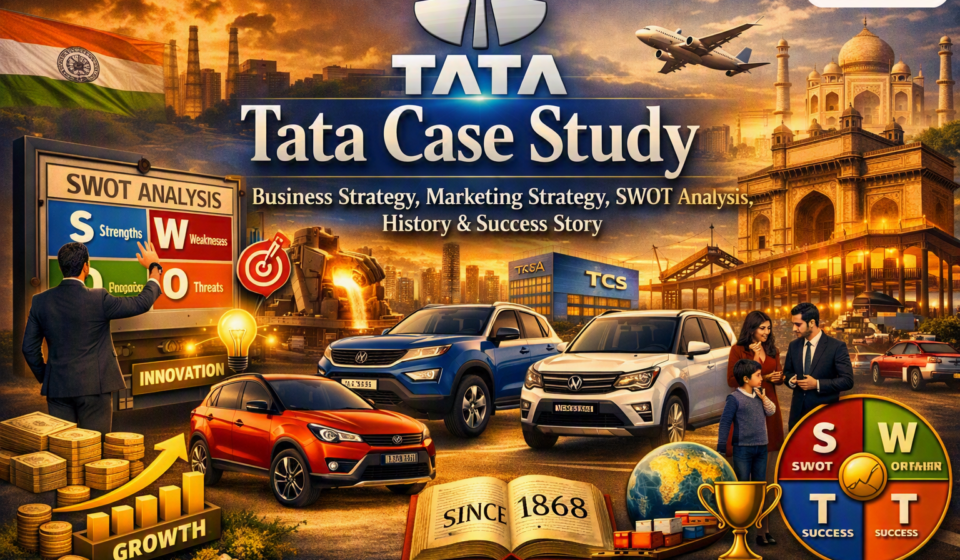
Tata Case Study: Business Strategy, Marketing Strategy, SWOT Analysis, History & Success Story – 2026

Explore a detailed Tata case study covering Tata Group history, business strategy, leadership, diversification, marketing, global expansion, competitive advantage, SWOT analysis, innovation, CSR and future growth.
Introduction: Tata Case Study
The Tata case study is one of the most important Indian business case studies for understanding how a company can build a diversified, globally recognized and long-lasting business group.
The Tata story is different from the story of a conventional single-product company.
Tata is a business group with interests across multiple industries, including automobiles, information technology, steel, consumer products, hospitality, aviation, financial services and other businesses.
The group’s history stretches back to the 19th century. Jamsetji Tata founded the trading enterprise that became the foundation of the Tata Group in 1868. Over time, the organization expanded from trading into manufacturing, infrastructure, services and global businesses.
The Tata case is therefore particularly useful for understanding:
- Entrepreneurship
- Diversification
- Corporate governance
- Brand management
- Global expansion
- Innovation
- Leadership
- Social responsibility
- Strategic acquisitions
- Long-term business building
Tata Group Case Study at a Glance
| Category | Details |
|---|---|
| Business Group | Tata Group |
| Founder | Jamsetji Tata |
| Origin | 1868 |
| Country | India |
| Business type | Diversified business group |
| Major sectors | Technology, automotive, steel, consumer, hospitality, aviation and more |
| Global presence | International |
| Famous companies | Tata Motors, TCS, Tata Steel, Tata Consumer Products, Tata Power and others |
| Major strengths | Brand trust, diversification, scale and global presence |
| Key philosophy | Long-term value creation and stakeholder orientation |
What Is Tata Group?
Tata Group is one of India’s most prominent business groups.
Unlike a company that operates primarily in one industry, Tata has built businesses across a wide range of sectors.
Examples include:
- Information technology
- Automobile manufacturing
- Steel
- Power
- Consumer products
- Hotels
- Aviation
- Retail
- Telecommunications
- Financial services
- Chemicals
- Infrastructure
This diversification is one of the most interesting aspects of the Tata Group business case study.
History of Tata Group
Understanding the Tata Group history is essential to understanding its success.
The group originated in the 19th century when Jamsetji Nusserwanji Tata established a trading business in 1868.
His vision went far beyond trading.
He wanted to contribute to India’s industrial and economic development.
This long-term thinking eventually led to investments in areas that were strategically important to India’s development.
Jamsetji Tata: The Founder
Jamsetji Tata is widely regarded as the founder of the Tata Group.
His approach to business combined:
- Entrepreneurship
- Industrial development
- Innovation
- Institution building
- Employee welfare
- National development
This philosophy became an important part of Tata’s corporate identity.
The Vision of Jamsetji Tata
Jamsetji Tata’s vision can be understood through several major ambitions:
Industrialization
Develop modern Indian industries.
Education
Support advanced education and research.
Scientific Development
Promote scientific and technological capabilities.
Employment
Create productive employment opportunities.
Nation Building
Build institutions that could contribute to India’s long-term development.
This is one reason the Tata case study is different from many conventional corporate success stories.
Tata’s Early Business Expansion
The Tata Group gradually moved from trading into industrial businesses.
Some of the historically important areas included:
- Textiles
- Hotels
- Steel
- Power
- Chemicals
The group was not built around a single product.
Instead, it developed multiple businesses around India’s changing economic needs.
Tata and the Indian Industrial Revolution
Tata played an important role in India’s industrial development.
The group’s businesses contributed to sectors such as:
- Steel production
- Electricity
- Hospitality
- Engineering
- Chemicals
- Manufacturing
This created a strong relationship between business growth and economic development.
Tata Steel Case Study
One of the most important parts of the Tata business story is Tata Steel.
Tata’s steel ambitions were rooted in the vision of developing a modern industrial base in India.
The creation of Tata Steel represented a major step toward large-scale Indian industrialization.
The company later became an international steel business.
Tata Steel and Global Expansion
Tata Steel’s acquisition of Corus in 2007 became a major example of Indian corporate globalization.
The transaction demonstrated that Indian companies could acquire and operate major international businesses.
However, the experience also demonstrates that international acquisitions can involve significant challenges.
These include:
- Integration
- Debt
- Market cycles
- Cost pressures
- Cultural differences
- Operational restructuring
Tata Motors Case Study
Another major component of the Tata Group case study is Tata Motors.
The company became one of India’s most important automobile manufacturers.
Its business includes:
- Passenger vehicles
- Commercial vehicles
- Electric vehicles
- International operations
Tata Motors has evolved considerably over the decades.
Tata Motors and Innovation
Tata Motors has pursued innovation through:
- New vehicle platforms
- Safety improvements
- Electric vehicles
- New designs
- Technology partnerships
- Global acquisitions
The company demonstrates how an established manufacturer can transform its product portfolio.
Tata Nano Case Study
The Tata Nano is one of the most discussed product-development case studies in Indian business.
The ambition was extraordinary:
Create an affordable car for Indian consumers.
The project generated enormous attention because it attempted to rethink automobile affordability.
However, commercial success depends on much more than manufacturing cost.
Factors such as:
- Brand perception
- Consumer psychology
- Safety
- Product positioning
- Marketing
- Aspirational value
also influence demand.
Tata Nano Marketing Lesson
One of the biggest lessons from the Tata Nano case is:
A low price does not automatically guarantee market success.
Consumers may want affordability while simultaneously seeking:
- Status
- Safety
- Quality
- Design
- Comfort
- Technology
Therefore, pricing must be connected to positioning.
Tata Consultancy Services Case Study
Tata Consultancy Services (TCS) is another major pillar of the Tata Group.
TCS became one of India’s largest IT services companies and played an important role in India’s emergence as a global technology-services hub.
The TCS story demonstrates the power of:
- Human capital
- Technology
- Global delivery
- Enterprise relationships
- Process excellence
- Innovation
TCS and India’s IT Revolution
India had a major opportunity in software and IT services because of:
- Large engineering talent
- English-language skills
- Lower operating costs
- Global demand
- Technology adoption
TCS successfully developed a global business around these advantages.
Tata Consumer Products Case Study
Tata’s consumer business demonstrates another strategic principle:
Building strong consumer brands can create recurring customer relationships.
Products associated with Tata’s consumer portfolio have included categories such as:
- Tea
- Coffee
- Packaged foods
- Beverages
- Consumer staples
The strategy involves creating trusted brands and distributing them across large consumer markets.
Tata Tea and Brand Building
Tata has built significant consumer recognition in the food and beverage sector.
Brand building requires:
- Consistency
- Distribution
- Product quality
- Advertising
- Customer trust
This is particularly important in FMCG because consumers make frequent purchasing decisions.
Tata Salt Case Study
Tata Salt is an interesting example of brand creation in a commodity category.
Salt is fundamentally a commodity.
Yet branding can differentiate a commodity.
Tata’s brand association helped position the product around themes such as:
- Trust
- Purity
- Quality
- Household consumption
This demonstrates an important marketing principle:
Branding can transform commodities into recognizable consumer products.
Taj Hotels Case Study
The hospitality business is another important part of Tata’s history.
The Taj brand became associated with:
- Luxury
- Hospitality
- Service
- Indian heritage
- Premium experiences
The hospitality business illustrates how intangible factors such as customer experience can create brand value.
Taj Hotel and Brand Trust
Luxury hospitality is not only about physical infrastructure.
It depends on:
- Service
- Employee behaviour
- Customer experience
- Location
- Brand reputation
- Consistency
The Taj brand has developed its reputation through decades of hospitality operations.
Tata Group Diversification Strategy
One of the most important elements of the Tata case study is diversification.
The group operates across many industries.
Diversification can reduce dependence on one sector.
For example:
If one industry experiences a downturn, other businesses may continue to perform.
However, diversification also creates challenges.
Advantages of Tata’s Diversification
1. Risk Distribution
Multiple sectors can reduce dependence on a single industry.
2. Multiple Revenue Sources
Different businesses generate revenue from different markets.
3. Global Opportunities
The group can participate in international growth.
4. Cross-Business Capabilities
Technology, finance, management and branding expertise can sometimes support multiple businesses.
5. Long-Term Resilience
A diversified group can adapt to changing economic conditions.
Disadvantages of Diversification
Diversification also creates challenges.
These include:
- Management complexity
- Capital allocation
- Different industry cycles
- Integration challenges
- Maintaining quality
- Strategic focus
Therefore, diversification must be carefully managed.
Tata Business Model
The Tata business model is unusual because the group includes numerous independent companies operating in different sectors.
The overall ecosystem combines:
Tata brand
Independent operating companies
Professional management
Long-term capital
Global operations
Strong governance framework
This structure provides both independence and group-level identity.
Tata Sons and the Group Structure
Tata Sons is the principal holding company of the Tata group.
It plays an important role in:
- Group strategy
- Brand management
- Governance
- Investments
- Long-term direction
The group operates through multiple companies rather than one centralized operating corporation.
Tata Brand Strategy
The Tata brand is one of the group’s greatest assets.
Brand trust has been developed over generations.
A powerful corporate brand can create:
- Consumer confidence
- Investor confidence
- Employee attraction
- Partner confidence
- International credibility
Tata’s Brand Positioning
Tata’s brand identity has historically been associated with:
- Trust
- Integrity
- Quality
- Nation building
- Innovation
- Social responsibility
These associations can provide significant strategic value.
Tata Marketing Strategy
The Tata marketing strategy varies by business.
A steel company cannot market itself in the same way as a hotel.
An IT company cannot use the same marketing approach as a consumer-products company.
Therefore, Tata uses a portfolio approach.
Tata Group Marketing Mix
The 4Ps can be analyzed at the individual-company level.
Product
Different Tata businesses offer different products and services.
Price
Pricing varies from mass-market products to premium offerings.
Place
Products are distributed through retail, dealers, digital channels and global markets.
Promotion
Marketing includes advertising, digital marketing, sponsorships, PR and corporate branding.
Tata’s Customer-Centric Approach
Different Tata companies serve different customer groups.
Examples include:
Consumers
Tata Consumer Products.
Automobile Buyers
Tata Motors.
Enterprise Clients
TCS.
Hotel Guests
Taj.
Industrial Customers
Tata Steel and other industrial businesses.
This demonstrates the complexity of managing a diversified group.
Tata Digital Transformation
Digital technology is transforming nearly every industry.
Tata companies have significant exposure to:
- Cloud computing
- Artificial intelligence
- Data analytics
- Automation
- Digital commerce
- Connected vehicles
- Cybersecurity
- Digital payments
This provides the group with opportunities to participate in India’s digital transformation.
Tata Neu and Digital Ecosystem
The Tata Group has also explored digital ecosystem strategies through platforms such as Tata Neu.
The broader idea is to connect multiple consumer services through digital channels.
This represents a strategic shift from individual businesses toward ecosystem-based customer engagement.
Tata’s Global Expansion Strategy
Tata has become a global business group through:
- Organic expansion
- International subsidiaries
- Partnerships
- Acquisitions
- Global talent
- International brands
Some Tata businesses have major international operations.
Major Tata Global Acquisitions
The Tata Group has become famous for several international acquisitions.
Important examples include:
Jaguar Land Rover
Tata Motors acquired Jaguar and Land Rover from Ford in 2008.
Corus
Tata Steel acquired Corus in 2007.
Tetley
Tata Tea acquired Tetley, strengthening its international tea business.
These transactions transformed Tata from an Indian-focused group into a more global enterprise.
Tata and Jaguar Land Rover Case Study
The Jaguar Land Rover acquisition is one of the most interesting examples of Tata’s international strategy.
At first glance, the acquisition appeared surprising.
Tata Motors was associated with commercial and mass-market vehicles.
JLR represented premium global automotive brands.
However, the acquisition provided Tata Motors with:
- Global brands
- Premium technology
- International distribution
- Engineering capabilities
- Access to luxury automotive markets
Lessons From Jaguar Land Rover Acquisition
The acquisition demonstrates that:
1. Emerging-market companies can acquire global brands.
2. Strategic acquisitions can accelerate international expansion.
3. Brand independence can be valuable.
4. Acquisitions involve significant risks.
5. Management and investment after acquisition are critical.
Tata Steel and Corus Acquisition Lessons
The Corus acquisition also provides important lessons.
Large international acquisitions can create:
- Scale
- Market access
- Technology
- International presence
But they can also expose companies to:
- Debt
- Commodity cycles
- Integration challenges
- Economic downturns
Therefore, acquisition strategy requires careful financial and operational planning.
Tata Group SWOT Analysis
Strengths
Strong Brand
Tata is one of India’s most trusted corporate brands.
Diversification
The group operates across multiple sectors.
Global Presence
Tata companies operate internationally.
Strong Leadership Heritage
The group has a long history of professional management.
Innovation
Several Tata companies invest heavily in technology and innovation.
Human Capital
Tata companies employ a large and diverse workforce.
Weaknesses
Complex Organizational Structure
Managing many businesses across industries is challenging.
Capital Allocation Complexity
Different businesses require different investment strategies.
International Exposure
Global businesses can face geopolitical and economic risks.
Brand Reputation Risk
Problems at one company can potentially affect broader perceptions of the Tata brand.
Opportunities
Digital Economy
India’s digital growth creates opportunities for TCS and other Tata businesses.
Electric Vehicles
Tata Motors has opportunities in India’s EV market.
Renewable Energy
Energy transition creates opportunities for Tata Power and related businesses.
Consumer Growth
India’s growing middle class supports consumer businesses.
Global Expansion
Tata can continue expanding internationally.
Threats
Global Competition
Tata businesses compete with international corporations.
Economic Downturns
Global recessions can affect multiple sectors.
Regulatory Changes
Different industries face complex regulations.
Technology Disruption
Rapid technology changes can make existing business models obsolete.
Commodity Volatility
Steel, energy and other businesses can be affected by raw-material prices.
Tata Porter’s Five Forces Analysis
1. Competitive Rivalry
High across many Tata industries.
Tata competes with some of the world’s largest companies.
2. Threat of New Entrants
Varies by industry.
Technology businesses can face new entrants more easily than steel or automobile manufacturing.
3. Supplier Power
Varies according to industry and supply-chain structure.
4. Buyer Power
Consumer businesses face significant customer choice.
5. Threat of Substitutes
Technology and changing consumer preferences can create substitute products.
Tata Competitive Advantage
Tata’s competitive advantage comes from several layers.
Brand Trust
A long history creates recognition.
Diversification
Multiple businesses reduce dependence on one industry.
Global Scale
International operations provide access to multiple markets.
Talent
Tata companies employ skilled professionals.
Capital
The group has access to significant resources across its businesses.
Innovation
Technology is increasingly important across the portfolio.
Tata Corporate Social Responsibility
One of the most distinctive aspects of the Tata Group is its association with philanthropy and social development.
The group has historically invested in:
- Education
- Healthcare
- Scientific research
- Community development
- Rural development
- Social welfare
This is a major part of the Tata business case study.
Tata Trusts and Social Impact
Tata’s philanthropic institutions have played an important role in India’s social-development landscape.
The group’s business structure is closely connected with charitable ownership through Tata Trusts.
This makes the Tata model particularly interesting compared with conventional shareholder-controlled corporations.
Business and Social Responsibility
The Tata story demonstrates that business and social objectives do not necessarily have to be completely separate.
A company can pursue:
Profitability
while also focusing on:
Long-term stakeholder value.
This has contributed to Tata’s corporate identity.
Tata Leadership Case Study
Leadership has been central to Tata’s development.
Important leaders include:
- Jamsetji Tata
- Sir Dorabji Tata
- J. R. D. Tata
- Ratan Tata
- N. Chandrasekaran
Each leadership period brought different strategic priorities.
J. R. D. Tata
J. R. D. Tata played a major role in building modern Tata businesses.
His leadership was associated with:
- Industrial expansion
- Professional management
- Aviation
- Engineering
- Institutional development
Ratan Tata Case Study
Ratan Tata became one of India’s most internationally recognized business leaders.
His tenure was strongly associated with:
- Global acquisitions
- International expansion
- Brand modernization
- Technology
- New products
- Entrepreneurship
The global expansion of Tata companies accelerated significantly during this era.
Ratan Tata’s Leadership Style
Ratan Tata’s leadership is often associated with:
- Humility
- Long-term thinking
- Innovation
- Strategic risk-taking
- Brand building
- Social responsibility
His leadership became an important part of Tata’s public identity.
Tata’s Innovation Strategy
Innovation is important because Tata operates in industries experiencing rapid technological change.
Innovation areas include:
- Electric mobility
- Artificial intelligence
- Software
- Digital platforms
- Renewable energy
- Advanced manufacturing
- Consumer products
Tata and Electric Vehicles
Tata Motors has become an important participant in India’s electric-vehicle market.
The shift toward EVs creates opportunities in:
- Electric cars
- Batteries
- Charging
- Software
- Energy ecosystems
The transition can also create challenges for traditional automotive manufacturers.
Tata Power and Renewable Energy
The energy sector is experiencing significant transformation.
Important trends include:
- Solar energy
- Wind power
- Battery storage
- EV charging
- Smart grids
- Energy efficiency
Tata’s presence in energy creates opportunities to participate in this transition.
Tata and Artificial Intelligence
AI is transforming:
- IT services
- Manufacturing
- Customer service
- Marketing
- Supply chains
- Automobile software
- Finance
- Healthcare
Tata’s diversified structure gives it exposure to many AI opportunities.
Tata Digital Strategy
The digital transformation of Tata companies can improve:
- Customer experience
- Operational efficiency
- Data analysis
- Personalization
- Supply-chain management
- Digital sales
Digital transformation will likely remain a major strategic priority.
Tata Case Study: Key Success Factors
Why has Tata survived and grown for more than a century?
1. Long-Term Vision
The group has historically focused beyond short-term profits.
2. Diversification
Multiple sectors provide resilience.
3. Strong Brand
Trust creates competitive advantage.
4. Professional Management
Large businesses require specialized leadership.
5. International Expansion
Global operations create new opportunities.
6. Innovation
Technology keeps businesses competitive.
7. Social Responsibility
Community investment supports the group’s reputation.
Tata’s Biggest Strategic Challenges
Despite its success, Tata faces major challenges.
Global Competition
Businesses compete against multinational corporations.
Technology Disruption
AI, EVs and digital platforms are transforming industries.
Capital Requirements
Infrastructure and manufacturing require significant investment.
Global Economic Risk
International businesses are exposed to global economic cycles.
Brand Management
A diversified group must maintain consistent values.
Tata Case Study: Failure and Learning
A complete case study should not only discuss successes.
It should also analyze failures and setbacks.
Tata’s history includes projects and acquisitions that did not always produce the expected results.
The lesson is important:
Even highly successful business groups cannot eliminate strategic risk.
The ability to learn, restructure and adapt is more important than avoiding every failure.
Tata Nano: Failure or Innovation?
The Tata Nano is often described as a commercial failure, but strategically it was an extraordinary innovation experiment.
It challenged conventional assumptions about:
- Car pricing
- Manufacturing
- Materials
- Product design
- Indian consumer mobility
The product’s commercial outcome was disappointing, but the project created valuable strategic lessons.
Tata’s Acquisition Strategy
Tata’s acquisitions demonstrate a willingness to think globally.
The basic strategic logic can be:
Acquire
→
Gain technology
→
Gain brands
→
Gain customers
→
Gain global distribution
However, successful acquisitions require:
- Capital
- Integration
- Management
- Patience
- Strategic alignment
Tata Case Study for MBA Students
The Tata Group is an excellent MBA case study because it covers almost every major management topic.
Strategic Management
Diversification and competitive advantage.
Marketing
Branding and customer segmentation.
Finance
Capital allocation and acquisitions.
International Business
Global expansion.
Operations
Manufacturing and supply chains.
HR
Talent and organizational culture.
Leadership
Long-term leadership.
CSR
Stakeholder management.
Tata Case Study for BBA Students
BBA students can analyze:
- Company history
- Business model
- SWOT analysis
- 4Ps
- STP
- Marketing
- Leadership
- CSR
- Innovation
- Globalization
Tata Case Study for Entrepreneurship Students
Entrepreneurs can learn from Tata’s approach to:
- Long-term vision
- Brand building
- Risk-taking
- Innovation
- Diversification
- Customer trust
- Social responsibility
Tata Case Study for Digital Marketing Students
Tata provides multiple digital marketing case-study opportunities.
Businesses can use:
- Search engine optimization
- Social media marketing
- YouTube
- Content marketing
- Influencer campaigns
- Email marketing
- Performance marketing
- Mobile applications
- E-commerce
- Data analytics
Tata SEO and Content Marketing Strategy
Modern customers increasingly use search engines to research products and companies.
People search for:
- Tata cars
- Tata EV
- Tata Motors price
- Tata Steel
- TCS jobs
- Tata products
- Tata hotels
- Tata shares
- Tata Group companies
- Tata business case study
This makes search visibility an important part of modern corporate communication.
Tata Customer Journey
A modern Tata customer journey may look like:
Online Search
↓
Social Media
↓
Website
↓
Product Research
↓
Comparison
↓
Customer Enquiry
↓
Purchase
↓
Service
↓
Loyalty
Digital technology increasingly influences every stage.
Tata Group’s Ecosystem Advantage
The Tata ecosystem is powerful because it contains businesses in many complementary areas.
For example:
Technology
Automobile
Energy
Consumer
Retail
Hospitality
Financial Services
can create a broad corporate ecosystem.
However, each business must still remain competitive independently.
What Startups Can Learn From Tata
Think Long Term
Don’t build only for immediate growth.
Build Trust
A strong reputation becomes an asset.
Diversify Carefully
Diversification should follow strategic logic.
Invest in People
Talent creates long-term competitive advantage.
Innovate
Technology changes markets.
Build Strong Partnerships
Strategic partnerships can accelerate growth.
Create Social Value
Responsible business can strengthen stakeholder relationships.
What Small Businesses Can Learn From Tata
Small businesses cannot copy Tata’s scale, but they can copy its principles.
A small business can focus on:
- Quality
- Customer trust
- Strong branding
- Long-term relationships
- Innovation
- Ethical practices
- Digital marketing
- Customer service
A trusted local brand can apply the same basic principles at a smaller scale.
Tata Case Study: SWOT Summary
| Strengths | Weaknesses |
|---|---|
| Strong brand | Complex group structure |
| Diversification | Management complexity |
| Global presence | Exposure to multiple industries |
| Strong leadership heritage | Capital-intensive businesses |
| Innovation | International risk |
| Opportunities | Threats |
|---|---|
| EVs | Global competition |
| AI | Economic downturns |
| Renewable energy | Technology disruption |
| Digital platforms | Regulatory changes |
| Global expansion | Commodity volatility |
Tata Case Study: Strategic Analysis
The Tata Group demonstrates a unique form of corporate strategy.
It combines:
Diversification
with
Professional management
and
Strong brand governance
and
Global expansion
and
Long-term investment
This combination has allowed Tata to remain relevant through enormous economic and technological changes.
Why Tata Is One of India’s Most Important Business Case Studies
The Tata story is valuable because it covers more than corporate profit.
It includes:
- Industrialization
- Entrepreneurship
- Technology
- Globalization
- Social development
- Leadership
- Innovation
- Brand building
Few Indian business groups provide such a broad management case.
Final Conclusion
The Tata case study demonstrates how a business can evolve from a small trading enterprise into a diversified global business group.
The journey began with Jamsetji Tata in 1868 and developed through generations of entrepreneurship, industrialization, professional management and international expansion.
Tata’s major strengths include:
- Strong brand trust
- Long-term vision
- Diversification
- Global presence
- Professional management
- Innovation
- Strategic acquisitions
- Social responsibility
At the same time, Tata faces significant challenges.
The future will depend on how effectively its companies respond to:
- Artificial intelligence
- Electric vehicles
- Renewable energy
- Digital transformation
- Global competition
- Changing consumer behaviour
- Sustainability
- New business models
The most important lesson from the Tata Group is that building a great business is not only about generating revenue—it is about creating durable institutions, developing people, earning trust and continuously adapting to a changing world.
For students, entrepreneurs, marketers and business leaders, the Tata Group case study provides a powerful example of how long-term strategy can create a business legacy that lasts across generations.
Frequently Asked Questions About Tata Case Study
1. What is the Tata case study?
The Tata case study analyzes the history, business strategy, leadership, diversification, marketing, innovation, acquisitions and global expansion of the Tata Group.
2. Who founded Tata Group?
Jamsetji Tata founded the business that became the Tata Group in 1868.
3. What is Tata Group famous for?
Tata is known for its diversified businesses, strong brand, international operations, innovation and social responsibility.
4. What are the major Tata companies?
Major Tata companies include TCS, Tata Motors, Tata Steel, Tata Power, Tata Consumer Products and other businesses.
5. What is Tata’s business strategy?
Tata’s strategy includes diversification, innovation, international expansion, strong brands and long-term value creation.
6. What is Tata’s competitive advantage?
Brand trust, global scale, diversified operations, human capital and long-term institutional reputation are important advantages.
7. What is Tata’s SWOT analysis?
The main strengths are brand, diversification and global presence. Major challenges include organizational complexity, competition and technology disruption.
8. What is Tata’s marketing strategy?
Marketing strategies differ by business but generally include brand building, product positioning, digital marketing, distribution and customer experience.
9. What can MBA students learn from Tata?
MBA students can study strategy, leadership, diversification, acquisitions, marketing, finance, operations and international business.
10. Why is Tata an important Indian business case study?
Because Tata combines entrepreneurship, industrial development, globalization, innovation and social responsibility.
SEO Keywords
Tata case study, Tata Group case study, Tata success story, Tata business case study, Tata Group business strategy, Tata marketing strategy, Tata SWOT analysis, Tata Group history, Tata business model, Tata competitive advantage, Tata Group companies, Tata global expansion, Tata entrepreneurship case study, Tata CSR strategy, Tata innovation strategy, Tata digital transformation, Tata leadership case study, Tata case study for MBA, Tata case study for BBA, Tata Motors case study, Tata Steel case study, TCS case study, Tata Nano case study, Jaguar Land Rover Tata case study, Tata Tea case study, Tata Salt case study, Taj Hotels case study, Tata Neu case study, Indian business case study, Indian company success story, Indian corporate case study, business strategy case study, marketing case study India, diversification strategy case study, international business case study, Tata Group SWOT analysis, Tata marketing mix, Tata 4P analysis, Tata STP analysis, Tata corporate strategy, Tata acquisition strategy.
