




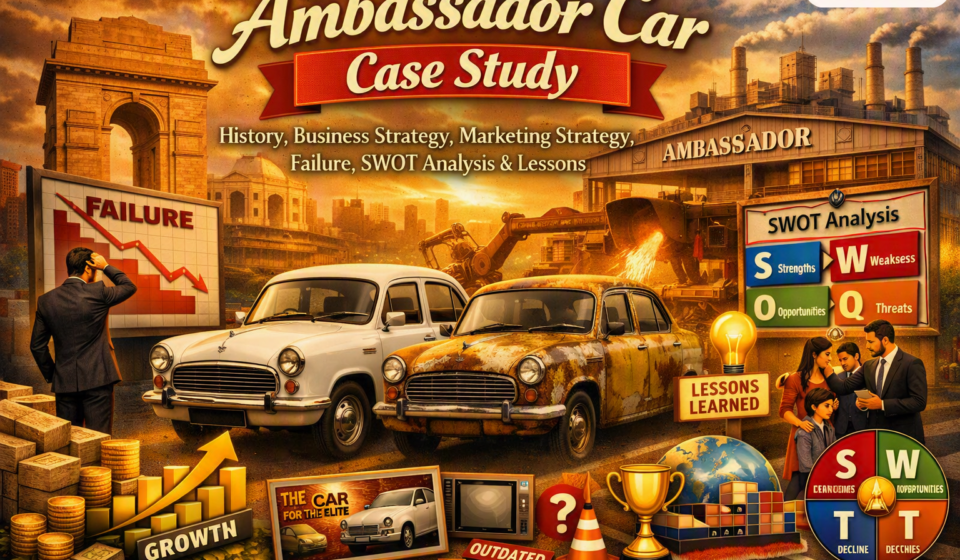
Ambassador Car Case Study: History, Business Strategy, Marketing Strategy, Failure, SWOT Analysis & Lessons – 2026

Explore a detailed Ambassador Car case study covering Hindustan Motors, Ambassador history, manufacturing, marketing strategy, iconic status, competitive advantages, reasons for decline, SWOT analysis, failure analysis and business lessons.
Introduction: Ambassador Car Case Study
The Ambassador Car case study is one of the most fascinating examples of the rise, dominance and eventual decline of an iconic Indian automobile.
For several decades, the Ambassador was much more than an automobile.
It became a symbol of:
- Indian roads
- Government transportation
- Political power
- Bureaucracy
- Diplomacy
- Family travel
- Business travel
- Status
- Reliability
- A particular era of Indian economic history
The Ambassador was manufactured by Hindustan Motors, an Indian automobile manufacturer associated with the Birla group. Its roots go back to the company’s establishment in 1942. The Ambassador was introduced in India in the 1950s and was based on the Morris Oxford design.
For years, the Ambassador enjoyed a powerful position in India’s relatively protected automobile market.
But the same market conditions that helped create its success eventually changed.
When competition increased, consumers gained more choices, technology improved and expectations changed, the Ambassador struggled to adapt.
This makes the Ambassador an excellent case study of:
- Product life cycle
- Competitive strategy
- Brand positioning
- Innovation
- Customer expectations
- Market disruption
- Manufacturing efficiency
- Strategic failure
- Business transformation
Ambassador Car Case Study at a Glance
| Category | Details |
|---|---|
| Vehicle | Hindustan Ambassador |
| Manufacturer | Hindustan Motors |
| Country | India |
| Production era | 1950s–2014 |
| Design origin | Morris Oxford |
| Main market | India |
| Famous segments | Government, taxi, private buyers |
| Major strengths | Spaciousness, durability, familiarity |
| Iconic image | Government and official vehicle |
| Major weakness | Aging design and technology |
| Key competitors | Maruti Suzuki, Premier, later Hyundai, Tata and others |
| Final production | 2014 |
What Was the Ambassador Car?
The Hindustan Ambassador was a large passenger car produced in India by Hindustan Motors.
Its design was based on the Morris Oxford Series III.
The vehicle became one of the longest-running automobile models in Indian automotive history.
For decades, the Ambassador remained visually recognizable.
Its design changed relatively little compared with the rapid evolution of competing vehicles.
This created both:
A strength
Customers recognized the vehicle immediately.
And:
A weakness
The car increasingly looked outdated as the automobile market modernized.
History of Hindustan Motors
To understand the Ambassador case study, we need to understand Hindustan Motors.
Hindustan Motors was established in 1942.
The company became one of India’s early automobile manufacturers.
During the early decades of India’s automobile industry, competition was limited.
This environment helped established manufacturers build strong positions.
Launch of the Ambassador
The Ambassador was introduced in India during the 1950s.
The vehicle’s British origins were adapted to the Indian market.
At the time, India’s automobile industry was very different from today’s market.
Consumers had relatively few choices.
Imports were restricted.
Domestic manufacturing was protected.
Automobile ownership was relatively limited.
This environment provided an opportunity for the Ambassador.
Why the Ambassador Became Successful
The initial success of the Ambassador can be explained by several factors.
1. Limited Competition
The Indian automobile market had relatively few choices.
2. Government Demand
Government departments became important users.
3. Spacious Interior
The Ambassador offered generous cabin space.
4. Strong Road Presence
Its large body gave it an authoritative appearance.
5. Durability
The car developed a reputation for being robust.
6. Familiarity
Generations of Indian drivers knew the vehicle.
7. Easy Repairability
Its relatively simple mechanical design supported widespread servicing.
Ambassador Car and Indian Government
One of the strongest associations with the Ambassador was the Indian government.
For many years, the Ambassador was widely used by:
- Government officials
- Ministers
- Bureaucrats
- Political leaders
- Public institutions
- Diplomats
The car therefore became associated with official authority.
Ambassador Car: Symbol of Power
The Ambassador developed a unique social identity.
A typical private car is mainly a transportation product.
The Ambassador became a symbol.
Seeing an Ambassador could suggest:
Government
Authority
Official status
Political power
This is a powerful example of how brand symbolism can influence consumer perception.
Ambassador Car as a Status Symbol
For decades, owning or travelling in an Ambassador could represent prestige.
The vehicle’s large dimensions and distinctive appearance contributed to its status.
The brand became embedded in Indian popular culture.
Ambassador Car and Indian Cinema
The Ambassador also appeared frequently in:
- Indian films
- Television
- News coverage
- Political reporting
- Government documentaries
- Historical footage
Its visual identity became instantly recognizable.
This created enormous cultural brand equity.
Ambassador Car Marketing Strategy
The Ambassador’s marketing strategy was very different from today’s automobile marketing.
The company did not have to compete with dozens of global brands.
Its market position was partly protected by the structure of the Indian economy.
Therefore, the company relied heavily on:
- Institutional customers
- Government buyers
- Taxi operators
- Traditional dealers
- Existing brand reputation
The Problem With a Protected Market
Protection can create stability.
But protection can also reduce pressure to innovate.
When competition is limited, a company may have less incentive to rapidly improve:
- Design
- Technology
- Safety
- Fuel efficiency
- Manufacturing
- Customer experience
This became an important issue in the Ambassador story.
Ambassador Car and the License Raj Era
India’s pre-liberalization economy had significant industrial controls.
Automobile production was heavily regulated.
Import restrictions limited foreign competition.
This environment created a relatively stable market for existing manufacturers.
The Ambassador benefited from this environment.
The Arrival of Maruti Suzuki
The automobile industry changed dramatically with the emergence of Maruti Udyog and the Maruti 800.
Maruti introduced a fundamentally different value proposition.
It emphasized:
- Compact size
- Modern engineering
- Fuel efficiency
- Affordability
- Reliability
- Modern styling
This created a major competitive challenge for older automobile manufacturers.
Ambassador vs Maruti 800
| Factor | Ambassador | Maruti 800 |
|---|---|---|
| Design | Traditional | Modern |
| Size | Large | Compact |
| Fuel economy | Less competitive | Strong |
| Urban usability | Limited | Strong |
| Technology | Older | More modern |
| Brand image | Official/traditional | Modern/family |
| Customer appeal | Established buyers | New-generation buyers |
The difference illustrates a fundamental market shift.
Change in Indian Consumer Preferences
Indian consumers increasingly wanted:
- Better mileage
- Modern styling
- Smaller cars
- Easier driving
- Better performance
- Better comfort
- Improved safety
- Lower maintenance costs
- More features
The Ambassador’s traditional strengths were no longer enough.
Ambassador’s Biggest Strategic Problem
The biggest problem was not that the Ambassador was a bad car.
Its problem was that the market changed faster than the product.
This is a crucial distinction.
A product can be successful for decades and still become obsolete.
Product Life Cycle of Ambassador
The Ambassador provides a classic example of the Product Life Cycle.
Stage 1: Introduction
The car entered a relatively undeveloped market.
Stage 2: Growth
Demand expanded as Indian automobile ownership increased.
Stage 3: Maturity
The Ambassador became a dominant and familiar vehicle.
Stage 4: Decline
Competition, technology and changing consumer expectations reduced demand.
This is one of the strongest reasons why the Ambassador is valuable as a business-school case study.
Ambassador Car Business Strategy
Historically, the business strategy relied on:
- Established demand
- Government customers
- Institutional buyers
- Brand familiarity
- Manufacturing continuity
- Taxi usage
- Limited competition
However, the strategy became less effective when the market opened.
Economic Liberalization and Automobile Competition
India’s economic reforms changed the automobile market.
International companies entered or expanded.
Consumers gained access to more brands.
Automobile technology improved rapidly.
Dealership experiences became more sophisticated.
Advertising became more competitive.
Suddenly, historical brand recognition was not enough.
New Competitors
The Ambassador increasingly faced competition from:
- Maruti Suzuki
- Hyundai
- Tata Motors
- Mahindra
- Honda
- Ford
- Toyota
- Other international manufacturers
These companies brought new:
- Designs
- Engines
- Features
- Technologies
- Marketing strategies
- Customer experiences
Ambassador Car Marketing Failure
The Ambassador’s marketing challenge was fundamentally a positioning problem.
Its strongest associations were:
- Government
- Officials
- Old India
- Traditional transportation
But the new generation wanted:
- Youthfulness
- Modernity
- Style
- Technology
- Efficiency
The brand struggled to bridge this gap.
The Importance of Brand Repositioning
A mature brand must sometimes change its identity.
For example:
Old Positioning
Government + Official + Traditional
could have been transformed into:
New Positioning
Classic + Premium + Heritage + Modern
The Ambassador never successfully completed such a transformation at scale.
Ambassador Car and Design
Design was one of the most visible issues.
The Ambassador maintained its distinctive shape for decades.
That created:
Positive
Instant recognition.
Negative
Perception of being old-fashioned.
In automotive markets, design changes rapidly.
Customers often interpret newer designs as:
- Safer
- Better
- More advanced
- More desirable
Even when the actual mechanical difference is smaller.
Ambassador Car and Technology
Automotive technology evolved dramatically.
Customers began expecting:
- Modern engines
- Better fuel injection
- Improved transmission
- Air conditioning
- Power steering
- Advanced safety
- Better suspension
- Electronics
- Infotainment
The Ambassador struggled to compete with newer products on these dimensions.
Fuel Efficiency Problem
Fuel economy became increasingly important.
Indian customers are highly sensitive to running costs.
Smaller modern cars often provided better fuel efficiency.
This created a major disadvantage for the Ambassador.
Maintenance and Ownership
The Ambassador had an advantage in simplicity.
Mechanics in many areas were familiar with the car.
However, consumers increasingly valued:
- Scheduled service
- Warranty
- Professional dealerships
- Modern service centres
- Predictable ownership costs
The industry was moving toward a more sophisticated ownership experience.
Ambassador Car and Taxi Market
The Ambassador remained important in the taxi market.
Its spacious cabin made it useful for:
- Commercial transportation
- Tourist services
- Long-distance travel
- Institutional transportation
But even taxi operators eventually gained access to more efficient alternatives.
Why Taxi Customers Switched
Taxi operators often prioritize:
- Fuel economy
- Maintenance cost
- Reliability
- Passenger comfort
- Vehicle price
- Resale value
Newer cars became more attractive on several of these factors.
Ambassador Car Production
The Ambassador was produced for more than half a century.
That longevity itself is remarkable.
Few automobile models maintain such a long production history.
However, long production life does not necessarily mean commercial success.
The Ambassador’s Declining Sales
As modern competitors expanded, Ambassador sales declined significantly.
The company faced:
- Lower demand
- Increasing competition
- Higher production costs
- Outdated product perception
- Changing customer preferences
Production eventually became economically difficult to sustain.
Ambassador Production Ends
Hindustan Motors suspended production of the Ambassador in 2014.
This marked the end of one of the most recognizable chapters in Indian automobile history.
Why Did Ambassador Car Fail?
The phrase “Ambassador car failure” should be understood carefully.
The Ambassador did not fail immediately.
It was successful for decades.
Its eventual decline resulted from a combination of strategic problems.
1. Lack of Product Innovation
The automobile industry was changing rapidly.
The Ambassador’s product evolution was comparatively slow.
2. Outdated Design
Customers increasingly wanted modern styling.
The Ambassador retained a traditional appearance.
3. Fuel Efficiency
Smaller cars became more efficient.
The Ambassador struggled to match their economics.
4. Increased Competition
International and domestic competitors entered the market.
5. Changing Consumer Expectations
Consumers wanted features that the Ambassador did not provide competitively.
6. Weak Repositioning
The brand remained strongly connected with its traditional image.
7. Manufacturing Efficiency
Older manufacturing systems can struggle to compete with modern high-volume factories.
8. Changing Government Fleet Preferences
Government fleets gradually adopted newer and more modern vehicles.
This reduced one of Ambassador’s historical customer bases.
Ambassador Car SWOT Analysis
Strengths
Iconic Brand
The Ambassador has enormous historical recognition.
Spacious Interior
Its large cabin was a major advantage.
Strong Cultural Identity
The car became part of Indian history.
Durability
The vehicle earned a reputation for robustness.
Easy Mechanical Understanding
Many mechanics were familiar with its architecture.
Weaknesses
Outdated Design
The design increasingly appeared old-fashioned.
Fuel Consumption
It struggled against more efficient modern cars.
Old Technology
Modern competitors offered more advanced features.
Heavy Construction
The large body was not ideal for modern urban mobility.
Weak Modern Positioning
The brand struggled to appeal to younger consumers.
Opportunities
If properly repositioned, the Ambassador could have explored:
- Heritage cars
- Premium classic cars
- Luxury chauffeur services
- Tourism
- Vintage-inspired modern vehicles
- Collector market
- Government heritage fleets
- Limited-edition products
Threats
Modern Competitors
New cars offered superior technology.
Consumer Preferences
Customers increasingly preferred compact and feature-rich cars.
Regulation
Emission and safety standards became stricter.
Fuel Costs
Higher fuel prices made inefficient vehicles less attractive.
Ambassador Car Porter’s Five Forces
Competitive Rivalry – High
The industry became increasingly competitive after liberalization.
Threat of New Entrants – Moderate
Automobile manufacturing requires significant capital.
Supplier Power – Moderate
Component specialization can increase supplier influence.
Buyer Power – High
Customers gained many alternatives.
Substitutes – Moderate
Public transport, motorcycles, taxis and newer mobility services provide alternatives.
Ambassador Car Competitive Advantage
Historically, the Ambassador’s competitive advantage came from:
- Limited competition
- Government relationships
- Brand familiarity
- Spaciousness
- Durability
- Institutional demand
But these advantages weakened over time.
The Ambassador Brand Paradox
The Ambassador’s greatest strength eventually became part of its weakness.
Strong historical identity
became
Old-fashioned identity.
Government association
became
Lack of modern consumer appeal.
Familiar design
became
Outdated design.
This is an important branding lesson.
Ambassador Car Case Study: Innovation vs Tradition
One of the most important lessons is the balance between:
Tradition
and
Innovation
A brand must preserve what customers love while updating what customers expect.
The Ambassador preserved tradition but did not modernize enough.
Could Ambassador Have Survived?
This is an interesting strategic question.
Possibly, but survival would have required major transformation.
A successful strategy could have included:
Modern Platform
Develop an entirely new chassis.
Modern Engine
Introduce efficient petrol, diesel, hybrid or electric powertrains.
Modern Safety
Add airbags, ABS, electronic stability systems and modern crash protection.
Modern Design
Retain Ambassador styling cues while creating a contemporary vehicle.
Premium Positioning
Move away from low-cost mass-market competition.
Heritage Marketing
Sell the car as an Indian automotive icon.
A Hypothetical Modern Ambassador Strategy
Imagine a new Ambassador.
It could be marketed as:
“India’s Icon, Reimagined.”
The product could combine:
- Retro-inspired design
- Modern electric powertrain
- Premium interior
- Advanced safety
- Connected technology
- Comfortable rear seats
- Chauffeur-focused features
This could create a unique market position.
Ambassador Car as a Heritage Brand
Instead of competing directly with Maruti or Hyundai, Ambassador could have pursued a different segment.
For example:
Mercedes
→ German luxury heritage
Mini
→ British heritage
Jeep
→ American heritage
Ambassador
→ Indian heritage
This could have created a distinctive brand story.
Ambassador Car Marketing Lessons
Lesson 1: Never Depend Only on Historical Success
Past dominance does not guarantee future demand.
Lesson 2: Keep Innovating
Technology changes customer expectations.
Lesson 3: Monitor Competitors
A competitor can redefine an entire category.
Lesson 4: Understand New Customers
Younger customers may not value the same things as older customers.
Lesson 5: Reposition Before Decline
Brand repositioning is easier before sales collapse.
Ambassador Car and Customer Segmentation
Historically, Ambassador served:
- Government
- Private families
- Taxi operators
- Business owners
- Institutional customers
But later, newer competitors segmented the market more effectively.
They created products for:
- First-time buyers
- Young professionals
- Families
- Premium customers
- SUV buyers
- Urban consumers
Ambassador vs Modern Automobile Marketing
| Ambassador Era | Modern Automobile Era |
|---|---|
| Limited competition | Intense competition |
| Few models | Many models |
| Traditional advertising | Digital + traditional |
| Dealer-focused | Omnichannel |
| Government demand | Consumer-led |
| Basic features | Technology-rich |
| Slow product cycles | Frequent updates |
| Limited choices | Highly competitive |
Ambassador Car and Digital Marketing
If Ambassador had been active in today’s digital environment, a strong strategy could have included:
- YouTube
- Google Search
- SEO
- Automotive influencers
- Heritage storytelling
- Short-form videos
- Online configurators
- Digital test-drive bookings
The brand has an enormous storytelling advantage because of its history.
Ambassador Car SEO Strategy
Potential search keywords include:
- Ambassador car
- Ambassador car history
- Ambassador car India
- Hindustan Ambassador
- Ambassador car price
- Ambassador car history in India
- why Ambassador car failed
- Ambassador car discontinued
- Hindustan Motors Ambassador
- Ambassador car case study
- Ambassador car failure case study
- Ambassador car success story
- Ambassador car SWOT analysis
- classic Indian cars
- iconic Indian cars
Ambassador Car as a Business School Case
The Ambassador is useful for teaching:
Marketing
Brand positioning.
Strategy
Competitive response.
Operations
Manufacturing efficiency.
Economics
Protected vs competitive markets.
Entrepreneurship
Innovation and adaptation.
Leadership
Strategic decision-making.
Product Management
Product life-cycle management.
Ambassador Car Case Study for MBA Students
MBA students can analyze the Ambassador through:
- SWOT analysis
- PESTLE analysis
- Porter’s Five Forces
- BCG Matrix
- Product Life Cycle
- STP
- 4Ps
- Competitive Strategy
- Blue Ocean Strategy
- Business Model Canvas
PESTLE Analysis of Ambassador
Political
Government policies strongly influenced India’s automobile sector.
Economic
Liberalization increased competition.
Social
Indian families increasingly desired modern cars.
Technological
Automotive technology improved rapidly.
Legal
Safety and emission standards became more demanding.
Environmental
Fuel efficiency and emissions became increasingly important.
Ambassador Car and Product Life Cycle
The Ambassador is almost a textbook example of a long product life cycle.
Introduction
Limited market.
Growth
Increasing automobile ownership.
Maturity
Dominant market position.
Decline
New competitors and changing customer expectations.
The Importance of Timing
A company can have a good product and still fail if it responds too slowly.
The Ambassador’s case shows that:
Market timing + innovation + customer expectations
are interconnected.
What Happened to Hindustan Motors?
The decline of Ambassador was part of a broader challenge for Hindustan Motors.
The company struggled to remain competitive as India’s automobile market became more modern and international.
The Ambassador’s declining demand significantly affected its historical business model.
Ambassador Car Case Study: Strategic Mistakes
Several strategic mistakes can be identified.
Mistake 1
Insufficient modernization.
Mistake 2
Overdependence on established customers.
Mistake 3
Slow response to new competitors.
Mistake 4
Failure to fully reposition the brand.
Mistake 5
Limited product diversification compared with competitors.
Was Ambassador a Bad Product?
No.
This is an important distinction.
The Ambassador was a successful product in the environment for which it was designed.
The problem was its declining fit with a changing environment.
Therefore:
Product-market fit is not permanent.
Businesses must continuously renew it.
Ambassador Case Study and Disruption
The Ambassador’s decline illustrates how disruption can happen.
It did not necessarily come from one revolutionary technology.
Instead, disruption occurred through:
- Better fuel efficiency
- Better design
- Better manufacturing
- Better distribution
- Better customer experience
- More choices
Collectively, these changes transformed the market.
Ambassador Case Study: Lessons for Startups
Startups should learn:
Don’t become comfortable.
Success can create complacency.
Watch customer behaviour.
Customer expectations change.
Invest in technology.
Technology can redefine industries.
Build a flexible organization.
Rigid businesses struggle during transitions.
Protect the brand.
But don’t let heritage prevent innovation.
Lessons for Existing Businesses
If a company has been successful for 20 years, it should ask:
- Are customers changing?
- Are competitors improving?
- Is our technology outdated?
- Is our pricing still competitive?
- Is our brand relevant?
- Are younger customers interested?
- Are new substitutes emerging?
These questions could help prevent an Ambassador-style decline.
Ambassador Car Case Study: The Biggest Lesson
The biggest lesson is simple:
Never confuse brand loyalty with permanent demand.
Customers may love a product today.
But tomorrow they may want something different.
Companies must continuously innovate while protecting their core strengths.
Ambassador Car Success Story
Before discussing its decline, it is important to recognize the Ambassador’s enormous success.
For decades, it:
- Sold across India
- Served government institutions
- Became a taxi
- Appeared in movies
- Became part of Indian culture
- Became a recognizable national symbol
Few automobiles achieved this cultural status.
Ambassador Car Cultural Legacy
Even after production ended, the Ambassador remains recognizable.
Collectors, automobile enthusiasts and vintage-car fans continue to appreciate the vehicle.
Its legacy is preserved through:
- Classic-car collections
- Museums
- Vintage rallies
- Films
- Photographs
- Historical archives
- Automobile enthusiasts
Ambassador Car: From Mass Market to Heritage
The vehicle’s commercial life ended, but its cultural value remained.
This demonstrates an interesting business principle:
Commercial value and cultural value are not always the same.
A product can stop being commercially competitive while becoming historically important.
Final Conclusion
The Ambassador Car case study is not simply the story of a discontinued automobile.
It is a story about how markets evolve.
The Ambassador succeeded because it perfectly matched its original environment.
It offered:
- Space
- Durability
- Familiarity
- Practicality
- Strong institutional demand
For decades, those qualities were enough.
But India’s automobile market eventually changed.
Customers wanted:
- Better fuel efficiency
- Modern styling
- Advanced technology
- Greater safety
- Better performance
- More features
- Better customer experience
Competitors such as Maruti Suzuki and later Hyundai, Tata Motors, Mahindra and other manufacturers responded aggressively to these changes.
The Ambassador struggled to evolve at the same speed.
Production ended in 2014, bringing the commercial chapter of one of India’s most iconic cars to a close.
However, the Ambassador remains an extraordinary business case because its history demonstrates both sides of business strategy:
How to build a powerful brand
and
How a powerful brand can decline if it stops adapting.
For entrepreneurs, marketers, MBA students and business owners, the central lesson is:
Build for today’s customer, but continuously prepare for tomorrow’s customer.
50 Frequently Asked Questions About Ambassador Car
1. What is the Ambassador Car case study?
It is a business and automobile case study analyzing the rise, success, decline and discontinuation of the Hindustan Ambassador.
2. Who manufactured the Ambassador car?
The Ambassador was manufactured by Hindustan Motors.
3. When was Ambassador car launched in India?
The Ambassador was introduced in India during the 1950s.
4. Which company made Ambassador car?
Hindustan Motors manufactured the Ambassador.
5. What was the Ambassador car based on?
The Ambassador was based on the Morris Oxford Series III.
6. Why was Ambassador car famous?
It was famous for its spacious cabin, durability, distinctive design and strong association with Indian government transportation.
7. Why did Ambassador become popular?
Limited competition, government demand, brand familiarity, spaciousness and durability contributed to its popularity.
8. Why did Ambassador car fail?
Its decline was associated with outdated design, slower technological evolution, increasing competition, fuel-efficiency concerns and changing customer preferences.
9. When was Ambassador car discontinued?
Production was suspended in 2014.
10. Who were Ambassador’s competitors?
Competition included Maruti Suzuki, Premier, Tata Motors, Mahindra and later several international manufacturers.
11. What was Ambassador’s biggest strength?
Brand recognition and its reputation for spaciousness and durability were major strengths.
12. What was Ambassador’s biggest weakness?
Its aging design and technology became increasingly difficult to compete with modern cars.
13. Was Ambassador a luxury car?
It was often associated with official and premium transportation, but its positioning varied over time.
14. Why did government officials use Ambassador?
Its spaciousness, durability, availability and institutional familiarity made it suitable for official use.
15. Was Ambassador fuel efficient?
Compared with newer compact cars, its fuel economy became a disadvantage.
16. What is the Ambassador SWOT analysis?
It examines strengths, weaknesses, opportunities and threats associated with the vehicle and brand.
17. What is the main lesson from Ambassador?
Businesses must continuously innovate as markets and customer expectations change.
18. Could Ambassador have survived?
Potentially, through major modernization, repositioning and investment in new technology.
19. Could Ambassador become an EV?
A modernized Ambassador concept could potentially use electric technology, but that would require a completely new product and business strategy.
20. Why is Ambassador important in Indian history?
It became a symbol of government, politics, Indian roads and a particular period of India’s economic development.
21. What is Hindustan Motors?
Hindustan Motors was one of India’s early automobile manufacturers and produced the Ambassador.
22. What caused Ambassador’s decline?
Increased competition, changing customer preferences, outdated technology and insufficient product modernization were major factors.
23. What can marketers learn from Ambassador?
Brand heritage must be balanced with modern positioning.
24. What can entrepreneurs learn from Ambassador?
Past success cannot replace continuous innovation.
25. What is Ambassador’s product life cycle?
It progressed through introduction, growth, maturity and eventual decline.
26. Why did Maruti Suzuki hurt Ambassador?
Maruti offered modern, compact and fuel-efficient vehicles that matched emerging consumer preferences.
27. Was Ambassador popular in rural India?
It had a broad presence, including institutional and commercial use, although market conditions varied by region.
28. Was Ambassador used as a taxi?
Yes, the Ambassador was widely used in taxi and commercial transportation applications.
29. Why was Ambassador spacious?
Its large traditional sedan body provided significant interior space.
30. What was Ambassador’s brand image?
It was strongly associated with government, authority, tradition and reliability.
31. Why didn’t Ambassador become modern?
The company faced significant strategic, technological and competitive challenges in modernizing the product.
32. What is the Ambassador marketing strategy?
Its historical strategy relied heavily on brand familiarity, institutional customers and established market demand.
33. What is Ambassador’s competitive advantage?
Historically, its advantages included brand recognition, government demand, durability and service familiarity.
34. What was Ambassador’s main target market?
Government institutions, families, taxi operators and other institutional or commercial customers were important segments.
35. What is the Ambassador business model?
The model centered on automobile manufacturing and sales through established channels, with significant institutional and commercial demand.
36. What is the Ambassador failure case study?
It analyzes how a historically successful product lost competitiveness after India’s automobile market opened and consumer expectations changed.
37. What is the biggest mistake made by Ambassador?
A major strategic weakness was the slow adaptation of the product and brand to a rapidly changing market.
38. Why is Ambassador studied in MBA courses?
It provides lessons in product life cycle, competition, innovation, positioning and strategic failure.
39. What is the future of the Ambassador brand?
The brand could potentially have heritage or collector value, although any commercial revival would require a completely new strategy.
40. Is Ambassador still manufactured?
No. Production was suspended in 2014.
41. Is Ambassador a classic car?
Yes, it is widely regarded as an iconic classic Indian automobile.
42. Why do people still remember Ambassador?
Its distinctive design and historical role in Indian society created strong cultural memory.
43. What happened to Hindustan Motors?
The company faced significant challenges as India’s automobile industry became more competitive and modern.
44. What is the Ambassador case study’s main marketing lesson?
A strong historical brand still needs relevant positioning.
45. What is the Ambassador case study’s main innovation lesson?
Innovation must continue even when a product is already successful.
46. What is the Ambassador case study’s main strategy lesson?
Companies must respond quickly to changes in competition and consumer behaviour.
47. Can heritage brands become successful again?
Yes, but heritage must be combined with modern products, technology and customer expectations.
48. What made Ambassador iconic?
Its long production history, distinctive styling and association with government and Indian culture made it iconic.
49. What is the biggest reason Ambassador declined?
The combination of increasing competition and insufficient adaptation to changing consumer needs was critical.
50. What is the final lesson from Ambassador?
Never stop adapting.
SEO Tags
Ambassador car case study, Ambassador car history, Hindustan Ambassador case study, Ambassador car success story, Ambassador car failure case study, Ambassador car business strategy, Ambassador car marketing strategy, Hindustan Motors case study, Ambassador car SWOT analysis, Ambassador car decline, why Ambassador car failed, Ambassador car discontinued, Indian automobile history, classic Indian car case study, Ambassador automobile case study, Hindustan Motors Ambassador, Ambassador car in India, Ambassador car market strategy, Ambassador car brand history, Ambassador car business failure, Ambassador car lessons, automobile industry case study India, Ambassador car marketing case study, Ambassador car product life cycle, Ambassador vs Maruti 800, Ambassador car failure analysis, Ambassador car competitive strategy, Ambassador car brand positioning, Ambassador car business model, Hindustan Motors history, Indian automobile case study, automobile marketing case study, Indian business failure case study, product failure case study, business strategy case study India, MBA automobile case study, BBA automobile case study.
