





Shyam Steel Case Study: Business Strategy, Growth, Manufacturing, SWOT Analysis and Competitive Advantage – 2026

Introduction
Shyam Steel Case Study: The Indian steel industry is one of the foundations of the country’s economic and infrastructure development. Steel is essential for residential construction, bridges, highways, railways, airports, ports, power plants, industrial buildings, manufacturing facilities and numerous other infrastructure projects. Within this highly competitive and capital-intensive industry, Shyam Steel provides an interesting case study of how a family-founded Indian manufacturing business can develop into a large, integrated and multi-product steel organization.
This Shyam Steel case study examines the company’s history, business model, manufacturing strategy, product portfolio, technology, distribution network, competitive advantages, sustainability initiatives, corporate social responsibility, SWOT analysis and future opportunities.
Established in 1953, Shyam Steel traces its origins to a small factory in Howrah founded by Shri Shriram Beriwal. The company says that it subsequently expanded its manufacturing capabilities and today operates as a multi-product steel group with manufacturing operations in West Bengal and a broader sales and distribution presence.
Shyam Steel’s development is particularly relevant for students of business management, strategic management, operations management, marketing, supply chain management, entrepreneurship and industrial economics.
The company also offers an excellent example of vertical integration in the steel industry, because its manufacturing ecosystem has included processes such as direct reduced iron production, electric arc furnace steelmaking, continuous billet casting and high-speed rolling.
1. Company Overview
Shyam Steel Industries Limited is an Indian steel manufacturer associated particularly with TMT reinforcement bars and other steel products.
According to the company’s official website, Shyam Steel was established in 1953 and manufactures products including:
- TMT rebars
- Billets
- Sponge iron
- Ferro alloys
- Structural steel
- Wires
- Nails
- Related construction products
The company states that it operates four fully operational steel manufacturing units in West Bengal and has an integrated steel plant in Durgapur.
The company’s operations are supported by a broader marketing and distribution network designed to serve both institutional and retail customers.
This combination of manufacturing + branding + distribution + institutional sales is central to understanding the Shyam Steel business model.
2. History of Shyam Steel
The history of Shyam Steel begins in 1953.
The company states that Shri Shriram Beriwal established a small factory in Howrah during that year. He was later joined by his younger brother, Shyam Sunder Beriwala. Over subsequent decades, the business developed manufacturing capabilities and expanded its product portfolio.
The company’s historical development can broadly be divided into several stages:
Stage 1: Entrepreneurial foundation
The business began as a relatively small manufacturing enterprise.
Stage 2: Manufacturing expansion
The company gradually increased its production capabilities.
Stage 3: Backward integration
The business expanded into processes and inputs connected with steel production.
Stage 4: Forward integration
The company developed downstream products such as TMT rebars and other finished steel products.
Stage 5: Technology adoption
Modern steelmaking and rolling technologies became increasingly important.
Stage 6: Brand development
Shyam Steel increasingly positioned itself as a branded TMT steel producer rather than simply an anonymous commodity supplier.
Stage 7: Geographical expansion
The company developed sales and distribution capabilities beyond its original market.
This evolution demonstrates how a manufacturing company can move from small-scale production toward integrated industrial operations.
3. The Shyam Steel Business Model
The Shyam Steel business model is based on creating value through an integrated manufacturing system and selling steel products to both institutional and retail markets.
A simplified representation is:
Raw Materials → Iron Making → Steel Making → Billet Casting → Rolling → TMT/Finished Products → Distribution → Customers
This model allows the company to participate in multiple stages of the value chain.
According to Shyam Steel, its Durgapur integrated plant includes:
- DRI unit
- Electric Arc Furnace
- Continuous billet casting
- High-speed rolling mill
- Thermex system
- Quality testing facilities
- Microprocessor-based product technologies
The importance of this model is that steel production is not simply about converting iron ore into finished bars.
It requires the coordination of:
- Raw materials
- Energy
- Furnaces
- Metallurgy
- Casting
- Rolling
- Quality control
- Logistics
- Distribution
- Customer relationships
Shyam Steel’s integrated approach attempts to coordinate these activities within a broader manufacturing ecosystem.
4. Why Shyam Steel Is an Important Case Study
The Shyam Steel case study is valuable because it demonstrates how a company can compete in a difficult industrial sector without relying solely on production volume.
The Indian steel industry is characterized by:
- High capital requirements
- Strong competition
- Commodity-price volatility
- Energy-intensive manufacturing
- Raw-material challenges
- Large infrastructure requirements
- Environmental regulations
- Quality standards
- Complex logistics
A steel manufacturer therefore needs to build several capabilities simultaneously.
Shyam Steel’s strategy can be analyzed through the following dimensions:
- Manufacturing integration
- Technology
- Product quality
- Brand building
- Distribution
- Institutional relationships
- Operational efficiency
- Sustainability
- Customer service
- Product diversification
5. Manufacturing Strategy of Shyam Steel
Manufacturing is at the heart of the Shyam Steel company strategy.
The company states that its West Bengal manufacturing network includes four operational steel units, with the Durgapur facility operating as an integrated steel plant.
The manufacturing system involves several important stages.
Step 1: Iron making
Iron-bearing raw materials are processed to produce iron units.
Step 2: Steel melting
The iron material is converted into molten steel.
Step 3: Continuous casting
Molten steel is converted into billets.
Step 4: Rolling
Billets are reheated and rolled into finished products.
Step 5: Thermomechanical treatment
The TMT process gives reinforcement bars a combination of strength and ductility.
Step 6: Quality testing
Finished products undergo testing to ensure that required specifications are met.
This integrated manufacturing structure provides a foundation for product consistency and process control.
6. Durgapur Integrated Steel Plant
The Shyam Steel Durgapur plant is one of the most important components of the company’s manufacturing strategy.
Durgapur is a major industrial center in West Bengal and has a long association with India’s steel and heavy-industry ecosystem.
Shyam Steel describes its Durgapur facility as an automated integrated steel plant containing a DRI unit, steel melting shop equipped with an Electric Arc Furnace, continuous billet casting and a rolling mill using Thermex technology. The company says the facility was established in collaboration with Concast AG-Zurich and HSE Germany.
From a strategic perspective, Durgapur offers several advantages.
Industrial ecosystem
The region has a developed industrial infrastructure.
Skilled workforce
The area’s industrial history supports access to technical skills.
Logistics
Connectivity to eastern Indian markets can support movement of raw materials and finished products.
Customer proximity
Eastern India represents an important construction and infrastructure market.
Manufacturing integration
The plant can connect multiple production stages within a single industrial complex.
7. Direct Reduced Iron and Sponge Iron
Direct Reduced Iron, commonly called DRI, is an important component of the steelmaking process used in integrated operations.
In the DRI process, iron ore is reduced without being melted in a blast furnace. Shyam Steel explains that its DRI process uses iron ore lumps or pellets and a carbonaceous reductant such as coal to produce sponge iron.
The resulting sponge iron can then be used as a metallic input for steelmaking.
This creates an important connection:
Iron Ore → DRI/Sponge Iron → Electric Arc Furnace → Molten Steel → Billets → TMT Bars
The integration of these processes can help improve control over production and raw-material utilization.
8. Electric Arc Furnace Technology
One of the important technological features of the Shyam Steel manufacturing model is its use of an Electric Arc Furnace (EAF).
An EAF melts metallic material through electrical energy.
The company has historically highlighted its investment in advanced EAF technology and describes itself as an early investor in advanced international EAF technology.
The strategic importance of EAF technology includes:
- Flexible steelmaking
- High-temperature melting
- Process control
- Compatibility with different metallic inputs
- Potential integration with scrap-based steelmaking
- Opportunities for energy optimization
For a modern steel company, furnace technology can significantly influence production efficiency and product quality.
9. Continuous Billet Casting
After steel is produced in the electric arc furnace, the molten steel must be converted into a usable semi-finished form.
Continuous casting allows molten steel to be solidified into billets in a continuous process.
Billets are important because they become the starting material for rolling operations.
The basic sequence is:
Molten Steel → Continuous Casting → Billets → Reheating → Rolling → TMT Rebars
This process can reduce handling requirements and support continuous manufacturing.
Shyam Steel’s Durgapur plant incorporates a continuous billet casting mill as part of its integrated production system.
10. Rolling Mill and TMT Manufacturing
The rolling mill is where billets are converted into finished steel products.
For TMT reinforcement bars, the rolling process is followed by controlled cooling and thermomechanical treatment.
The company’s Durgapur plant uses a high-speed rolling mill and Thermex technology.
The objective is to produce steel bars with a useful combination of:
- High strength
- Ductility
- Weldability
- Durability
- Dimensional consistency
These characteristics are particularly important in construction.
11. What Are TMT Bars?
TMT bars, or Thermo-Mechanically Treated reinforcement bars, are steel reinforcement products used extensively in concrete structures.
Concrete has strong compressive strength but comparatively low tensile strength.
Steel reinforcement helps compensate for this limitation.
Therefore:
Concrete + Steel Reinforcement = Reinforced Concrete Structure
TMT bars are widely used in:
- Houses
- Apartment buildings
- Bridges
- Highways
- Industrial buildings
- Dams
- Metro systems
- Airports
- Power projects
- Commercial structures
This explains why the TMT bar business is closely linked to India’s infrastructure and construction sector.
12. Shyam Steel TMT Bars
The Shyam Steel TMT bar is the company’s flagship product category.
The company states that its TMT rebars are designed to provide consistent quality, uniform grades, dimensions and tolerances, along with strength, durability and workability.
The company also markets different grades of reinforcement steel.
Its published materials reference grades including:
- Fe415
- Fe415D
- Fe500
- Fe500D
- Fe550
- Fe550D
- Fe600
The specific grade selected for a project depends on structural design requirements and applicable standards.
13. Product Quality as a Competitive Advantage
Quality is one of the most important parts of the Shyam Steel competitive strategy.
Steel used in construction is a safety-critical product.
A problem with reinforcement steel can potentially affect the integrity and durability of a structure.
Therefore customers evaluate TMT bars on factors such as:
- Chemical composition
- Tensile strength
- Yield strength
- Elongation
- Bendability
- Dimensional accuracy
- Surface quality
- Weight consistency
- Corrosion resistance
- Certification
Shyam Steel states that its integrated manufacturing facilities include dedicated quality-assurance and testing laboratories.
The company also highlights ISO certifications and other quality credentials in its corporate materials.
14. Brand Building in the Steel Industry
One of the most interesting aspects of the Shyam Steel marketing strategy is its development as a branded steel company.
Steel can be treated as a commodity, where buyers focus primarily on price.
But branded TMT manufacturers attempt to differentiate themselves through:
- Quality
- Reliability
- Certification
- Product consistency
- Availability
- Dealer relationships
- Technical support
- Customer trust
This is particularly important in the retail construction market.
A homeowner constructing a house may not understand the technical differences between all steel grades.
Therefore, brand reputation can influence purchase decisions.
15. Retail and Dealer Network
Distribution is another important component of the Shyam Steel business strategy.
The company states that it has branches, stockyards and a dealer network serving institutional and retail customers, with particularly strong footprints in eastern and northern India.
A dealer network provides several advantages.
Product availability
Customers can obtain steel closer to their construction sites.
Market penetration
Dealers allow a manufacturer to reach smaller towns and villages.
Customer relationships
Local dealers can develop relationships with contractors and builders.
Inventory management
Regional stockyards can help reduce delivery times.
Brand visibility
Physical distribution improves the visibility of the product.
For a TMT manufacturer, this network can be a significant competitive asset.
16. Institutional Sales Strategy
Shyam Steel also operates in the institutional market.
Institutional customers can include:
- Government projects
- Infrastructure companies
- Contractors
- Developers
- Industrial companies
- Power projects
- Transportation projects
The company’s project credentials page lists associations with sectors and projects including highways, metro railways, airports, power plants, ports, refineries and government projects.
Institutional customers typically require:
- Consistent quality
- Large quantities
- Reliable delivery
- Technical documentation
- Certification
- Competitive pricing
- Strong supply-chain capabilities
Therefore, institutional sales require a different approach from retail sales.
17. Project-Based Competitive Advantage
The company’s published credentials identify projects such as:
- Nivedita Setu
- Kolkata Metro Railway
- Haldia Petrochemicals
- Sagardighi Thermal Power Station
- Paradip Refinery
- Other infrastructure projects
These examples are presented by Shyam Steel as evidence of its participation in large infrastructure projects.
Such project associations can strengthen brand credibility.
A potential customer may ask:
“Where has this steel been used before?”
A manufacturer with a strong institutional project history can use those references to demonstrate experience and reliability.
18. Customer Segmentation
The Shyam Steel target market can broadly be divided into two major segments.
Retail customers
These include:
- Individual homeowners
- Small builders
- Local contractors
- Small construction companies
Retail customers tend to value:
- Brand trust
- Price
- Availability
- Quality
- Dealer recommendations
Institutional customers
These include:
- Infrastructure companies
- Government agencies
- Large contractors
- Industrial companies
- Developers
Institutional customers tend to place greater emphasis on:
- Technical specifications
- Large-volume supply
- Certification
- Delivery schedules
- Quality consistency
- Commercial terms
Serving both segments diversifies the company’s customer base.
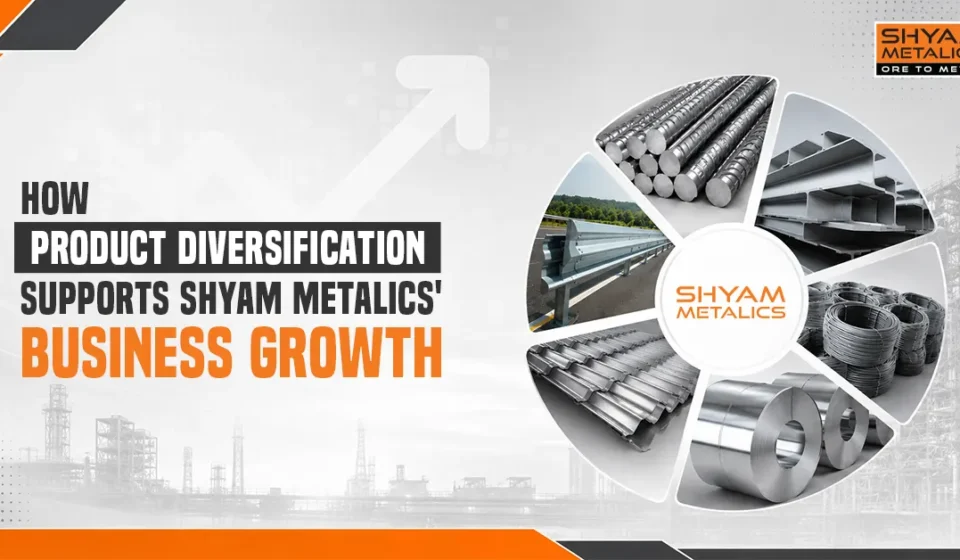
19. Product Diversification
Although TMT rebars are central to the Shyam Steel brand, the company has a broader product portfolio.
Its website lists products and categories including:
- TMT rebars
- Structural steel
- Billets
- Ferro alloys
- Sponge iron
- Wires
- Nails
- Gates and grills
- Waterproofing solutions
This diversification creates opportunities to participate in different parts of the construction value chain.
For example:
TMT Bars → Structural Steel → Wires → Nails → Construction Solutions
The broader product strategy can increase customer touchpoints.
20. Vertical Integration at Shyam Steel
The vertical integration strategy of Shyam Steel is a major theme in this case study.
Vertical integration means that a company controls multiple stages of its value chain.
In Shyam Steel’s case, the manufacturing chain can be represented as:
Raw Materials
↓
DRI / Sponge Iron
↓
Electric Arc Furnace
↓
Continuous Casting
↓
Billets
↓
Rolling Mill
↓
TMT Rebars
↓
Distribution
↓
Customers
The company’s environmental-compliance documentation also describes a history of forward and backward integration and reports an installed iron-making capacity on a consolidated basis.
Vertical integration can provide several strategic benefits.
21. Benefits of Vertical Integration
Better production control
The company can coordinate production across different stages.
Potential cost advantages
Internal production can reduce dependence on certain external suppliers.
Quality consistency
Controlling more production stages can make quality management easier.
Supply reliability
Internal manufacturing capabilities can help reduce supply disruptions.
Faster production planning
Different production units can be coordinated more effectively.
Better capacity utilization
Management can optimize the flow of material between production stages.
However, vertical integration also has disadvantages.
It requires:
- Higher capital expenditure
- More complex management
- Greater maintenance requirements
- Larger operational risks
Therefore, integration must be accompanied by strong operational management.
22. Technology Strategy
Technology is another important component of the Shyam Steel growth strategy.
The company has emphasized modern steelmaking and rolling technology as part of its manufacturing model.
Its Durgapur plant incorporates:
- Electric Arc Furnace
- Continuous casting
- High-speed rolling
- Thermex technology
- Microprocessor-based process technology
- Quality-testing laboratories
Technology can help a steel producer improve:
- Production speed
- Product consistency
- Energy utilization
- Quality
- Process control
- Safety
- Resource efficiency
23. Research and Development
Research and development can be particularly important in steel because customers increasingly demand specialized performance.
R&D can address:
- Higher-strength grades
- Better ductility
- Corrosion resistance
- Weldability
- Dimensional accuracy
- Lower weight
- Better production efficiency
Shyam Steel identifies continuous R&D and technology adaptation among the factors behind its development.
For a steel company, R&D is therefore not necessarily limited to laboratories.
It can also involve continuous improvement on the production floor.
24. Operational Efficiency
The steel industry has high fixed costs.
This makes operational efficiency in steel manufacturing extremely important.
A plant must optimize:
- Furnace productivity
- Energy consumption
- Raw-material utilization
- Yield
- Equipment availability
- Maintenance
- Production scheduling
- Workforce productivity
Suppose a plant produces 1 million tonnes of steel.
If the company reduces its average cost by only ₹500 per tonne, the potential annual impact is:
1,000,000 × ₹500 = ₹500 million
This illustrates why small efficiency improvements can become economically significant at industrial scale.
25. Supply Chain Management
The Shyam Steel supply chain begins with raw materials and ends with construction customers.
A simplified supply chain looks like:
Raw Materials → Manufacturing Plants → Warehouses → Dealers → Retailers/Institutional Customers → Construction Projects
Supply-chain performance influences:
- Product availability
- Delivery time
- Transportation cost
- Inventory
- Working capital
- Customer satisfaction
The company’s pan-India marketing and logistics network is therefore an important component of its business model.
26. Logistics Strategy
Steel is heavy and expensive to transport.
Therefore, logistics can have a substantial effect on the final selling price.
A manufacturer must consider:
- Distance to raw materials
- Distance to customers
- Road connectivity
- Rail availability
- Warehousing
- Stockyards
- Truck availability
- Loading and unloading
- Delivery scheduling
This makes manufacturing location and distribution strategy closely connected.
Shyam Steel’s concentration of manufacturing facilities in West Bengal, combined with broader distribution, allows the company to serve eastern Indian markets from a strong regional manufacturing base.
27. Quality Certifications
Quality certification can be an important trust mechanism in the steel industry.
Shyam Steel states that it has certifications including:
- ISO 9001
- ISO 14001
- ISO 45001
and has also highlighted product standards and laboratory accreditation in its corporate materials.
These standards relate broadly to:
ISO 9001: Quality management
ISO 14001: Environmental management
ISO 45001: Occupational health and safety
For institutional customers, such systems can strengthen confidence in a supplier’s processes.
28. Sustainability Strategy
Sustainability has become increasingly important for the global steel industry.
Steel manufacturing is energy-intensive and can generate:
- Carbon emissions
- Dust
- Slag
- Industrial waste
- Water consumption
- Other environmental impacts
Consequently, steel companies must increasingly consider:
- Energy efficiency
- Waste management
- Emission control
- Water management
- Recycling
- Environmental compliance
- Cleaner technologies
Shyam Steel maintains an environmental-compliance section on its website and publishes environmental compliance documentation for several facilities.
29. Green Steel Opportunity
One of the largest future opportunities for Shyam Steel is the development of green steel and lower-carbon manufacturing.
Global steel production is under pressure to reduce greenhouse-gas emissions.
Potential approaches include:
- Increased scrap utilization
- Electric arc furnaces
- Renewable electricity
- Energy-efficient equipment
- Hydrogen-based reduction
- Low-carbon ironmaking
- Process optimization
- Waste-heat recovery
- Carbon capture
Companies with electric arc furnace capabilities may have strategic opportunities as the industry moves toward greater use of electricity and recycled steel, although the overall carbon footprint depends on the metallic inputs and electricity source.
30. Expansion Opportunities
Shyam Steel’s future growth can potentially come from several areas.
Geographic expansion
The company can expand its dealer network into additional Indian markets.
Product expansion
The company can introduce more specialized steel products.
Premium TMT
Higher-strength and higher-value grades can potentially improve product differentiation.
Institutional projects
Infrastructure spending can create opportunities for large-volume steel supply.
Green construction
Demand for environmentally preferable construction materials may grow.
Digital sales
Online customer engagement and dealer platforms can improve market reach.
31. Indian Infrastructure and Shyam Steel
India’s infrastructure expansion creates significant structural opportunities for steel manufacturers.
Major demand areas include:
Roads
Highways and bridges require substantial quantities of reinforcement and structural steel.
Railways
Railway stations, bridges, tracks and related infrastructure require steel.
Metro systems
Metro construction involves reinforced concrete, stations, viaducts and associated structures.
Airports
Airport terminals and supporting infrastructure require steel.
Ports
Ports use steel for structural and industrial applications.
Power projects
Power plants use significant quantities of structural and reinforcement steel.
Housing
Residential construction remains one of the largest end-use markets for TMT bars.
This broad demand base can provide long-term opportunities for established steel manufacturers.
32. Shyam Steel and Infrastructure Projects
The company’s project portfolio is an important component of its brand positioning.
Shyam Steel’s published project credentials identify associations with projects and organizations across sectors such as:
- Metro rail
- Highways
- Refineries
- Power generation
- Airports
- Ports
- Government infrastructure
From a marketing perspective, major projects act as proof of capability.
They can communicate:
Quality + Reliability + Scale + Technical Acceptance
This can be particularly powerful in B2B industrial marketing.
33. Corporate Social Responsibility
Corporate social responsibility is another important dimension of the Shyam Steel case study.
The company describes initiatives related to:
- Healthcare
- Community support
- Clean-city initiatives
- Disaster relief
- Food distribution
- Children’s welfare
- Public assistance
For example, Shyam Steel describes a Mobile Health Care Unit initiative intended to improve access to healthcare and reports relief activities following Cyclone Yaas and during the COVID-19 pandemic.
CSR can create value by strengthening relationships with:
- Employees
- Communities
- Local authorities
- Customers
- Other stakeholders
34. Stakeholder Management
A large steel company interacts with numerous stakeholders.
These include:
- Employees
- Customers
- Dealers
- Suppliers
- Government agencies
- Investors
- Local communities
- Contractors
- Environmental authorities
- Transporters
A successful strategy must balance these interests.
For example:
Customers want quality and competitive prices.
Employees want safety and career opportunities.
Communities want employment and responsible environmental behavior.
Government wants compliance and industrial development.
Management wants sustainable profitability.
Effective stakeholder management is therefore central to long-term industrial success.
35. SWOT Analysis of Shyam Steel
A Shyam Steel SWOT analysis provides a structured way to understand its strategic position.
Strengths
Long operating history
Established in 1953, the company has more than seven decades of industrial history.
Integrated manufacturing
The company operates integrated manufacturing capabilities including DRI, EAF, casting and rolling.
Strong TMT brand
TMT reinforcement bars are a major part of the company’s market identity.
Technology
The company emphasizes modern production technology.
Distribution network
Its dealer and branch network supports retail and institutional markets.
Project credentials
The company identifies associations with major infrastructure projects across India.
36. Weaknesses
Capital intensity
Steel manufacturing requires significant capital investment.
Cyclical industry
Demand and prices can fluctuate.
Energy exposure
Steel production requires substantial energy.
Regional manufacturing concentration
A significant manufacturing presence in West Bengal may create geographical concentration risk.
Complex operations
Integrated plants require sophisticated management and maintenance.
Raw-material exposure
Changes in the prices or availability of key inputs can affect production economics.
37. Opportunities
Infrastructure development
India’s infrastructure investment provides potential long-term demand.
Housing
Urbanization and housing development can increase demand for TMT bars.
Premium steel
Higher-grade and specialized steel products can offer differentiation.
Green steel
Low-carbon steel could become an important future market.
Geographic expansion
Additional distribution and manufacturing capacity can expand market reach.
Digital transformation
Automation, analytics and AI can improve manufacturing efficiency.
38. Threats
Steel price volatility
Rapid changes in steel prices can affect profitability.
Raw-material inflation
Higher input prices can compress margins.
Competition
India has many large and regional steel producers.
Regulatory changes
Environmental and safety regulations can increase costs.
Economic slowdown
Reduced construction and infrastructure spending can reduce demand.
Substitute materials
Aluminum, composites and other materials can compete with steel in selected applications.
39. Porter’s Five Forces Analysis of Shyam Steel
Porter’s Five Forces provides another framework for analyzing the competitive environment of Shyam Steel.
39.1 Threat of New Entrants
The threat is relatively low in primary steel manufacturing.
Entry requires:
- Large capital
- Land
- Technology
- Environmental approvals
- Infrastructure
- Skilled employees
- Raw-material access
- Distribution capabilities
These factors create substantial barriers.
39.2 Bargaining Power of Suppliers
Supplier power can be significant because raw materials and energy are critical inputs.
The company’s integration can reduce some external dependence.
However, no steel producer is completely insulated from commodity markets.
39.3 Bargaining Power of Buyers
Large institutional customers may possess substantial negotiating power.
They can compare suppliers on:
- Price
- Quality
- Delivery
- Certifications
- Product specifications
A strong brand and project track record can help reduce pure price competition.
39.4 Threat of Substitutes
Steel competes with:
- Aluminum
- Concrete
- Composite materials
- Plastics
- Engineered materials
However, steel remains essential in many construction and industrial applications.
39.5 Competitive Rivalry
Competitive rivalry is high.
Indian steel companies compete through:
- Cost
- Quality
- Scale
- Brand
- Distribution
- Technology
- Customer service
- Product availability
Therefore, continuous operational improvement is essential.
40. Marketing Strategy of Shyam Steel
The Shyam Steel marketing strategy can be analyzed through the traditional 4Ps.
Product
The company offers TMT rebars and several related steel products.
Price
Steel is a price-sensitive product, so cost competitiveness is important.
Place
Dealers, branches, stockyards and logistics support market access.
Promotion
The company uses:
- Brand communication
- Project references
- Digital marketing
- Dealer engagement
- Product education
- Corporate communication
The company’s positioning focuses strongly on quality, strength, safety and infrastructure development.
41. Brand Positioning
A key component of the Shyam Steel brand is the concept of strength.
This is a natural fit for the steel industry.
The company’s broader positioning emphasizes building the nation through steel and focuses on the combination of strength and flexibility.
This creates a clear emotional connection:
Strong Steel → Strong Buildings → Strong Infrastructure → Strong Nation
Such positioning can make a technically complex product easier for consumers to understand.
42. Digital Marketing Opportunities
The future of Shyam Steel digital marketing could involve increasing use of:
- Search engine optimization
- YouTube educational content
- Social media
- Dealer portals
- Online product verification
- Construction calculators
- Mobile applications
- WhatsApp-based customer service
- Digital lead generation
For example, a consumer searching for:
“best TMT bars for house construction”
could be directed to educational content explaining:
- TMT grades
- Steel quantity calculation
- Quality testing
- BIS standards
- Storage requirements
- Construction best practices
This approach can generate brand trust before a purchase.
43. SEO Strategy for Shyam Steel
From a digital marketing perspective, Shyam Steel has opportunities around high-intent keywords.
Commercial keywords
- Shyam Steel TMT bar
- Shyam Steel price
- Shyam Steel TMT price
- Shyam Steel dealer
- Shyam Steel distributor
- Shyam Steel near me
- Shyam Steel contact number
Informational keywords
- What is TMT bar?
- Best TMT bar for house construction
- Fe500 vs Fe500D
- Fe550 vs Fe550D
- How TMT bars are manufactured
- TMT bar manufacturing process
- How to calculate TMT bar quantity
Local SEO keywords
- Best TMT bar in West Bengal
- TMT bar manufacturer in Kolkata
- TMT bar manufacturer in Durgapur
- TMT bar supplier in West Bengal
- TMT bar dealer in Kolkata
- Shyam Steel dealer in Durgapur
This keyword structure can help capture customers at different stages of the buying journey.
44. Customer Journey
The typical TMT customer journey can be represented as:
Awareness
↓
Searches for steel brands
↓
Consideration
↓
Compares quality, price and certifications
↓
Dealer Interaction
↓
Checks availability and quotation
↓
Purchase
↓
Steel delivered to construction site
↓
Post-Purchase
↓
Customer evaluates quality and service
Shyam Steel can strengthen each stage by providing useful information and reliable customer support.
45. Operations Management Lessons
The Shyam Steel operations management case study provides several useful lessons.
Lesson 1: Integration improves coordination
Connecting multiple manufacturing stages can improve material flow.
Lesson 2: Technology supports quality
Modern equipment can improve process consistency.
Lesson 3: Quality control must be continuous
Steel quality must be monitored throughout the production chain.
Lesson 4: Logistics matters
Manufacturing efficiency has little value if finished products cannot reach customers on time.
Lesson 5: Scale requires systems
Large manufacturing operations need disciplined processes, maintenance and management.
46. Entrepreneurship Lessons from Shyam Steel
The history of Shyam Steel also offers lessons for entrepreneurs.
Start with a long-term vision
A small factory can become the foundation of a much larger business.
Build capabilities
Entrepreneurs should develop manufacturing and organizational capabilities rather than focusing only on sales.
Adapt to technology
Industrial companies need continuous modernization.
Develop trust
A strong reputation is particularly valuable when products affect customer safety.
Diversify carefully
New products and markets can create growth opportunities.
Think beyond short-term profits
Capital-intensive industries require long-term planning.
47. Human Resource Management
A modern steel plant requires employees with expertise in:
- Metallurgy
- Mechanical engineering
- Electrical systems
- Automation
- Production
- Quality
- Maintenance
- Safety
- Logistics
- Sales
Therefore, human resource management in steel manufacturing must focus on:
- Technical training
- Safety
- Skill development
- Leadership
- Productivity
- Employee retention
Automation may reduce certain manual tasks, but skilled people remain essential for managing complex industrial systems.
48. Safety Management
Steel manufacturing involves:
- Extreme temperatures
- Heavy machinery
- High-voltage equipment
- Molten metal
- Moving vehicles
- Industrial gases
- Dust
- Mechanical hazards
Consequently, workplace safety must be treated as a core operational priority.
The company’s stated ISO 45001 certification is associated with occupational health and safety management.
A strong safety culture can produce benefits beyond compliance.
It can reduce:
- Accidents
- Downtime
- Employee turnover
- Compensation costs
- Operational disruptions
49. Environmental Management
Environmental management is becoming increasingly important in the steel sector.
A comprehensive environmental strategy can address:
Air emissions
Controlling dust and particulate matter.
Water
Reducing consumption and improving recycling.
Solid waste
Finding productive uses for industrial by-products.
Energy
Improving energy efficiency.
Carbon emissions
Reducing greenhouse-gas intensity.
Shyam Steel’s environmental-compliance publications demonstrate that environmental compliance is part of its facility-management framework.
50. Future of Shyam Steel
The future strategy of Shyam Steel can potentially revolve around five major priorities:
1. Capacity expansion
Additional production capacity can support long-term growth if market demand remains strong.
2. Premium products
Higher-value grades can improve differentiation.
3. Geographic expansion
A wider national distribution footprint can increase market access.
4. Digital transformation
Data analytics and automation can improve operational efficiency.
5. Sustainability
Lower-carbon steelmaking can become increasingly important.
The company’s environmental-compliance documentation also describes expansion plans involving additional steelmaking-related infrastructure, including pelletization, producer gas, DRI and power facilities. Any current capacity figures or expansion status should be verified against the latest company disclosures before using them in an investment or academic report.
51. Strategic Recommendations
Based on the case analysis, several strategic recommendations can be proposed.
Recommendation 1: Strengthen premium positioning
Shyam Steel can continue emphasizing quality rather than competing solely on price.
Recommendation 2: Expand digital customer engagement
Digital tools can connect manufacturers, dealers, contractors and homeowners.
Recommendation 3: Invest in green steel
Low-carbon production can become an important long-term differentiator.
Recommendation 4: Increase product specialization
Specialized steel products can provide higher value than commodity products.
Recommendation 5: Develop dealer analytics
Data can identify high-growth regions and improve inventory planning.
Recommendation 6: Strengthen customer education
Educational content can help customers understand why steel quality matters.
Recommendation 7: Continue process automation
Automation can improve productivity, safety and consistency.
52. Shyam Steel vs Generic Commodity Steel Manufacturer
A useful way to understand the company’s strategy is to compare a branded manufacturer with a generic commodity producer.
| Factor | Generic Steel Producer | Shyam Steel Strategic Approach |
|---|---|---|
| Product | Commodity-focused | Branded TMT and broader products |
| Manufacturing | May be specialized | Integrated manufacturing |
| Brand | Limited differentiation | Stronger consumer brand focus |
| Distribution | Wholesalers | Dealers + branches + institutional sales |
| Quality | Specification-driven | Quality and brand positioning |
| Projects | Transaction-focused | Project credentials |
| Technology | Production-oriented | Technology as differentiation |
| Customer | Primarily industrial | Retail + institutional |
| Marketing | Price-oriented | Quality + strength + trust |
| Growth | Volume-driven | Integration + branding + distribution |
This distinction is important because branded steel companies attempt to create additional value beyond the underlying commodity.
53. Key Success Factors of Shyam Steel
The major success factors in the Shyam Steel case study can be summarized as follows:
1. Long-term entrepreneurship
The company has operated since 1953.
2. Manufacturing integration
Multiple steelmaking processes are connected.
3. Technology
Modern steelmaking and rolling technologies support production.
4. Quality
Testing and certification support customer confidence.
5. Branding
The company has developed a recognizable TMT brand.
6. Distribution
Dealers and stockyards improve product availability.
7. Institutional relationships
Large infrastructure projects provide credibility.
8. Product diversification
Multiple products reduce dependence on one category.
9. Sustainability
Environmental compliance and responsible manufacturing are increasingly integrated into strategy.
10. Customer focus
The company serves both retail and institutional segments.
54. Major Risks
A comprehensive Shyam Steel risk analysis should consider several categories.
Market risk
Steel prices can fluctuate significantly.
Raw-material risk
Input prices can affect production costs.
Energy risk
Electricity and fuel costs influence profitability.
Demand risk
Construction slowdowns can reduce demand.
Regulatory risk
Environmental and safety requirements may change.
Financial risk
Large expansion projects require significant capital.
Logistics risk
Transport disruptions can affect supply.
Competitive risk
Large national steel producers and regional manufacturers compete for customers.
55. Lessons for Business Students
Students can use Shyam Steel as a case for studying:
Strategic Management
How a company creates competitive advantage.
Operations Management
How integrated manufacturing works.
Marketing
How a commodity can become a branded product.
Supply Chain Management
How raw materials and finished goods move through an industrial network.
Entrepreneurship
How a small business can evolve into a large enterprise.
Sustainability
How environmental responsibilities influence industrial strategy.
Human Resource Management
How skilled employees support complex manufacturing.
Financial Management
How capital-intensive businesses manage investment and operating costs.
56. Frequently Asked Questions
What is Shyam Steel?
Shyam Steel is an Indian steel manufacturing group established in 1953 and known particularly for TMT reinforcement bars and other steel products.
When was Shyam Steel established?
Shyam Steel states that it was established in 1953, beginning with a small factory in Howrah.
Where is Shyam Steel headquartered?
The company’s official website lists its corporate contact location at Shyam Towers, Sector V, Salt Lake, Kolkata, West Bengal.
What products does Shyam Steel manufacture?
Its listed products include TMT rebars, structural steel, billets, ferro alloys and sponge iron, along with additional construction-related products.
Where are Shyam Steel manufacturing plants located?
The company states that it has four fully operational steel manufacturing units in West Bengal, including an integrated steel plant at Durgapur.
What technology does Shyam Steel use?
Its Durgapur integrated plant includes DRI, an Electric Arc Furnace, continuous billet casting, a high-speed rolling mill and Thermex technology.
What is Shyam Steel best known for?
Shyam Steel is particularly associated with TMT reinforcement bars used in residential, commercial and infrastructure construction.
What is the competitive advantage of Shyam Steel?
Its competitive advantages can be analyzed around integrated manufacturing, technology, quality systems, TMT branding, distribution, project credentials and long-term industrial experience.
Is Shyam Steel involved in infrastructure projects?
The company’s published credentials identify associations with infrastructure projects including metro railways, highways, power plants, ports, refineries and airports.
What is the future opportunity for Shyam Steel?
Potential opportunities include infrastructure demand, housing construction, geographic expansion, premium steel, digital transformation and low-carbon or green steel.
57. Conclusion
The Shyam Steel case study provides a valuable example of the development of an Indian manufacturing enterprise in a highly competitive and capital-intensive industry.
From its origins as a small factory in Howrah in 1953, the company has developed an integrated manufacturing and marketing ecosystem. Its current corporate materials emphasize TMT rebars, billets, sponge iron, ferro alloys and other steel products, supported by manufacturing facilities and distribution capabilities.
The company’s Durgapur integrated steel plant illustrates the importance of manufacturing integration. DRI, electric arc furnace steelmaking, continuous casting and high-speed rolling are connected into a coordinated production system.
The case also demonstrates that steel-industry competitiveness is not determined solely by production capacity.
A modern steel company needs to combine:
Technology + Quality + Manufacturing + Distribution + Branding + Customer Relationships + Sustainability
Shyam Steel’s emphasis on TMT rebars and infrastructure projects illustrates how a traditionally commodity-oriented product can be differentiated through quality, trust, certification, availability and brand reputation.
At the same time, the company operates in an industry exposed to substantial risks, including commodity-price volatility, energy costs, competition, environmental requirements and economic cycles.
Looking ahead, the most important strategic opportunities are likely to involve operational efficiency, product innovation, geographic expansion, digital transformation and sustainable steel production.
The transition toward lower-carbon steel could become particularly important. Companies capable of producing steel efficiently while reducing their environmental impact may gain a stronger position as customers, governments and investors increasingly focus on sustainability.
Ultimately, the Shyam Steel business case demonstrates an important principle of industrial strategy:
Long-term competitiveness is built not through a single advantage, but through the combination of manufacturing capability, technology, quality, distribution, brand trust and continuous improvement.
SEO Keyword Strategy for the Shyam Steel Article
Primary SEO Keywords
- Shyam Steel case study
- Shyam Steel case study in India
- Shyam Steel company case study
- Shyam Steel Industries case study
- Shyam Steel business case study
- Shyam Steel analysis
- Shyam Steel company analysis
- Shyam Steel business model
Secondary Keywords
- Shyam Steel history
- Shyam Steel business strategy
- Shyam Steel marketing strategy
- Shyam Steel manufacturing process
- Shyam Steel TMT bars
- Shyam Steel TMT bar
- Shyam Steel Durgapur plant
- Shyam Steel products
- Shyam Steel SWOT analysis
- Shyam Steel competitive advantage
- Shyam Steel supply chain
- Shyam Steel sustainability
- Shyam Steel infrastructure projects
- Shyam Steel growth strategy
- Shyam Steel distribution network
Long-Tail SEO Keywords
- detailed case study of Shyam Steel
- case study on Shyam Steel Industries
- Shyam Steel business strategy case study
- Shyam Steel manufacturing case study
- Shyam Steel TMT bar company analysis
- Shyam Steel SWOT analysis and business strategy
- Shyam Steel marketing strategy case study
- Shyam Steel supply chain management case study
- Shyam Steel operations management case study
- Shyam Steel success story
- Shyam Steel growth strategy in India
- Shyam Steel competitive strategy
- Shyam Steel Durgapur manufacturing plant
- case study of Shyam Steel Industries Limited
- Shyam Steel company profile and analysis
- Shyam Steel TMT bar manufacturing process
Suggested SEO Title
Shyam Steel Case Study: Business Strategy, Growth, SWOT Analysis and Competitive Advantage
Alternative SEO Titles
- Shyam Steel Case Study: History, Business Model, Manufacturing and Growth Strategy
- Shyam Steel Industries Case Study: TMT Business, Strategy, SWOT and Competitive Advantage
- Shyam Steel Company Analysis: Business Model, Manufacturing Process and Future Growth
- Case Study of Shyam Steel: From a Small Factory to a Major TMT Steel Brand
- Shyam Steel Case Study in India: Business Strategy, Operations and Marketing Analysis
Suggested Meta Description
Explore a detailed Shyam Steel case study covering company history, business model, TMT manufacturing, Durgapur plant, marketing strategy, SWOT analysis, sustainability, competitive advantage and future growth opportunities.
Suggested URL Slug
shyam-steel-case-study-business-strategy-analysis
Suggested H1
Shyam Steel Case Study: Business Strategy, Manufacturing, Growth and Competitive Advantage
Suggested Content Clusters
For a larger SEO website, this pillar article can be supported by separate articles targeting:
- Shyam Steel TMT Bar Price
- Shyam Steel TMT Bar Grades
- Shyam Steel Fe500D vs Fe550D
- Shyam Steel Manufacturing Process
- Shyam Steel Durgapur Plant
- Best TMT Bar for House Construction
- How to Choose TMT Bars for Construction
- TMT Bar Manufacturing Process in India
- Shyam Steel vs Other TMT Brands
- TMT Bar Grades Explained
- Fe500 vs Fe500D
- Fe550 vs Fe550D
- How Much TMT Steel Is Required for a House
- How to Check TMT Bar Quality
- BIS Standards for TMT Bars
Source note
Company history, manufacturing information, products, certifications, project credentials, sustainability material and CSR examples in this article are based primarily on Shyam Steel’s published corporate information. Current capacity, revenue, workforce, expansion status, prices and other time-sensitive commercial figures should be checked against the latest official disclosures before publication as factual current data.
