





Introduction
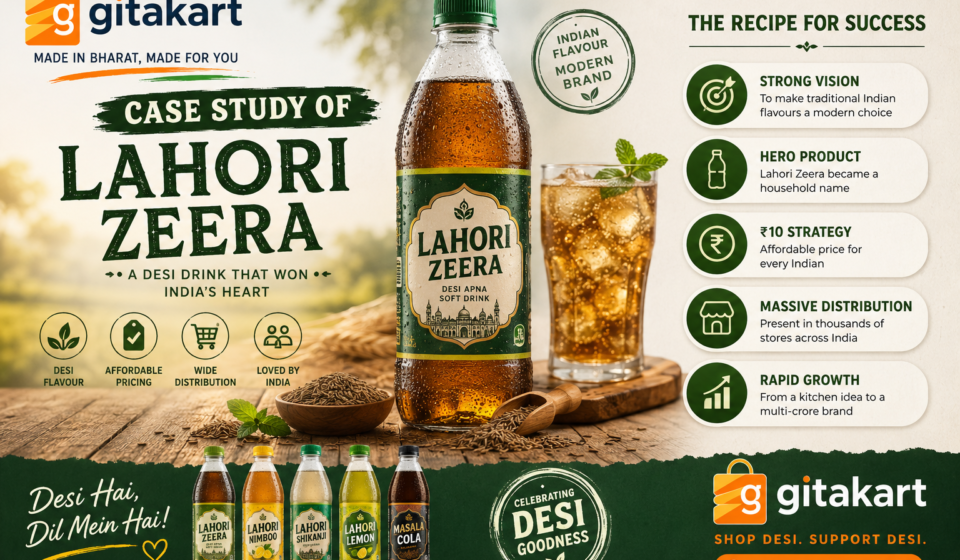
Case Study of Lahori Zeera: India’s beverage market has traditionally been dominated by a handful of powerful multinational and large Indian brands. For decades, consumers associated soft drinks with names such as Coca-Cola, Pepsi, Sprite, Fanta, Thums Up and Limca. These companies possessed enormous advertising budgets, sophisticated distribution systems and strong relationships with retailers.
Yet, underneath this highly competitive market existed another opportunity: India’s traditional drinks and regional flavours.
Across Indian households and streets, people had always consumed beverages such as jaljeera, shikanji, nimbu pani, aam panna, masala soda and other homemade or locally prepared drinks. These beverages were deeply connected with Indian food culture, summer traditions and nostalgia, but they were rarely presented as modern national consumer brands.
This gap created an opportunity for Lahori, the beverage company best known for its flagship product Lahori Zeera.
Founded in 2017 by cousins Saurabh Munjal, Saurabh Bhutna and Nikhil Doda, Lahori attempted something deceptively simple: take a familiar Indian flavour, package it attractively, make it affordable and distribute it at massive scale. Verlinvest describes the company as having started from a kitchen in Chandigarh and says the founders were motivated by their interest in traditional Indian flavours and the opportunity to offer an accessible alternative to conventional soft drinks.
The result has been one of the more interesting Indian beverage startup stories of the last decade.
By FY2024, Lahori reported operating revenue of approximately ₹312 crore, with net profit reaching around ₹22 croreaccording to reporting based on company financial information. In May 2025, Motilal Oswal Wealth invested approximately ₹200 crore, taking Lahori’s valuation to around ₹2,800 crore. (The Economic Times)
More recently, the company has continued to scale aggressively. Financial Express reported in June 2026 that Archian Foods, the company behind Lahori, had reached approximately ₹775 crore in FY2026 sales and was targeting ₹1,150–1,200 crore in FY2027, with a longer-term ambition of reaching ₹2,000 crore in revenue. (Financial Express)
The Lahori story therefore provides a fascinating case study in:
- Indian consumer behaviour
- Product-market fit
- Regional flavours
- Affordable pricing
- Distribution strategy
- Grassroots marketing
- Brand building
- FMCG economics
- Competition with multinational companies
- Venture capital
- Manufacturing scale
- Indian entrepreneurship
1. Company Overview
Company: Archian Foods Pvt. Ltd.
Consumer brand: Lahori
Flagship product: Lahori Zeera
Industry: Food & Beverage / FMCG
Category: Carbonated non-alcoholic beverages
Founded: 2017
Founders: Saurabh Munjal, Saurabh Bhutna and Nikhil Doda
Headquarters/roots: Punjab/Chandigarh region
Major investor: Verlinvest
Later investor: Motilal Oswal Wealth
Lahori’s product portfolio has expanded beyond Zeera. Its official website currently lists products including Lahori Zeera, Lahori Shikanji, Lahori Nimboo, Minty Lemon and Masala Cola, among others. (Lahori Zeera)
The company’s own brand philosophy is built around changing the perception of traditional Indian drinks and making “desi” flavours modern and desirable. It explicitly states that it wants its products to reach cities and villages alike and aims to become a leading non-alcoholic beverage company in India. (Lahori Zeera)
This philosophy is important because Lahori did not attempt to compete with Coca-Cola or Pepsi simply by creating another cola.
Instead, it essentially asked:
What if Indian consumers could have a modern soft drink built around flavours they already understand and love?
That question became the foundation of the business.
2. The Beginning: From a Homemade Drink to a Business
One of the most important aspects of the Lahori story is that the original opportunity was not based on complicated technology.
It was based on observation.
The founders were familiar with traditional Indian flavours and beverages. According to Verlinvest, the product originated in the founders’ own kitchen in Chandigarh. Their goal was to create a commercially viable version of a traditional Indian drink using familiar flavours. (Verlinvest)
The initial insight was powerful:
Traditional Indian beverages had:
- familiarity,
- cultural relevance,
- distinctive flavours,
- emotional associations,
- low-cost ingredients,
- and strong regional acceptance.
What they often lacked was:
- modern packaging,
- national distribution,
- consistent quality,
- brand identity,
- and large-scale marketing.
This meant the opportunity was not necessarily to invent a new taste.
The opportunity was to commercialise an existing taste.
That distinction is critical.
Many entrepreneurs believe innovation means creating something nobody has seen before.
Lahori demonstrated another type of innovation:
Commercial innovation
Instead of inventing a new category, the company modernised an existing cultural product.
3. The Problem Lahori Identified
The Indian beverage consumer has historically had two broad choices.
Option 1: Global-style carbonated beverages
These included:
- cola,
- lemon-lime soda,
- orange soda,
- energy drinks,
- packaged fruit beverages.
They had excellent branding and distribution but often did not reflect specifically Indian flavour preferences.
Option 2: Traditional beverages
These included:
- jaljeera,
- shikanji,
- aam panna,
- nimbu pani,
- masala soda,
- lassi,
- regional drinks.
These had cultural relevance but were generally fragmented and locally produced.
Lahori identified the space between these two worlds.
The company’s proposition could effectively be summarised as:
Traditional Indian taste + modern packaging + mass-market pricing + scalable distribution.
That combination became its competitive advantage.
4. Why “Zeera”?
The choice of cumin was particularly strategic.
“Zeera” is not an unfamiliar flavour to Indian consumers.
Cumin is deeply integrated into Indian cuisine.
It appears in:
- curries,
- raita,
- chaas,
- masala,
- chutneys,
- snacks,
- spice blends,
- digestive drinks,
- and traditional beverages.
Therefore, Lahori Zeera did not require consumers to learn a completely new flavour.
The consumer already knew the taste profile.
This significantly reduced the psychological barrier to trial.
A consumer seeing a cola brand might think:
“I know this category.”
But a consumer seeing a traditional cumin-based drink can think:
“I know this flavour.”
That difference is commercially valuable.
5. The Power of Nostalgia
One of Lahori’s strongest branding assets is nostalgia.
Indian consumers often associate traditional drinks with:
- childhood,
- summer holidays,
- family meals,
- street food,
- local markets,
- roadside restaurants,
- weddings,
- festivals,
- and home cooking.
Lahori effectively packaged this nostalgia into a modern FMCG product.
Verlinvest specifically describes Lahori Zeera as evoking the nostalgia of a typical Indian household. (Verlinvest)
This is a major branding lesson.
Consumers don’t always buy products because they are objectively superior.
They frequently buy products because the product makes them feel something.
Lahori Zeera’s flavour is therefore not merely a functional attribute.
It is part of the brand’s emotional identity.
6. The ₹10 Strategy
One of Lahori’s most important strategic decisions was its focus on affordability.
The company initially positioned Lahori Zeera around the ₹10 price point, helping make the product accessible to a very broad consumer base.
Economic Times has highlighted the company’s “₹10 strategy” as one of the important factors behind its growth. (The Economic Times)
This is more significant than it might initially appear.
A ₹10 beverage can be purchased by:
- students,
- workers,
- families,
- rural consumers,
- urban consumers,
- roadside customers,
- restaurant customers,
- and impulse buyers.
The low price reduces the perceived risk of trying the product.
A customer might hesitate before spending ₹100 on an unfamiliar beverage.
But ₹10 is different.
The thought process becomes:
“Let’s try it.”
That small decision can generate enormous volume when multiplied across millions of consumers.
7. The Psychology Behind Low Pricing
The ₹10 price point did more than make Lahori affordable.
It created a trial engine.
Imagine two products:
Product A: ₹80
Product B: ₹10
If consumers have never heard of either product, Product B has a massive advantage in trial.
Once the consumer tastes Product B and likes it, the business can begin building:
- repeat purchases,
- brand recognition,
- word-of-mouth,
- retailer demand,
- distribution pull.
Therefore, affordability can act as a form of marketing.
Instead of spending enormous amounts to convince consumers through advertising, the company can allow consumers to experience the product themselves.
8. Distribution: The Real Secret Behind the Business
One of the biggest lessons from Lahori’s journey is that creating a good beverage is only half the problem.
The other half is getting it into the hands of consumers.
This is where FMCG becomes extremely difficult.
A beverage company needs:
Manufacturing → Distributor → Wholesaler → Retailer → Consumer
Every stage involves:
- margins,
- logistics,
- inventory,
- transportation,
- refrigeration,
- working capital,
- retailer relationships,
- and execution.
Lahori’s growth has been heavily dependent on offline distribution.
Economic Times reported in 2025 that more than 95% of Lahori’s revenue came from offline channels, although the company had begun expanding into quick commerce. (The Economic Times)
This is an important point.
Many modern startups begin with:
- Instagram,
- Amazon,
- Shopify,
- D2C websites,
- influencers,
- digital advertising.
But beverages behave differently.
The consumer often wants the drink right now.
Someone eating samosa at a roadside shop does not necessarily want to order a beverage online.
Therefore, physical availability is critical.
9. The Importance of Kirana Stores
India’s traditional retail ecosystem is extraordinarily powerful.
Millions of:
- kirana stores,
- paan shops,
- restaurants,
- dhabas,
- roadside stalls,
- canteens,
- supermarkets,
- local retailers
serve consumers every day.
A beverage brand that gets listed in thousands of these outlets can generate enormous recurring sales.
This creates an important business principle:
In FMCG, distribution itself can become a competitive moat.
If a competitor launches a similar beverage but cannot get it into stores, the product may fail even if consumers like its taste.
Lahori understood that availability mattered.
The company built its presence through distributors and retailers, particularly across northern India before expanding further.
10. Tier-2 and Tier-3 India
Another major strategic advantage was the company’s focus beyond India’s largest metropolitan cities.
Traditional Indian flavours often have especially strong resonance in:
- Tier-2 cities,
- Tier-3 cities,
- smaller towns,
- semi-urban areas,
- villages.
These markets can be underestimated by premium consumer brands.
Lahori’s positioning allowed it to address these consumers without making the product feel overly sophisticated or foreign.
The brand’s own stated ambition is to reach both cities and villages. (Lahori Zeera)
This is strategically important because India’s next wave of FMCG growth is not necessarily going to come only from Mumbai, Delhi or Bengaluru.
A huge opportunity exists in smaller cities and towns.
11. Brand Positioning
Lahori’s brand positioning can be expressed through five major pillars:
1. Desi
The brand embraces Indian cultural identity.
2. Affordable
The product is positioned for mass consumption.
3. Fun
The brand does not present traditional beverages as old-fashioned.
Instead, it makes “desi” flavours feel youthful.
4. Nostalgic
The taste reminds consumers of familiar traditional drinks.
5. Modern
The packaging, branding and distribution make the traditional drink compatible with contemporary FMCG retail.
This combination is powerful because it avoids two extremes.
The product is neither:
too traditional
nor
too Westernised.
It sits in the middle.
12. Turning “Desi” Into “Cool”
One of Lahori’s stated philosophies is essentially to make desi the new cool. (Lahori Zeera)
This is an interesting marketing transformation.
Traditionally, Indian consumers sometimes viewed Western brands as aspirational.
A multinational soft drink could represent:
- modernity,
- youth,
- lifestyle,
- global culture.
Lahori attempts to reverse that equation.
It says:
Indian culture can also be modern.
The strategy is not to reject modern consumer culture.
It is to combine modern branding with traditional Indian identity.
This is increasingly visible across Indian consumer businesses.
Brands in:
- food,
- fashion,
- beauty,
- beverages,
- snacks,
- ayurvedic products,
- handicrafts
are increasingly converting Indian cultural elements into modern commercial products.
13. Product Expansion
Lahori did not remain dependent on one product.
Its portfolio has expanded into other Indian-inspired flavours.
The company’s official product catalogue includes:
- Lahori Zeera
- Lahori Nimboo
- Lahori Shikanji
- Minty Lemon
- Masala Cola
- and other offerings. (Lahori Zeera)
This follows a classic FMCG strategy:
Build a hero product first.
Then:
Use the brand’s distribution to launch adjacent products.
This is much easier than launching multiple products simultaneously.
Suppose Lahori has already convinced a retailer to stock Zeera.
Introducing Nimboo becomes easier.
The retailer already knows:
- the distributor,
- the company,
- the sales representative,
- the brand,
- the consumer demand.
The company therefore lowers its customer-acquisition cost for subsequent products.
14. The “Hero Product” Strategy
Lahori Zeera became the company’s hero product.
A hero product performs several functions:
- attracts consumers,
- creates brand awareness,
- establishes distribution,
- builds retailer relationships,
- generates cash flow,
- creates credibility for new products.
This is a strategy used across many successful consumer companies.
A company does not necessarily need ten amazing products.
Sometimes it needs one product that opens the door.
Lahori Zeera was that door.
15. Manufacturing Scale
Beverages are deceptively difficult to manufacture at scale.
The company must manage:
- ingredients,
- water quality,
- carbonation,
- flavour consistency,
- packaging,
- bottles,
- caps,
- labels,
- quality control,
- logistics,
- storage,
- transportation,
- shelf life.
As demand increases, manufacturing capacity becomes a constraint.
In 2025, Lahori planned to increase its manufacturing capacity from approximately 5 million bottles per day to 8 million bottles per day. The company had two manufacturing plants in Punjab and Gujarat and was working toward an additional facility in Uttar Pradesh, according to Economic Times. (The Economic Times)
This illustrates an important startup transition.
Initially, the problem is:
“Can we sell enough?”
Later, the problem becomes:
“Can we manufacture enough?”
That transition is a sign of successful product-market fit—but it also creates operational risk.
16. Funding Journey
Lahori’s growth was supported by institutional capital.
In January 2022, Belgian consumer-focused investment firm Verlinvest invested approximately $15 million in Lahori’s Series A round for a minority stake. The company said the funds would support offline and online expansion and strengthen its national retail presence. (The Economic Times)
Verlinvest’s own portfolio page confirms its investment in Lahori and describes it as an active investment dating to 2021. (Verlinvest)
The investment was significant because it provided the company with capital to move beyond regional scale.
Then came another major milestone.
In May 2025, Motilal Oswal Wealth invested around ₹200 crore in Lahori.
The transaction valued the company at approximately ₹2,800 crore, roughly three times its reported ₹900 crore valuation in 2022. (The Economic Times)
This represents an important signal:
Investors increasingly viewed Lahori as a scalable FMCG company rather than merely a regional beverage startup.
17. Revenue Growth
The company’s financial growth provides one of the clearest indicators of its business success.
According to Economic Times, Lahori reported:
| Financial Year | Operating Revenue |
|---|---|
| FY2023 | Approximately ₹212 crore* |
| FY2024 | Approximately ₹312 crore |
| FY2025 | Estimated above ₹500 crore |
| FY2026 | Approximately ₹775 crore |
*Reported historical figures can vary depending on whether sources refer to company revenue, operating revenue, brand revenue or other measures.
The FY2024 number of ₹312 crore represented approximately 47% growth, while net profit reportedly tripled to ₹22 crore. (The Economic Times)
By June 2026, Financial Express reported that Archian Foods had reached around ₹775 crore in FY2026 sales. (Financial Express)
The trajectory is striking.
A company that began with a traditional beverage concept evolved into a business approaching the ₹1,000-crore revenue scale.
18. A Note About Revenue Figures
A proper case study should be careful with numbers.
Various media reports have cited different revenue figures for Lahori because they may refer to:
- operating revenue,
- brand sales,
- gross sales,
- company revenue,
- financial-year estimates,
- projected revenue,
- or management targets.
For example, a 2025 Delhi High Court order records the plaintiff’s submission that revenue generated from the sale of Lahori Zeera products during FY2023–24 amounted to approximately ₹416.67 crore. (Indian Kanoon)
This differs from the approximately ₹312 crore operating-revenue figure reported by Economic Times for FY2024. (The Economic Times)
Therefore, these numbers should not automatically be treated as contradictory. They may represent different accounting or sales measures.
For serious academic or investment analysis, the underlying statutory financial statements should be used whenever available.
19. Profitability
Revenue growth is impressive, but profitability is even more important.
A company can sell ₹1,000 crore worth of products and still lose money.
Lahori’s reported FY2024 net profit of approximately ₹22 crore is therefore significant. (The Economic Times)
It indicates that the business was not simply purchasing growth through aggressive spending.
However, beverage margins can be affected by:
- sugar prices,
- packaging costs,
- transportation,
- fuel,
- distributor margins,
- retailer margins,
- advertising,
- manufacturing costs,
- commodity prices,
- seasonal demand.
Therefore, maintaining profitability while scaling rapidly is one of Lahori’s major future challenges.
20. Offline vs Online
Lahori represents an interesting contrast with modern D2C startups.
Many consumer startups begin online.
Lahori’s core business has remained overwhelmingly offline.
Economic Times reported that more than 95% of Lahori’s revenue came from offline channels in 2025. (The Economic Times)
This tells us something important:
Digital presence is not the same thing as digital distribution.
A beverage company can have millions of Instagram views and still fail if consumers cannot find the product in a shop.
Lahori’s business model is fundamentally built around physical availability.
Quick commerce can supplement this, but it does not replace traditional FMCG distribution.
21. Competition With Coca-Cola and PepsiCo
Lahori does not have the financial resources of Coca-Cola or PepsiCo.
The multinational companies possess:
- enormous advertising budgets,
- global supply chains,
- extensive bottling networks,
- established retailer relationships,
- decades of brand recognition.
Trying to beat them directly would be extremely difficult.
So Lahori chose a different strategy.
Instead of fighting them on their strongest ground, it created a different battlefield.
Coca-Cola has Coke.
Pepsi has Pepsi.
But Lahori has Zeera.
This is an example of differentiation strategy.
Rather than saying:
“Our cola is better than Coca-Cola.”
Lahori effectively says:
“We are offering something different.”
That makes direct comparison more difficult.
22. The Rise of Indian Beverage Brands
The broader market is also changing.
Economic Times reported that the Indian soft drinks market was seeing increasing disruption from newer players such as Reliance-backed Campa and Lahori Zeera. Data cited in the report indicated that their combined market share had reached nearly 15% during January–September 2025, roughly doubling, while Coca-Cola and PepsiCo’s combined share declined to around 85%. (The Economic Times)
The significance goes beyond Lahori.
It suggests Indian consumers are increasingly willing to experiment with:
- Indian flavours,
- regional brands,
- affordable alternatives,
- traditional beverages,
- new packaging,
- local brands with modern identities.
This creates a favourable environment for companies like Lahori.
23. SWOT Analysis of Lahori Zeera
Strengths
1. Unique flavour
Zeera provides strong differentiation.
2. Indian identity
The product has cultural relevance.
3. Affordable positioning
The initial ₹10 strategy encouraged trial and mass adoption.
4. Strong distribution
Offline retail provides extensive physical availability.
5. Product-market fit
The brand has demonstrated strong consumer acceptance.
6. Portfolio expansion
The company can introduce adjacent flavours using the existing distribution network.
7. Strong investor confidence
Verlinvest and Motilal Oswal Wealth investments provide financial credibility.
24. Weaknesses
Despite its success, Lahori has weaknesses.
1. High dependence on offline distribution
Physical distribution is expensive and operationally complicated.
2. Limited international recognition
The brand remains primarily associated with the Indian market.
3. Category dependence
The company is heavily exposed to the carbonated beverage category.
4. Competition
Large companies can quickly copy flavour profiles, packaging formats or pricing strategies.
5. Manufacturing requirements
Rapid growth requires significant investment in factories and supply chains.
6. Seasonal demand
Beverage consumption is heavily influenced by weather, particularly summer.
25. Opportunities
The company has substantial opportunities.
Rural expansion
India’s rural and semi-urban beverage market remains enormous.
Tier-2 and Tier-3 cities
These markets can become major growth engines.
International Indian diaspora
Traditional Indian flavours could appeal to consumers in:
- UAE,
- UK,
- Canada,
- USA,
- Australia,
- Singapore,
- Gulf countries.
New flavours
The company can develop:
- aam panna,
- kokum,
- jaljeera,
- guava masala,
- kala khatta,
- bel,
- traditional fruit beverages.
Premium products
Lahori could potentially create premium glass-bottle or restaurant-focused products.
Quick commerce
Platforms can increase availability in urban markets.
Food-service partnerships
Restaurants and QSRs could become important channels.
26. Threats
1. Coca-Cola and PepsiCo
These companies can respond aggressively.
2. Reliance Campa
Campa represents a powerful Indian corporate competitor.
3. Regional beverage brands
Local competitors can compete on price.
4. Ingredient inflation
Sugar, packaging and logistics costs can hurt margins.
5. Changing health preferences
Consumers may increasingly prefer:
- low sugar,
- zero sugar,
- natural drinks,
- functional beverages,
- water,
- protein drinks.
6. Regulatory changes
Taxes and regulations around sugary beverages could affect the industry.
27. Porter’s Five Forces Analysis
Competitive Rivalry — Very High
The beverage industry is intensely competitive.
Consumers have countless alternatives.
Therefore, brands must constantly compete on:
- taste,
- price,
- packaging,
- distribution,
- advertising.
Threat of New Entrants — Moderate
Launching a beverage brand is relatively easy.
But scaling it nationally is extremely difficult.
The barriers include:
- manufacturing,
- distribution,
- working capital,
- retailer relationships,
- brand awareness,
- marketing.
Therefore:
Entry barrier = low
but
scale barrier = high.
Bargaining Power of Suppliers — Moderate
Large beverage companies can negotiate with suppliers due to scale.
Smaller companies have less leverage.
As Lahori grows, its bargaining power should improve.
Bargaining Power of Retailers — High
Retailers can choose from many beverage brands.
Shelf space is limited.
A brand that sells quickly gets better placement.
Therefore, Lahori must continuously maintain:
- retailer margins,
- availability,
- promotional support,
- sales velocity.
Threat of Substitutes — Very High
The consumer can choose:
- water,
- tea,
- coffee,
- juice,
- lassi,
- coconut water,
- energy drinks,
- milkshakes,
- other soft drinks.
Therefore, Lahori is competing for a consumer’s thirst occasion, not simply against another soft drink.
28. The Business Model
Lahori’s business model can be represented as:
Manufacturing
↓
Distributors
↓
Wholesalers / Retailers
↓
Consumers
Revenue is generated primarily through the sale of packaged beverages.
The economics depend heavily on:
Volume × Average Realisation – Cost of Goods – Distribution – Marketing – Operating Expenses
This is why scale matters so much.
Suppose a company earns only a small contribution per bottle.
Selling one thousand bottles does not create a huge business.
Selling millions of bottles every day can create enormous revenue.
Thus:
Lahori is fundamentally a volume business.
29. Why Volume Matters More Than High Margins
Imagine a beverage generating a contribution of ₹3 per bottle.
At:
1 lakh bottles/day
contribution = ₹3 lakh/day.
At:
10 lakh bottles/day
contribution = ₹30 lakh/day.
At:
50 lakh bottles/day
contribution = ₹1.5 crore/day.
The exact economics will differ in reality, but the principle is important.
FMCG businesses often win through:
small margins × huge volume × repeat purchases.
Lahori’s growth strategy fits this model.
30. The Importance of Retailer Economics
A beverage brand cannot succeed without making retailers happy.
The retailer asks:
- Does this product sell?
- How quickly does it sell?
- What margin do I earn?
- Is supply reliable?
- Does the customer ask for it?
- Does the product occupy valuable refrigerator space?
If Lahori Zeera sells faster than a competing product, the retailer has a reason to keep stocking it.
That creates a feedback loop:
Consumer demand
↓
Retailer demand
↓
Distributor demand
↓
More availability
↓
More consumer trial
↓
More consumer demand
This is one of the strongest mechanisms in FMCG growth.
31. Marketing Without Depending Entirely on Celebrity Advertising
Traditional beverage giants are famous for enormous celebrity campaigns.
Lahori’s challenge was different.
A startup cannot initially spend like Coca-Cola.
Therefore, its marketing has to be more efficient.
The product itself becomes part of the marketing.
The bright packaging, unusual flavour and cultural positioning encourage:
- curiosity,
- trial,
- conversations,
- social media posts,
- word-of-mouth.
This is particularly powerful for an unusual product.
When people encounter a familiar category with an unexpected flavour, they have a reason to talk about it.
32. The Power of Word-of-Mouth
Imagine a consumer buys Lahori Zeera.
They drink it.
They like it.
Then they tell a friend:
“Try this. It’s like a desi masala soda.”
That friend buys it.
Then another person tries it.
This creates organic acquisition.
Word-of-mouth is particularly effective for products that have:
- low price,
- strong taste,
- novelty,
- cultural familiarity.
Lahori possesses all four.
33. Cultural Branding as a Competitive Advantage
Perhaps the deepest lesson from Lahori is the commercial power of cultural authenticity.
The company didn’t need to manufacture a new cultural identity.
It already existed.
Indian consumers knew:
- zeera,
- nimbu,
- shikanji,
- masala,
- aam,
- traditional summer drinks.
Lahori simply transformed these cultural assets into packaged consumer products.
This is a powerful entrepreneurial formula:
Find something people already love informally and build a professional business around it.
34. The Role of Packaging
Packaging is especially important in FMCG.
A product has only a few seconds to communicate:
- What is it?
- Who is it for?
- Why should I buy it?
Lahori’s packaging reinforces its Indian identity.
The bottle becomes more than a container.
It becomes a brand billboard.
In crowded retail environments, packaging helps create recognition.
This is especially important when competing for refrigerator space.
35. Why Traditional Flavours Can Become Modern Brands
There is a common misconception that traditional products are inherently low-growth.
Lahori challenges that assumption.
A traditional product can become a modern brand if it receives:
- consistent quality,
- attractive packaging,
- reliable distribution,
- appropriate pricing,
- professional marketing,
- strong brand identity.
The raw cultural idea may already exist.
The business opportunity lies in standardisation and scale.
36. The Entrepreneurial Lesson
The Lahori story demonstrates that entrepreneurs should not always search for futuristic problems.
Sometimes the biggest opportunities are hiding in ordinary behaviour.
Ask:
- What do people already consume?
- What do they already love?
- What do they make at home?
- What do they buy locally?
- What products have no strong national brand?
- Can quality be standardised?
- Can distribution be expanded?
- Can the product be made more convenient?
These questions can uncover billion-rupee opportunities.
37. Why the Product Worked
The product succeeded because several variables aligned.
Product
Distinctive Indian taste.
Price
Affordable.
Packaging
Modern.
Distribution
Mass-market.
Positioning
Desi but contemporary.
Consumer psychology
Nostalgia + curiosity.
Market
Large and growing.
Timing
Increasing consumer openness toward Indian brands.
This is a classic example of product-market fit.
38. The Importance of Timing
Timing also played a role.
Indian consumers have increasingly embraced domestic brands.
The rise of:
- D2C companies,
- Indian startups,
- local fashion brands,
- Indian food brands,
- regional products,
- quick commerce
has created an environment where consumers are more willing to experiment.
Lahori benefited from this broader shift.
The company did not create the trend alone.
It positioned itself well within the trend.
39. Why Lahori’s Story Is Different From a Typical Startup
A technology startup might aim to:
- acquire users,
- build an app,
- optimise software,
- raise venture capital.
Lahori’s challenges were fundamentally different.
It had to:
- build factories,
- procure ingredients,
- manage bottles,
- transport heavy products,
- negotiate with distributors,
- convince retailers,
- maintain inventory,
- manage working capital.
This is a reminder that entrepreneurship isn’t synonymous with technology.
FMCG entrepreneurship can be just as innovative.
40. The Scaling Challenge
Lahori’s next phase may be harder than its first phase.
Why?
Because going from:
₹10 crore → ₹100 crore
is difficult.
But going from:
₹100 crore → ₹1,000 crore
requires a completely different organisation.
The company must develop:
- professional management,
- advanced supply-chain systems,
- financial controls,
- regional teams,
- manufacturing capacity,
- quality assurance,
- data analytics,
- national marketing,
- institutional processes.
Growth changes the nature of the company.
41. The ₹2,000 Crore Ambition
As of June 2026, Financial Express reported that Archian Foods was targeting ₹1,150–1,200 crore in FY2027 revenueafter achieving around ₹775 crore in FY2026, while aiming for ₹2,000 crore within three years. (Financial Express)
This is an ambitious target.
Achieving it will require more than simply selling more Zeera.
The company will likely need:
- deeper national distribution,
- greater manufacturing capacity,
- new products,
- stronger brand investment,
- improved supply-chain efficiency,
- increased penetration in southern and eastern India,
- and possibly international expansion.
42. The Biggest Strategic Question
The most important question for Lahori now is not:
“Can Lahori Zeera become popular?”
It already has.
The bigger question is:
Can Lahori become a multi-category national beverage company without losing the authenticity that made it successful?
This is the classic challenge of scaling a founder-led consumer brand.
Growth can create pressure to:
- change the packaging,
- increase prices,
- introduce too many products,
- enter unrelated categories,
- target premium consumers.
But the original consumer may love the brand precisely because it feels simple and authentic.
Therefore, Lahori must grow without becoming generic.
43. Brand Dilution Risk
There is a danger in expanding too quickly.
Suppose Lahori launches:
- cola,
- energy drink,
- sports drink,
- juice,
- soda,
- sparkling water,
- protein drink,
- premium beverage.
At some point, consumers may ask:
“What does Lahori actually stand for?”
The brand needs a central idea.
That idea could remain:
Indian flavours, modern beverages.
If every new product reinforces this idea, expansion strengthens the brand.
If products move too far away from it, the brand could become diluted.
44. Health and Wellness Challenge
One major long-term issue for the carbonated beverage category is health perception.
Consumers are increasingly concerned about:
- sugar,
- calories,
- artificial ingredients,
- obesity,
- metabolic health.
Therefore, Lahori’s future product strategy may need to consider:
- lower-sugar products,
- zero-sugar variants,
- natural sweeteners,
- smaller portion sizes,
- transparent ingredient communication.
The challenge is to accomplish this without destroying the taste consumers love.
45. International Expansion
Indian diaspora markets could provide an attractive opportunity.
Consider countries with significant Indian populations:
- United Arab Emirates
- United Kingdom
- Canada
- United States
- Australia
- Singapore
Consumers familiar with Indian food may naturally understand:
- zeera,
- shikanji,
- nimbu,
- masala,
- aam panna.
Indian restaurants and grocery stores could become distribution points.
However, international expansion introduces:
- regulatory requirements,
- import duties,
- logistics costs,
- local competition,
- packaging requirements,
- food-safety regulations.
Therefore, it must be approached carefully.
46. The Strategic Importance of “Indian-ness”
Lahori’s biggest advantage is also potentially its biggest limitation.
Its Indian identity differentiates it.
But if the brand becomes too dependent on one regional cultural association, international expansion may become harder.
The solution is not necessarily to remove Indian identity.
Instead, the company could position Indian flavours as a global culinary experience.
Just as:
- sushi became global,
- kimchi became global,
- ramen became global,
- tacos became global,
Indian beverages can potentially travel internationally.
47. Lessons for Small Businesses
The Lahori case is not only relevant to venture-backed startups.
Small businesses can learn from it.
Lesson 1: Don’t underestimate local demand.
A product popular in one city may have national potential.
Lesson 2: Build around familiarity.
Consumers are more willing to try products they understand.
Lesson 3: Price strategically.
Low prices can accelerate trial.
Lesson 4: Distribution matters.
A great product nobody can find will not become a great business.
Lesson 5: Build a brand, not just a product.
The brand creates long-term value.
Lesson 6: Start with one hero product.
Master one product before launching ten.
Lesson 7: Use culture as an asset.
Local culture can become a powerful commercial advantage.
48. Lessons for Indian Entrepreneurs
Perhaps the biggest entrepreneurial lesson is this:
You do not have to copy Silicon Valley.
A successful Indian startup can be built around:
- food,
- beverages,
- agriculture,
- manufacturing,
- logistics,
- handicrafts,
- regional culture,
- traditional knowledge,
- local distribution.
India has enormous underdeveloped consumer categories.
Entrepreneurs should look beyond fashionable startup sectors.
There may be massive opportunities hiding in everyday Indian life.
49. Lessons in Product-Market Fit
Lahori provides a textbook example of product-market fit.
The product satisfied several consumer needs simultaneously:
Taste
People wanted something flavorful.
Price
People wanted affordability.
Convenience
They wanted packaged drinks.
Identity
They wanted something culturally familiar.
Refreshment
They wanted a cold beverage.
Novelty
They wanted something different from cola.
When one product satisfies multiple needs at once, adoption can accelerate rapidly.
50. Lessons in Competitive Strategy
Lahori’s strategy can be summarised using one phrase:
Don’t fight the strongest competitor where they are strongest.
Coca-Cola is extraordinarily strong in cola.
PepsiCo is extraordinarily strong in mass-market beverages.
Instead of trying to defeat them at cola, Lahori created a distinctive Indian-flavour territory.
This is a classic differentiation strategy.
51. The Lahori Zeera Formula
The company’s growth can be simplified into a strategic formula:
Traditional flavour
Modern packaging
Affordable pricing
Mass distribution
Strong branding
Product consistency
Consumer nostalgia
=
Scalable FMCG brand
That formula is arguably the most important takeaway from the entire case study.
52. A Simplified Business Timeline
2017
Lahori is founded by Saurabh Munjal, Saurabh Bhutna and Nikhil Doda. (Verlinvest)
Early phase
The company focuses on traditional Indian flavours, particularly Lahori Zeera.
Expansion phase
The brand develops offline distribution and expands beyond its initial regional market.
2022
Verlinvest invests approximately $15 million in Lahori’s Series A round. (The Economic Times)
2024
Lahori reports approximately ₹312 crore operating revenue and ₹22 crore net profit, according to Economic Times reporting. (The Economic Times)
2025
Motilal Oswal Wealth invests around ₹200 crore, valuing the company at approximately ₹2,800 crore. (The Economic Times)
2025
The company plans to increase production capacity from approximately 5 million to 8 million bottles per day. (The Economic Times)
2026
Financial Express reports approximately ₹775 crore FY2026 sales, with management targeting ₹1,150–1,200 crore for FY2027 and ₹2,000 crore within three years. (Financial Express)
53. What Could Go Wrong?
A good case study must also examine failure scenarios.
Scenario 1: Competitors copy the product
A large beverage company could launch another cumin-based beverage.
Response: Strengthen brand equity, distribution and consumer loyalty.
Scenario 2: Price competition
Competitors could offer cheaper alternatives.
Response: Protect the ₹10 mass-market segment while developing differentiated products.
Scenario 3: Rising input costs
Packaging or sugar prices could rise.
Response: Improve manufacturing efficiency and procurement scale.
Scenario 4: Consumer health concerns
Consumers could move away from sugary carbonated beverages.
Response: Develop low-sugar and zero-sugar alternatives.
Scenario 5: Brand dilution
Too many products could weaken the core identity.
Response: Keep every new product connected to the central Indian-flavour proposition.
Scenario 6: Distribution complexity
National expansion could create operational inefficiencies.
Response: Invest in technology, forecasting, regional warehouses and supply-chain management.
54. What Makes Lahori Difficult to Copy?
At first glance, Lahori Zeera seems easy to copy.
Someone could create another cumin-flavoured drink.
But copying the recipe is not the same as copying the business.
The real moat consists of:
- retailer relationships,
- distributor network,
- manufacturing infrastructure,
- brand recognition,
- consumer trust,
- repeat purchase,
- shelf space,
- production scale,
- capital,
- accumulated market knowledge.
This is an important startup lesson:
The product can be copied. The ecosystem around the product is much harder to copy.
55. Why Distribution Is the Hidden Moat
Suppose a competitor creates an equally good Zeera drink tomorrow.
Can they immediately reach:
- 100,000 retailers?
- thousands of distributors?
- restaurants?
- supermarkets?
- rural markets?
Probably not.
That is why distribution becomes a competitive moat.
In FMCG, the winner is often not the company with the best product.
It is the company that can put a good product everywhere.
56. The Role of Capital
The 2022 and 2025 funding rounds were important because scaling FMCG requires capital.
Money can fund:
- factories,
- machinery,
- inventory,
- warehouses,
- marketing,
- employees,
- distribution,
- technology,
- working capital.
However, capital alone cannot create demand.
The product must first demonstrate consumer acceptance.
Lahori’s funding came after it had already established a business, making the capital particularly useful for accelerating an existing growth engine.
57. Why Investors Were Interested
Investors typically look for businesses with:
- large markets,
- strong growth,
- repeat purchases,
- brand potential,
- scalable distribution,
- attractive margins,
- management capability.
Lahori checks several of these boxes.
The Indian beverage market is enormous.
The product is purchased repeatedly.
The company has demonstrated growth.
The brand has differentiated positioning.
The distribution model can scale.
Therefore, the investment case is not simply:
“People like Zeera.”
It is:
“A differentiated Indian beverage brand can potentially capture a meaningful share of a huge recurring-consumption market.”
58. The Strategic Importance of India
India is uniquely suited to this kind of business.
It has:
- 1.4+ billion consumers,
- diverse regional cuisines,
- strong food traditions,
- rapidly growing consumption,
- millions of retailers,
- increasing disposable income,
- expanding cities,
- large youth population.
Every region has traditional flavours that could potentially become national brands.
Imagine commercialising:
- kokum,
- aam panna,
- sattu,
- bel,
- jaljeera,
- thandai,
- nimbu,
- imli,
- rose,
- khus,
- lassi-inspired flavours.
The opportunity is enormous.
59. Lahori as a Case Study in “Bharat Consumption”
One of the most interesting aspects of Lahori is its alignment with what can broadly be called the Bharat consumption opportunity.
India’s growth is increasingly coming from consumers outside the traditional premium metropolitan audience.
These consumers want:
- affordable products,
- trusted products,
- familiar flavours,
- aspirational packaging,
- modern brands.
Lahori sits directly in this intersection.
It makes a product feel modern without abandoning cultural familiarity.
60. The Core Strategic Insight
If the entire Lahori case study had to be reduced to one sentence, it would be:
Lahori did not invent a new Indian taste; it built a scalable modern business around an old one.
That is the heart of the company’s success.
61. Final Business Analysis
Lahori Zeera is an excellent example of how a relatively simple consumer insight can become a large-scale business when combined with disciplined execution.
The company’s journey demonstrates that successful innovation does not always require advanced technology.
Sometimes innovation means:
- recognising an overlooked consumer preference,
- improving the product,
- packaging it professionally,
- pricing it correctly,
- distributing it widely,
- and building a memorable brand.
Lahori took a flavour associated with traditional Indian beverages and transformed it into a modern FMCG proposition.
The company’s reported growth—from hundreds of crores in annual revenue to approximately ₹775 crore in FY2026—shows the potential of this strategy. Its latest reported funding valuation of approximately ₹2,800 crore demonstrates that institutional investors also see significant value in the business. (The Economic Times)
But the company’s next chapter will be more challenging.
The initial question was:
Can people be convinced to drink Lahori Zeera?
That question appears to have been answered.
The next questions are harder:
Can Lahori become a national beverage powerhouse?
Can it maintain profitability while scaling?
Can it compete against Coca-Cola, PepsiCo and Campa?
Can it expand beyond Zeera without diluting its identity?
Can Indian regional flavours become globally recognised brands?
The answers will determine whether Lahori remains a successful beverage startup or evolves into one of India’s major consumer brands.
62. Key Lessons From the Lahori Zeera Case Study
| Business Area | Lahori’s Approach | Key Lesson |
|---|---|---|
| Product | Traditional Indian flavour | Familiarity can drive adoption |
| Pricing | Mass-market positioning | Low price can accelerate trial |
| Branding | Desi + modern | Culture can become a competitive asset |
| Distribution | Strong offline focus | Availability is critical in FMCG |
| Marketing | Product + cultural identity | Differentiation reduces direct competition |
| Expansion | Adjacent Indian flavours | Build around a hero product |
| Manufacturing | Increasing capacity | Scale requires operational investment |
| Funding | Institutional capital | Capital can accelerate proven demand |
| Competition | Differentiation | Don’t fight giants on their strongest ground |
| Market | Bharat + urban consumers | Tier-2/3 markets can be enormous |
| Future | National and category expansion | Scaling requires discipline |
Conclusion
The Lahori Zeera case is ultimately a story about Indian consumer insight.
The founders did not need to convince India to like cumin.
India already liked cumin.
They did not need to teach consumers what shikanji or nimbu tasted like.
People already knew.
They simply took these familiar experiences and gave them:
a brand, a bottle, a price, a distribution network and a modern identity.
That is what makes Lahori interesting.
Its success demonstrates that the next generation of Indian consumer companies may not necessarily emerge from futuristic technologies. Some may emerge from ordinary Indian habits that have been overlooked for decades.
The biggest entrepreneurial lesson is therefore simple:
Look at what millions of people already love, find what is missing, and build the system that turns that everyday behaviour into a scalable brand.
Lahori Zeera did exactly that.
And its journey—from a traditional desi drink to a rapidly scaling FMCG company valued at billions of rupees—shows just how powerful that strategy can be.
In the end, Lahori’s greatest innovation was not Zeera. Its greatest innovation was recognising that something as traditionally Indian as Zeera could become a modern, scalable, national consumer brand.


[…] Case Study of Lahori Zeera: How a ₹10 Desi Drink Challenged India’s Beverage Giants […]