




Dabur India Case Study: The 140-Year Journey of an Ayurvedic Brand Into a Global FMCG Powerhouse

Introduction – Dabur India Case Study
Dabur India Case Study: The story of Dabur India is one of the most fascinating business case studies in Indian corporate history. What began in 1884 as an Ayurvedic medicines business founded by Dr. S. K. Burman in Calcutta eventually developed into a professionally managed multinational consumer-goods company with a large portfolio spanning healthcare, personal care, oral care, hair care, home care, food and beverages. Dabur says its products are available in more than 120 countries and that it has a portfolio of more than 250 herbal and Ayurvedic products. (Dabur)
Dabur’s journey is especially important because the company managed to solve a difficult business problem:
How do you take traditional Ayurvedic knowledge and turn it into modern, branded, mass-market consumer products?
The answer involved a combination of:
- heritage,
- research,
- manufacturing,
- branding,
- distribution,
- product innovation,
- advertising,
- rural penetration,
- international expansion,
- acquisitions,
- professional management,
- and continuous adaptation to changing consumer preferences.
Today, Dabur is not simply an Ayurvedic medicine company.
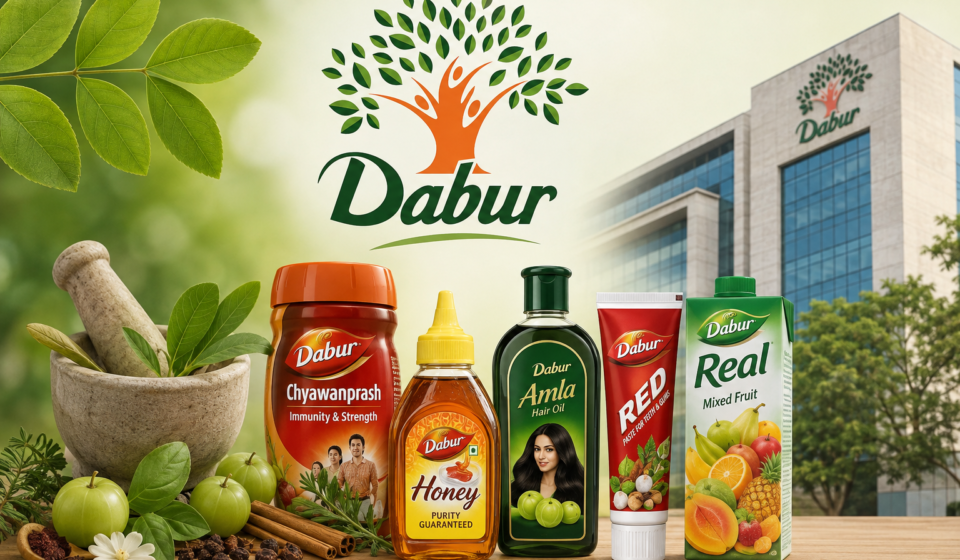
It is a major FMCG business with brands across categories such as:
- Dabur Chyawanprash,
- Dabur Honey,
- Dabur Honitus,
- Dabur Pudin Hara,
- Dabur Lal Tail,
- Dabur Amla,
- Dabur Red Paste,
- Réal,
- Vatika,
- and many other products.
Dabur’s current corporate profile identifies eight Indian “Power Brands” spanning healthcare, personal care and food & beverages, while Vatika is identified as an international Power Brand. (Dabur)
This makes Dabur an excellent case study for understanding brand building, traditional-product modernization, FMCG distribution and long-term business transformation.
1. Dabur at a Glance
| Category | Details |
|---|---|
| Company | Dabur India Limited |
| Founder | Dr. S. K. Burman |
| Founded | 1884 |
| Origin | Calcutta, India |
| Original business | Ayurvedic medicines |
| Current sector | FMCG |
| Major categories | Healthcare, personal care, hair care, oral care, food & beverages, home care |
| Ayurvedic products | 250+ according to Dabur |
| Countries | 120+ according to Dabur |
| Retail reach | 7.7 million outlets according to Dabur |
| Major brands | Chyawanprash, Honey, Amla, Red Paste, Réal, Vatika and others |
| Business model | Branded FMCG + international business |
| Core differentiation | Ayurveda, natural products and strong consumer brands |
Dabur currently describes itself as one of India’s leading FMCG companies, with more than ₹12,400 crore in revenue, more than ₹1 lakh crore in market capitalization, more than 7.7 million retail outlets and presence in more than 120 countries. (Dabur)
These figures are company-reported and can change over time.
2. The Beginning of Dabur
The story starts in 1884.
Dr. S. K. Burman founded Dabur with a mission centered on providing affordable healthcare products.
At the time, healthcare accessibility was very different from today.
Modern pharmaceutical manufacturing was still developing, while traditional Indian systems of medicine had a long history.
Dabur began by applying entrepreneurial thinking to Ayurvedic healthcare.
The company’s own historical account states that Dr. Burman’s initial mission was to make healthcare products available and affordable, and that the company began operations as an Ayurvedic medicines business in Calcutta. (Dabur)
3. The Founder: Dr. S. K. Burman
Dr. S. K. Burman was not simply interested in selling medicines.
He saw a larger problem:
Healthcare products were not easily accessible to everyone.
His approach was to create formulations that could be produced and distributed more systematically.
That idea eventually became the foundation for Dabur’s industrialization.
4. From Traditional Knowledge to Commercial Product
This is the first major lesson from Dabur.
Traditional knowledge alone does not automatically create a successful modern business.
A company must build:
- standardized formulations,
- manufacturing processes,
- packaging,
- distribution,
- quality control,
- branding.
Dabur gradually developed these capabilities.
5. The First Manufacturing Plant
As demand increased, Dabur expanded beyond small-scale production.
The company’s official history records the establishment of a manufacturing plant in 1896 for mass production of formulations. (Dabur)
This was a crucial transition.
The business moved from:
Individual preparation
to:
Industrial production.
6. Why Manufacturing Changed Everything
Mass production provided several advantages.
Dabur could potentially achieve:
- consistency,
- higher output,
- lower unit costs,
- wider distribution,
- standardized packaging.
This is where a traditional healthcare practice started becoming a modern business.
7. Entering Nature-Based Ayurvedic Medicines
In the early 1900s, Dabur expanded into nature-based Ayurvedic medicines.
The company says it entered this specialized area at a time when standardized Ayurvedic drugs were not widely available. (Dabur)
This became an important competitive position.
Dabur was not merely selling an old remedy.
It was attempting to:
Standardize traditional knowledge for mass consumption.
8. Research Becomes Important
By 1919, Dabur established research laboratories.
The company’s history says this was driven by the need for scientific processes and quality checks in the mass production of traditional Ayurvedic medicines. (Dabur)
This was a major strategic decision.
It meant Dabur understood something very important:
Tradition needs technology.
9. Ayurveda + Science
Dabur’s long-term strategy can be summarized as:
Traditional Ayurveda
Modern science
Industrial manufacturing
=
Modern Ayurvedic consumer products.
The company itself describes its differentiation as marrying traditional Ayurvedic knowledge with modern science. (Dabur)
10. Early Distribution Expansion
Dabur gradually expanded its manufacturing and distribution network.
By the 1920s, its operations had expanded to additional manufacturing units and its distribution had reached regions including Bihar and the North-East, according to the company’s historical timeline. (Dabur)
This shows another important business principle:
A great product is useless if customers cannot find it.
11. The Importance of Distribution
FMCG is fundamentally a distribution business.
Customers do not normally travel 20 kilometers to buy toothpaste.
They expect it to be available:
- at the local grocery shop,
- pharmacy,
- supermarket,
- convenience store,
- online marketplace.
Dabur’s eventual distribution scale became one of its major competitive advantages.
12. Dabur Becomes a Company
In 1936, Dabur became a full-fledged company under the name Dabur India (Dr. S. K. Burman) Pvt. Ltd., according to its official history. (Dabur)
The transformation from founder-led enterprise to formal corporate organization was another important stage.
13. The Delhi Transition
In 1972, Dabur shifted operations to Delhi.
The company also established a manufacturing plant in Faridabad during this period. (Dabur)
This reflected the company’s growing scale.
14. Sahibabad and Research
In 1979, Dabur began commercial production at its Sahibabad factory and established the Dabur Research & Development Centre.
This represented a major commitment to scientific research and manufacturing capability. (Dabur)
The company was increasingly becoming:
An industrial consumer-products organization.
15. Going Public
In 1986, Dabur became a public limited company.
Dabur India Ltd. came into existence after a reverse merger with Vidogum Limited, according to the company’s historical account. (Dabur)
Going public introduced a new dimension:
Capital Markets.
The company could access public capital while becoming accountable to a wider shareholder base.
16. The 1994 Public Issue
Dabur’s first public issue took place in 1994.
The company says the issue was oversubscribed 21 times, reflecting strong market interest at the time. (Dabur)
This illustrates the importance of investor confidence.
17. Diversification Begins
Dabur gradually expanded beyond traditional medicines.
This was necessary because the consumer market was changing.
People were buying more:
- personal-care products,
- packaged foods,
- beverages,
- household products.
Dabur recognized that its brand equity could potentially be transferred into adjacent categories.
18. The FMCG Transformation
The central transformation was:
Old Dabur
Ayurvedic medicines.
Modern Dabur
Healthcare + personal care + food + beverages + home care.
This is the heart of the case study.
19. From Medicine to Everyday Life
The biggest strategic breakthrough was taking the Dabur brand into everyday consumption.
For example:
Healthcare
Chyawanprash.
Hair care
Amla.
Oral care
Red Paste.
Food
Réal.
This expanded Dabur’s addressable market enormously.
20. Brand Extension
Brand extension means using an established brand’s reputation to enter another category.
But it must be done carefully.
A healthcare brand may not automatically succeed in food.
Dabur’s success came partly from maintaining a common association with:
- nature,
- wellness,
- Ayurveda,
- trust.
21. The Power of the Dabur Name
Dabur has been associated with healthcare and Ayurveda for generations.
That creates:
Brand recognition.
Brand trust.
Heritage.
Emotional connection.
These are difficult for new competitors to replicate.
22. Heritage as a Competitive Advantage
A company founded in 1884 has something modern startups cannot easily buy:
History.
Heritage can create a perception of:
- experience,
- authenticity,
- reliability.
However, heritage alone is not enough.
The company must continue innovating.
23. Dabur Chyawanprash
Dabur Chyawanprash became one of the company’s iconic healthcare products.
The product is strongly associated with:
- immunity,
- traditional wellness,
- Ayurveda,
- family health.
This allowed Dabur to create a powerful connection between:
Traditional Indian wellness
and
Modern packaged consumer products.
24. Dabur Honey
Honey provided another opportunity.
Honey is naturally associated with:
- health,
- natural ingredients,
- nutrition.
Dabur could therefore position the product within its broader natural-health identity.
25. Dabur Amla
Dabur Amla became one of the company’s major hair-care brands.
This was strategically important because it moved Dabur from:
Healthcare
into:
Personal care.
The underlying connection remained:
Ayurveda + natural ingredients + hair wellness.
26. Dabur Red Paste
Oral care was another major category.
Toothpaste is a daily-use product.
That means the business opportunity is very different from occasional healthcare purchases.
A customer can buy toothpaste:
Every few weeks.
This creates recurring consumption.
27. Réal
Réal helped Dabur enter the packaged fruit beverage category.
This was an important diversification.
Now the company was competing in a completely different FMCG environment.
Yet the broader brand promise remained connected to:
- family,
- health,
- natural ingredients.
28. Vatika
Vatika became an important international brand.
Dabur identifies Vatika as an international Power Brand. (Dabur)
This demonstrates how a brand developed in India can be adapted for global consumers.
29. Dabur’s Brand Portfolio
Dabur’s current corporate profile identifies eight distinct Power Brands in India:
Healthcare
- Dabur Chyawanprash
- Dabur Honey
- Dabur Honitus
- Dabur Pudin Hara
- Dabur Lal Tail
Personal Care
- Dabur Amla
- Dabur Red Paste
Food & Beverages
- Réal
Vatika is identified as the international Power Brand. (Dabur)
This illustrates the company’s multi-category strategy.
30. Why Multiple Brands Matter
A company does not need one brand to serve every consumer need.
Instead:
One corporate company
can own:
Multiple specialized brands.
This allows different:
- price points,
- consumer segments,
- categories,
- marketing strategies.
31. Brand Architecture
Dabur therefore operates as:
Dabur India
↓
Multiple Product Categories
↓
Multiple Brands
↓
Multiple Consumer Segments
This is a classic FMCG portfolio strategy.
32. The FMCG Business Model
FMCG means:
Fast-Moving Consumer Goods.
These are products that:
- sell frequently,
- have relatively low prices per unit,
- are purchased repeatedly,
- require extensive distribution.
Examples include:
- toothpaste,
- shampoo,
- honey,
- beverages,
- health products.
33. Why FMCG Is Attractive
Successful FMCG brands can create:
Recurring demand.
A customer may buy a product repeatedly for years.
This creates predictable consumption patterns.
34. Consumer Habit
One of the most valuable assets in FMCG is:
Habit.
If a customer has used the same toothpaste for 10 years, switching becomes less likely.
Brand loyalty can therefore become a competitive moat.
35. Distribution as a Moat
Dabur says its distribution network covers approximately 7.7 million retail outlets, with significant penetration across urban and rural markets. (Dabur)
That scale is extremely difficult for a new entrant to replicate.
36. Rural India
Rural markets are particularly important for FMCG.
Rural consumers represent:
- enormous population,
- growing purchasing power,
- increasing product awareness.
Companies that can reach rural retail networks have a significant advantage.
37. Rural Distribution
A rural consumer should be able to find:
- toothpaste,
- hair oil,
- honey,
- healthcare products,
without needing to travel to a major city.
Distribution therefore becomes part of the brand.
38. Urban Markets
Urban consumers create different opportunities.
They are often more exposed to:
- premium products,
- online shopping,
- modern retail,
- health trends,
- natural-product positioning.
Dabur can serve both segments.
39. Rural + Urban Strategy
This creates:
Rural scale
Urban premiumization.
This is a powerful FMCG combination.
40. Premiumization
Premiumization means encouraging consumers to move from basic products to higher-value products.
For example:
Basic hair oil
↓
Herbal premium hair-care product.
Consumers may be willing to pay more for:
- natural ingredients,
- specialized formulations,
- premium packaging.
41. Ayurveda as a Premiumization Tool
Ayurveda can create a premium perception.
Customers may associate:
- herbs,
- natural ingredients,
- traditional formulations,
with wellness and quality.
This can support premium pricing when backed by strong product value.
42. The Natural Products Trend
Consumers worldwide have become increasingly interested in:
- natural products,
- herbal ingredients,
- wellness,
- preventive health.
Dabur’s heritage gives it a natural position in this trend.
43. The Global Ayurveda Opportunity
Dabur says it is present in more than 120 countries and describes itself as a global leader in Ayurveda and natural health care. (Dabur)
This gives the company an opportunity to export not just products, but:
Indian wellness concepts.
44. International Markets
Dabur identifies strong international presence in:
- Middle East,
- SAARC,
- Africa,
- United States,
- Europe,
- Russia.
The company says overseas revenue accounts for more than 25% of total turnover. (Dabur)
45. Why Internationalization Matters
International revenue provides:
Geographic diversification.
If one market slows down, another may grow.
It also helps build global brand recognition.
46. Indian Diaspora
One natural international market is the Indian diaspora.
Consumers familiar with:
- Ayurveda,
- Chyawanprash,
- Amla,
- Indian hair oils,
may already understand the products.
This reduces the educational burden.
47. Beyond the Diaspora
The larger opportunity is introducing Ayurveda to consumers who are not Indian.
This requires:
- modern packaging,
- scientific explanations,
- localized marketing,
- regulatory compliance.
48. Localization
A product that works in India may require changes elsewhere.
Companies must consider:
- consumer preferences,
- regulations,
- language,
- packaging,
- cultural expectations.
Dabur’s international business therefore requires more than simply exporting Indian products.
49. Acquisitions
Acquisitions have also played an important role in Dabur’s growth.
The company has used strategic partnerships and acquisitions to expand its portfolio and geographic presence.
Its history records international joint ventures beginning in the 1990s, including a partnership with Spain’s Agrolimen in 1992. (Dabur)
50. Why Acquisitions Matter
Building a new brand can take decades.
Acquiring an existing brand can provide:
- customers,
- distribution,
- manufacturing,
- brand recognition.
This can accelerate expansion.
51. Organic vs Inorganic Growth
Dabur uses both.
Organic growth
Developing products internally.
Inorganic growth
Acquiring or partnering with existing businesses.
A combination can accelerate portfolio expansion.
52. Research and Development
Dabur’s early decision to establish research laboratories was strategically significant.
It recognized that Ayurveda needed:
- standardization,
- quality control,
- scientific processes.
The company’s Sahibabad facility and Dabur Research & Development Centre were important milestones in this evolution. (Dabur)
53. Science Behind Tradition
This remains one of Dabur’s most important strategic ideas.
The company can tell a story that combines:
Ancient knowledge
with
Modern science.
This differentiates it from both:
- purely traditional sellers,
- purely synthetic consumer-product companies.
54. The Trust Equation
Dabur’s brand proposition can be simplified as:
Heritage
Science
Quality
Availability
=
Consumer Trust.
55. Packaging
Packaging is extremely important in FMCG.
A customer sees:
- bottle,
- tube,
- box,
- label,
before using the product.
Packaging must communicate:
- brand,
- benefits,
- quality,
- ingredients,
- usage.
56. Modernizing Ayurveda
A major challenge for traditional products is appearing outdated.
Dabur has increasingly modernized:
- packaging,
- advertising,
- product formats,
- distribution.
This allows Ayurveda to remain relevant to younger consumers.
57. Generational Marketing
Older customers may already trust Dabur.
Younger consumers need different communication.
They may respond to:
- social media,
- influencers,
- wellness content,
- modern packaging,
- convenience.
Dabur must therefore preserve heritage while avoiding an outdated image.
58. The “Old Brand, Modern Consumer” Problem
This is a fascinating marketing challenge.
If Dabur looks:
Too traditional,
young consumers may ignore it.
If it looks:
Too modern,
it may lose its heritage advantage.
The solution is:
Modernize the expression, preserve the heritage.
59. Advertising Strategy
Dabur has historically used mass advertising to create brand awareness.
FMCG advertising often relies on:
- television,
- print,
- outdoor advertising,
- digital media,
- celebrity endorsements,
- educational content.
60. Emotional Branding
Many Dabur products are associated with:
- family,
- health,
- care,
- tradition.
These emotional associations are powerful.
Customers often don’t buy only a product.
They buy:
A feeling of trust.
61. Family Positioning
Products like Chyawanprash can be positioned around:
Parents caring for children.
This creates emotional motivation beyond product functionality.
62. Wellness Positioning
Other products can be positioned around:
- self-care,
- fitness,
- natural living.
This makes Ayurveda relevant to modern lifestyles.
63. Digital Marketing
The FMCG industry has increasingly moved toward digital channels.
Dabur can use:
- social media,
- search,
- influencer marketing,
- video,
- e-commerce advertising.
This allows more targeted communication than traditional mass media alone.
64. E-Commerce
Online shopping creates new opportunities for Dabur.
Consumers can purchase:
- healthcare products,
- hair-care products,
- toothpaste,
- food products,
without relying exclusively on physical retail.
65. Quick Commerce
The rise of quick-commerce platforms is particularly interesting for FMCG.
Consumers increasingly expect products to arrive quickly.
Daily-use products are naturally suited to this model.
66. E-Commerce + Traditional Distribution
The future is not necessarily:
Online instead of offline.
It is:
Online + offline.
Dabur’s huge physical distribution network remains valuable while digital commerce adds another channel.
67. Omnichannel Strategy
An omnichannel FMCG strategy can include:
- kirana stores,
- supermarkets,
- pharmacies,
- modern retail,
- e-commerce,
- quick commerce.
Consumers choose the channel based on convenience.
68. Rural Digitalization
Rural India is also becoming increasingly digital.
This means digital marketing can complement traditional rural distribution.
The combination of:
Physical availability
and
Digital awareness
can accelerate brand adoption.
69. Supply Chain
An FMCG company requires a sophisticated supply chain.
The process looks like:
Raw Materials
↓
Manufacturing
↓
Warehousing
↓
Distributors
↓
Retailers
↓
Consumers
Every stage must work efficiently.
70. Raw Materials
Ayurvedic products require ingredients such as:
- herbs,
- plant extracts,
- oils,
- natural materials.
This creates supply-chain challenges.
71. Agricultural Dependency
Natural ingredients can be affected by:
- weather,
- crop yields,
- climate change,
- commodity prices.
Therefore, Dabur must manage raw-material sourcing carefully.
72. Quality Control
For healthcare and food products, quality control is critical.
A company must maintain:
- safety,
- consistency,
- regulatory compliance.
Brand trust can be damaged quickly by quality failures.
73. Regulatory Environment
Dabur operates across multiple regulated categories.
These can include:
- food,
- healthcare,
- cosmetics,
- consumer products.
Different products face different regulatory requirements.
74. Recent Regulatory Example
The regulatory environment remains important.
In August 2026, Dabur received interim relief from the Delhi High Court in a dispute involving an FSSAI order concerning certain “100%” claims on food products. Reuters reported that the court stayed the regulator’s order temporarily while the legal challenge proceeds. (Reuters)
This is an important reminder that FMCG companies must carefully manage:
- product claims,
- labeling,
- advertising,
- regulatory compliance.
The matter is ongoing, so it should not be treated as a final judicial determination.
75. Pharmaceutical Manufacturing Risk
Dabur also operates in health-related products, where manufacturing standards are critical.
In June 2026, Reuters reported that the U.S. FDA issued an import alert concerning pharmaceutical products from a Dabur facility in Dadra and Nagar Haveli following inspection findings. Dabur said it was working with the regulator on corrective actions and that the alert did not affect its domestic-market products. (Reuters)
This illustrates a broader lesson:
For healthcare companies, manufacturing quality is not merely an operational issue; it is a strategic brand issue.
76. Crisis Management
A company with more than a century of heritage must protect its reputation carefully.
Potential crises include:
- product complaints,
- regulatory action,
- labeling disputes,
- manufacturing problems.
The response must be:
Fast.
Transparent.
Evidence-based.
Consumer-focused.
77. Corporate Governance
Dabur describes itself as a promoter-owned but professionally managed company and emphasizes corporate governance in its corporate history. (Dabur)
This is strategically significant.
Family ownership can provide:
- long-term thinking,
- continuity,
- strong founder identity.
Professional management provides:
- systems,
- accountability,
- specialized expertise.
78. Family Business to Professional Company
This transformation is one of Dabur’s most important achievements.
The business started as:
Founder-led.
It evolved into:
Family-promoted.
And eventually became:
Professionally managed.
This model is particularly relevant to Indian family businesses.
79. The Family Business Challenge
Family businesses often face questions around:
- succession,
- professionalization,
- governance,
- capital allocation.
Dabur’s history demonstrates that family ownership does not necessarily prevent professional management.
80. The Burman Family
The Burman family remains associated with the ownership and stewardship of Dabur.
But day-to-day corporate management is handled through professional structures.
This separation can improve institutional strength.
81. Long-Term Thinking
One advantage of a long-established promoter family is the ability to think in decades rather than quarters.
Dabur’s 140-year history demonstrates an unusually long time horizon.
82. Brand Longevity
Most brands do not survive for more than a century.
Dabur has.
That itself is a major business achievement.
Why?
Because the company repeatedly adapted.
83. Adaptation as the Real Competitive Advantage
Dabur changed from:
Ayurvedic medicine
to:
FMCG
then:
International consumer goods
then:
Modern wellness and natural products.
The company did not abandon its identity.
It evolved it.
84. The Dabur Strategic Formula
The strategy can be summarized as:
Heritage
Innovation
Distribution
Branding
Diversification
Internationalization
=
Long-Term Growth.
85. Dabur’s Core Competitive Advantages
1. Brand Heritage
More than a century of history.
2. Ayurveda
Deep association with natural wellness.
3. Distribution
Millions of retail outlets.
4. Product Portfolio
Multiple categories.
5. International Reach
120+ countries according to the company.
6. Research
Scientific development of traditional formulations.
7. Professional Management
Institutionalized operations.
86. The Competitive Landscape
Dabur competes with major FMCG and consumer-health companies.
Depending on category, competitors include:
- Hindustan Unilever,
- Colgate-Palmolive,
- Marico,
- Emami,
- Patanjali,
- Procter & Gamble,
- Nestlé,
- ITC,
- Reckitt,
- Himalaya,
- various regional brands.
87. Ayurveda Competition
Dabur’s Ayurveda position is no longer unique.
Consumers can choose among:
- Dabur,
- Himalaya,
- Patanjali,
- regional Ayurvedic brands,
- modern wellness brands.
Therefore, heritage alone is not enough.
88. Patanjali as a Strategic Competitor
Patanjali significantly changed the Indian Ayurvedic FMCG market.
It emphasized:
- Ayurveda,
- Indian identity,
- natural products,
- aggressive pricing,
- broad distribution.
This forced established players to compete more aggressively in the natural-products segment.
89. Dabur’s Response
Dabur’s advantage is its:
- established brand,
- research capability,
- distribution,
- product portfolio,
- international presence.
This creates a strong competitive position.
90. Oral Care Competition
In toothpaste, Dabur competes with very strong brands.
The market includes:
- Colgate,
- Pepsodent,
- Closeup,
- Sensodyne,
- Patanjali,
- Dabur Red.
This is a highly competitive category.
91. Hair Care Competition
Hair care is similarly competitive.
Dabur faces:
- Marico,
- Hindustan Unilever,
- L’Oréal,
- regional brands,
- specialized natural brands.
Dabur Amla and Vatika provide differentiation through their herbal positioning.
92. Food & Beverage Competition
Réal competes with:
- PepsiCo,
- Coca-Cola,
- other juice brands,
- regional beverage companies.
This illustrates the challenge of diversification.
93. Why Diversification Works
Diversification allows Dabur to participate in multiple consumption occasions.
A consumer might use:
Dabur toothpaste
morning.
Dabur hair oil
weekly.
Dabur honey
occasionally.
Réal
with meals.
This creates multiple touchpoints.
94. Why Diversification Can Fail
Entering too many unrelated categories can dilute:
- management attention,
- capital,
- brand identity.
Therefore, Dabur needs a common strategic thread.
That thread is largely:
Health + Wellness + Natural Products + Consumer Trust.
95. The Brand Umbrella
The corporate brand can support multiple categories because consumers associate Dabur with:
- wellness,
- Ayurveda,
- natural ingredients.
This makes brand extension easier.
96. Dabur’s Business Model
A simplified model is:
Research
↓
Product Development
↓
Manufacturing
↓
Brand Building
↓
Distribution
↓
Retail
↓
Consumer
↓
Repeat Purchase
This is the classic FMCG engine.
97. The Flywheel
A stronger version is:
Strong Brand
↓
More Consumers
↓
Higher Sales
↓
More Distribution
↓
More Visibility
↓
More Brand Trust
↓
More Sales
This creates a self-reinforcing flywheel.
98. Distribution Flywheel
More sales justify:
More distributors.
More distributors create:
Better availability.
Better availability creates:
More sales.
This is why distribution scale can become a moat.
99. Marketing Flywheel
More customers create:
More awareness.
Awareness creates:
More trial.
Trial creates:
More customers.
This is particularly powerful when combined with strong advertising.
100. Product Innovation
FMCG companies cannot rely forever on old products.
Consumer preferences change.
Dabur therefore needs to continue developing:
- new formats,
- new ingredients,
- premium variants,
- convenient packaging.
101. Health and Wellness Trends
Consumers increasingly care about:
- immunity,
- nutrition,
- natural ingredients,
- preventive health,
- personal wellness.
These trends align strongly with Dabur’s brand heritage.
102. Modern Ayurveda
The future of Ayurveda may not look exactly like traditional Ayurveda.
Consumers may want:
Ayurveda in convenient modern formats.
Examples could include:
- gummies,
- drinks,
- ready-to-use products,
- modern supplements,
- personal-care products.
This creates innovation opportunities.
103. The Younger Consumer
Younger consumers are increasingly influenced by:
- Instagram,
- YouTube,
- influencers,
- wellness creators.
Dabur needs to communicate Ayurveda in contemporary language.
104. Digital-First Brand Building
The next generation of Dabur consumers may discover products through:
Social media.
rather than:
Television.
This means marketing strategies must evolve.
105. Influencer Marketing
Influencers can demonstrate:
- hair-care routines,
- wellness habits,
- oral-care products,
- cooking uses for honey.
This can create product discovery.
106. Educational Marketing
Dabur can also educate consumers about:
- ingredients,
- traditional formulations,
- product usage,
- wellness practices.
Education can strengthen credibility.
107. Scientific Communication
For modern consumers, simply saying:
“Ayurvedic”
may not be sufficient.
Consumers increasingly ask:
- What are the ingredients?
- How does it work?
- Is it safe?
- What evidence exists?
This increases the importance of transparent scientific communication.
108. The Trust Challenge
Dabur must balance:
Traditional claims
with
Modern regulatory and scientific standards.
This is especially important in healthcare.
109. Sustainability
Modern consumers increasingly care about:
- packaging,
- plastic use,
- water consumption,
- emissions,
- responsible sourcing.
Dabur’s future competitiveness will partly depend on sustainability.
110. Natural Ingredients and Sustainability
Natural products create a sustainability opportunity but also a sourcing challenge.
The company needs reliable supplies of:
- herbs,
- plants,
- oils.
Climate change can affect these supplies.
111. Climate Risk
Agricultural raw materials depend on:
- rainfall,
- temperature,
- soil,
- water.
Extreme weather can increase:
- costs,
- shortages,
- volatility.
This is a long-term supply-chain risk.
112. International Risk
Operating in more than 120 countries creates geographic opportunities but also risks.
These include:
- currency fluctuations,
- political instability,
- trade restrictions,
- regulatory differences.
113. Currency Risk
If international sales increase, foreign-exchange movements can affect reported results.
A strong Indian rupee may reduce the rupee value of overseas revenue.
A weaker rupee can have the opposite effect.
114. Geopolitical Risk
International markets can be affected by:
- wars,
- sanctions,
- political instability,
- trade restrictions.
Global diversification therefore creates both opportunity and risk.
115. Inflation
FMCG companies are sensitive to:
- raw-material costs,
- packaging,
- transportation,
- energy.
If costs rise rapidly, margins can be squeezed.
116. Pricing Power
Strong brands can sometimes increase prices without losing too many customers.
This is known as:
Pricing Power.
Dabur’s brand strength can help manage inflation, although consumer price sensitivity remains important.
117. Rural Consumption
Rural demand is a key growth driver.
Factors affecting rural demand include:
- agricultural income,
- monsoon,
- employment,
- inflation,
- government spending.
118. Urban Consumption
Urban consumers may drive:
- premium products,
- modern retail,
- e-commerce,
- wellness products.
Dabur needs both markets.
119. Premium vs Mass
A successful FMCG portfolio often covers:
Mass products
for scale.
Premium products
for margin.
Dabur can use its broad portfolio to participate in both.
120. The Rural-to-Premium Strategy
A powerful strategy is:
Build mass-market reach.
Then:
Introduce premium products.
This allows the company to increase revenue per consumer.
121. Dabur’s SWOT Analysis
Strengths
Brand Heritage
More than 140 years of history.
Ayurveda Expertise
Deep association with traditional wellness.
Distribution
7.7 million retail outlets according to company information.
International Presence
Products available in 120+ countries.
Brand Portfolio
Multiple powerful brands.
Research
Long history of scientific R&D.
Professional Management
Family-promoted but professionally managed.
122. Weaknesses
High competition
FMCG markets are crowded.
Dependence on consumer demand
Economic downturns can affect volumes.
Raw-material exposure
Natural ingredients can be affected by supply conditions.
Regulatory exposure
Healthcare and food products face significant regulation.
Brand complexity
Large portfolios require careful management.
123. Opportunities
Ayurveda
Global interest in natural wellness.
Rural India
Increasing consumption potential.
Premium products
Higher-value wellness products.
Digital commerce
E-commerce and quick commerce.
International markets
Growing global interest in Ayurveda.
Innovation
New formats and product categories.
Wellness
Growing health-conscious consumer base.
124. Threats
Competition
Strong domestic and international FMCG companies.
Regulation
Product claims and labeling.
Raw-material inflation
Higher costs.
Climate change
Agricultural supply risks.
Counterfeit products
Can damage brand trust.
Consumer preferences
Rapid changes in trends.
125. Porter’s Five Forces
Competitive Rivalry — Very High
Dabur competes with powerful FMCG companies.
Threat of New Entrants — Moderate
Building a small brand is easy; building national distribution is difficult.
Supplier Power — Moderate
Natural ingredients can create supply risks.
Buyer Power — High
Consumers have many alternatives.
Threat of Substitutes — High
Consumers can switch between brands and product categories.
126. Dabur’s Economic Moat
Dabur’s moat comes from:
Brand
People recognize the name.
Distribution
Millions of outlets.
Heritage
More than a century.
Research
Traditional + scientific knowledge.
Portfolio
Multiple strong brands.
Scale
Large manufacturing and marketing operations.
127. The Distribution Moat
A new FMCG company may develop an excellent product.
But getting it into millions of stores is extremely difficult.
Dabur has already built that infrastructure.
Therefore:
Distribution is a barrier to entry.
128. The Brand Moat
A new toothpaste brand must convince customers:
“Try us.”
Dabur Red Paste already has brand recognition.
That reduces customer-acquisition friction.
129. The Heritage Moat
A new Ayurveda company can say:
“We use traditional ingredients.”
Dabur can say:
“We have been doing this for generations.”
That difference matters.
130. But Moats Can Erode
No competitive advantage is permanent.
Dabur must continue:
- innovating,
- improving quality,
- modernizing marketing,
- investing in distribution.
131. The Biggest Lesson From Dabur
The most important lesson is:
Do not confuse tradition with stagnation.
Dabur preserved its Ayurvedic identity while repeatedly changing:
- products,
- technology,
- distribution,
- branding,
- management.
132. Second Major Lesson
Build a strong core before diversifying.
Dabur first established expertise in healthcare and Ayurveda.
Then it expanded into:
- personal care,
- food,
- beverages,
- home care.
133. Third Major Lesson
Distribution can be more valuable than advertising.
Advertising creates awareness.
Distribution converts awareness into purchases.
A product that is unavailable cannot be bought.
134. Fourth Major Lesson
Trust compounds.
Dabur has spent more than a century building consumer recognition.
Trust accumulated over generations can become an extraordinary business asset.
135. Fifth Major Lesson
Modernize without destroying identity.
Dabur could have abandoned Ayurveda to become a conventional FMCG company.
Instead, it made Ayurveda part of its competitive identity.
136. Sixth Major Lesson
Professionalize the family business.
Dabur demonstrates how a family-promoted company can evolve into a professionally managed enterprise. (Dabur)
137. Seventh Major Lesson
Think internationally.
A strong Indian brand does not have to remain limited to India.
Dabur’s presence in more than 120 countries demonstrates the potential of taking Indian consumer products global. (Dabur)
138. Eighth Major Lesson
Research can transform tradition into scalable products.
The creation of research laboratories in 1919 was a crucial step in standardizing Ayurvedic production. (Dabur)
139. Ninth Major Lesson
Diversify around a common consumer need.
Dabur’s businesses can be connected through:
- health,
- wellness,
- personal care,
- natural products.
That makes diversification more coherent.
140. Tenth Major Lesson
Adapt to every generation.
A brand cannot survive for 140 years by speaking only to its original consumers.
It must continuously win new generations.
141. Dabur’s Future Strategy
The future opportunity can be divided into several major areas.
1. Ayurveda
Expand global acceptance.
2. Wellness
Develop modern health products.
3. Personal care
Premium natural products.
4. Food and beverages
Health-focused consumption.
5. Digital commerce
Online and quick-commerce growth.
6. International markets
Expand beyond traditional markets.
142. Ayurveda Goes Global
Global consumers increasingly recognize concepts such as:
- yoga,
- meditation,
- natural wellness,
- plant-based products.
Ayurveda can potentially become another global Indian export.
Dabur is well positioned to participate.
143. The Challenge of Global Ayurveda
However, international consumers may demand:
- scientific evidence,
- clear labeling,
- standardized formulations.
Therefore, Dabur must combine heritage with modern scientific communication.
144. The Wellness Economy
Wellness is expanding beyond medicine.
It includes:
- nutrition,
- fitness,
- skincare,
- haircare,
- mental wellness,
- preventive health.
Dabur’s portfolio can potentially participate across many of these areas.
145. Beauty and Personal Care
Natural beauty products are increasingly popular.
This provides opportunities for:
- herbal hair care,
- skincare,
- oils,
- shampoos.
Vatika and Dabur Amla demonstrate the potential of this category.
146. Healthier Food
Consumers increasingly want:
- low-sugar,
- natural,
- nutritious,
- convenient products.
Dabur’s food portfolio can potentially evolve around these trends.
147. Digital-First Consumers
Future consumers may discover Dabur through:
- Google,
- Instagram,
- YouTube,
- influencers,
- e-commerce platforms.
The company must therefore become increasingly digital.
148. AI in FMCG
Artificial intelligence could transform:
- demand forecasting,
- inventory planning,
- customer analytics,
- advertising,
- personalization.
Large consumer companies can potentially use AI to improve efficiency.
149. AI-Powered Marketing
Instead of showing the same advertisement to everyone, brands can personalize messages.
For example:
Young consumer
Natural hair-care content.
Parent
Family wellness content.
Fitness consumer
Healthy lifestyle products.
150. AI-Powered Supply Chain
AI can predict:
- product demand,
- regional sales,
- seasonal trends.
This can reduce:
- excess inventory,
- stockouts.
151. E-Commerce Data
Online shopping provides direct consumer data.
Dabur can potentially learn:
- which products consumers search for,
- which products convert,
- which combinations are purchased together.
This can support innovation.
152. Quick Commerce Opportunity
Products like:
- toothpaste,
- honey,
- hair oil,
are ideal for quick-commerce purchases.
A customer may suddenly realize:
“I need toothpaste.”
They can order it immediately.
153. The Future of Retail
The winning FMCG model is likely to combine:
Kirana
Modern retail
E-commerce
Quick commerce.
Dabur’s scale makes this omnichannel model possible.
154. The Dabur Business Flywheel
The complete model can be represented as:
Ayurvedic Knowledge
↓
Research
↓
Product Innovation
↓
Manufacturing
↓
Brand Building
↓
Distribution
↓
Consumer Trust
↓
Repeat Purchase
↓
Revenue
↓
More R&D and Marketing
↓
Stronger Brands
155. The Long-Term Competitive Question
Dabur has already proven that it can survive.
The bigger question is:
Can Dabur remain relevant for the next 100 years?
That requires continuous adaptation.
156. What Could Threaten Dabur?
The biggest threats are not necessarily traditional competitors.
They could include:
Changing consumer behavior.
Digital-native brands.
Premium global brands.
New wellness startups.
Scientific skepticism.
Regulatory restrictions.
Climate-driven raw-material shortages.
157. Digital-Native Competitors
New brands can build audiences without traditional television advertising.
They can use:
- Instagram,
- YouTube,
- influencers,
- D2C websites.
This can reduce barriers to entry.
158. Dabur’s Response
Dabur’s advantage is:
Existing trust.
The challenge is:
Making that trust relevant to younger consumers.
159. Direct-to-Consumer
D2C brands sell directly to customers.
Dabur can participate in this trend while maintaining its traditional distribution.
Direct sales provide:
- customer data,
- direct feedback,
- higher control over presentation.
160. The D2C + Distribution Model
The ideal future may be:
Traditional Retail
Modern Retail
D2C
Marketplaces
Quick Commerce
This creates maximum availability.
161. Sustainability and Packaging
Packaging will increasingly become a competitive issue.
Consumers may prefer:
- recyclable packaging,
- less plastic,
- responsible sourcing.
Large FMCG companies can make a significant difference because of their enormous volumes.
162. Responsible Sourcing
For an Ayurveda-based company, responsible sourcing is especially important.
The company depends on natural ingredients.
Therefore:
Protecting ecosystems can also protect the supply chain.
163. The Social Dimension
Dabur’s history is connected to the idea of affordable healthcare and wellness.
Its future social responsibility can include:
- health education,
- rural development,
- sustainability,
- community programs.
164. Dabur as an Indian Business Case
Dabur is particularly valuable as a case study because it combines:
Entrepreneurship
Founder vision.
Innovation
Research.
Marketing
Brand building.
Operations
Manufacturing.
Supply Chain
Distribution.
Finance
Capital markets.
Governance
Family + professional management.
International Business
Global expansion.
165. MBA Case Study Question
A business-school case could ask:
How can Dabur preserve its Ayurvedic heritage while competing against modern FMCG, wellness and digital-native brands?
Possible answers include:
- Invest in innovation.
- Modernize branding.
- Expand digital marketing.
- Strengthen scientific credibility.
- Develop premium products.
- Expand internationally.
- Improve e-commerce capabilities.
166. Strategic Recommendation 1: Protect the Core
Dabur should continue protecting its strongest associations:
- Ayurveda,
- natural wellness,
- trust.
167. Strategic Recommendation 2: Modernize the Core
Traditional products should be available in modern formats.
The objective is:
Ancient wisdom, modern convenience.
168. Strategic Recommendation 3: Invest in Science
Research and evidence should remain central.
This is especially important for health-related products.
169. Strategic Recommendation 4: Own Digital Relationships
Dabur should increasingly build:
- direct consumer relationships,
- digital communities,
- loyalty programs,
- first-party customer data.
170. Strategic Recommendation 5: Strengthen International Branding
Rather than simply exporting products, Dabur can export:
Indian Wellness.
That is a much larger opportunity.
171. Strategic Recommendation 6: Premiumize
Develop higher-value products for:
- urban consumers,
- global markets,
- health-conscious customers.
172. Strategic Recommendation 7: Protect Quality
Quality must remain non-negotiable.
Recent regulatory and manufacturing developments demonstrate why quality systems and compliance are strategically important. (Reuters)
173. Strategic Recommendation 8: Use AI
AI can improve:
- forecasting,
- personalization,
- supply chain,
- marketing,
- customer service.
174. Strategic Recommendation 9: Build Younger Audiences
Dabur should make Ayurveda attractive to:
- Gen Z,
- millennials,
- young families.
This requires:
- digital storytelling,
- influencers,
- modern packaging,
- educational content.
175. Strategic Recommendation 10: Continue Global Expansion
The international presence already provides a strong foundation.
The next stage should be deeper localization.
176. Final Strategic Assessment
Dabur’s extraordinary achievement is not simply that it has survived since 1884.
It is that it repeatedly transformed itself.
The company moved from:
Ayurvedic Medicines
to
Mass Manufacturing
to
FMCG
to
International Consumer Goods
to
Global Ayurveda and Wellness.
That evolution is the real business lesson.
177. Conclusion
The Dabur case study is ultimately a story about adaptation without losing identity.
Dr. S. K. Burman founded the company in 1884 with a healthcare mission. Over time, Dabur developed manufacturing capabilities, established research laboratories, professionalized its management, entered the public markets, expanded into FMCG categories and developed an international presence. (Dabur)
Today, Dabur describes itself as one of India’s leading FMCG companies, with more than 250 herbal and Ayurvedic products, operations across healthcare, hair care, oral care, skin care, home care and food & beverages, and products available in more than 120 countries. (Dabur)
Its distribution network, brand portfolio and association with Ayurveda provide significant competitive advantages.
But the company also operates in intensely competitive and highly regulated markets.
The future will require Dabur to balance:
Tradition
with
Innovation.
Ayurveda
with
Science.
Mass-market reach
with
Premiumization.
Physical distribution
with
Digital commerce.
Indian heritage
with
Global consumer expectations.
The greatest lesson from Dabur is therefore not simply:
“Traditional products can become successful.”
The deeper lesson is:
“Traditional knowledge becomes a powerful business asset when it is combined with standardized manufacturing, scientific research, strong branding, efficient distribution, professional management and continuous innovation.”
Dabur’s 140-plus-year journey demonstrates precisely that.
From a small Ayurvedic healthcare operation in nineteenth-century Calcutta to a multinational FMCG company with a global footprint, Dabur has built an enduring business by repeatedly adapting its products and operations while maintaining a recognizable core identity.
And that is why Dabur remains one of the most valuable case studies for understanding Indian entrepreneurship, FMCG strategy, Ayurveda, branding, distribution, family-business professionalization and long-term corporate growth.
