






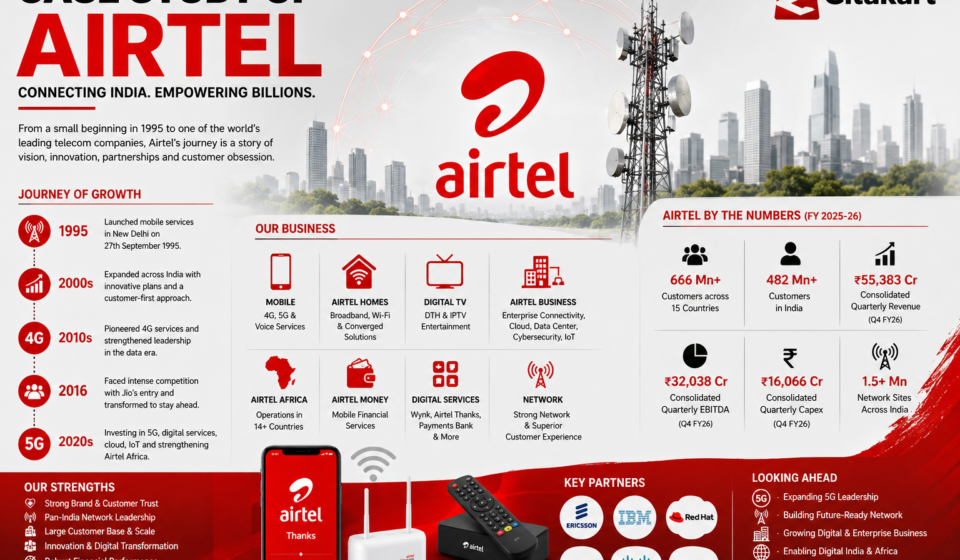
Case Study of Airtel: How Bharti Airtel Built, Survived and Reinvented One of India’s Most Powerful Telecom Brands – 2026

Introduction – Case Study of Airtel
Case Study of Airtel: The story of Bharti Airtel is one of the most important business case studies in India’s modern corporate history. Long before smartphones became part of everyday life, before 4G and 5G transformed mobile internet, and before companies such as Jio fundamentally changed India’s telecom pricing, Airtel was already attempting to solve a basic problem:
How can mobile communication become affordable, scalable and accessible to millions of Indians?
What began as a telecom venture in the 1990s eventually became a multinational communications company operating across India and Africa.
Airtel’s journey is particularly interesting because it has not been a straight-line success story. The company has faced regulatory uncertainty, enormous capital requirements, aggressive competitors, spectrum costs, technology transitions, debt pressure and the extraordinary disruption caused by Reliance Jio.
Yet Airtel survived.
More importantly, it repeatedly reinvented itself.
Today, Airtel describes itself as an integrated communications solutions provider, with businesses spanning mobile, broadband, digital TV, enterprise connectivity, cloud, data centres, cybersecurity, IoT and digital services. Its operations extend across India and Africa, with associate presence in Bangladesh and Sri Lanka. (Airtel)
As of the quarter ended March 31, 2026, Bharti Airtel reported an overall customer base of approximately 666 million across 15 countries, quarterly consolidated revenue of ₹55,383 crore, EBITDA of ₹32,038 crore, and India customer base of approximately 482 million. (Airtel Assets)
That scale makes Airtel far more than a traditional telecom company.
It is a case study in:
- entrepreneurship,
- strategic outsourcing,
- asset-light business models,
- pricing,
- customer acquisition,
- brand building,
- international expansion,
- infrastructure investment,
- crisis management,
- competitive strategy,
- digital transformation,
- and long-term corporate survival.
This article examines how Airtel was built, how its famous business model worked, how it responded to Jio, why its brand remained powerful, and what entrepreneurs can learn from its journey.
1. Company Overview
Company: Bharti Airtel Limited
Brand: Airtel
Founder: Sunil Bharti Mittal
Industry: Telecommunications and Digital Services
Corporate roots: Bharti Enterprises
Telecom journey: Began in 1995
Headquarters: New Delhi / Gurugram, India
Core markets: India and Africa
Major businesses: Mobile, Homes, Digital TV, Airtel Business, infrastructure and digital services
Airtel’s official corporate information states that the company was established as a public limited company on July 7, 1995, while its mobile-service history records the launch of cellular services in New Delhi on September 27, 1995. (Airtel)
The company’s business has since expanded dramatically.
Its current portfolio includes:
- Mobile telecommunications
- 4G
- 5G
- Broadband
- Fibre
- Digital TV
- IPTV
- Enterprise connectivity
- Cloud
- Data centres
- Cybersecurity
- IoT
- Digital financial services
- Communications platforms
- Network infrastructure
Airtel Business alone says it operates a global fibre network exceeding 400,000 route kilometres, with more than 120 edge data centres, 10+ large data centres, 34 international cables and 65 global points of presence. (Airtel)
This illustrates the scale of transformation from the company’s original mobile-phone business.
2. The Founder: Sunil Bharti Mittal
The Airtel story cannot be understood without understanding Sunil Bharti Mittal.
Mittal was an entrepreneur who entered business well before telecom became India’s growth engine.
Bharti Enterprises was founded in 1976 and eventually expanded into multiple sectors. Today, Bharti describes itself as having interests in areas including telecommunications, space communications, digital infrastructure, financial services, real estate and hospitality. (Airtel)
Mittal’s telecom opportunity emerged during the liberalisation of India’s telecommunications sector.
The government was opening the industry to private participation.
For an entrepreneur, this represented a major opportunity.
But telecom was also extremely capital intensive.
Building networks required:
- licences,
- spectrum,
- towers,
- switches,
- fibre,
- customer-service infrastructure,
- billing systems,
- retail distribution.
A small entrepreneur could not simply enter the market and build everything independently.
That constraint eventually helped shape one of Airtel’s most important strategic innovations.
3. Airtel’s Beginning
Airtel launched cellular services in New Delhi in September 1995.
At that time, mobile phones were not mass-market products.
They were expensive.
Handsets were expensive.
Calls were expensive.
Network infrastructure was expensive.
The average Indian consumer was nowhere near today’s level of mobile usage.
Mobile phones were primarily associated with:
- businesspeople,
- corporate executives,
- wealthy consumers,
- professionals,
- government officials.
The challenge was therefore not merely to sell mobile connections.
It was to make mobile communication economically viable for a much broader population.
4. The Original Telecom Problem
The telecom industry initially had a relatively simple economic problem.
Operators needed to build expensive networks.
But consumers were unwilling or unable to pay very high prices.
That created a difficult equation:
High infrastructure costs
Low consumer affordability
=
Difficult business model
Airtel’s response was to fundamentally rethink how the telecom business should be structured.
Instead of trying to own everything, the company increasingly focused on owning the customer relationship and core strategic assets, while partnering for many operational functions.
This became one of Airtel’s defining competitive advantages.
5. The Airtel Business Model Revolution
One of the most important aspects of Airtel’s history was its early move toward an asset-light operating model.
Instead of building every component internally, Airtel partnered with specialised companies for areas such as:
- network equipment,
- IT systems,
- network management,
- tower infrastructure,
- handset distribution,
- customer-facing services.
This allowed Airtel to concentrate on:
- brand,
- customer acquisition,
- spectrum,
- service design,
- pricing,
- distribution,
- strategic management.
The model became famous in management discussions because it challenged the conventional assumption that a telecom company needed to own and operate every layer of its network.
6. The “Minute Factory” Concept
Airtel’s early growth strategy is often described as the “minute factory” model.
The idea was relatively simple.
Instead of trying to make enormous profit from each individual call, Airtel wanted to:
Sell more minutes
at
lower prices
to
more customers.
The economics were based on scale.
Imagine a hypothetical operator earning ₹10 from one call.
It could instead try to earn ₹1 from ten calls.
Then ₹1 from one hundred calls.
The absolute economics depend on the underlying costs, but the strategic idea was:
Lower unit economics can work if volume increases dramatically and the cost structure is tightly controlled.
Recent reporting on Airtel’s transformation has again highlighted the importance of this original “minute factory” model and the company’s early outsourcing strategy. (The Economic Times)
7. Why Outsourcing Was So Important
Airtel’s outsourcing strategy allowed the company to avoid putting all of its capital into physical assets.
Instead of saying:
“We need to own the network equipment.”
Airtel increasingly thought:
“We need to deliver an excellent network to customers. Who is best positioned to operate the technology?”
This distinction is crucial.
A company doesn’t necessarily need to own every asset required to provide a service.
It needs to control the parts that create strategic value.
This principle became central to Airtel’s business model.
8. Strategic Partnerships
Airtel developed relationships with major technology and infrastructure companies.
This allowed the company to use specialised expertise without building every capability internally.
That strategy continues today.
For example, in 2025 Airtel signed a multi-year agreement with Ericsson under which Ericsson would provide network operations support across Airtel’s 4G, 5G NSA, 5G SA, fixed wireless access, private networks and network slicing environment. (Airtel)
This illustrates an important continuity.
Airtel’s philosophy has evolved, but partnership remains part of its DNA.
9. Customer First, Infrastructure Second
At first glance, this may sound strange for a telecom company.
Telecom is an infrastructure business.
But Airtel understood that the infrastructure only creates value when customers use it.
Therefore, the company’s real strategic asset was the combination of:
Network
Brand
Customer relationship
Distribution
Pricing
The network was essential.
But the customer relationship was where the long-term value existed.
10. The Power of the Airtel Brand
Airtel’s brand development was another major success.
The company did not position itself simply as a cheap telecom provider.
Its brand was designed to represent:
- connectivity,
- aspiration,
- lifestyle,
- technology,
- youth,
- quality.
Airtel’s own historical brand materials explain that the brand was positioned as an aspirational lifestyle brand rather than merely a tariff-based service. (Airtel)
This was an important distinction.
Airtel wanted customers to choose the brand because they trusted it, not merely because it was the cheapest.
11. The Name “Airtel”
The brand name itself was developed around the concept of telephony over airwaves.
Airtel’s historical annual-report material says the name “AirTel” was selected by Sunil Bharti Mittal, with several alternatives considered before settling on Airtel. (Airtel)
The name helped communicate:
- technology,
- communication,
- modernity.
This was important in the 1990s when mobile telecom represented the future.
12. Advertising as a Competitive Weapon
Airtel became famous for its advertising.
The brand invested heavily in emotional communication rather than relying entirely on price-based messaging.
Its campaigns often focused on:
- relationships,
- friendship,
- communication,
- youth,
- aspiration,
- national identity.
The famous Airtel tune became one of India’s most recognisable brand assets.
This created something powerful:
Brand memory.
When consumers hear the sound, see the red logo or encounter the brand name, they immediately associate it with telecommunications.
That kind of recognition takes years to build.
13. The Emotional Side of Telecom
Airtel understood something important:
Consumers don’t emotionally love telecom infrastructure.
They don’t wake up thinking:
“I want a better base station.”
They care about what connectivity allows them to do.
They want to:
- call family,
- talk to friends,
- watch videos,
- use social media,
- work,
- study,
- shop.
Therefore, Airtel’s marketing focused on human outcomes, not technical infrastructure.
This remains an important marketing lesson.
14. Expansion Across India
After launching in Delhi, Airtel expanded into other markets.
Its historical timeline records expansion into Himachal Pradesh in 1996 and later acquisitions and launches across additional states. In 1999, Bharti acquired a majority stake in JT Mobiles, enabling expansion in Karnataka and Andhra Pradesh. (Airtel)
The strategy was clear:
Build scale quickly.
Telecom economics favour scale because:
- network costs are high,
- customers are recurring,
- infrastructure can serve many users,
- brand investments can be spread over a larger base.
Airtel therefore needed to become a national operator rather than remain a regional player.
15. The Importance of Scale
Suppose an operator spends ₹100 crore on infrastructure.
If it serves:
1 lakh customers
the infrastructure cost per customer is extremely high.
But if it serves:
10 million customers
the economics become much more attractive.
This is why telecom businesses constantly pursue:
- subscriber growth,
- network utilisation,
- market share,
- spectrum efficiency.
Airtel understood this very early.
16. The Indian Telecom Boom
During the late 1990s and 2000s, India’s mobile market exploded.
Several factors contributed:
- liberalisation,
- falling handset prices,
- expanding networks,
- prepaid plans,
- lower tariffs,
- rising incomes,
- urbanisation,
- improved distribution.
Airtel was one of the companies best positioned to benefit.
17. Prepaid as a Growth Engine
One of the major innovations in India’s telecom market was prepaid mobile.
Prepaid allowed consumers to:
- control spending,
- avoid contracts,
- recharge in small amounts,
- use mobile services without a bank account.
This was particularly important in a country where many consumers had irregular incomes.
Prepaid transformed mobile phones from an elite product into a mass-market product.
Airtel’s distribution network became extremely important in supporting this model.
18. The Retail Distribution Network
Airtel needed its customers to be able to recharge almost anywhere.
That meant building relationships with:
- small retailers,
- mobile shops,
- distributors,
- supermarkets,
- electronics stores.
The result was an enormous physical network.
This became a competitive advantage.
A new competitor could offer a great plan.
But if consumers couldn’t easily buy or recharge it, adoption would be limited.
19. The Real Airtel Moat
Airtel’s moat was never simply its SIM card.
Its competitive advantage came from the combination of:
- brand,
- network,
- spectrum,
- distribution,
- customer base,
- partnerships,
- technology,
- scale,
- financial resources.
This is important because individual telecom features are relatively easy to copy.
The system is difficult to copy.
20. Airtel’s International Expansion
Airtel eventually expanded beyond India.
Africa became one of the company’s most important international markets.
This was a bold move.
International expansion creates significant risks:
- currency fluctuations,
- political uncertainty,
- different regulations,
- different consumer behaviour,
- infrastructure challenges,
- taxation,
- competitive differences.
Yet Africa also represented a huge connectivity opportunity.
21. Why Africa?
Many African markets had characteristics that were attractive to a telecom operator:
- relatively low mobile penetration in some markets,
- large young populations,
- growing demand for mobile connectivity,
- limited fixed-line infrastructure,
- increasing smartphone adoption,
- strong need for mobile financial services.
Airtel could bring its experience in:
- prepaid,
- low-cost telecom,
- distribution,
- mobile financial services,
- network scaling.
The strategy was therefore transferable.
22. Airtel Africa
Airtel Africa eventually became a major part of the group’s international operations.
Airtel’s FY2024–25 report recorded 166.1 million Africa customers at year-end. (Airtel)
The Africa business has also developed Airtel Money, which has become an important financial-services platform.
In FY2024–25, Airtel reported that Airtel Money revenue grew 30% and EBITDA grew 32% on a constant-currency basis. (Airtel Assets)
This is significant.
Airtel took a connectivity business and expanded it into financial services.
23. Mobile Money: A Second Business Model
In Africa, mobile phones often serve as more than communication devices.
They can also become:
- wallets,
- payment systems,
- banking tools,
- money-transfer systems.
This created a huge opportunity.
Airtel Money allows the company to monetise customer relationships beyond voice and data.
This provides a useful lesson:
When you have a large customer base, look for adjacent services that solve another major problem for the same customer.
24. The Digital Transformation
Airtel eventually expanded beyond telecom.
Its portfolio today includes:
Mobile
4G and 5G connectivity.
Homes
Broadband and fixed-line services.
Digital TV
DTH and IPTV.
Airtel Business
Enterprise connectivity and technology services.
Cloud
Enterprise cloud infrastructure.
Data centres
Digital infrastructure.
Cybersecurity
Protection and enterprise security.
IoT
Connected devices and industrial applications.
This transformation reflects the broader evolution of telecom.
25. Telecom Is No Longer Just Telecom
Traditional telecom operators once sold:
- calls,
- SMS.
Then they sold:
- data.
Now they increasingly sell:
- connectivity,
- entertainment,
- cloud,
- cybersecurity,
- financial services,
- IoT,
- enterprise technology.
The telecom network has become a platform.
Airtel has followed this evolution.
26. Airtel Homes
Airtel expanded into fixed broadband and home services.
The logic was simple.
A customer who uses Airtel mobile may also need:
- home internet,
- television,
- streaming,
- Wi-Fi,
- connected devices.
Therefore:
Mobile customer
can become
Home customer.
Airtel’s FY2024–25 report says its Homes business served customers across 1,476 Indian cities and delivered 18.8% year-on-year revenue growth. (Airtel)
27. Airtel Xstream Fiber
Airtel’s broadband proposition has evolved into an integrated home entertainment and connectivity offering.
Instead of selling only internet access, the company increasingly combines:
- broadband,
- entertainment,
- streaming,
- Wi-Fi,
- digital TV.
This increases customer lifetime value.
28. Airtel Digital TV
Digital TV was another major adjacent business.
The company’s DTH service competes in India’s television and entertainment market.
But television itself is changing.
Consumers are moving toward:
- OTT,
- streaming,
- IPTV,
- on-demand video.
Airtel therefore has had to evolve from a traditional DTH operator toward a broader entertainment platform.
29. Airtel Business
Airtel Business is an important part of the company’s diversification.
It serves:
- large enterprises,
- government,
- SMEs,
- global carriers,
- OTT platforms,
- multinational corporations.
Its portfolio includes:
- connectivity,
- cloud,
- cybersecurity,
- IoT,
- communications,
- data centres,
- enterprise networking.
Airtel Business currently describes itself as a major secure connectivity and technology communications provider, with more than 1 million small and medium businesses among its customer base. (Airtel)
30. Why Enterprise Telecom Matters
Consumer telecom can be highly price-sensitive.
Enterprise customers can have different economics.
Businesses may pay for:
- dedicated connectivity,
- security,
- cloud,
- data centres,
- managed services,
- IoT,
- private networks.
These services can create higher-value and longer-term relationships.
Therefore, Airtel’s enterprise business reduces its dependence on consumer mobile revenue.
31. The Jio Shock
Airtel’s greatest modern strategic challenge came from Reliance Jio.
When Jio commercially launched in 2016, the telecom industry changed dramatically.
Jio introduced:
- very aggressive data pricing,
- free voice,
- high-speed 4G,
- simple plans,
- massive customer acquisition.
It forced the industry into a price war and triggered consolidation.
Airtel had to respond.
32. Why Jio Was So Dangerous
Jio had several structural advantages.
It was building a modern network from scratch.
It had enormous financial backing.
It could pursue aggressive pricing.
It entered with no large legacy customer base.
Airtel, by contrast, already had:
- millions of customers,
- older infrastructure,
- legacy technologies,
- existing employees,
- existing contracts,
- spectrum commitments.
This created what can broadly be described as a legacy burden.
33. Airtel’s Response to Jio
Airtel’s response was not simply to copy Jio.
Instead, the company focused increasingly on:
- network quality,
- premium customers,
- 4G/5G migration,
- higher ARPU,
- broadband,
- enterprise services,
- digital products,
- customer experience.
This was strategically important.
If Airtel tried to permanently win through the lowest price, it could destroy its own economics.
Instead, it sought to compete through:
Value + quality + network + brand.
34. Airtel’s Premium Customer Strategy
Airtel increasingly focused on acquiring and retaining higher-quality customers.
Its current strategy explicitly refers to acquiring and retaining “quality customers” and delivering differentiated services. (Airtel)
This is a major strategic shift.
Rather than saying:
“We want every customer regardless of economics.”
the company increasingly asks:
“Which customers generate sustainable long-term value?”
That is a much healthier business model.
35. ARPU as a Strategic Metric
One of the most important telecom metrics is:
ARPU — Average Revenue Per User.
Airtel has repeatedly argued that the Indian telecom industry needs healthier ARPU levels to support network investment.
In June 2024, Airtel stated that mobile ARPU needed to be above ₹300 for a financially healthy telecom business capable of supporting spectrum and network investment. (Airtel)
This reveals a central tension.
Consumers want:
Lower prices.
Operators need:
Higher revenue.
Networks require:
Huge investment.
The industry must find the balance.
36. Airtel’s 2024 Tariff Strategy
In July 2024, Airtel raised mobile tariffs.
The company said it wanted to maintain affordability while improving industry economics, with less than ₹0.70 per day added to entry-level plans. It also offered unlimited 5G data to customers on eligible 2GB-per-day and above plans. (Airtel)
This illustrates a major change from the early Airtel model.
The company is no longer primarily fighting to make mobile affordable.
It is now trying to make telecom financially sustainable.
37. Airtel’s 4G Strategy
After Jio’s launch, Airtel accelerated its 4G deployment.
The company focused on:
- spectrum efficiency,
- network densification,
- fibre backhaul,
- 4G customer migration.
The objective was to ensure that its customers experienced strong data connectivity.
This was critical because network quality became one of the main ways Airtel could differentiate itself.
38. Network Quality as a Brand
Telecom is unusual because consumers can experience the infrastructure directly.
If a network works:
Brand trust increases.
If calls fail:
Brand trust decreases.
Therefore, network performance is effectively part of marketing.
Airtel’s current strategy describes its focus on a “brilliant experience” across the customer lifecycle and integrated digital services. (Airtel)
39. Airtel 5G
Airtel entered the 5G era with Airtel 5G Plus.
The company has continued expanding 5G coverage across India.
Its current coverage information lists numerous cities and towns across states, including many locations in West Bengal. (Airtel)
The strategic objective is not merely to provide faster smartphone speeds.
5G can support:
- private networks,
- IoT,
- industrial automation,
- fixed wireless access,
- enterprise applications,
- network slicing,
- low-latency services.
40. Airtel’s Move Toward 5G Standalone
Initially, Airtel’s 5G deployment relied heavily on non-standalone architecture.
But the company is now preparing for broader 5G Standalone capabilities.
In February 2025, Airtel announced a collaboration with Ericsson to deploy Ericsson’s 5G Core solutions, supporting Airtel’s transition toward a commercially live full-scale 5G Standalone network over time. (Airtel)
This matters because 5G Standalone can unlock more advanced capabilities.
41. Network Slicing
One such capability is network slicing.
In simple terms, network slicing allows an operator to create specialised virtual network environments for different applications.
For example:
Consumer slice
Normal smartphone usage.
Industrial slice
High reliability.
Healthcare slice
Low latency and security.
Enterprise slice
Dedicated business requirements.
This could create new revenue opportunities for Airtel.
42. Airtel and Cloud
Airtel is also becoming more deeply involved in cloud infrastructure.
Its current corporate materials highlight Airtel Cloud, including sovereign cloud capabilities for Indian enterprises. (Airtel)
This is strategically important because telecom networks increasingly resemble distributed computing platforms.
The future network is not just:
Tower → Phone
It increasingly becomes:
Tower → Edge → Cloud → AI → Application → Customer
Airtel is positioning itself across these layers.
43. Airtel and IBM/Red Hat
In 2020, Airtel announced a partnership with IBM and Red Hat to build an open hybrid-cloud network.
The objective was to make the network:
- more flexible,
- more automated,
- more scalable,
- better suited for 5G,
- capable of supporting edge computing,
- capable of enabling new B2B and B2C services. (Airtel)
This demonstrates that Airtel’s technology strategy has moved far beyond traditional telecom hardware.
44. Airtel’s Business Model Today
A simplified representation looks like this:
Mobile
↓
Home Broadband
↓
Digital TV
↓
Enterprise
↓
Cloud & Data Centres
↓
Cybersecurity
↓
IoT
↓
Digital Services
↓
Integrated Digital Ecosystem
This creates multiple sources of revenue.
45. The Airtel Flywheel
Airtel’s current strategy can be understood through a flywheel:
Strong network
↓
Customer acquisition
↓
Higher usage
↓
Higher ARPU
↓
More cash flow
↓
Network investment
↓
Better experience
↓
Higher customer retention
↓
More customers
This is a sustainable version of the growth cycle.
46. Airtel’s Strategy According to the Company
Airtel’s stated strategy is built around several concepts:
Win customers for life
Build long-term customer relationships.
Quality customers
Focus on economically valuable segments.
Brilliant experience
Improve every customer interaction.
Services at scale
Build digital services across a large customer base.
Micromarketing
Use customer data to personalise offers and channels.
War on waste
Simplify operations and reduce unnecessary costs.
People One Airtel
Create a unified organisational culture. (Airtel)
These principles reveal how Airtel has evolved from a pure telecom operator into a sophisticated digital company.
47. “War on Waste”
This concept deserves particular attention.
Telecom businesses have enormous operating costs.
Waste can exist in:
- energy,
- network equipment,
- logistics,
- customer acquisition,
- retail,
- maintenance,
- IT systems,
- duplicated processes.
Airtel’s stated “war on waste” strategy focuses on simplification, collaboration and better utilisation of assets. (Airtel)
This is especially important in a mature market.
When revenue growth becomes harder, cost efficiency becomes a major source of profitability.
48. Airtel’s Financial Scale
Airtel’s FY2024–25 corporate information reported:
Revenue: ₹1,729,852 million
or approximately ₹1.73 lakh crore
EBITDA: ₹942,489 million
or approximately ₹94,249 crore. (Airtel)
The company’s customer base at March 2025 included:
- 361.6 million India mobile customers,
- 10 million Homes customers,
- 15.9 million Digital TV customers,
- 166.1 million Africa customers. (Airtel)
These numbers demonstrate the enormous scale of the business.
49. The 2026 Position
By the quarter ended March 31, 2026, Airtel reported:
Global customers
Approximately 666 million
India customers
Approximately 482 million
Quarterly consolidated revenue
Approximately ₹55,383 crore
Quarterly EBITDA
Approximately ₹32,038 crore
India quarterly revenue
Approximately ₹39,566 crore
India quarterly EBITDA
Approximately ₹23,965 crore. (Airtel Assets)
The company has therefore continued to grow despite an extremely competitive Indian telecom market.
50. Airtel vs Jio
Airtel and Jio represent two different strategic approaches.
| Factor | Airtel | Jio |
|---|---|---|
| Origin | Telecom incumbent | Greenfield digital challenger |
| Network | Legacy + modernised | Modern greenfield architecture |
| Strategy | Quality + premium + ecosystem | Scale + affordability + ecosystem |
| Brand | Long-established | New-generation digital brand |
| International | Strong Africa presence | Primarily India-focused |
| Enterprise | Very strong | Growing rapidly |
| Distribution | Extensive | Extensive |
| Customer strategy | Quality customers | Massive scale |
| Core advantage | Brand + network + experience | Scale + infrastructure + ecosystem |
Neither strategy is automatically superior.
They reflect different starting positions.
51. Why Airtel Survived Jio
This is perhaps the most important question in the entire case study.
Many companies were severely damaged by Jio’s entry.
Airtel survived because it had:
1. Strong brand equity
Customers trusted Airtel.
2. Network quality
Airtel continued investing.
3. Scale
It had a huge customer base.
4. Financial resources
It could invest and absorb pressure.
5. Premium positioning
It focused increasingly on higher-value customers.
6. Enterprise business
B2B revenue diversified the business.
7. Africa
International operations created additional scale.
8. Broadband
The company had another growth engine.
9. Digital ecosystem
Airtel expanded beyond connectivity.
52. The Importance of Customer Quality
This is one of Airtel’s most important strategic lessons.
Not all customers are equally valuable.
Consider two customers.
Customer A
Pays ₹100/month.
Consumes little data.
High support costs.
Customer B
Pays ₹500/month.
Uses multiple services.
Has broadband.
Uses entertainment.
Rarely churns.
Customer B is far more valuable.
Therefore, Airtel increasingly focused on customer quality rather than raw subscriber numbers.
53. Customer Lifetime Value
Airtel’s business can be understood through customer lifetime value.
A customer might start with:
Prepaid mobile
Then upgrade to:
Postpaid
Then add:
Broadband
Then:
Entertainment
Then:
Family connections
Then:
Cloud or enterprise services
The longer Airtel retains the customer, the greater the lifetime value.
54. Convergence Strategy
Airtel increasingly uses a convergence strategy.
One customer can use:
- mobile,
- broadband,
- television,
- entertainment,
- digital services.
This creates a stronger relationship.
Instead of selling one product, Airtel sells an integrated connectivity experience.
55. The Importance of Broadband
Mobile is powerful.
But home broadband can create stronger customer relationships.
A family may depend on its home connection for:
- work,
- education,
- streaming,
- gaming,
- smart devices.
This increases switching friction.
Therefore, Airtel’s Homes strategy is strategically important.
56. Enterprise as a Defensive Moat
Airtel Business also provides a significant defensive advantage.
A consumer can switch mobile providers relatively easily.
A large enterprise with:
- international connectivity,
- cloud systems,
- cybersecurity,
- data centres,
- IoT,
- managed networks
cannot switch providers overnight.
Enterprise relationships can therefore be deeper and longer-term.
57. Airtel’s International Diversification
Africa reduces Airtel’s dependence on India.
But international operations also create risks.
Benefits
- larger customer base,
- diversified revenue,
- mobile-money opportunity,
- growth markets.
Risks
- currency depreciation,
- political instability,
- regulatory uncertainty,
- lower purchasing power,
- infrastructure challenges.
Airtel must balance both.
58. SWOT Analysis of Airtel
Strengths
Strong brand
Airtel is one of India’s most recognisable consumer brands.
Large customer base
Hundreds of millions of customers.
Strong network
Extensive 4G/5G infrastructure.
Enterprise strength
Large B2B business.
Broadband
Strong Homes business.
Africa
Significant international footprint.
Financial scale
Large revenue and EBITDA base.
Partnerships
Deep relationships with global technology companies.
59. Weaknesses
High capital intensity
Telecom requires constant investment.
Regulatory dependence
Spectrum and tariffs are regulated.
Legacy infrastructure
Airtel has operated networks for decades.
Large organisational complexity
Managing hundreds of millions of customers is difficult.
Competitive pressure
Jio remains a powerful competitor.
Debt and financing needs
Telecom expansion requires substantial capital.
60. Opportunities
5G
Enterprise and consumer use cases.
AI
Network intelligence and customer services.
Cloud
Sovereign cloud and enterprise technology.
IoT
Connected industry.
Private 5G
Industrial networks.
Broadband
Home connectivity.
Financial services
Digital payments and financial products.
Africa
Mobile money and data growth.
Cybersecurity
Increasing enterprise demand.
61. Threats
Jio
Powerful domestic competitor.
Vodafone Idea
Continued competitive pressure.
Regulatory changes
Tariff, spectrum and taxation decisions.
Cybersecurity
Increasing attack sophistication.
Technology disruption
Satellite internet and alternative connectivity.
Price sensitivity
Indian consumers remain highly price conscious.
Currency volatility
Particularly relevant to Africa.
62. Porter’s Five Forces
1. Competitive Rivalry — Extremely High
The Indian telecom industry is highly competitive.
Airtel competes primarily with:
- Jio,
- Vodafone Idea,
- BSNL.
Network quality and pricing are constantly compared.
2. Threat of New Entrants — Low
Telecom has enormous entry barriers.
A new entrant requires:
- spectrum,
- licences,
- towers,
- fibre,
- technology,
- capital,
- distribution.
Therefore, new national entrants are difficult.
3. Supplier Power — Moderate
Equipment suppliers have influence.
However, Airtel’s enormous scale gives it significant bargaining power.
4. Buyer Power — High
Customers can change operators.
Number portability makes switching relatively easy.
Airtel therefore must continuously provide value.
5. Threat of Substitutes — Moderate
Potential substitutes include:
- Wi-Fi,
- satellite connectivity,
- fixed broadband,
- private networks.
But mobile connectivity remains fundamental.
63. Airtel’s Marketing Strategy
Airtel’s marketing can be divided into several stages.
Stage 1 — Aspirational telecom
Mobile communication as a premium lifestyle.
Stage 2 — Mass connectivity
Affordable mobile services.
Stage 3 — Data revolution
4G and mobile internet.
Stage 4 — Network quality
Differentiation against Jio.
Stage 5 — Digital lifestyle
Entertainment, broadband and digital services.
Stage 6 — Integrated ecosystem
Mobile + home + enterprise + cloud + digital services.
The brand has therefore evolved with the industry.
64. Why Airtel Did Not Become a Low-Price Brand
This is an important strategic decision.
If Airtel had tried to permanently become the cheapest operator, it could have entered a destructive price war.
Instead, the company increasingly positioned itself around:
- quality,
- reliability,
- network,
- customer experience.
This creates a more sustainable competitive position.
65. The Power of Differentiation
Airtel’s strategy demonstrates that:
You don’t always have to be the cheapest to win.
A company can charge more if customers believe it provides:
- better quality,
- better coverage,
- better service,
- better reliability,
- better experience.
This is especially relevant in telecom.
When the network is used every day, reliability becomes valuable.
66. The Airtel Customer Experience Strategy
Airtel’s current strategy explicitly emphasises customer experience from “Search to Referral.” (Airtel)
That means the company is thinking about:
- discovery,
- acquisition,
- onboarding,
- usage,
- support,
- renewal,
- upgrade,
- referral.
This is a lifecycle approach rather than a single transaction.
67. Micromarketing
Airtel also focuses on micromarketing.
The idea is to use customer data and a unified customer view to deliver more relevant offers.
Instead of sending every customer the same message, the company can potentially differentiate:
- heavy data users,
- low-value users,
- premium customers,
- families,
- broadband users,
- enterprise customers.
This increases marketing efficiency.
68. Data as a Business Asset
Telecom companies generate enormous amounts of data.
They can understand:
- usage patterns,
- network congestion,
- customer preferences,
- recharge behaviour,
- churn probability,
- geographic demand.
When used responsibly and within privacy rules, this information can improve:
- network planning,
- customer experience,
- product design,
- marketing.
Airtel’s future strategy increasingly depends on using data intelligently.
69. Artificial Intelligence
AI is becoming increasingly important to Airtel.
The company describes its current network strategy as incorporating AI-powered platforms. (Airtel)
AI can be used for:
- network optimisation,
- fraud detection,
- spam detection,
- customer support,
- predictive maintenance,
- demand forecasting,
- personalised marketing.
This could significantly reduce operating costs while improving service.
70. Airtel’s Spam Protection
One example is Airtel’s use of AI and network intelligence to detect and block spam.
This is strategically important because spam calls and messages directly affect customer experience.
A network that protects users from unwanted communications can differentiate itself.
This demonstrates how telecom infrastructure can become an intelligent customer-protection platform.
71. Airtel and Cybersecurity
As connectivity increases, cybersecurity becomes increasingly important.
Airtel’s enterprise business includes cybersecurity services.
The company has also been expanding partnerships and capabilities in this area.
This represents another adjacency:
Network
↓
Data
↓
Security
The company already sits at the centre of digital communications, making cybersecurity a natural extension.
72. Airtel Cloud
Cloud is another major opportunity.
Enterprises increasingly need:
- computing,
- storage,
- backup,
- disaster recovery,
- data residency,
- security.
Airtel can leverage its:
- network,
- data centres,
- enterprise relationships.
This gives it an advantage over standalone cloud providers in certain use cases.
73. The Network-as-a-Platform Concept
The future Airtel business could increasingly resemble:
Network
Cloud
AI
Security
Data
Applications
This is very different from the old telecom model of:
Calls + SMS.
74. The Asset-Light Lesson
Airtel’s early outsourcing strategy provides a powerful business lesson.
Entrepreneurs often think:
“I need to own everything.”
Airtel demonstrated another approach:
Own the customer and strategic capabilities; partner for specialised infrastructure where appropriate.
This can reduce:
- capital requirements,
- operational complexity,
- technology risk.
At the same time, it allows the company to focus management attention on what matters most.
75. Partnership as a Strategic Weapon
Airtel’s history shows that partnerships can be a source of competitive advantage.
Partners can provide:
- technology,
- infrastructure,
- expertise,
- global reach,
- innovation.
A company does not need to develop everything internally.
It needs to build a strong ecosystem.
76. The “Focus on Core Competence” Lesson
Airtel’s core strengths historically included:
- customer acquisition,
- brand,
- telecom service design,
- distribution,
- spectrum,
- strategic management.
It partnered for many technical and infrastructure functions.
This is an example of focusing on core competence.
77. The Airtel Africa Lesson
Airtel’s African expansion provides another lesson:
Replicate the model, not necessarily the product.
The Indian model of:
- prepaid,
- affordable connectivity,
- distribution,
- mobile money,
could be adapted to different markets.
The company did not simply copy every Indian practice.
It adapted to local conditions.
78. The Importance of Localisation
International businesses must understand:
- culture,
- regulation,
- income levels,
- payment systems,
- consumer behaviour.
Airtel’s Africa operations demonstrate the need to adapt.
For example, mobile money became far more important in some African markets than it was in India’s original telecom business.
79. Airtel as a Case Study in Survival
Perhaps the greatest lesson is not Airtel’s early success.
It is its survival.
The company survived:
- industry liberalisation,
- intense price competition,
- regulatory changes,
- technological disruption,
- spectrum auctions,
- consolidation,
- the Jio shock,
- the shift from voice to data.
That is remarkable.
80. Why Survival Matters
Many businesses can grow when market conditions are favourable.
The real test comes when the rules change.
Airtel’s strategy repeatedly changed.
Voice era
Focus on minutes.
Data era
Focus on 3G/4G.
Jio era
Focus on quality and premium customers.
5G era
Focus on network leadership.
Digital era
Focus on cloud, enterprise and platforms.
The company evolved.
81. Airtel’s Transformation Formula
Airtel’s journey can be represented as:
Telecom Licence
↓
Network
↓
Customers
↓
Brand
↓
Scale
↓
Data
↓
Broadband
↓
Enterprise
↓
Digital Services
↓
Cloud + AI + 5G
↓
Integrated Digital Infrastructure Company
82. What Small Businesses Can Learn From Airtel
The Airtel case is relevant even to small businesses.
Lesson 1: Don’t build everything yourself.
Use partners.
Lesson 2: Focus on your core competence.
Don’t waste capital on non-core activities.
Lesson 3: Build a brand.
Price alone is not enough.
Lesson 4: Scale distribution.
A great product needs reach.
Lesson 5: Build recurring revenue.
Subscriptions are powerful.
Lesson 6: Diversify carefully.
Add services around existing customers.
Lesson 7: Prepare for disruption.
Never assume today’s business model will remain unchanged.
83. The Airtel Formula for Customer Loyalty
Airtel’s strategy can be simplified as:
Good network
Good experience
Trusted brand
Useful ecosystem
Reasonable price
=
Long-term customer relationship
This is more sustainable than competing purely on discounts.
84. The Importance of Brand Equity
Brand equity is invisible on a balance sheet in the same way physical infrastructure is.
But it has enormous economic value.
A strong brand can reduce:
- customer acquisition cost,
- switching,
- marketing friction.
It can also increase:
- trust,
- pricing power,
- customer retention.
Airtel’s decades of branding provide exactly this advantage.
85. Airtel’s Financial Model
At a high level, the telecom model can be represented as:
Customers
×
ARPU
=
Revenue
Revenue then funds:
- network investment,
- spectrum,
- employees,
- distribution,
- marketing,
- technology,
- finance costs.
The objective is to maximise:
Customer lifetime value
while controlling:
Cost per customer.
86. The Importance of ARPU Growth
Airtel’s future profitability depends heavily on ARPU.
If:
Customers ↑
and
ARPU ↑
then revenue can grow rapidly.
But if customer growth is flat and ARPU declines, profitability becomes difficult.
This is why Airtel has supported industry tariff increases.
The company argues that healthy ARPU is necessary to fund network and spectrum investment. (Airtel)
87. Capital Expenditure
Telecom is a capital-intensive industry.
Airtel must continuously invest in:
- spectrum,
- towers,
- fibre,
- 4G,
- 5G,
- data centres,
- cloud,
- enterprise networks.
In Q4 FY2025–26 alone, Airtel reported consolidated capex of approximately ₹16,066 crore, including ₹13,488 crore in India. (Airtel Assets)
This demonstrates how expensive network leadership can be.
88. The Network Investment Dilemma
Airtel faces a constant dilemma.
If it invests too little:
Network quality declines.
If it invests too much:
Returns may decline.
Therefore, network investment must be optimised.
The goal is:
Maximum customer value per rupee of capital expenditure.
This is where AI, automation and network analytics become increasingly important.
89. Sustainability
Telecom networks consume significant amounts of energy.
Airtel has been working on:
- greener network sites,
- solarisation,
- reduced diesel consumption,
- energy efficiency.
Its FY2024–25 annual report highlights these efforts as part of its broader sustainability approach. (Airtel Assets)
This is becoming strategically important as networks expand.
90. Airtel’s Corporate Social Responsibility
The Bharti Airtel Foundation has been involved in education initiatives since 2000.
Its programmes focus particularly on education and opportunities for underserved communities. (Airtel)
This demonstrates that Airtel’s corporate identity extends beyond commercial telecom operations.
91. The Future of Airtel
Airtel’s next chapter is likely to revolve around several major themes:
5G
Moving from consumer connectivity to enterprise applications.
Cloud
Building Indian enterprise cloud infrastructure.
AI
Using artificial intelligence across network and customer operations.
Cybersecurity
Protecting increasingly digital enterprises.
IoT
Connecting machines, vehicles and industrial systems.
Broadband
Expanding home connectivity.
Enterprise
Growing B2B digital services.
Africa
Increasing mobile money and data monetisation.
92. The AI + Telecom Opportunity
One of the biggest future opportunities is the combination of:
AI + Network
AI can predict:
- network congestion,
- equipment failures,
- customer churn,
- fraud,
- spam.
This can lower operating costs.
But the bigger opportunity may be:
AI + Customer
Personalised services could become a major source of differentiation.
93. Airtel’s Biggest Future Challenge
The biggest strategic challenge is no longer survival.
Airtel has demonstrated that it can survive.
The challenge is:
How does Airtel become more valuable without becoming significantly more expensive?
The company must simultaneously:
- improve network quality,
- increase ARPU,
- expand services,
- control costs,
- invest in 5G,
- grow enterprise,
- grow Africa,
- build cloud,
- deploy AI.
That requires exceptional execution.
94. The Jio-Airtel Competitive Future
The Indian telecom market is likely to remain dominated by a small number of major operators.
Jio and Airtel are the two strongest private-sector competitors.
Their competition will increasingly be about:
- 5G,
- broadband,
- AI,
- enterprise,
- cloud,
- content,
- customer experience,
- premium services.
The battle is no longer simply:
“Who offers the cheapest SIM?”
It is becoming:
“Who can build the best digital ecosystem around the customer?”
95. Airtel’s Strategic Position
Airtel’s strongest strategic position may be its balance.
It has:
- enormous scale,
- premium customers,
- enterprise relationships,
- international exposure,
- network infrastructure,
- broadband,
- brand strength.
This gives it multiple sources of resilience.
96. The Airtel Business Case in One Sentence
If the entire Airtel story had to be summarised in one sentence:
Airtel transformed telecommunications from an expensive elite service into a mass-market business by combining scale, outsourcing, distribution, branding and operational efficiency—and later survived digital disruption by reinventing itself as an integrated connectivity and technology company.
97. The Airtel Flywheel
The complete business flywheel looks like this:
Strong Brand
↓
Customer Acquisition
↓
Large Customer Base
↓
Higher Network Utilisation
↓
Better Unit Economics
↓
Network Investment
↓
Better Experience
↓
Higher Customer Retention
↓
Higher ARPU
↓
More Cash Flow
↓
More Investment
↓
Stronger Airtel
98. Airtel’s Most Important Strategic Lessons
| Area | Airtel Strategy | Business Lesson |
|---|---|---|
| Pricing | Affordable mass-market telecom | Volume can create scale |
| Operations | Outsourcing and partnerships | Don’t own everything |
| Branding | Aspirational brand | Brand creates pricing power |
| Distribution | Massive retail network | Reach matters |
| Scale | National expansion | Fixed costs need scale |
| International | Africa expansion | Successful models can travel |
| Innovation | 4G, 5G, cloud, AI | Reinvent continuously |
| Competition | Quality vs price | Don’t always compete on price |
| Enterprise | B2B digital services | Diversify revenue |
| Broadband | Homes strategy | Increase customer lifetime value |
| Mobile money | Airtel Money in Africa | Monetise adjacent needs |
| Technology | Cloud-native networks | Telecom is becoming software |
| Customer | Quality customers | Not all users have equal value |
| Cost | War on waste | Efficiency matters at scale |
| Partnerships | Ericsson, IBM, Red Hat and others | Ecosystems accelerate innovation |
99. What Makes Airtel a Great Business Case Study?
Airtel is particularly valuable as a business case because it demonstrates multiple business models within one company.
It began as:
Telecom operator
Then became:
Mass-market connectivity provider
Then:
Data company
Then:
Broadband provider
Then:
Digital TV provider
Then:
Enterprise technology company
Then:
Cloud and digital infrastructure company
And increasingly:
AI-enabled digital platform.
Few companies demonstrate such a broad transformation.
100. Final Conclusion
The Airtel story is ultimately a story about adaptation.
The company did not succeed because it had one perfect strategy from the beginning.
It succeeded because it repeatedly changed its strategy as the market changed.
In the 1990s, the problem was:
How can mobile phones become affordable?
Airtel responded through:
- scale,
- prepaid,
- distribution,
- operational efficiency,
- partnerships.
In the 2000s, the challenge became:
How can Airtel become a national telecom leader?
The company expanded across India.
Then the opportunity became:
How can the model work internationally?
Airtel expanded into Africa.
Then the market shifted toward:
Data and smartphones.
Airtel invested in 3G and 4G.
Then Jio arrived and changed the rules.
Airtel responded with:
- network quality,
- premium customers,
- stronger ARPU,
- 4G/5G,
- broadband,
- enterprise,
- digital services.
Then the industry moved toward:
5G, cloud, AI and digital infrastructure.
Airtel began investing in those areas as well.
That is the deepest lesson from the company.
Airtel did not survive by defending the past.
It survived by repeatedly rebuilding the future.
From a mobile operator launched in Delhi in 1995 to a company with approximately 666 million customers across 15 countries as of March 2026, Airtel has demonstrated how scale, brand, partnerships, infrastructure and strategic reinvention can create extraordinary long-term resilience. (Airtel)
Its current business is increasingly built around a powerful combination:
Mobile
5G
Broadband
Enterprise
Cloud
Cybersecurity
IoT
Digital Services
AI
This means Airtel’s future is no longer simply about connecting phones.
It is about connecting people, homes, businesses, machines and digital services.
And that is what makes Airtel one of India’s most valuable business case studies.
The Airtel formula can ultimately be summarised as:
Build scale → control the customer relationship → partner intelligently → keep costs disciplined → build the brand → invest in network quality → adapt to disruption → diversify around the customer → continuously reinvent.
That formula helped Airtel survive one of the most competitive industries in the world.
And it offers a powerful lesson for every entrepreneur:
A successful business is not the one that never changes. It is the one that knows what must never change—and what must change before the market forces it to.

[…] India Case Study: The story of Dabur India is one of the most fascinating business case studies in Indian […]