






Case Study of Vodafone Idea (Vi): The Merger, Crisis, Survival and Turnaround of India’s Third-Largest Telecom Operator – 2026

Introduction
Case Study of Vodafone Idea: The story of Vodafone Idea Limited (Vi) is one of the most complex and fascinating business case studies in India’s telecom industry.
It is not simply a story of a successful company.
It is a story of two major telecom brands coming together to survive an unprecedented market disruption, followed by years of financial stress, customer losses, network underinvestment, regulatory liabilities and intense competition from Reliance Jio and Bharti Airtel.
At the same time, Vi’s recent performance shows why the company should not be viewed only through the lens of its past difficulties.
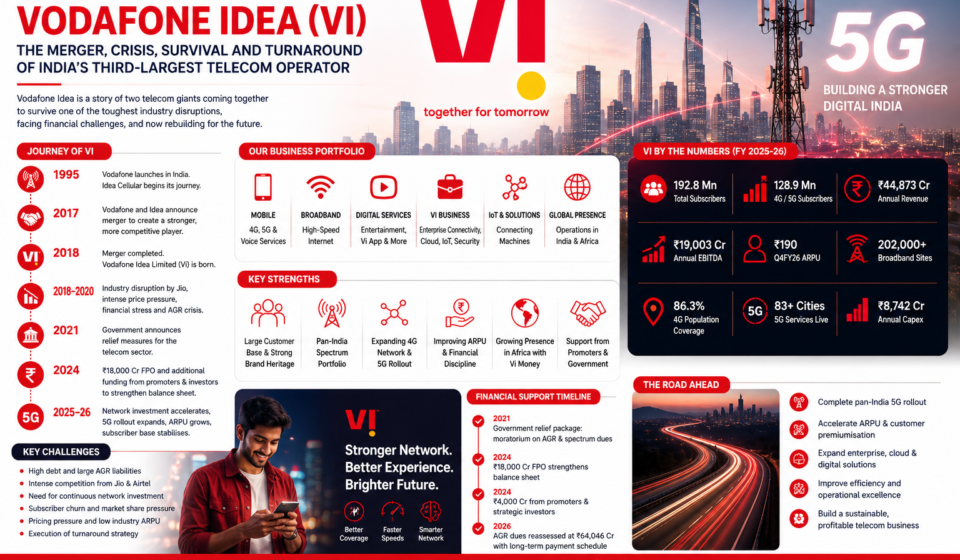
By FY2025–26, Vodafone Idea reported several important signs of operational improvement: annual revenue reached ₹44,873 crore, annual EBITDA reached ₹19,003 crore, customer ARPU increased to ₹190, the subscriber base stabilised at 192.8 million, and the company had launched 5G in 83 cities. (MYVI)
The company is therefore entering a new phase.
The question is no longer simply:
“Can Vodafone Idea survive?”
The more interesting question is:
“Can Vi convert its network investment, improved ARPU, 5G rollout and financial restructuring into a sustainable telecom turnaround?”
That question makes Vi an excellent case study for understanding:
- mergers and acquisitions,
- corporate restructuring,
- telecom economics,
- financial distress,
- pricing strategy,
- customer retention,
- network investment,
- capital raising,
- government intervention,
- competitive strategy,
- brand transformation,
- and business turnaround management.
1. Company Overview
Company: Vodafone Idea Limited
Consumer brand: Vi
Industry: Telecommunications
Major shareholders/promoter groups: Vodafone Group and Aditya Birla Group, with the Government of India also holding a significant equity stake following conversion of certain dues
Headquarters: Mumbai
Business: Mobile voice, 4G, 5G, broadband/data, enterprise connectivity and digital services
Current brand: Vi
Primary market: India
Vodafone Idea describes itself as an Aditya Birla Group and Vodafone Group partnership providing pan-India voice and data services. The company says its Vi brand serves more than 200 million customers and covers more than 1.2 billion Indians, with 4G and expanding 5G services. (MYVI)
As of March 2026, the company reported:
- 192.8 million total subscribers
- 128.9 million 4G/5G subscribers
- ₹44,873 crore FY2026 revenue
- ₹19,003 crore FY2026 EBITDA
- ₹190 Q4FY26 customer ARPU
- 202,000+ unique broadband towers
- 86.3% 4G population coverage
- 5G presence in more than 80 cities
- ₹8,742 crore FY2026 capex. (MYVI)
These numbers are important because they demonstrate that Vi is still a very large telecommunications company despite years of financial pressure.
2. The Origins: Vodafone and Idea
To understand Vi, we first have to understand the two companies that created it.
Vodafone
Vodafone India was part of the global Vodafone Group.
It developed a strong presence in India’s telecom market and became one of the country’s best-known mobile brands.
Vodafone was particularly recognised for:
- strong urban presence,
- international brand recognition,
- customer experience,
- marketing,
- network infrastructure,
- enterprise relationships.
Its famous red branding and communication campaigns gave it significant consumer recognition.
3. Idea Cellular
Idea Cellular emerged from the Aditya Birla Group’s telecom interests.
Idea became particularly strong in:
- semi-urban markets,
- rural India,
- prepaid customers,
- value-oriented segments,
- network expansion.
Its brand was associated with:
- mass-market connectivity,
- innovative advertising,
- affordability,
- customer-focused campaigns.
The company became one of India’s largest telecom operators.
4. Two Strong Companies, One Difficult Market
On paper, Vodafone and Idea were competitors.
But the Indian telecom market was becoming increasingly difficult.
The industry was experiencing:
- falling tariffs,
- huge spectrum costs,
- increasing data demand,
- massive network investment requirements,
- intense competition,
- consolidation.
Then came the biggest disruption of all.
Reliance Jio.
5. The Jio Disruption
Reliance Jio commercially launched its services in September 2016.
Its strategy changed the economics of India’s telecom industry.
Jio offered:
- very low-cost data,
- free voice,
- high-speed 4G,
- aggressive introductory offers,
- simplified plans.
The result was a massive increase in mobile data consumption and an industry-wide price war.
Traditional operators suddenly had to compete with a new player that had built a modern nationwide network and was backed by Reliance’s enormous financial resources.
Vodafone and Idea were both affected.
6. Why the Telecom Industry Was So Vulnerable
Telecom has a peculiar cost structure.
Operators must continuously invest in:
- spectrum,
- towers,
- fibre,
- network equipment,
- software,
- transmission,
- maintenance.
But consumers are highly price-sensitive.
Therefore, if prices fall sharply:
Revenue per user ↓
while
Infrastructure costs remain high.
That creates margin pressure.
And when margins fall, companies have less money to invest in networks.
This creates a dangerous cycle:
Lower prices
↓
Lower cash flow
↓
Lower network investment
↓
Worse customer experience
↓
Customer losses
↓
Lower revenue
This was one of the biggest challenges faced by Vodafone and Idea.
7. Why Vodafone and Idea Decided to Merge
The merger was essentially a strategic response to the new competitive reality.
Instead of continuing to compete separately, Vodafone and Idea decided that combining their resources would create a stronger company.
The merger was announced in March 2017. The companies subsequently obtained regulatory approvals, and the merger was completed in 2018.
The logic was straightforward:
Vodafone had:
- strong brand equity,
- network assets,
- customers,
- urban strength,
- international expertise.
Idea had:
- strong Indian market presence,
- spectrum,
- customers,
- distribution,
- rural and semi-urban strength.
Together:
Vodafone + Idea = greater scale.
8. The Historic Merger
The merger created one of India’s largest telecom companies.
Vodafone Idea’s own merger announcement described it as creating India’s leading telecom operator. At the time of completion, the company reported approximately ₹1,092 billion of net debt as of June 30, 2018. It also estimated annual merger synergies of approximately ₹140 billion, including around ₹84 billion of operating-cost synergies. (MYVI)
This reveals something important.
The merger created scale.
But it did not magically eliminate financial problems.
In fact, the combined company inherited a massive balance-sheet burden.
9. The Merger Was a Defensive Strategy
The merger can be viewed as an example of defensive consolidation.
In normal circumstances, companies merge to:
- accelerate growth,
- enter new markets,
- acquire technology,
- gain customers.
Vodafone and Idea had another powerful reason:
Survival.
The companies needed:
- more spectrum,
- larger scale,
- lower costs,
- better network economics,
- stronger bargaining power.
The merger was therefore a strategic response to industry disruption.
10. The Scale Advantage
After the merger, Vodafone Idea had a much larger combined customer base and network.
This created potential advantages.
Network scale
More customers could share infrastructure costs.
Spectrum scale
The combined spectrum portfolio could support greater capacity.
Distribution scale
The company could leverage both organisations’ retail networks.
Cost synergies
Duplicate functions could be consolidated.
Procurement
Larger volumes could improve bargaining power.
Brand resources
The company could eventually develop one unified brand.
11. But Mergers Are Not Free
A common mistake in business analysis is assuming:
“Two companies merge, therefore they become stronger immediately.”
In reality, mergers create enormous integration challenges.
Vodafone Idea had to integrate:
- network systems,
- IT platforms,
- billing systems,
- employees,
- retail networks,
- spectrum,
- towers,
- corporate structures,
- customer databases,
- processes.
This is extremely difficult.
A merger creates a new organisation while the business continues operating every day.
12. The Network Integration Challenge
Perhaps the hardest part was combining two telecom networks.
Telecom networks are highly complex.
Vodafone and Idea had:
- different network architectures,
- different equipment,
- different frequencies,
- different software,
- different sites.
The company had to decide:
- which equipment to retain,
- which sites to consolidate,
- which spectrum to refarm,
- how to optimise coverage,
- how to minimise customer disruption.
This required years of work.
13. The Birth of Vodafone Idea Limited
The merged entity was officially named:
Vodafone Idea Limited
The company initially operated with both legacy brands.
Customers continued to see:
- Vodafone,
- Idea.
But maintaining two brands indefinitely was inefficient.
Eventually the company needed a unified identity.
14. The Birth of “Vi”
On September 7, 2020, Vodafone Idea introduced its unified consumer brand:
Vi
The company explained that “Vi” represented the coming together of Vodafone and Idea and could be read as “we.”(MYVI)
This was more than a logo change.
It represented the completion of an important part of the merger.
The company was effectively saying:
Vodafone + Idea are no longer two separate identities.
They are now:
Vi.
15. Why the Rebranding Was Important
A unified brand provides several advantages.
Marketing efficiency
One brand instead of two.
Customer clarity
Customers know what the company represents.
Digital simplicity
One app, one identity, one ecosystem.
Operational efficiency
Less duplication.
Emotional positioning
“We” creates a sense of community.
The brand therefore attempted to transform a complicated corporate merger into a simple consumer proposition.
16. The Vi Brand Philosophy
The company’s messaging positioned Vi around:
- togetherness,
- customer-centricity,
- reliability,
- future readiness.
The official Vi story describes the name as representing the broader Indian society and the idea of “we.” (MYVI)
This was an attempt to turn the merger from a corporate event into a consumer narrative.
17. The Biggest Problem: Financial Pressure
The merger solved one problem.
It did not solve the balance sheet.
Vodafone Idea faced enormous financial obligations related to:
- spectrum,
- AGR,
- interest,
- network investment,
- vendor payments,
- operating expenses.
The company therefore entered a period of severe financial stress.
18. What Is AGR?
AGR stands for:
Adjusted Gross Revenue.
It is important because telecom operators in India pay certain government dues linked to their revenue.
The definition of AGR became the subject of a major legal dispute.
The Supreme Court’s 2019 judgment upheld the government’s broader interpretation of AGR for telecom dues.
This significantly affected Vodafone Idea.
19. The AGR Crisis
The AGR issue became one of the biggest threats to the company’s survival.
The company faced massive liabilities.
This created a difficult equation:
Operating cash flow
vs.
Government dues
vs.
Network investment
vs.
Debt servicing
The company needed money simply to remain operational while also investing in the network.
20. The Financial Trap
A telecom operator cannot simply stop investing.
If it stops investing:
- network quality declines,
- customers leave,
- data speeds deteriorate,
- competitors gain share.
But if it invests heavily while losing money:
- debt increases,
- cash flow deteriorates.
Vi was caught between these two pressures.
21. The 2021 Government Relief Package
The Indian government introduced a telecom relief package in 2021.
The package included measures around:
- AGR payments,
- spectrum payments,
- moratoriums,
- interest,
- and the possibility of converting certain government dues into equity.
This was highly significant for Vodafone Idea.
It gave the company additional time to manage its liabilities.
22. Government Equity Ownership
The government’s involvement became increasingly important.
Certain deferred telecom liabilities were converted into equity.
This eventually resulted in the Government of India becoming a major shareholder in Vodafone Idea.
By 2025, Reuters reported that the government’s stake had reached approximately 48.99% after conversion of spectrum-related dues into equity. (Reuters)
This is highly unusual.
The government effectively became one of the company’s largest shareholders.
23. Why Government Support Matters
Vi is not simply another private company.
Telecommunications infrastructure is strategically important.
A healthy telecom industry is necessary for:
- national connectivity,
- digital payments,
- online education,
- healthcare,
- defence communications,
- business,
- digital government.
If Vi were to disappear suddenly, the Indian telecom market could become even more concentrated.
Therefore, the company’s survival has broader economic implications.
24. The Three-Player Market
India’s telecom market gradually consolidated around three major private/public operators:
- Reliance Jio
- Bharti Airtel
- Vodafone Idea
alongside BSNL/MTNL in the public sector.
This changed the competitive structure.
Vodafone Idea therefore remained strategically important.
25. Why Vi Could Not Simply Compete on Price
Jio’s entry had already demonstrated how dangerous telecom price wars can become.
Vi could not sustainably compete by saying:
“We will always be cheaper.”
It needed to differentiate through:
- network improvements,
- customer experience,
- premiumisation,
- 4G,
- 5G,
- enterprise services,
- digital products.
26. The Importance of ARPU
One of Vi’s most important metrics is:
Average Revenue Per User — ARPU.
If ARPU increases, the company earns more revenue from each customer.
This is extremely important for a financially stressed telecom operator.
Vi’s customer ARPU reached ₹190 in Q4FY26, compared with ₹175 in Q4FY25, an increase of 8.3%. The company said this was driven primarily by customer upgrades and premiumisation. (MYVI)
This is one of the strongest positive signals in the turnaround story.
27. Why Premiumisation Matters
Premiumisation means moving customers toward higher-value plans.
For example:
Basic user
Low data allowance.
Premium user
More data + 5G + entertainment + higher-value services.
The company earns more without necessarily needing to acquire a new customer.
That is powerful.
28. Vi’s Customer Strategy
Vi increasingly focuses on:
- retaining customers,
- upgrading customers,
- improving network experience,
- increasing 4G/5G adoption.
This is different from simply chasing subscriber numbers.
A customer who generates ₹190 per month is significantly more valuable than a low-spending customer.
29. Subscriber Decline: The Major Challenge
Vi’s subscriber base declined for years after the merger.
This was one of the biggest weaknesses in the business.
By FY2026, however, management reported that the customer base had stabilised at 192.8 million, with monthly subscriber additions turning positive from February 2026. (MYVI)
This is strategically important.
A stabilising customer base means:
The company may finally be reaching the bottom of the subscriber decline cycle.
30. Why Subscriber Stabilisation Matters
Imagine a business with:
100 million customers.
If it loses:
5 million every year,
then even strong ARPU growth may not fully compensate.
But if customer losses stop:
Stable customers
Higher ARPU
=
Better revenue visibility
That is why Vi’s recent subscriber stabilisation matters so much.
31. The 4G Challenge
One of Vi’s biggest problems was the pace of network investment.
Jio and Airtel invested heavily in:
- 4G,
- 5G,
- fibre,
- capacity.
Vi had less financial flexibility.
This affected:
- coverage,
- capacity,
- customer experience.
The company therefore had to raise capital.
32. The ₹18,000 Crore FPO
One of the biggest milestones in Vi’s recovery plan was its ₹18,000 crore Further Public Offer (FPO) in 2024.
The company allotted approximately 16.36 billion shares at ₹11 per share, raising ₹180 billion. (MYVI)
This was one of the largest equity fundraises in India’s telecom sector.
33. Why the FPO Was Critical
The money was needed primarily for:
- network expansion,
- 4G sites,
- capacity expansion,
- 5G deployment,
- technology investment.
Vi could not execute a meaningful turnaround without new capital.
This is a fundamental lesson:
A telecom turnaround requires both financial restructuring and network investment.
Fixing the balance sheet alone is insufficient.
34. Additional Capital From Promoters
The company also received additional capital from promoter groups and strategic stakeholders.
Vi’s FY2025 annual report says it raised nearly ₹61,500 crore in equity through:
- ₹18,000 crore FPO,
- ₹4,000 crore preferential issue to promoters,
- ₹2,500 crore preferential issue to Nokia and Ericsson,
- approximately ₹37,000 crore through government equity conversion.
It invested approximately ₹9,620 crore in capex during FY2025. (MYVI)
This marked a major shift.
The company finally had more resources to improve its network.
35. Vendor Financing and Strategic Alignment
The involvement of Nokia and Ericsson was particularly interesting.
Vi issued equity to the two network equipment companies.
This created a form of strategic alignment between:
- telecom operator,
- network vendors,
- future network investment.
The company allotted shares to Nokia Solutions and Networks India and Ericsson India at ₹14.80 per share in July 2024. (MYVI)
This helped address vendor obligations while also supporting the company’s broader capital structure.
36. The ₹55,000 Crore Network Investment Plan
Vi announced a planned investment of approximately ₹55,000 crore over three years to strengthen its network and roll out 5G. (MYVI)
This is crucial.
Vi’s turnaround depends on rebuilding its competitive network position.
37. The Network Turnaround
By FY2026, the results were beginning to show.
Vi reported:
- more than 17,300 new unique broadband towers added during FY26
- more than 202,000 unique broadband towers
- 4G population coverage of 86.3%
- 48.2 million incremental population brought under 4G coverage
- 4G data capacity up more than 12% year over year. (MYVI)
These are substantial improvements.
38. Why Network Investment Is So Important
Telecom is one of the rare industries where the customer can immediately experience infrastructure quality.
If network quality improves:
- data speeds improve,
- indoor coverage improves,
- video streaming improves,
- calls become more reliable,
- customers are less likely to leave.
Therefore:
Network investment → customer retention.
39. Vi’s 5G Journey
Vi was later than Jio and Airtel in launching commercial 5G.
The company launched 5G services in Mumbai in March 2025 and subsequently expanded into other cities.
By March 2026, Vi reported 5G presence in more than 80 cities across all 17 priority circles where it held 5G spectrum. (MYVI)
The company reported that its 5G services were launched in 83 cities during FY2026. (MYVI)
40. Why 5G Is Critical for Vi
5G is important for three reasons.
1. Competitive parity
Customers increasingly expect 5G.
2. Premiumisation
5G can support higher-value plans.
3. Enterprise opportunities
5G can support:
- private networks,
- IoT,
- industrial applications,
- smart infrastructure.
Without 5G, Vi risks being perceived as technologically behind its major competitors.
41. Vi’s 5G Strategy
Vi initially adopted a relatively focused approach.
Rather than attempting to cover the entire country immediately, it concentrated on:
- priority circles,
- high-value markets,
- major cities.
This is financially sensible.
The company cannot spend like a company with unlimited capital.
It must prioritise markets that generate the highest returns.
42. The 17 Priority Circles
Vi’s 5G spectrum is concentrated in 17 priority circles, which together contribute approximately 99% of its revenueaccording to the company. (MYVI)
This is strategically important.
Instead of trying to cover every location immediately, Vi is targeting the regions that matter most economically.
43. The 5G User Opportunity
Vi reported that its 4G/5G subscriber base reached 128.9 million in Q4FY26, up from 126.4 million in Q4FY25. (MYVI)
This means a substantial portion of the company’s customer base is already using modern broadband services.
As more customers migrate to 5G, the company can potentially increase:
- data usage,
- ARPU,
- customer engagement.
44. Data Consumption Growth
Vi reported that overall data usage increased by more than 30% year over year, reaching approximately 83 petabytes per day in Q4FY26. Average data usage by a 4G/5G subscriber rose to 20.2 GB per month, up 27.2% year over year. (MYVI)
This is a positive sign.
The business is not only retaining customers.
Customers are also using more data.
45. Data Consumption as a Growth Engine
The future of telecom is fundamentally tied to data.
Consumers increasingly use mobile networks for:
- YouTube,
- Instagram,
- WhatsApp,
- video calls,
- gaming,
- streaming,
- online education,
- digital payments,
- work.
Therefore:
More data consumption
↓
Higher-value plans
↓
Higher ARPU
↓
More revenue
This is central to Vi’s turnaround strategy.
46. Vi’s Business Model
Vi’s business model can be divided into several major layers.
Consumer Mobile
Voice + data.
4G/5G
High-speed mobile connectivity.
Enterprise
Vi Business.
IoT
Connected devices.
Cloud
Enterprise cloud services.
Security
Cybersecurity solutions.
Digital Services
Entertainment and digital experiences.
This diversification reduces dependence on traditional voice revenue.
47. Vi Business
Vi Business is the company’s enterprise arm.
It provides:
- mobility,
- connectivity,
- cloud,
- security,
- IoT,
- managed services,
- enterprise networking.
The company says Vi Business is focused on helping businesses across India with telecom and technology solutions. (MYVI)
This is important because enterprise customers can produce higher-value recurring revenue.
48. Enterprise Opportunity
Businesses need increasingly sophisticated connectivity.
A company may require:
- secure internet,
- SD-WAN,
- cloud connectivity,
- private networks,
- cybersecurity,
- IoT.
Vi already owns the underlying telecom infrastructure.
Therefore, enterprise technology is a natural extension.
49. IoT Opportunity
The Internet of Things can connect:
- vehicles,
- factories,
- meters,
- machines,
- logistics systems,
- agricultural equipment.
Telecom operators can provide:
Connectivity + platform + analytics.
Vi therefore has the opportunity to move from connecting people to connecting machines.
50. Cloud Opportunity
Cloud services offer another growth area.
Businesses increasingly need:
- data storage,
- cloud computing,
- backup,
- disaster recovery,
- security.
A telecom company can combine:
Network + Cloud + Security.
That combination can be attractive to enterprise customers.
51. The Vi Digital Ecosystem
Vi also provides entertainment and digital services to consumers.
The company’s strategy increasingly involves partnerships around:
- OTT,
- entertainment,
- music,
- content.
The purpose is not simply to give customers free entertainment.
It is to increase:
Customer engagement.
A customer who uses multiple services is more likely to remain within the ecosystem.
52. Customer Retention Strategy
For Vi, retention is arguably more important than aggressive acquisition.
Why?
Because acquiring a new telecom customer costs money.
The company must spend on:
- SIM,
- distribution,
- promotions,
- network capacity,
- marketing.
If the customer leaves after a few months, the investment is lost.
Therefore:
Retaining an existing customer is often cheaper than acquiring a new one.
53. Premiumisation
Vi’s recent ARPU improvement shows the importance of premiumisation.
The company has focused on:
- higher-value plans,
- 4G upgrades,
- 5G,
- additional data,
- entertainment bundles.
The goal is:
Increase the value of each customer.
54. Vi’s Brand Positioning
Vi attempts to position itself between two extremes.
Jio
Mass scale + aggressive value.
Airtel
Premium experience + strong network.
Vi
Affordable connectivity + improving network + differentiated customer offerings.
This positioning is still evolving.
55. Can Vi Become the “Value Alternative”?
One possible strategic opportunity is to become the strong third player.
Instead of trying to beat Jio and Airtel at everything, Vi can focus on:
- competitive pricing,
- strong 4G,
- expanding 5G,
- attractive entertainment bundles,
- differentiated plans,
- regional strength.
This could provide a sustainable niche.
56. Vi’s Biggest Competitive Advantage
Vi’s biggest advantage is not necessarily its technology.
It is:
Existing scale.
Almost 193 million customers is still a huge customer base.
If the company can stabilise these customers and increase ARPU, the economics can improve substantially.
57. The Importance of the Installed Base
Consider:
192.8 million customers
Even a ₹10 monthly ARPU increase would theoretically represent:
₹10 × 192.8 million
= approximately ₹1.93 billion additional monthly gross revenue before considering churn, taxes and other factors.
This illustrates why monetising the existing customer base is so important.
The installed base itself has enormous economic value.
58. Vi’s Financial Turnaround
Vi’s financial story is particularly interesting.
FY2025:
Revenue: ₹43,571 crore
EBITDA: ₹18,127 crore
FY2026:
Revenue: ₹44,873 crore
EBITDA: ₹19,003 crore
Revenue grew by approximately 3%.
EBITDA grew by approximately 4.8%. (MYVI)
This is not explosive growth.
But for a company undergoing a major turnaround, it is meaningful.
59. The Profitability Problem
Vi still faces significant financial challenges.
For Q4FY26, the company reported:
- revenue of ₹11,332 crore,
- EBITDA of ₹4,889 crore,
- but a reported PAT of approximately ₹51,970 crore, largely affected by a one-time accounting gain associated with AGR reassessment and recognition of the present value of future AGR payments. (MYVI)
Therefore, the headline PAT number should not be interpreted as ordinary recurring profitability.
This is a critical point in any serious case study.
60. Recurring vs One-Time Gains
A business analyst must distinguish between:
Operating improvement
Revenue and EBITDA improvement.
and
Accounting gains
One-time changes related to liabilities or restructuring.
Vi’s underlying operating improvement is better reflected by:
- revenue,
- EBITDA,
- ARPU,
- subscribers,
- data usage,
- network coverage.
Not simply by the reported PAT for one quarter.
61. The AGR Resolution in 2026
One of the biggest recent developments came in April 2026.
Vodafone Idea disclosed that the Department of Telecommunications had finalised its AGR dues at ₹64,046 crore as of December 31, 2025, following reassessment.
The payment schedule was set as:
- minimum ₹100 crore annually from FY2031–32 through FY2034–35,
- remaining amount in six equal annual instalments from FY2035–36 through FY2040–41. (MYVI)
This is a major development for the company’s long-term financial planning.
62. Why the AGR Reassessment Matters
Previously, AGR liabilities created enormous uncertainty.
The reassessment provides greater visibility.
The company can now plan around:
- network investment,
- debt,
- cash flow,
- future payments.
However, the liability has not disappeared.
It has been deferred and restructured.
That distinction matters.
63. The New AGR Reality
The company now has a longer runway.
Instead of facing enormous immediate payments, Vi has more time to:
- grow revenue,
- improve ARPU,
- strengthen network quality,
- expand 5G,
- increase EBITDA,
- generate cash.
This is exactly what a distressed company needs:
Time.
64. The Government’s Role
The Government of India has become deeply involved in Vi’s capital structure.
This creates both:
Opportunity
The government has a strategic interest in telecom continuity.
and
Complexity
A government stake can influence:
- capital decisions,
- governance,
- strategic direction.
Vi therefore occupies a unique position between private enterprise and public-interest infrastructure.
65. The ₹4,730 Crore Promoter Commitment
In May 2026, Vi’s board approved the issuance of fully convertible warrants worth ₹4,730 crore ($500 million) to an Aditya Birla Group promoter entity. (MYVI)
This is another signal of promoter support.
It suggests the Aditya Birla Group remains committed to the company’s turnaround.
66. Why Promoter Commitment Matters
Telecom investors, lenders and vendors need confidence.
If promoters continue to invest:
- lenders may be more willing to lend,
- vendors may support expansion,
- customers may have greater confidence,
- employees may see a future,
- investors may perceive lower survival risk.
Promoter support can therefore have a multiplier effect.
67. The Network Turnaround Is the Core
Ultimately, Vi’s financial recovery depends on one thing:
Network competitiveness.
If customers believe:
“Vi’s network is good enough.”
then retention improves.
If customers believe:
“Jio or Airtel is much better.”
then subscriber losses continue.
Therefore, the network is not simply an operational issue.
It is the central strategic issue.
68. Vi’s 4G Strategy
The company is prioritising 4G because it remains the primary revenue-generating network.
Even while deploying 5G, Vi cannot neglect 4G.
Its FY2026 results show that the company added over 17,300 broadband towers and expanded 4G population coverage to 86.3%. (MYVI)
This is sensible.
5G receives attention.
But 4G still pays the bills.
69. 5G as the Future
5G, however, is essential for long-term competitiveness.
It can:
- improve speeds,
- increase capacity,
- support premium plans,
- enable enterprise applications,
- improve network efficiency.
Therefore, Vi needs both:
4G for today’s economics.
5G for tomorrow’s growth.
70. The “Dual Network” Strategy
Vi’s current strategy can be thought of as:
4G
= revenue engine
5G
= future growth engine
This balance is essential because the company cannot afford to abandon either.
71. The Role of Technology Partners
Vi works with major network vendors such as:
- Nokia,
- Ericsson.
These partnerships are critical because Vi needs to deploy sophisticated network infrastructure without developing everything internally.
Its 2024 capital raise included preferential equity issuance to Nokia and Ericsson. (MYVI)
72. Strategic Partnership With Ericsson
In its 5G rollout, Vi has worked with Ericsson for network deployment.
For example, its Delhi-NCR rollout involved Ericsson infrastructure and AI-powered Self-Organising Network technology. (MYVI)
This shows how Vi is attempting to combine:
Capital discipline
with
technology partnerships.
73. AI-Powered Network Management
AI can help Vi improve network performance.
Self-Organising Network technology can assist with:
- optimisation,
- capacity,
- fault management,
- traffic balancing.
This is important because Vi must improve network quality without proportionally increasing operating costs.
74. SWOT Analysis of Vi
Strengths
Large customer base
Approximately 193 million subscribers.
Strong brand heritage
Vodafone and Idea both had substantial brand equity.
Spectrum portfolio
Vi holds a significant spectrum portfolio.
Nationwide presence
The company operates across India.
Improving network
4G coverage and capacity are expanding.
5G rollout
Now live in more than 80 cities.
Enterprise business
Vi Business creates additional revenue opportunities.
Promoter support
Aditya Birla Group remains involved.
Government support
Government equity and AGR restructuring provide financial runway.
75. Weaknesses
High financial obligations
AGR and other liabilities remain significant.
Smaller subscriber base than Jio and Airtel
Scale disadvantage matters in telecom.
Historical network underinvestment
Years of financial stress affected network expansion.
Later 5G rollout
Vi entered the 5G race after its major competitors.
Customer churn
The company has experienced prolonged subscriber losses.
Limited financial flexibility
Capital remains a key constraint.
76. Opportunities
5G
Premium consumers and enterprise use cases.
ARPU growth
Upgrade existing customers.
Broadband
Home and fixed wireless connectivity.
Enterprise
Cloud, IoT, security and connectivity.
Digital services
Entertainment and ecosystem offerings.
Rural expansion
Improve 4G coverage.
Premiumisation
Higher-value customer segments.
AI
Network optimisation and customer experience.
77. Threats
Jio
Massive scale and financial strength.
Airtel
Strong premium positioning and network quality.
Tariff competition
Price wars can destroy margins.
Spectrum costs
Large capital requirements.
AGR obligations
Long-term financial burden.
Customer churn
Customers can switch providers.
Technology gap
Falling behind in 5G could damage competitiveness.
78. Porter’s Five Forces
Competitive Rivalry — Extremely High
Vi competes directly with:
- Jio,
- Airtel,
- BSNL.
Telecom competition is intense.
Threat of New Entrants — Very Low
Entry requires:
- spectrum,
- licences,
- towers,
- fibre,
- technology,
- capital.
The barriers are enormous.
Supplier Power — Moderate to High
Vi depends heavily on network equipment suppliers.
Large contracts with Nokia and Ericsson give suppliers strategic importance.
Buyer Power — High
Customers can switch networks.
Mobile number portability makes switching easier.
Therefore, customer experience matters enormously.
Threat of Substitutes — Moderate
Alternatives include:
- Wi-Fi,
- fibre broadband,
- satellite connectivity,
- enterprise private networks.
But mobile remains fundamental.
79. Vi’s Marketing Strategy
Vi’s marketing strategy combines the heritage of Vodafone and Idea with a new unified identity.
The brand focuses on:
- youthful communication,
- entertainment,
- digital lifestyle,
- affordability,
- network quality,
- customer experience.
The “Vi” identity allows the company to communicate a sense of togetherness.
80. The Importance of Entertainment
Entertainment can be a powerful telecom retention tool.
Customers may choose a plan because it includes:
- OTT subscriptions,
- movies,
- sports,
- music.
The telecom operator is therefore competing not only on:
Network
but also on:
Digital experience.
81. The Vi Ecosystem
The ecosystem can be represented as:
Mobile
↓
4G
↓
5G
↓
Entertainment
↓
Enterprise
↓
IoT
↓
Cloud
↓
Digital Services
This creates multiple ways to monetise the same customer.
82. Vi’s Enterprise Opportunity
Vi Business can become an increasingly important source of higher-value revenue.
Businesses may need:
- connectivity,
- secure networks,
- SD-WAN,
- cloud,
- IoT,
- cybersecurity.
The company can bundle these services.
83. The SD-WAN Opportunity
Vi Business has also been expanding its enterprise networking capabilities.
SD-WAN can help businesses manage distributed networks across:
- offices,
- branches,
- warehouses,
- stores.
This is especially useful for large organisations.
Vi’s enterprise business has positioned itself around mobility, connectivity, security, IoT and cloud services. (MYVI)
84. Vi and Small Businesses
The MSME market represents another opportunity.
Millions of Indian businesses need:
- reliable internet,
- digital payments,
- cloud,
- cybersecurity,
- communications.
Vi can potentially bundle these services.
85. The Rural Opportunity
Vi’s rural and semi-urban legacy from Idea remains potentially valuable.
India’s rural population increasingly consumes:
- video,
- social media,
- online education,
- digital payments.
If Vi can improve rural 4G coverage, it can potentially recover customers in markets where its brand has historical strength.
86. The Coverage Strategy
The company’s FY2026 results indicate that 4G population coverage has reached 86.3%, with the company targeting more than 95% coverage across its 17 priority circles with planned investment. (MYVI)
This could become a major competitive advantage if executed successfully.
87. The Customer Experience Challenge
Coverage alone is insufficient.
Customers also care about:
- speed,
- indoor coverage,
- call quality,
- latency,
- customer support,
- billing,
- recharge experience.
Vi therefore needs to improve the entire customer journey.
88. Digital Customer Service
Modern telecom customers expect:
- mobile apps,
- instant recharge,
- online support,
- self-service,
- digital payments,
- personalised plans.
The Vi app and digital ecosystem are therefore strategically important.
89. The Vi App as a Platform
A telecom app can become a central customer interface.
Customers can:
- recharge,
- change plans,
- buy data,
- access entertainment,
- manage accounts,
- receive offers.
This reduces customer-service costs and increases engagement.
90. The Importance of Churn
Churn is one of Vi’s most important metrics.
If customers leave faster than new customers join:
Subscriber base declines.
If churn falls:
Subscriber base stabilises.
If acquisition exceeds churn:
Subscriber base grows.
Vi’s move into positive monthly subscriber additions from February 2026 is therefore strategically significant. (MYVI)
91. The Turnaround Flywheel
Vi’s potential turnaround can be represented as:
Capital Infusion
↓
Network Investment
↓
Better 4G/5G Experience
↓
Lower Churn
↓
Subscriber Stabilisation
↓
Premiumisation
↓
Higher ARPU
↓
Higher Revenue
↓
Higher EBITDA
↓
More Cash for Network Investment
↓
Stronger Vi
This is the flywheel management is attempting to create.
92. The Biggest Challenge: Funding
This flywheel only works if Vi has enough capital.
Telecom networks require continuous investment.
Vi therefore needs access to:
- equity,
- debt,
- vendor financing,
- operating cash flow.
The 2024 FPO was an important step.
The promoter’s 2026 commitment is another.
But long-term funding remains critical.
93. Vi’s Debt Position
Vi has made progress in reducing certain bank borrowings.
As of March 31, 2026, bank debt was reported at ₹726 crore, down from ₹2,326 crore a year earlier. The company also had ₹3,715 crore in cash and bank balances and had raised ₹3,300 crore through NCDs in December 2025. (MYVI)
However, this should not be confused with eliminating the company’s overall financial obligations.
The AGR and spectrum-related liabilities remain important.
94. Why the Turnaround Is Still Difficult
Vi has made progress.
But the company still faces:
- large long-term liabilities,
- intense competition,
- huge network investment needs,
- customer churn risk,
- 5G catch-up,
- high capital requirements.
Therefore, declaring a complete turnaround would be premature.
The more accurate description is:
Vi has entered a turnaround phase.
95. What Vi Must Do Next
Vi’s next five strategic priorities should be:
1. Stabilise subscribers
Stop net customer losses.
2. Improve network quality
Continue 4G and 5G expansion.
3. Increase ARPU
Upgrade customers to higher-value plans.
4. Expand enterprise
Grow B2B connectivity, cloud, IoT and security.
5. Protect cash flow
Avoid excessive leverage while investing.
96. Strategy 1: Stop Subscriber Losses
This should be the first priority.
Every customer retained improves:
- revenue,
- network utilisation,
- brand strength.
Vi does not necessarily need explosive subscriber growth immediately.
It needs:
Stability first.
97. Strategy 2: Improve Network Perception
Customers need to believe:
“Vi’s network is good enough for my daily life.”
This requires:
- strong indoor coverage,
- reliable data,
- 5G availability,
- better rural coverage.
Marketing cannot compensate for a weak network.
98. Strategy 3: Premiumise the Base
Vi already has nearly 129 million 4G/5G subscribers.
That creates an opportunity to migrate users toward:
- higher data plans,
- 5G,
- entertainment bundles,
- family plans.
This can increase ARPU.
99. Strategy 4: Enterprise Growth
Consumer telecom is highly competitive.
Enterprise services can provide additional growth.
Vi should continue expanding:
- SD-WAN,
- cloud,
- cybersecurity,
- IoT,
- private networks,
- managed connectivity.
100. Strategy 5: Financial Discipline
The company cannot return to aggressive spending without corresponding revenue growth.
Every rupee of capex needs to generate:
- customer retention,
- higher ARPU,
- capacity,
- better coverage,
- enterprise revenue.
Capital allocation will determine the success of the turnaround.
101. What Can Vi Learn From Airtel?
Airtel demonstrates that a telecom operator can survive aggressive price competition by focusing on:
- network quality,
- premium customers,
- brand,
- enterprise,
- broadband.
Vi can learn from this model.
102. What Can Vi Learn From Jio?
Jio demonstrates the power of:
- infrastructure,
- scale,
- ecosystem,
- technology,
- aggressive network expansion.
Vi cannot copy Jio’s capital structure.
But it can learn from Jio’s focus on:
- data usage,
- digital experience,
- 5G,
- ecosystem.
103. Vi’s Unique Opportunity
Vi should not try to become:
another Jio
or
another Airtel.
It needs its own positioning.
One possible strategic direction is:
“The smart value network.”
A network combining:
- competitive pricing,
- strong coverage,
- personalised plans,
- entertainment,
- 5G,
- enterprise services.
104. The Importance of Brand Heritage
Vodafone and Idea were both major brands.
Vi therefore has something many startups would love:
Historical brand equity.
The challenge is to convert that legacy into a modern proposition.
The brand cannot rely on nostalgia.
It must deliver:
- modern network,
- modern technology,
- modern customer experience.
105. Vi as a Merger Case Study
The Vodafone-Idea merger provides several lessons about mergers.
Lesson 1
Scale does not automatically create profitability.
Lesson 2
Synergies take time.
Lesson 3
Integration is harder than announcing a merger.
Lesson 4
Financial liabilities can overwhelm operating synergies.
Lesson 5
Brand consolidation matters.
Lesson 6
Capital planning must happen before the merger closes.
106. Merger Synergies
The companies expected approximately ₹140 billion of annual synergies when the merger was completed. (MYVI)
But synergy realisation is complicated.
Cost savings can be offset by:
- customer losses,
- network investment,
- integration costs,
- technology upgrades,
- regulatory obligations.
Therefore:
Synergy estimates are not the same thing as cash in the bank.
107. Vi as a Financial Distress Case Study
Vi is also a textbook example of corporate financial distress.
The company faced:
- high liabilities,
- declining customers,
- negative profitability,
- heavy capex requirements,
- regulatory dues.
Yet it continued operating.
This demonstrates the importance of:
- restructuring,
- capital raising,
- government support,
- vendor negotiations,
- promoter commitment.
108. The Role of Government in Corporate Survival
Vi raises an interesting policy question.
Should a government support a distressed private telecom company?
The argument for support is that telecom is critical infrastructure.
A three-player market is also more competitive than a market dominated by two private operators.
Therefore, government intervention can be seen as supporting:
Competition + connectivity + national digital infrastructure.
109. The Risk of Government Ownership
However, government ownership also creates potential complications.
The company must balance:
- commercial objectives,
- shareholder interests,
- public policy,
- telecom competition.
Good governance becomes particularly important.
110. Vi’s Future Competitive Position
If Vi succeeds in stabilising its customer base, it could remain a powerful third player.
If it fails to improve network quality, customer losses could resume.
Therefore, the next few years are critical.
111. Three Possible Future Scenarios
Scenario A — Successful Turnaround
Vi achieves:
- subscriber stabilisation,
- higher ARPU,
- strong 5G,
- improved cash flow.
Result:
Vi becomes a sustainable third major telecom player.
Scenario B — Partial Recovery
Vi improves operations but remains financially constrained.
Result:
Vi survives but remains significantly smaller than Jio and Airtel.
Scenario C — Failed Turnaround
Network investment slows.
Customers continue leaving.
ARPU growth cannot compensate.
Financial obligations become difficult.
Result:
The company requires further restructuring or strategic intervention.
112. The Most Likely Strategic Objective
The most realistic short-term objective is not:
“Become India’s number-one telecom company.”
It is:
“Become financially sustainable while maintaining a strong national customer base.”
That is a much more achievable goal.
113. Key Performance Indicators for Vi
Investors and analysts should monitor:
Subscriber base
Is it growing or shrinking?
ARPU
Is it increasing?
4G/5G subscribers
Are customers upgrading?
Data usage
Are users consuming more?
4G coverage
Is network quality improving?
5G cities
Is deployment accelerating?
EBITDA
Is operating profitability improving?
Capex
Is investment sufficient but disciplined?
Cash flow
Can the company fund itself?
AGR obligations
Is the payment burden manageable?
114. The Seven KPIs Vi Uses
Vi management has itself described seven key parameters used to benchmark its progress.
Its Q4FY26 commentary highlighted:
- subscriber stabilisation,
- revenue growth,
- ARPU growth,
- 4G/5G subscriber growth,
- network expansion,
- data usage,
- EBITDA improvement.
Management said all seven showed improvement in Q4FY26. (MYVI)
This provides a useful framework for evaluating the turnaround.
115. A Simple Vi Turnaround Scorecard
| Metric | Direction |
|---|---|
| Subscribers | Stabilising |
| ARPU | Rising |
| 4G/5G users | Rising |
| Data usage | Rising |
| 4G coverage | Rising |
| 5G footprint | Expanding |
| EBITDA | Improving |
| Capex | Increasing |
| AGR burden | Restructured/deferred |
| Financial flexibility | Improving but still constrained |
The overall picture is therefore mixed but increasingly positive.
116. Final SWOT Summary
| Category | Key Points |
|---|---|
| Strengths | Large customer base, spectrum, brand, national network, promoter support |
| Weaknesses | Financial obligations, smaller scale than Jio/Airtel, historical network gap |
| Opportunities | 5G, ARPU growth, enterprise, broadband, IoT, cloud |
| Threats | Jio, Airtel, price wars, capex needs, regulatory obligations |
117. Major Lessons From the Vi Case Study
Lesson 1: Scale can be a survival mechanism
The Vodafone-Idea merger demonstrated why scale matters in telecom.
Lesson 2: Mergers don’t automatically solve problems
A merger can create a bigger company without creating a healthier company.
Lesson 3: Balance-sheet strength matters
A great operating business can still fail if financial obligations become unmanageable.
Lesson 4: Network quality is everything
In telecom, marketing cannot permanently compensate for poor network performance.
Lesson 5: Customer quality matters more than customer quantity
ARPU and customer lifetime value are critical.
Lesson 6: Capital must follow strategy
Money should go toward:
- network,
- customer retention,
- technology,
- revenue-generating assets.
Lesson 7: Regulatory risk can reshape an entire industry
AGR demonstrates how government policy can fundamentally affect telecom economics.
Lesson 8: Brand transformation matters
Vodafone + Idea had to become Vi.
Lesson 9: Turnarounds take time
A company cannot repair years of underinvestment in one quarter.
Lesson 10: Survival itself can be strategic
Remaining a strong third player can be valuable even without being number one.
118. The Vi Business Formula
The future Vi model can be summarised as:
Capital
Network Investment
4G Coverage
5G Expansion
Customer Retention
Premiumisation
Enterprise Growth
Financial Discipline
=
Sustainable Vi
119. The Vi Flywheel
A successful Vi turnaround would look like this:
New Capital
↓
Network Investment
↓
Better 4G/5G
↓
Better Customer Experience
↓
Lower Churn
↓
Subscriber Stabilisation
↓
Premiumisation
↓
Higher ARPU
↓
Higher Revenue
↓
Higher EBITDA
↓
More Cash Flow
↓
More Network Investment
↓
Stronger Vi
120. Final Conclusion
The Vodafone Idea case study is ultimately a story about survival, consolidation and reinvention.
Vodafone and Idea were once two of India’s largest telecom companies.
They became competitors.
Then the market changed.
Jio entered with an entirely new economic model.
Prices fell.
Data consumption exploded.
Telecom margins came under enormous pressure.
Vodafone and Idea realised that competing separately was becoming increasingly difficult.
They merged.
The merger created scale, but it also created a giant organisation carrying enormous financial obligations.
Then came:
- AGR liabilities,
- customer losses,
- network investment challenges,
- debt pressure,
- regulatory uncertainty.
The company reached a point where its survival itself became a major business story.
Yet Vi did not disappear.
Instead, it began rebuilding.
The company raised ₹18,000 crore through its 2024 FPO, received additional promoter and strategic capital, increased network investment, expanded 4G coverage, launched 5G, improved ARPU and began stabilising its subscriber base. (MYVI)
By FY2026, the operating indicators were increasingly encouraging:
- 192.8 million subscribers
- 128.9 million 4G/5G subscribers
- ₹44,873 crore annual revenue
- ₹19,003 crore annual EBITDA
- ₹190 ARPU
- 202,000+ broadband towers
- 86.3% 4G population coverage
- 5G in more than 80 cities. (MYVI)
The AGR reassessment announced in April 2026 also gave the company substantially greater visibility over its long-term obligations, with ₹64,046 crore finalised as of December 31, 2025 and repayments largely pushed into the 2030s. (MYVI)
But the story is not finished.
Vi still faces extremely strong competitors in Jio and Airtel.
It still needs enormous network investment.
It still carries substantial long-term obligations.
It still needs to demonstrate that subscriber stabilisation can become sustained growth.
And it needs to prove that higher ARPU can translate into genuine free cash flow.
Therefore, the most accurate way to describe Vodafone Idea today is not simply as a troubled telecom company.
Nor is it accurate to call it a fully recovered telecom company.
Vi is a telecom turnaround in progress.
Its future will depend on whether the company can successfully convert:
Capital
into
Network
into
Customer Experience
into
Retention
into
Higher ARPU
into
Cash Flow
into
Sustainable Growth.
That is the central lesson of the Vi case.
The Ultimate Vi Case-Study Formula
Vodafone + Idea
↓
Merger
↓
Scale
↓
Jio Disruption
↓
Price Pressure
↓
Customer Loss
↓
Financial Stress
↓
AGR Crisis
↓
Government Support
↓
Capital Raising
↓
Network Investment
↓
4G Expansion
↓
5G Rollout
↓
ARPU Growth
↓
Subscriber Stabilisation
↓
Potential Telecom Turnaround
And that is what makes Vodafone Idea one of the most compelling corporate case studies in India’s telecom history.
It demonstrates that business success is not always about growing faster than everyone else.
Sometimes it is about surviving the most difficult period in your industry’s history, rebuilding your fundamentals, and finding a credible path forward.
For Vi, that path is now becoming clearer:
Stabilise the customer base. Strengthen the network. Grow 4G and 5G. Increase ARPU. Expand enterprise services. Control capital. Resolve long-term liabilities. And rebuild customer trust one network experience at a time.
If Vi can execute that strategy consistently, the company has the opportunity to turn one of India’s most difficult corporate survival stories into one of its most interesting telecom turnaround stories.

[…] Case Study of Vodafone Idea (Vi): The Merger, Crisis, Survival and Turnaround of India’s Third-Lar… […]