





Patanjali Case Study: How an Ayurvedic and Yoga Movement Became a Major Indian Consumer Business – 2026

Introduction
Patanjali Case Study: The rise of Patanjali is one of the most remarkable business stories in modern Indian consumer markets.
In a relatively short period, Patanjali moved from being primarily associated with Yoga, Ayurveda and traditional Indian wellness to becoming a broad consumer-products group with businesses spanning food, edible oils, personal care, healthcare, home care, beverages, nutraceuticals and other FMCG categories.
Patanjali Ayurved was established in 2006, founded by Baba Ramdev and Acharya Balkrishna, according to Patanjali’s own corporate materials. The organization says its purpose is centered on creating a healthier society through Yoga and Ayurveda. (Patanjali Ayurved)
The story is particularly interesting because Patanjali did not enter India’s consumer market as a conventional FMCG company.
It entered with something different:
A combination of Ayurveda, Yoga, Indian identity, mass communication, low-cost products, direct consumer connection and a highly recognizable public figure.
That combination allowed Patanjali to challenge established FMCG companies in categories that had traditionally been dominated by multinational and large Indian corporations.
However, Patanjali’s journey has not been without challenges.
The group has faced regulatory scrutiny, advertising-related legal disputes, questions around product claims, manufacturing and compliance issues, and the operational difficulties that accompany rapid diversification. In 2024, India’s Supreme Court took action over advertisements claiming that Patanjali Ayurved’s medicines could cure certain diseases, and later proceedings focused on compliance with the court’s directions. (Reuters)
Therefore, Patanjali is not simply a success story.
It is a much more useful business case:
A case study of rapid brand creation, disruption, distribution, consumer psychology, traditional knowledge commercialization, diversification, acquisitions, governance and the risks of aggressive growth.
1. Patanjali at a Glance
| Category | Details |
|---|---|
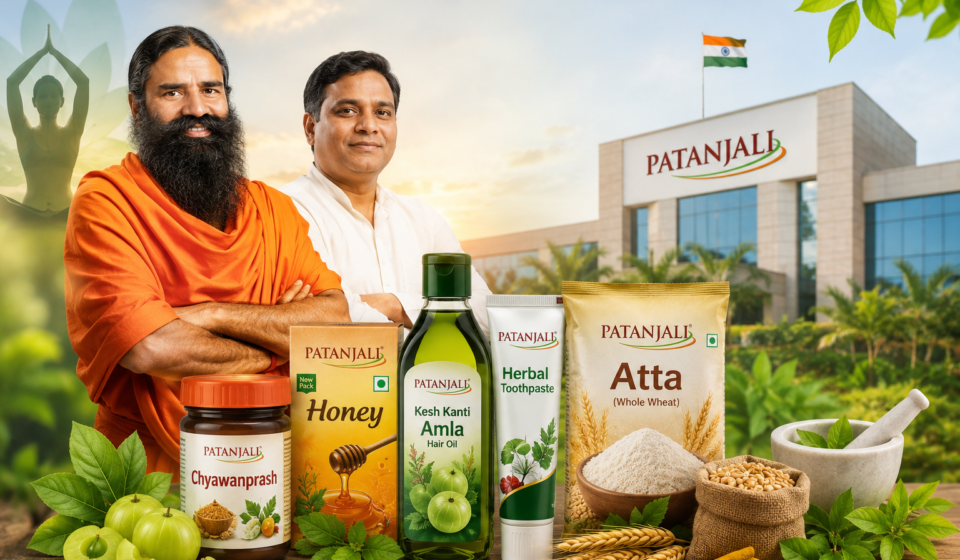
| Organization | Patanjali Group |
| Major operating company | Patanjali Ayurved Limited |
| Major listed FMCG company | Patanjali Foods Limited |
| Founded | 2006 |
| Founders | Baba Ramdev and Acharya Balkrishna |
| Core origins | Yoga and Ayurveda |
| Major base | Haridwar, Uttarakhand |
| Major categories | Food, healthcare, personal care, home care, edible oils, nutraceuticals and FMCG |
| Major listed business | Patanjali Foods |
| Key positioning | Ayurveda, natural products, Indian identity, affordability |
| Major strategic move | Acquisition of Ruchi Soya |
| International ambitions | Global markets |
| Distribution | Large retail and distributor network |
| Major challenge | Balancing rapid growth with quality, compliance and corporate governance |
Patanjali’s own materials describe a portfolio of more than 900 products, a network of around 47,000 retail counters and 3,500 distributors, and a workforce of more than 2 lakh globally in a 2024 corporate brochure. These are company-reported figures and should be understood as applying to the broader Patanjali organization rather than automatically to one individual legal entity. (Patanjali Ayurved)
2. Understanding the Patanjali Group
One of the biggest mistakes in discussing Patanjali is treating every Patanjali business as if it were one company.
The broader ecosystem contains multiple entities.
Two of the most important are:
Patanjali Ayurved Limited
The original consumer-products and Ayurveda-focused company.
Patanjali Foods Limited
The listed company that was formerly known as Ruchi Soya Industries.
This distinction is extremely important.
3. Patanjali Ayurved
Patanjali Ayurved was established in 2006.
Its stated mission is connected to:
- Yoga,
- Ayurveda,
- healthcare,
- natural products,
- social development.
The company describes itself as an organization focused on creating a healthier society through Yoga and Ayurveda. (Patanjali Ayurved)
Its products include categories such as:
- Ayurvedic medicines,
- personal care,
- home care,
- food,
- beverages,
- herbal products.
4. Patanjali Foods
Patanjali Foods is a different and particularly important part of the story.
It was formerly known as Ruchi Soya Industries.
In 2019, Patanjali acquired Ruchi Soya through an insolvency-resolution process for approximately ₹4,350 crore. The company subsequently changed its name to Patanjali Foods in 2022. (The Indian Express)
This acquisition fundamentally changed the scale of the Patanjali business.
5. Why Ruchi Soya Was Important
Before the acquisition, Patanjali’s strength was primarily its association with:
- Ayurveda,
- healthcare,
- personal care,
- consumer products.
Ruchi Soya brought:
- edible oils,
- food manufacturing,
- large-scale industrial infrastructure,
- established distribution,
- the Nutrela brand,
- a listed corporate structure.
Therefore, the acquisition was much more than buying a company.
It gave Patanjali:
Industrial Scale.
6. The Strategic Logic Behind the Acquisition
The acquisition can be understood through a simple equation:
Patanjali Brand
Ruchi Soya Manufacturing
Existing Distribution
Consumer Product Portfolio
=
Larger FMCG Platform.
This was one of the most important strategic moves in Patanjali’s history.
7. From Ayurveda to FMCG
Patanjali’s original competitive advantage came from Ayurveda.
But Ayurveda alone is a relatively narrow market.
FMCG is much larger.
Consumers purchase:
- cooking oil,
- biscuits,
- toothpaste,
- noodles,
- shampoo,
- atta,
- spices,
- snacks,
- beverages.
By entering these categories, Patanjali dramatically expanded the number of occasions on which consumers could encounter the brand.
8. The Central Business Strategy
The core Patanjali strategy can be summarized as:
Take the trust and cultural relevance of Ayurveda and Indian wellness and apply it to everyday consumer products.
This was a powerful idea.
Instead of telling consumers:
“Buy an Ayurvedic medicine.”
Patanjali could tell consumers:
“Use an Indian, natural or Ayurvedic alternative in your everyday life.”
9. The Indian Identity Strategy
One of Patanjali’s most powerful differentiators was its strong Indian identity.
Its branding frequently connected products with:
- Swadeshi,
- Indian culture,
- Ayurveda,
- Yoga,
- traditional knowledge,
- local manufacturing,
- Indian agriculture.
This created a distinct emotional position.
10. Swadeshi as a Marketing Strategy
Traditional FMCG competition often focuses on:
- product quality,
- price,
- advertising,
- distribution.
Patanjali added another dimension:
Identity.
The brand could appeal to consumers who wanted to support Indian businesses and traditional systems.
This gave Patanjali a differentiated narrative.
11. Baba Ramdev’s Role
Baba Ramdev became one of the most recognizable faces in India through Yoga.
His television programs and public appearances created an enormous audience.
This was a major competitive advantage.
A conventional company might spend enormous amounts of money trying to build awareness.
Patanjali had something different:
A pre-existing audience.
12. Founder-Led Brand Building
Baba Ramdev effectively became part of the brand’s communication system.
Consumers did not simply see:
Patanjali advertisement.
They saw:
A person they already associated with Yoga and wellness.
This reduced the distance between:
Messenger
and
Product.
13. Acharya Balkrishna
Acharya Balkrishna played a major role in the operational and organizational development of Patanjali.
Patanjali’s corporate materials identify him as a central management figure and describe the company’s development around large-scale manufacturing and a broad FMCG and Ayurvedic portfolio. (Patanjali Ayurved)
The division of roles between a highly visible public-facing figure and an organizational leader was strategically significant.
14. The Two-Pillar Leadership Model
The Patanjali story can therefore be understood as having two major leadership dimensions:
Baba Ramdev
Public influence, Yoga, communication and brand identity.
Acharya Balkrishna
Management, operations, product development and organizational execution.
This combination was unusual.
15. The Power of Trust Transfer
Imagine a consumer who already trusts Baba Ramdev for:
- Yoga,
- fitness,
- traditional wellness.
That trust can potentially transfer to:
- toothpaste,
- honey,
- ghee,
- hair oil,
- herbal products.
This is known as:
Trust Transfer.
16. But Trust Transfer Has Limits
A person trusted for Yoga is not automatically trusted for every product claim.
This is particularly important for:
- medicines,
- disease claims,
- nutritional claims.
The 2024 Supreme Court proceedings showed why companies must distinguish carefully between brand communication and legally supportable product claims. (Reuters)
17. The Product Portfolio
Patanjali operates across a remarkably broad range of categories.
These include:
Food
- atta,
- rice,
- pulses,
- spices,
- biscuits,
- noodles,
- cereals,
- ghee.
Personal Care
- toothpaste,
- shampoo,
- soap,
- hair oil.
Healthcare
- Ayurvedic medicines,
- wellness products,
- traditional remedies.
Home Care
- detergents,
- cleaners,
- household products.
Beverages
- juices,
- herbal drinks.
Nutrition
- nutraceuticals,
- protein-related products.
Edible Oils
- cooking oils,
- soybean oil,
- mustard oil,
- other edible oils.
18. Why This Portfolio Is Important
Patanjali is no longer dependent on one product.
A customer might buy:
Patanjali toothpaste
every few weeks,
Patanjali atta
every month,
Patanjali oil
regularly,
and
Patanjali honey
occasionally.
This creates multiple consumption occasions.
19. Everyday Consumption Strategy
This is one of Patanjali’s most important strategic transformations.
The company moved from:
Wellness as an occasional purchase
to:
Wellness as an everyday consumption system.
20. Toothpaste as an Example
Toothpaste is a particularly attractive FMCG category because it is:
- frequently purchased,
- relatively inexpensive,
- habit-driven,
- widely distributed.
Entering oral care allowed Patanjali to reach consumers repeatedly.
21. Food as an Example
Food is even more powerful.
A consumer may purchase:
- atta,
- ghee,
- spices,
- biscuits,
- noodles,
- edible oil.
These are household staples.
Once a brand becomes part of the household basket, customer lifetime value can increase substantially.
22. The Household Basket Strategy
Patanjali’s ambition can therefore be understood as:
Become part of the Indian household.
Not just:
Sell an Ayurvedic medicine.
This is a much larger commercial opportunity.
23. Distribution Strategy
A consumer brand cannot become large without distribution.
Patanjali invested heavily in:
- distributors,
- dedicated stores,
- retail counters,
- supermarkets,
- general trade,
- modern trade,
- online commerce.
The company’s own corporate materials describe a network of thousands of distributors and tens of thousands of retail counters. (Patanjali Ayurved)
24. Patanjali Stores
Dedicated Patanjali stores created several advantages.
They provided:
- visibility,
- product breadth,
- controlled presentation,
- direct customer access.
They also strengthened the perception that Patanjali was a complete consumer ecosystem.
25. General Trade
General trade includes:
- kirana stores,
- neighborhood shops,
- local retailers.
This channel is extremely important in India.
A product available only online cannot compete effectively for everyday consumption.
26. Rural Distribution
Patanjali’s value-oriented positioning was particularly suitable for rural and semi-urban consumers.
Its products could be positioned around:
- affordability,
- Indian identity,
- traditional ingredients.
This created strong potential outside major metropolitan areas.
27. Urban Consumers
Urban consumers provided another opportunity.
They were increasingly interested in:
- organic products,
- natural products,
- wellness,
- herbal ingredients,
- Yoga.
Patanjali could therefore appeal to both:
Traditional consumers
and
Modern wellness consumers.
28. Price Strategy
One of Patanjali’s disruptive strategies was competitive pricing.
The company often positioned products as:
Affordable alternatives to established brands.
This made trial easier.
29. Low-Price Entry
Suppose a consumer is already using a major toothpaste brand.
Switching can involve risk.
But if the alternative is:
Affordable
and
Familiar
the barrier to trial becomes lower.
30. Value Proposition
Patanjali’s broad value proposition can be summarized as:
Indian
Natural/Ayurvedic
Affordable
Widely Available
=
Strong Consumer Appeal.
31. The “Good Enough” Strategy
Patanjali did not necessarily need to convince every customer that its product was the world’s best.
It needed to convince consumers:
“This is good enough, affordable and aligned with my values.”
That can be a powerful mass-market strategy.
32. Disrupting Established Brands
Before Patanjali’s rise, many FMCG categories were dominated by established players.
Examples included:
- Colgate,
- Hindustan Unilever,
- Procter & Gamble,
- Marico,
- ITC,
- Emami,
- Dabur.
Patanjali entered these categories with a completely different narrative.
33. Competitive Positioning
A simplified positioning map might look like this:
| Brand Type | Main Appeal |
|---|---|
| Multinational FMCG | Scale + innovation + brand |
| Traditional Indian FMCG | Trust + distribution |
| Ayurvedic brands | Natural + traditional |
| Patanjali | Ayurveda + Indian identity + price + mass distribution |
This positioning helped Patanjali create a distinctive space.
34. The Disruption Effect
Patanjali’s rapid rise forced established competitors to pay greater attention to:
- Ayurveda,
- herbal products,
- natural ingredients,
- Indian identity,
- affordable wellness.
The market changed.
35. Competitive Response
Established FMCG companies responded with:
- herbal product lines,
- natural products,
- Ayurvedic variants,
- traditional ingredient campaigns.
This is a classic example of competitive imitation.
36. Category Creation
Patanjali did not invent Ayurveda.
Ayurveda is thousands of years old.
But Patanjali helped turn Ayurveda into a modern mass-market FMCG proposition.
That distinction is important.
37. Traditional Knowledge as Commercial IP
The knowledge itself may be ancient.
But the business can build intellectual property around:
- formulations,
- packaging,
- brands,
- manufacturing,
- distribution,
- marketing.
38. Manufacturing Strategy
Patanjali invested heavily in manufacturing infrastructure.
Its major operations in and around Haridwar became central to its identity.
The company emphasizes large-scale manufacturing and processing capabilities in its corporate materials. (Patanjali Ayurved)
39. Why Manufacturing Matters
Controlling manufacturing can provide:
- cost advantages,
- quality control,
- supply reliability,
- product customization.
But it also requires:
- capital,
- technical expertise,
- compliance,
- maintenance.
40. Economies of Scale
If a factory produces:
1,000 units,
the cost per unit may be relatively high.
If it produces:
1 crore units,
fixed costs can be spread over much larger volumes.
This creates:
Economies of Scale.
41. Supply Chain
Patanjali’s supply chain includes:
Farmers
↓
Raw Materials
↓
Processing
↓
Manufacturing
↓
Warehouses
↓
Distributors
↓
Retailers
↓
Consumers
The scale of this system is enormous.
42. Farmers as Strategic Partners
Patanjali’s corporate materials state that farmers are treated as important assets and that the company works with farmers through initiatives including contract farming. (Patanjali Ayurved)
This is strategically significant.
It can help create:
- predictable supply,
- quality control,
- farmer relationships.
43. Contract Farming
Contract farming can connect:
Agriculture
with
Manufacturing.
A company can specify:
- crop requirements,
- quality,
- quantity.
Farmers receive a potential buyer relationship.
44. Agricultural Integration
For food and Ayurveda businesses, controlling more of the agricultural supply chain can create advantages.
It may improve:
- traceability,
- quality,
- sourcing reliability.
45. But Agriculture Is Risky
Agricultural supply can be affected by:
- monsoon,
- drought,
- floods,
- pests,
- climate change.
Therefore, supply-chain diversification remains necessary.
46. Research and Development
Patanjali has built significant emphasis around Ayurveda and product development.
The challenge is to convert traditional formulations into:
- standardized products,
- scalable products,
- safe products,
- consumer-friendly formats.
47. Standardization
Traditional medicine may vary depending on:
- raw materials,
- processing,
- preparation.
Industrial FMCG production requires:
Consistency.
Every package should meet defined specifications.
48. Quality Control
Quality is critical because a consumer brand is only as strong as its weakest product experience.
If customers encounter:
- inconsistent quality,
- packaging defects,
- contamination,
- inaccurate claims,
trust can decline.
49. Regulatory Compliance
This is particularly important for Patanjali because it operates across:
- food,
- healthcare,
- cosmetics,
- consumer goods.
Each category has its own regulations.
50. The Advertising Challenge
Patanjali’s biggest strategic weakness has arguably been the tension between:
Aggressive marketing
and
Regulatory limits.
The 2024 Supreme Court case became a major example.
51. The Misleading-Advertisement Case
In February 2024, the Supreme Court barred Patanjali Ayurved from publishing advertisements claiming that its Ayurvedic medicines could cure certain diseases. The court’s action followed allegations that the company continued publishing claims despite an earlier undertaking. (Reuters)
52. Court Proceedings
In April 2024, the Supreme Court criticized the company’s compliance and rejected an apology as insufficient at that stage. The proceedings involved Baba Ramdev and Acharya Balkrishna. (Reuters)
Later that month, Ramdev publicly apologized and acknowledged mistakes. (Reuters)
53. Product-License Issue
In April 2024, an Indian state regulator suspended licenses for 14 products linked to Patanjali-affiliated companies amid the dispute over misleading advertisements. (Reuters)
This illustrates a major business lesson:
Marketing claims must be designed around what can actually be substantiated and legally communicated.
54. Why This Matters Strategically
A strong brand can be damaged faster by a trust issue than it can be built by advertising.
This is especially true for healthcare.
If a company says:
“This product supports wellness.”
that is different from:
“This product cures a serious disease.”
The second type of claim requires much greater scientific and regulatory support.
55. The COVID-19 Episode
Patanjali also faced controversy around its Coronil product during the COVID-19 pandemic.
In 2024, Uttarakhand authorities accused Baba Ramdev of misleading the public by promoting Coronil and other products with disease-related claims; Reuters reported that the allegations included claims about COVID-19 and other diseases. (Reuters)
This became another example of the risks associated with aggressive health claims.
56. Business Lesson From the Controversies
The lesson is not simply:
“Avoid marketing.”
The lesson is:
Build marketing around evidence, regulation and responsible communication.
57. Brand Trust Is Fragile
Patanjali’s biggest asset is arguably its trust-based positioning.
Therefore, anything that creates doubt around:
- product claims,
- quality,
- regulatory compliance,
can have an outsized impact.
58. Corporate Governance
As Patanjali expanded, its organizational structure became increasingly complex.
The group includes:
- private companies,
- listed companies,
- trusts,
- operating entities.
Complex structures require strong:
- governance,
- disclosures,
- internal controls,
- board oversight.
59. The Importance of Patanjali Foods
Patanjali Foods provides a different governance framework because it is a listed company.
Its investor-relations platform publishes:
- financial results,
- annual reports,
- corporate governance information,
- shareholding information,
- regulatory disclosures. (Patanjali)
60. Public-Market Discipline
A listed company faces:
- shareholders,
- analysts,
- stock exchanges,
- regulators.
This increases transparency requirements.
61. The Ruchi Soya Transformation
The acquisition of Ruchi Soya was one of the most important chapters.
The company entered Patanjali’s orbit through an insolvency process in 2019.
It was subsequently renamed Patanjali Foods in 2022. (The Indian Express)
62. Why Acquiring a Listed Company Was Strategic
Instead of building an enormous food company from zero, Patanjali gained access to an existing platform.
This provided:
- manufacturing,
- brands,
- employees,
- infrastructure,
- distribution,
- listed-company structure.
63. The Acquisition as a Growth Shortcut
Organic growth:
Build everything yourself.
Acquisition:
Buy an existing platform.
The second option can accelerate scale dramatically.
64. But Acquisitions Carry Risks
An acquisition can create:
- integration problems,
- debt,
- operational complexity,
- culture clashes,
- unexpected liabilities.
Therefore, acquisition is not automatically successful.
65. Patanjali Foods’ Transformation
Patanjali Foods describes its own transformation as a move from a commodity-driven business toward a more diversified FMCG company. Its FY2024-25 annual report shows revenue of about ₹34,157 crore, compared with about ₹31,742 crore in FY2023-24, and describes increasing FMCG exposure as a strategic objective. (Patanjali)
66. Moving Beyond Edible Oils
The historical Ruchi Soya business was heavily associated with edible oils.
Patanjali’s strategy has been to expand the company into:
- food,
- biscuits,
- noodles,
- cereals,
- nutraceuticals,
- home and personal care.
This is a major portfolio transformation. (Patanjali)
67. Acquisition of Food Businesses
Patanjali Foods acquired:
- biscuits,
- cookies,
- rusks,
- noodles,
- breakfast cereals,
from Patanjali-related entities in 2021.
It subsequently acquired Patanjali Ayurved’s food business in 2022. (Patanjali)
68. Home and Personal Care Acquisition
In November 2024, Patanjali Foods acquired Patanjali Ayurved’s Home and Personal Care business for approximately ₹1,100 crore.
The transaction was structured as a slump sale. (Patanjali)
This further increased Patanjali Foods’ exposure to FMCG categories.
69. Why This Matters
The group is increasingly creating:
A Full FMCG Platform.
Instead of having separate businesses with limited overlap, it can leverage:
- distribution,
- marketing,
- manufacturing,
- brand recognition.
70. Synergy
Synergy means:
Two businesses together can create more value than they could separately.
For example:
One distributor
can sell:
- edible oil,
- biscuits,
- atta,
- toothpaste,
- shampoo.
This can reduce distribution inefficiency.
71. Distribution Synergy
Suppose a distributor already delivers five Patanjali products.
Adding another ten products does not necessarily require ten separate distribution systems.
This is a major FMCG advantage.
72. Marketing Synergy
A single advertising campaign can potentially increase awareness of the broader brand.
For example:
“Patanjali — trusted Indian wellness.”
can support multiple categories.
73. Manufacturing Synergy
Facilities, warehouses and procurement systems can potentially be shared.
This may reduce operating costs.
74. Brand Royalty
Patanjali Foods’ annual report discloses royalty arrangements for the use of Patanjali brands in businesses transferred from Patanjali Ayurved. The FY2024-25 report describes different royalty percentages depending on the business acquired. (Patanjali)
This demonstrates an important distinction:
Brand ownership
and
Operating-company economics.
75. Business Structure Lesson
The Patanjali case therefore offers an interesting corporate-structure lesson:
Different legal entities can own, operate and monetize different parts of a broader brand ecosystem.
But the structure must be transparent and properly governed.
76. Financial Scale
Patanjali Foods’ FY2024-25 annual report reports:
- Revenue: approximately ₹34,157 crore
- EBITDA: approximately ₹1,519 crore
- Profit after tax: approximately ₹765 crore
- Net worth: approximately ₹6,743 crore
These are reported by Patanjali Foods for FY2023-24/FY2024-25 comparisons and should not be interpreted as consolidated revenue for the entire Patanjali Group. (Patanjali)
77. Why Revenue Alone Is Not Enough
A company can generate enormous revenue but still have weak profitability.
This is particularly important in commodity-heavy businesses.
Edible oils can generate:
High revenue
but comparatively lower margins.
Branded FMCG can potentially generate:
Higher margins.
78. The Strategic Importance of FMCG Mix
Patanjali Foods’ own FY2024-25 materials emphasize increasing FMCG contribution and a longer-term objective of reaching a much higher FMCG revenue mix. (Patanjali)
This suggests a strategic shift:
From commodity scale to branded-consumer economics.
79. Commodity vs Brand
Consider two businesses.
Commodity business
Competes heavily on:
- procurement,
- price,
- scale.
Brand business
Can compete on:
- trust,
- differentiation,
- customer loyalty,
- pricing.
Patanjali is trying to move more of its portfolio toward the second model.
80. The Nutrela Opportunity
Nutrela was an important part of the Ruchi Soya legacy.
Patanjali Foods has used the brand as part of its nutrition and protein strategy.
This gives Patanjali a bridge between:
Traditional wellness
and
Modern nutrition.
81. Nutraceuticals
Nutraceuticals are products positioned between:
- food,
- nutrition,
- wellness.
This is a rapidly developing category.
It fits naturally with Patanjali’s broader health positioning.
82. The Modern Wellness Consumer
Today’s consumer may want:
- protein,
- immunity,
- nutrition,
- natural ingredients,
- convenience.
Patanjali has an opportunity to serve this customer.
83. The “Natural” Opportunity
Natural products are attractive because consumers increasingly associate them with:
- health,
- sustainability,
- authenticity.
But “natural” is not a substitute for:
Quality.
84. The Quality Challenge
As the product portfolio expands, maintaining consistent quality becomes more difficult.
A company with:
100 products
has one level of complexity.
A company with:
900+ products
has dramatically more.
Patanjali’s own brochure says its portfolio exceeds 900 products. (Patanjali Ayurved)
85. Product Portfolio Complexity
Every product requires:
- sourcing,
- manufacturing,
- packaging,
- quality checks,
- distribution,
- marketing,
- regulatory compliance.
Large portfolios require strong systems.
86. The SKU Problem
SKU means Stock Keeping Unit.
If Patanjali has thousands of variants, inventory management becomes complicated.
Too many SKUs can create:
- slow-moving inventory,
- higher logistics costs,
- forecasting challenges.
87. Portfolio Rationalization
A smart FMCG company periodically asks:
Which products should we continue?
Which products should we improve?
Which products should we discontinue?
This protects capital.
88. Product Innovation
Patanjali needs to continue launching products that match:
- consumer trends,
- convenience,
- health,
- affordability.
But innovation should not mean:
“Launch everything.”
It should mean:
“Launch products consumers actually need.”
89. Packaging Innovation
Modern consumers expect:
- attractive packaging,
- easy usage,
- convenient sizes,
- recyclable materials.
Traditional-looking packaging may reinforce heritage but can also appear outdated.
The challenge is to combine:
Indian identity
with
Modern design.
90. Digital Transformation
Patanjali’s traditional distribution remains important.
But e-commerce is increasingly relevant.
Consumers can buy:
- grocery,
- personal care,
- wellness products,
online.
91. Direct-to-Consumer
A direct-to-consumer strategy can provide:
- customer data,
- direct communication,
- subscription opportunities,
- personalized offers.
92. Subscription Opportunity
Many Patanjali products are recurring purchases.
For example:
Toothpaste
Shampoo
Hair oil
Atta
Cooking oil
A subscription model could automate repeat purchasing.
93. E-Commerce Opportunity
Patanjali can use e-commerce to:
- expand product availability,
- reach customers outside physical retail,
- test products,
- gather customer feedback.
94. Quick-Commerce Opportunity
Quick-commerce platforms are particularly suitable for:
- toothpaste,
- soap,
- cooking oil,
- snacks,
- beverages.
The customer can purchase these products within minutes.
95. Digital Marketing
Patanjali’s traditional marketing strength came from:
- television,
- Yoga programs,
- public events.
The future requires stronger:
- Instagram,
- YouTube,
- short-form video,
- influencer marketing.
96. YouTube Strategy
The Patanjali ecosystem is naturally suited to video.
Content could include:
- Yoga tutorials,
- Ayurveda education,
- product demonstrations,
- recipes,
- wellness advice.
This connects content directly to commerce.
97. Content-Commerce Flywheel
The model can become:
Yoga Content
↓
Audience
↓
Wellness Interest
↓
Product Discovery
↓
Purchase
↓
Customer
↓
Repeat Purchase
This is a powerful ecosystem.
98. Influencer Marketing
Patanjali can also work with:
- Yoga instructors,
- fitness creators,
- nutrition influencers,
- Ayurveda educators.
However, health claims made through influencers must also comply with applicable advertising rules.
99. Brand Community
Patanjali’s biggest opportunity may be building a community around:
Indian Wellness.
The community could include:
- Yoga,
- Ayurveda,
- healthy food,
- natural living,
- fitness.
This is larger than a product brand.
100. The Ecosystem Model
The broader Patanjali ecosystem includes more than consumer products.
Its official education materials describe initiatives including:
- Acharyakulam,
- Vedic Gurukulam,
- Vedic Kanyagurukulam,
- Patanjali University. (Patanjali Ayurved)
This demonstrates how the organization extends into:
- education,
- culture,
- wellness,
- healthcare.
101. Why the Ecosystem Matters
The ecosystem strengthens:
Brand identity.
A person can encounter Patanjali through:
- Yoga,
- education,
- products,
- healthcare.
This creates multiple touchpoints.
102. The Brand Is Bigger Than Products
For many FMCG companies:
Brand = Products.
For Patanjali:
Brand = Products + Yoga + Ayurveda + Indian identity + Wellness.
This makes the brand architecture unusually broad.
103. The Advantage of an Ecosystem
An ecosystem can lower customer acquisition costs.
Someone who discovers Patanjali through Yoga may later become a product customer.
104. The Risk of an Ecosystem
But an ecosystem can also create complexity.
If one part faces controversy, other parts can be affected.
This is known as:
Reputation Spillover.
105. Reputation Spillover
Suppose a consumer trusts Patanjali because of Yoga.
A controversy involving an unrelated product can still influence their perception of the entire brand.
Therefore, the larger the umbrella, the more carefully it must be managed.
106. SWOT Analysis of Patanjali
Strengths
Strong brand identity
Patanjali has a highly distinctive position.
Founder recognition
Baba Ramdev is a major public figure.
Ayurveda
Deep association with traditional wellness.
Distribution
Large retail and distributor network.
Product breadth
Hundreds of products.
Indian identity
Strong emotional positioning.
Manufacturing
Large-scale manufacturing capabilities.
FMCG platform
Patanjali Foods adds substantial scale.
107. Weaknesses
Brand concentration
The public identity remains strongly associated with key personalities.
Regulatory exposure
Healthcare claims require careful compliance.
Portfolio complexity
Hundreds of products increase operational difficulty.
Quality management
Large-scale manufacturing requires strong systems.
Commodity exposure
Patanjali Foods retains significant exposure to edible oils.
Governance complexity
Multiple entities require sophisticated controls.
108. Opportunities
Global Ayurveda
International demand for wellness.
Rural India
Large consumer opportunity.
Premium wellness
Higher-margin products.
Digital commerce
E-commerce and quick commerce.
Nutraceuticals
Growing health and nutrition market.
International expansion
Global natural-product demand.
SaaS and digital services
Potential ecosystem extensions.
Yoga tourism
Wellness centers and education.
109. Threats
Strong FMCG competitors
HUL, ITC, Dabur, Marico and others.
Patanjali-specific regulatory risks
Advertising and health claims.
Consumer skepticism
Scientific scrutiny.
Raw-material inflation
Agricultural and commodity prices.
Climate change
Supply-chain risk.
Reputation risk
Founder-centered branding.
Competitive imitation
Competitors can launch herbal alternatives.
110. Porter’s Five Forces
Competitive Rivalry — Very High
Patanjali competes with some of India’s largest consumer companies.
Threat of New Entrants — Moderate
Launching a small brand is easy.
Building Patanjali-level distribution is extremely difficult.
Supplier Power — Moderate
Agricultural and natural ingredients can create supply pressure.
Buyer Power — High
Consumers have enormous choice.
Threat of Substitutes — Very High
Consumers can switch brands easily in many FMCG categories.
111. Patanjali’s Competitive Moat
Its moat can be divided into:
Brand moat
Distinctive identity.
Distribution moat
Large network.
Cultural moat
Connection to Yoga and Ayurveda.
Cost moat
Scale and value positioning.
Founder moat
High public recognition.
112. Is the Founder a Moat or a Risk?
This is one of the most interesting questions in the case study.
Baba Ramdev helped create extraordinary awareness.
But a founder-centered brand also creates:
Key-person risk.
If the public perception of the founder changes, the brand can be affected.
113. Reducing Founder Dependency
Patanjali can reduce this risk by strengthening:
- institutional branding,
- scientific credibility,
- professional leadership,
- product quality,
- independent customer trust.
The goal should be:
Consumers trust the product even when the founder is not in the advertisement.
114. Professionalization
As Patanjali becomes larger, it needs:
- professional managers,
- independent oversight,
- strong audit systems,
- transparent disclosures.
This becomes more important as the group expands internationally and through acquisitions.
115. Patanjali Foods as a Case in Professionalization
The listed company’s investor platform includes formal:
- board structures,
- committees,
- disclosures,
- financial reporting.
This provides an institutional framework for the larger business. (Patanjali)
116. Financial Strategy
A major lesson from the Patanjali Foods story is the use of acquisitions to accelerate growth.
The company acquired:
- Ruchi Soya,
- food businesses,
- biscuits,
- noodles,
- breakfast cereals,
- home and personal care.
This created a broader consumer platform. (Patanjali)
117. Capital Allocation
Capital must be allocated carefully between:
- acquisitions,
- manufacturing,
- advertising,
- working capital,
- debt reduction,
- new products.
118. Debt Reduction
Patanjali Foods reports that it fully prepaid its debt in 2022 as part of its transformation journey. (Patanjali)
This is significant because acquisitions can create financial pressure.
Reducing debt improves:
- financial flexibility,
- resilience,
- interest-cost management.
119. Follow-on Public Offer
Patanjali Foods completed a ₹4,300 crore follow-on public offering in 2022, according to its corporate history. (Patanjali)
The capital-market transaction helped strengthen the company’s financial position and public-market presence.
120. Public Markets and Growth
A listed company can access capital for:
- expansion,
- acquisitions,
- technology,
- manufacturing.
But public shareholders also expect:
- growth,
- profitability,
- transparency.
121. The FMCG Margin Opportunity
Branded products can potentially offer better economics than commodities.
For example:
Edible oil
may be heavily influenced by commodity prices.
Branded toothpaste
has more differentiation.
Therefore, Patanjali Foods’ strategy to increase FMCG exposure is strategically important.
122. Premiumization Strategy
Patanjali can gradually move customers toward:
- premium herbal products,
- nutraceuticals,
- high-protein products,
- specialty foods.
This can increase margins.
123. Rural-to-Urban Strategy
The company can continue serving:
Rural consumers
through affordable products.
while targeting:
Urban consumers
with premium wellness products.
This creates a broad market architecture.
124. International Expansion
Patanjali’s corporate materials describe global operations and footprints in markets including the USA, Canada, Germany and Dubai. (Patanjali Ayurved)
International expansion provides enormous potential.
125. The Global Ayurveda Market
India has a cultural advantage in:
- Yoga,
- Ayurveda,
- meditation,
- natural wellness.
Patanjali can potentially package these into globally appealing products.
126. Global Branding Challenge
However, international consumers may not understand:
- Sanskrit terminology,
- traditional formulations,
- Indian health concepts.
The company must explain them clearly.
127. Science + Culture
The international formula should therefore be:
Indian Heritage
Modern Science
Clear Communication
Regulatory Compliance
=
Global Wellness Brand.
128. Export vs Global Brand
Exporting means:
Sending Indian products overseas.
Building a global brand means:
Creating products specifically designed for international consumers.
The second is more powerful.
129. Localization
Different markets may require different:
- flavors,
- package sizes,
- ingredients,
- claims,
- pricing.
Patanjali’s international growth will require localization.
130. The Role of E-Commerce in International Growth
Online commerce allows smaller brands to test foreign markets without immediately building extensive physical distribution.
This could help Patanjali identify:
- popular countries,
- popular products,
- customer segments.
131. Digital Community Strategy
Patanjali can potentially build international communities around:
- Yoga,
- Ayurveda,
- healthy living.
This can support product discovery.
132. The Youth Market
India’s young population presents another major opportunity.
Young consumers are interested in:
- fitness,
- protein,
- natural beauty,
- wellness,
- sustainability.
Patanjali can modernize its products and communication for this audience.
133. Modern Packaging
One way to attract younger customers is through:
- minimalist packaging,
- premium designs,
- convenient formats.
But the brand should retain recognizable Patanjali identity.
134. Social Media Strategy
A future-focused strategy could include:
Lifestyle and wellness.
YouTube
Yoga and education.
Short videos
Product demonstrations.
Podcasts
Ayurveda and health education.
E-commerce
Direct conversion.
135. The Content Funnel
Yoga Video
↓
Wellness Interest
↓
Ayurveda Education
↓
Product Recommendation
↓
E-Commerce
↓
Purchase
This is a powerful digital funnel.
136. Customer Lifetime Value
Suppose a consumer buys:
- toothpaste,
- shampoo,
- atta,
- honey,
- ghee,
- hair oil.
The company can potentially generate much greater lifetime value than from a single product.
This is why product portfolio breadth matters.
137. Cross-Selling
Patanjali can cross-sell:
Toothpaste buyer
→ mouthwash.
Hair-oil buyer
→ shampoo.
Atta buyer
→ ghee.
Protein buyer
→ nutraceuticals.
This increases basket size.
138. Bundling
Bundles can make purchasing easier.
Examples:
Healthy Family Pack
- atta,
- ghee,
- honey,
- spices.
Personal Care Pack
- shampoo,
- soap,
- toothpaste,
- hair oil.
139. Subscription Commerce
Recurring household products are ideal for subscriptions.
A monthly plan could include:
- toothpaste,
- shampoo,
- soap,
- household essentials.
This creates predictable revenue.
140. Customer Data
Direct digital commerce can provide insights into:
- buying frequency,
- preferred categories,
- geographic demand,
- repeat purchases.
This can improve marketing.
141. Artificial Intelligence
AI could improve Patanjali’s operations through:
- demand forecasting,
- inventory optimization,
- personalized recommendations,
- customer service,
- marketing analysis.
142. AI Demand Forecasting
For example:
If sales of honey increase every winter, AI can forecast higher demand.
This helps reduce:
- stockouts,
- excess inventory.
143. AI Product Recommendations
A customer might search:
“Natural shampoo for dry hair.”
An AI system could recommend suitable products.
This improves customer experience.
144. AI Customer Support
An AI assistant could answer:
- product ingredients,
- usage instructions,
- availability,
- shipping,
- returns.
Human support can handle complicated issues.
145. AI Marketing
AI can help identify:
- high-performing advertisements,
- customer segments,
- content topics.
This can reduce wasted advertising spend.
146. Sustainability
Patanjali’s natural-product positioning creates an opportunity to strengthen sustainability.
Potential areas include:
- recyclable packaging,
- responsible sourcing,
- renewable energy,
- water efficiency,
- waste reduction.
147. Environmental Risk
Natural ingredients depend on agriculture.
Climate change can affect:
- herbs,
- oils,
- grains,
- fruits.
Therefore:
Sustainability is also supply-chain strategy.
148. Farmer Relationships
Patanjali’s stated emphasis on farmers and contract farming can become a major strategic asset if combined with:
- sustainable farming,
- technology,
- crop diversification,
- traceability. (Patanjali Ayurved)
149. Rural Entrepreneurship
A large distribution network can also support rural entrepreneurship.
Retailers and distributors can become:
- local business owners,
- employment generators.
This creates economic impact beyond product sales.
150. The Social Business Dimension
Patanjali’s organizational philosophy extends into:
- Yoga,
- education,
- wellness,
- agriculture,
- consumer products.
This gives the organization a broader social narrative than a conventional FMCG company.
151. The Risk of Mixing Business and Mission
A mission-driven business can create strong loyalty.
But it must still maintain:
- financial discipline,
- regulatory compliance,
- product quality.
A good mission cannot compensate for poor execution.
152. The Patanjali Business Model Canvas
Customer Segments
- Indian households,
- rural consumers,
- urban wellness consumers,
- health-conscious consumers,
- Yoga followers,
- international consumers.
Value Proposition
- Ayurveda,
- natural products,
- Indian identity,
- affordability,
- wide product range.
Channels
- retail stores,
- distributors,
- kirana stores,
- modern trade,
- e-commerce,
- direct stores.
Customer Relationships
- brand community,
- Yoga,
- wellness content,
- customer service,
- repeat consumption.
Revenue Streams
- FMCG,
- food,
- edible oils,
- personal care,
- healthcare,
- nutraceuticals.
Key Resources
- brand,
- distribution,
- manufacturing,
- product portfolio,
- consumer trust.
Key Activities
- manufacturing,
- R&D,
- marketing,
- distribution,
- agriculture,
- product development.
153. Patanjali’s Growth Flywheel
The business flywheel can be represented as:
Yoga Audience
↓
Brand Awareness
↓
Product Trial
↓
Retail Distribution
↓
Sales
↓
More Products
↓
Cross-Selling
↓
Repeat Purchase
↓
More Distribution
↓
Stronger Brand.
154. The Disruption Flywheel
Another model is:
Indian Identity
↓
Consumer Interest
↓
Affordable Pricing
↓
Trial
↓
Market Share
↓
Retailer Interest
↓
More Availability
↓
More Consumers
This helps explain the speed of Patanjali’s expansion.
155. Why Patanjali Grew So Quickly
Several factors worked together.
1. Existing audience
Baba Ramdev’s Yoga popularity.
2. Strong positioning
Ayurveda + Indian identity.
3. Affordable pricing
Low barrier to trial.
4. Distribution
Large retail network.
5. Product breadth
Many everyday categories.
6. Manufacturing
Large-scale capacity.
7. Cultural timing
Growing interest in natural products and Indian brands.
156. Timing Was Critical
Patanjali’s growth occurred during a period when India was experiencing:
- rising middle-class consumption,
- expanding television penetration,
- increasing smartphone adoption,
- greater interest in health,
- growing e-commerce.
The market environment was favorable.
157. The Indian Consumer Was Changing
Consumers increasingly wanted:
Convenience
but also:
Authenticity.
They wanted:
Modern products
but also:
Traditional values.
Patanjali sat directly at that intersection.
158. “Modern Tradition”
This is perhaps the best description of the Patanjali proposition.
It is:
Traditional Indian knowledge packaged as modern consumer products.
159. Why This Model Is Powerful
It avoids two extremes.
Purely traditional
May feel outdated.
Purely modern
May lack cultural differentiation.
Patanjali combines both.
160. Competitive Advantage vs Dabur
Dabur also has strong Ayurvedic heritage.
But the positioning differs.
Dabur
Heritage + professional FMCG + Ayurveda.
Patanjali
Ayurveda + Yoga + Indian identity + founder-led mass movement.
Both have strong natural-product positioning but different brand personalities.
161. Competitive Advantage vs HUL
Hindustan Unilever’s strength is:
- enormous distribution,
- global expertise,
- brand portfolio,
- innovation.
Patanjali’s differentiator is:
- cultural identity,
- Ayurveda,
- Yoga.
162. Competitive Advantage vs Patanjali’s New Entrants
Smaller Ayurvedic startups may have:
- modern design,
- D2C capability,
- social media strength.
But they lack Patanjali’s:
- physical distribution,
- brand awareness,
- manufacturing scale.
163. The Big Lesson
A startup does not necessarily need a completely new product.
It can create disruption through:
Positioning + Distribution + Community.
Patanjali is a strong example.
164. Business Lesson: Build a Category Story
Consumers remember stories.
Patanjali’s story is:
Ayurveda + Yoga + Indian wellness.
That is much easier to remember than:
“We sell consumer products.”
165. Business Lesson: Build a Mission
A mission can create:
- emotional loyalty,
- differentiation,
- employee motivation.
Patanjali’s mission around Yoga and Ayurveda gives it a clear identity. (Patanjali Ayurved)
166. Business Lesson: Own Distribution
Online marketing can create demand.
But physical distribution creates availability.
Patanjali invested heavily in both.
167. Business Lesson: Expand Carefully
Diversification can create huge growth.
But too many categories can increase:
- complexity,
- capital requirements,
- regulatory exposure.
168. Business Lesson: Acquisitions Can Transform Scale
The Ruchi Soya acquisition shows how a company can use acquisition to accelerate entry into a much larger industrial and FMCG platform. (The Indian Express)
169. Business Lesson: Brand Extensions Need Logic
Patanjali’s strongest extensions are those connected to:
- food,
- health,
- wellness,
- natural products.
The farther a company moves from its core identity, the harder the brand extension becomes.
170. Business Lesson: Trust Requires Discipline
The advertising disputes show that strong public influence can become a liability if claims are not carefully controlled.
This is perhaps the most important cautionary lesson in the case.
171. Business Lesson: Regulatory Compliance Is Strategy
Compliance is not simply an administrative function.
It directly affects:
- brand reputation,
- product availability,
- advertising,
- investor confidence.
172. Business Lesson: Quality Is Non-Negotiable
For a healthcare and FMCG business, quality problems can destroy years of brand building.
173. Business Lesson: Founder Branding Has Limits
Founder-led brands can grow quickly.
But institutional brands are more durable.
Patanjali’s long-term challenge is therefore to ensure:
The brand remains strong even when the founder is not the central messenger.
174. Business Lesson: Professionalization Matters
As companies become large, informal systems stop working.
They need:
- governance,
- audit,
- data,
- process,
- professional management.
175. Business Lesson: Build a Portfolio
A strong company should not depend on one product.
Patanjali’s move into:
- food,
- healthcare,
- personal care,
- home care,
- oils,
creates diversification.
176. Business Lesson: Use Existing Assets
Patanjali used its:
- Yoga audience,
- brand,
- distribution,
- cultural identity,
to enter multiple categories.
This is a powerful entrepreneurial principle:
Leverage existing assets before building new ones.
177. Business Lesson: Distribution Is an Asset
A company with 50,000 retail relationships has an enormous strategic advantage.
Even if a competitor develops a better product, getting distribution can take years.
178. Business Lesson: Affordable Products Can Scale Fast
Patanjali’s value positioning reduced barriers to adoption.
Affordable products are particularly powerful in emerging markets.
179. Business Lesson: Cultural Relevance Matters
Global companies often have enormous resources.
But a local company can win by understanding:
- language,
- culture,
- identity,
- habits.
Patanjali used Indian cultural relevance as a competitive advantage.
180. Business Lesson: Authenticity Matters
Consumers increasingly ask:
Where did this product come from?
What does the brand stand for?
Patanjali has a clear answer.
181. The Future of Patanjali
The next phase of Patanjali’s growth could focus on:
1. Premium wellness
2. Global Ayurveda
3. Digital commerce
4. Nutraceuticals
5. Food innovation
6. Personal care
7. Sustainable sourcing
8. AI and supply-chain automation
9. Professional governance
10. Younger consumers.
182. Global Ayurveda 2.0
The next stage of Ayurveda should be:
Evidence-led.
Convenient.
Modern.
Globally understandable.
Patanjali has the brand foundation to participate in this transformation.
183. Modern Wellness Products
Potential growth areas include:
- protein,
- supplements,
- functional foods,
- herbal beverages,
- natural skincare,
- modern Ayurvedic formats.
184. The Protein Opportunity
India’s growing fitness culture creates demand for:
- protein,
- nutrition,
- performance foods.
Nutrela gives Patanjali Foods a strong platform in this area.
185. Healthy Convenience
Consumers increasingly want:
Healthy + convenient.
This creates opportunities for:
- ready-to-eat products,
- healthy snacks,
- instant breakfast,
- functional beverages.
186. Premium Indian Products
Patanjali can potentially build premium product lines around:
- traditional ingredients,
- high-quality sourcing,
- sophisticated packaging.
This can help increase margins.
187. International Premiumization
Indian Ayurveda can potentially be positioned as:
Premium Wellness.
This is different from:
Low-Cost Indian Product.
The first has much greater long-term brand potential.
188. The Digital Consumer
The future consumer may discover Patanjali through:
- YouTube Yoga,
- Instagram wellness content,
- Google search,
- e-commerce,
- influencers.
The brand must therefore become digitally native.
189. The Next Generation
The most important question is:
Will a 20-year-old consumer in 2035 feel that Patanjali is relevant?
The answer depends on:
- product innovation,
- design,
- science,
- digital marketing,
- authenticity.
190. The 2035 Patanjali
A future Patanjali could potentially look like:
Yoga
Ayurveda
Nutrition
Beauty
FMCG
Digital Commerce
Global Wellness
AI-powered supply chain
=
Global Indian Wellness Platform.
191. Strategic Recommendations
Recommendation 1: Strengthen scientific credibility
Invest heavily in:
- clinical research where appropriate,
- product testing,
- transparent ingredient information.
Recommendation 2: Separate health education from aggressive product claims
Education can build trust without making unsupported promises.
Recommendation 3: Reduce founder dependency
Build institutional trust around:
- products,
- science,
- quality.
Recommendation 4: Simplify the product portfolio
Focus resources on the strongest categories.
Recommendation 5: Increase premiumization
Build higher-margin wellness products.
Recommendation 6: Expand internationally
Target global wellness markets with localized products.
Recommendation 7: Build digital relationships
Develop:
- apps,
- websites,
- subscriptions,
- communities.
Recommendation 8: Use AI
Improve:
- forecasting,
- customer service,
- marketing,
- inventory.
Recommendation 9: Strengthen governance
As the group grows, governance must become increasingly institutional.
Recommendation 10: Protect the brand
Every product and advertisement should reinforce:
- quality,
- trust,
- authenticity.
192. Patanjali Case Study Summary
| Factor | Assessment |
|---|---|
| Brand awareness | Extremely strong |
| Cultural differentiation | Extremely strong |
| Distribution | Very strong |
| Product breadth | Very broad |
| Ayurveda positioning | Very strong |
| Price positioning | Strong |
| Manufacturing | Strong |
| International opportunity | High |
| Digital opportunity | High |
| Regulatory risk | Significant |
| Governance complexity | Significant |
| Competition | Extremely high |
| Long-term opportunity | Very high |
193. The Patanjali Growth Formula
Patanjali’s growth can be summarized as:
Yoga audience + Ayurveda + Indian identity + affordability + distribution + manufacturing + product diversification = rapid FMCG expansion.
But the future formula needs one additional element:
+ scientific credibility + regulatory discipline.
194. The Complete Business Flywheel
The long-term flywheel could become:
Yoga & Wellness
↓
Community
↓
Brand Trust
↓
Product Discovery
↓
Affordable FMCG Products
↓
Retail Distribution
↓
Repeat Purchases
↓
Customer Data
↓
Product Innovation
↓
Premium Products
↓
Higher Margins
↓
Global Expansion
↓
Stronger Patanjali Brand.
195. Final Conclusion
The Patanjali case study is one of the most important examples of how a company can use culture, identity, community and distribution to disrupt a mature consumer market.
Patanjali did not invent Ayurveda.
It did something commercially different.
It took the concept of Ayurveda and connected it with:
- mass manufacturing,
- modern packaging,
- FMCG distribution,
- aggressive marketing,
- affordable pricing,
- Yoga,
- Indian identity,
- and a huge existing audience.
The result was a brand capable of competing with some of India’s largest consumer companies.
The acquisition of Ruchi Soya and its transformation into Patanjali Foods represented another major strategic shift. It gave the group access to industrial-scale food and edible-oil operations and created a platform for expansion into additional FMCG categories. Patanjali Foods subsequently acquired businesses covering biscuits, noodles, breakfast cereals, food products and, in 2024, the Home and Personal Care business of Patanjali Ayurved. (The Indian Express)
Patanjali Foods’ FY2024-25 reporting shows how significant this transformation has become, with reported revenue of approximately ₹34,157 crore and an increasing strategic focus on FMCG. (Patanjali)
But the Patanjali story also demonstrates that rapid growth creates new responsibilities.
The same brand power that helps a company acquire customers can amplify reputational damage when advertising or product claims become controversial.
The Supreme Court proceedings in 2024 over advertisements claiming that Patanjali Ayurved medicines could cure diseases demonstrated the seriousness of this issue. (Reuters)
The lesson is straightforward:
A strong brand can open the door, but quality, evidence and compliance determine whether the customer stays.
Patanjali’s future therefore depends on successfully combining two worlds.
The first is its traditional strength:
Ayurveda
Yoga
Indian identity
Natural products
Wellness
The second is the modern business requirement:
Scientific research
Professional management
Quality systems
Regulatory compliance
Digital commerce
Global branding
Data and AI
Sustainable supply chains
If Patanjali can successfully combine these two worlds, it has the potential to evolve beyond being an Indian Ayurvedic FMCG company.
It could become:
A Global Indian Wellness and Consumer-Products Platform.
That is the real significance of the Patanjali case study.
It is not merely a story about Baba Ramdev, Ayurveda or FMCG products.
It is a story about how identity can become a business asset, how distribution can become a competitive moat, how an audience can become a customer base, how acquisitions can accelerate scale, and how a traditional idea can be transformed into a modern consumer business.
And perhaps the most important lesson for entrepreneurs is this:
Don’t compete only by selling a product. Build a reason for people to believe in the product, a system that makes it available everywhere, and a brand that remains relevant as customers and markets change.
Patanjali’s rise demonstrates the power of that approach.
Its next chapter will depend on whether it can turn that extraordinary initial disruption into a more disciplined, scientifically credible, professionally governed and globally competitive consumer business.
That is what will determine whether Patanjali becomes simply one of India’s most successful FMCG challengers—or one of India’s enduring global consumer brands.

Your explanation gave me good reasons to explore the topic further during my research and I look forward to reading more from you