




Britannia Industries Case Study: The 130+ Year Journey of One of India’s Most Powerful FMCG Brands

Introduction
Britannia Industries Case Study: Few Indian consumer brands have survived for more than a century while remaining relevant to successive generations.
Britannia Industries is one of them.
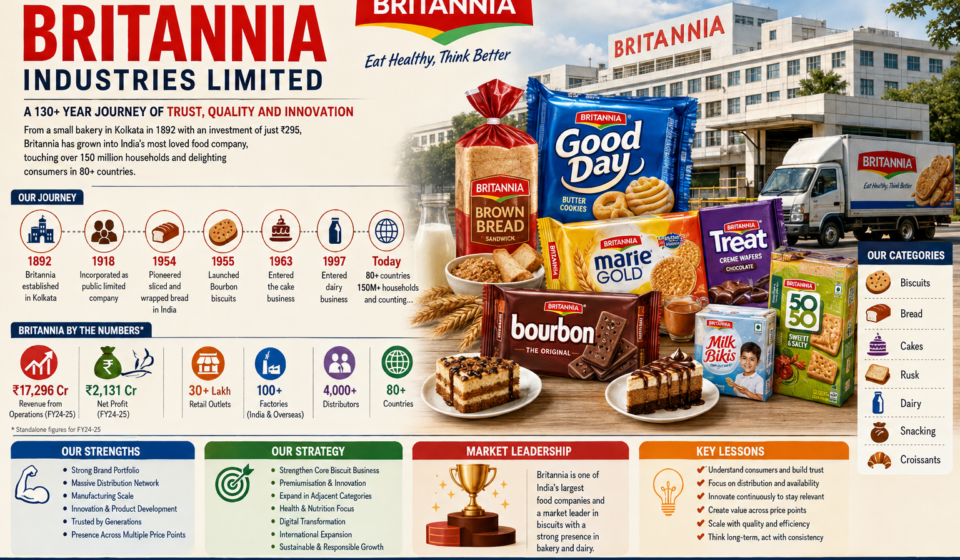
From a small bakery business established in Kolkata in 1892 with an investment of just ₹295, Britannia has evolved into one of India’s best-known food companies, with businesses spanning bakery, dairy and adjacent snacking categories. The company says its products now reach consumers in more than 80 countries.
Britannia’s story is not simply the story of biscuits.
It is a case study in:
- brand building,
- product innovation,
- mass-market distribution,
- consumer psychology,
- premiumisation,
- manufacturing,
- portfolio management,
- advertising,
- rural and urban penetration,
- strategic partnerships,
- international expansion,
- corporate restructuring,
- and long-term business survival.
Its portfolio today includes iconic products and brands such as Good Day, Marie Gold, Bourbon, 50-50, Milk Bikis, NutriChoice, Little Hearts, Pure Magic, Treat, cakes, breads, rusks, croissants and dairy products. Britannia’s current corporate communication describes the company as a responsible global total foods company focused on bakery, dairy and adjacent snacking categories.
The remarkable aspect of Britannia is that the company has managed to do two things at the same time:
Preserve the power of traditional brands while continuously creating products for new generations.
That is the central theme of this case study.
1. Britannia at a Glance
| Particular | Details |
|---|---|
| Company | Britannia Industries Limited |
| Founded | 1892 |
| Origin | Kolkata, India |
| Initial investment | ₹295 |
| Industry | FMCG / Food |
| Core categories | Bakery, Dairy, Snacking |
| Major products | Biscuits, Cakes, Bread, Rusk, Dairy, Snacks |
| International presence | 80+ countries |
| Corporate group | Wadia Group |
| Registered office | Kolkata |
| Current Chairman | Nusli N. Wadia |
| Current CEO & MD | Rakshit Hargave |
Britannia’s official corporate profile identifies it as a Kolkata-founded food company established in 1892, while its current leadership includes Chairman Nusli N. Wadia and CEO & Managing Director Rakshit Hargave.
2. The Beginning: 1892
Britannia’s history begins in 1892 in Kolkata.
The company was established with an investment of only:
₹295
That number is remarkable when compared with the size of the company today.
The business began during a period when India’s packaged food industry was very different from the modern FMCG market.
There was:
- limited organised retail,
- limited packaged food consumption,
- limited industrial manufacturing,
- limited mass advertising,
- and relatively low consumer purchasing power.
Britannia’s early success therefore depended on identifying a very basic opportunity:
Consumers wanted convenient, reliable food products.
3. From Bakery to Food Company
Britannia did not immediately become the giant biscuit company people know today.
Its evolution took decades.
The company gradually expanded its capabilities and product portfolio.
This is one of the most important lessons from Britannia:
Great companies are often built through repeated small expansions rather than one revolutionary event.
Britannia moved from:
Bakery
to
Biscuits
to
Bread
to
Cakes
to
Dairy
to
Snacking
to
International food markets.
4. Incorporation in 1918
Britannia was incorporated as a public limited company on 21 March 1918 under the Indian Companies Act, VII of 1913.
This was an important stage in the company’s institutional development.
Moving from a small business to a formal corporate structure allowed Britannia to develop:
- capital,
- governance,
- professional management,
- manufacturing capability,
- larger distribution.
5. The Evolution of Britannia
Britannia’s journey can be summarised through several major milestones.
1892
Britannia established in Kolkata.
1918
Company incorporated as a public limited company.
1954
Britannia pioneered high-quality sliced and wrapped bread in India.
1955
Britannia launched Bourbon biscuits.
1963
Britannia entered cakes.
1979
The company changed its name from Britannia Biscuit Co. Ltd. to Britannia Industries Ltd.
1997
Britannia launched its “Eat Healthy. Think Better” corporate identity and expanded into dairy.
2017
Britannia entered a joint venture with Chipita for croissants.
2018
The company marked 100 years of incorporation.
These milestones show how Britannia repeatedly expanded its addressable market.
6. The First Major Strategic Insight: Don’t Remain a Single-Product Company
One of Britannia’s most important strategic decisions was diversification.
Imagine Britannia had remained only a biscuit company.
It would have been exposed to:
- biscuit competition,
- changing consumer preferences,
- commodity prices,
- category saturation.
Instead, Britannia gradually created multiple categories.
Today its product architecture includes:
- biscuits,
- dairy,
- bread,
- rusk,
- cakes,
- snacks,
- croissants.
This is portfolio diversification.
7. The Power of the Biscuit Business
Even after diversification, biscuits remain central to Britannia.
Biscuits are an attractive FMCG category because they offer:
- frequent consumption,
- low ticket sizes,
- long shelf life,
- easy transportation,
- broad consumer appeal,
- multiple price points.
A biscuit can be consumed:
- with tea,
- as a snack,
- while travelling,
- at school,
- at work,
- at home.
That creates enormous potential purchase frequency.
8. Britannia’s Iconic Brands
Britannia has created one of the strongest brand portfolios in India’s food industry.
Major brands include:
Good Day
A major cookie brand.
Marie Gold
Strong association with tea-time consumption.
Bourbon
Chocolate biscuit with long-standing brand recognition.
50-50
Known for its sweet-and-salty proposition.
Milk Bikis
Strong family and child-oriented positioning.
NutriChoice
Health and wellness-oriented positioning.
Little Hearts
Distinctive sweet snack biscuit.
Pure Magic
Premium indulgence.
Treat
Cream biscuit range.
The company also operates in:
- cakes,
- bread,
- rusk,
- croissants,
- dairy,
- snacks.
Britannia’s current brand portfolio demonstrates its strategy of covering multiple consumer needs and price segments.
9. Britannia’s Real Competitive Advantage
Many companies can manufacture biscuits.
That is not Britannia’s biggest advantage.
Its real advantage is the combination of:
Brand
Distribution
Manufacturing
Innovation
Consumer trust
Portfolio breadth
This combination is much harder to replicate.
10. Brand Portfolio Strategy
Britannia does not rely on a single brand.
Instead, it operates a portfolio.
This creates a powerful structure.
For example:
Value / everyday consumption
Marie Gold
Mass premium
Good Day
Indulgence
Bourbon / Pure Magic
Health
NutriChoice
Family and children
Milk Bikis
Snacking
50-50 / Little Hearts
This allows Britannia to capture consumers with different preferences.
11. The Importance of Good Day
Good Day is one of Britannia’s most important brands.
The brand transformed the perception of biscuits from simply:
“A cheap snack.”
to:
“A delicious cookie experience.”
This helped Britannia participate in premiumisation.
12. Premiumisation
Premiumisation means convincing consumers to spend more on a category.
For example:
A basic biscuit may cost ₹5.
A premium cookie may cost:
₹20,
₹30,
₹50,
or more.
If consumers become wealthier, companies can increase revenue not only by selling more products but also by increasing:
Revenue per consumption occasion.
Britannia’s portfolio enables it to participate in this trend.
13. Britannia’s Multi-Price Strategy
The company can effectively create a ladder:
Entry
Low-priced biscuits.
↓
Mainstream
Marie Gold, 50-50 and similar products.
↓
Premium
Good Day.
↓
Indulgent
Bourbon, Pure Magic and premium cookies.
This is powerful because consumers can remain within the Britannia ecosystem even as their purchasing power changes.
14. The Consumer Lifetime Value Strategy
Imagine a consumer starts with a low-priced Britannia biscuit as a child.
Later:
They buy Marie Gold.
Then:
They buy Good Day.
Then:
They purchase premium cookies.
The consumer has moved up the value chain.
Britannia can potentially retain the consumer throughout that journey.
This is a classic customer lifetime value strategy.
15. Distribution: The Backbone of Britannia
Advertising creates awareness.
Distribution converts awareness into sales.
Britannia has built an enormous distribution system.
Its sustainability reporting has described a network involving:
- more than 4,000 distributors,
- over 25 lakh retail outlets,
- 20 own factories in India,
- 48 contract packers,
- 8 own depots,
- and more than 1,400 suppliers.
More recent company communication says Britannia’s products reach more than 30 lakh outlets and over 150 million households, while being manufactured across nearly 100 factories.
The exact footprint varies by reporting period and definition, but the strategic point is clear:
Britannia has built massive distribution density.
16. The Indian Kirana Network
The kirana store remains crucial to FMCG.
Millions of Indian consumers purchase products from neighbourhood shops.
For Britannia, being present in these stores means:
- high visibility,
- frequent purchases,
- easy access,
- strong retailer relationships.
17. The Distribution Flywheel
Britannia’s distribution system creates a powerful loop:
More distributors
↓
More retailers
↓
More availability
↓
More consumers
↓
More sales
↓
More retailer demand
↓
More distributor orders
↓
Greater manufacturing scale
↓
Better economics
↓
More distribution
This is a classic FMCG growth flywheel.
18. Rural India
India’s rural market is extremely important for FMCG.
Rural consumers increasingly purchase:
- packaged food,
- biscuits,
- snacks,
- dairy products.
Britannia’s low-ticket products fit naturally into this environment.
The company can therefore combine:
Mass affordability
with
Distribution depth.
19. Urban India
Urban consumers offer a different opportunity.
They increasingly want:
- convenience,
- premium products,
- healthier choices,
- new flavours,
- indulgence,
- ready-to-eat foods.
Britannia’s portfolio allows it to serve both mass and premium urban consumers.
20. One Company, Multiple Consumer Segments
This is one of Britannia’s most important strengths.
It does not need to choose between:
Rural
and
Urban.
It can serve both.
It does not need to choose between:
Value
and
Premium.
It can serve both.
It does not need to choose between:
Traditional
and
Modern.
Its portfolio can accommodate both.
21. Marketing Strategy
Britannia has historically invested heavily in brand communication.
The company itself has stated that it supports its brands and innovations with investments in digital and mass media.
Its marketing strategy typically combines:
- television,
- digital,
- social media,
- sports,
- celebrity partnerships,
- regional communication,
- emotional storytelling,
- product demonstrations.
22. Good Day Marketing
Good Day’s advertising has traditionally focused on:
- happiness,
- indulgence,
- sharing,
- celebration.
The strategy is to transform the product from:
“A biscuit.”
into:
“A small moment of happiness.”
This is emotional positioning.
23. Marie Gold Marketing
Marie Gold is strongly associated with:
Tea.
Britannia’s current communication around Marie Gold continues to highlight the enduring combination of chai and Marie Gold.
This is a powerful positioning strategy.
Instead of selling only a biscuit, the brand sells a:
Consumption ritual.
24. Why Consumption Rituals Matter
A product associated with a daily habit becomes more powerful.
For example:
Tea + Marie Gold
creates a predictable consumption occasion.
That means the brand becomes part of routine.
Routine creates repeat purchase.
25. Bourbon Marketing
Bourbon has a different personality.
It focuses on:
- chocolate,
- indulgence,
- youth,
- taste,
- fun.
This allows Britannia to target consumers who want something different from traditional biscuits.
26. 50-50 Positioning
Britannia 50-50 is another interesting example.
The product is positioned around the combination of:
Sweet + salty.
This is a differentiated taste proposition.
The brand demonstrates an important marketing lesson:
If the category is crowded, create a memorable reason to choose your product.
27. NutriChoice Strategy
NutriChoice targets the growing health-conscious segment.
This is strategically important because traditional biscuits face criticism around:
- sugar,
- calories,
- refined flour,
- fat.
Health-oriented products allow Britannia to participate in a changing consumer environment.
28. Health and Wellness
The Indian consumer is becoming more conscious about:
- nutrition,
- ingredients,
- calories,
- protein,
- fibre,
- sugar.
This creates an opportunity for Britannia.
The company can develop products positioned around:
- whole grains,
- fibre,
- nutrition,
- better ingredients,
- portion control.
29. The Risk of Health Trends
At the same time, health awareness creates risk.
If consumers reduce traditional packaged snacks, biscuit consumption patterns could change.
Therefore, Britannia must innovate.
The answer is not to abandon biscuits.
The answer is to make the portfolio broader.
30. From Biscuit Company to Total Foods Company
Britannia now describes itself as a:
Responsible Global Total Foods Company.
This positioning is strategically important.
The company is moving from:
“We make biscuits.”
to:
“We provide food and snacking solutions throughout the day.”
Britannia’s current corporate vision explicitly centres on being a responsible global total foods company.
31. The Total Foods Strategy
Imagine a consumer’s day.
Morning
Bread.
Breakfast
Dairy.
Mid-morning
Biscuits.
Afternoon
Snack.
Evening
Tea + Marie Gold.
Night
Cake or indulgent snack.
Britannia wants to participate in multiple moments.
That increases customer lifetime value.
32. Bread Business
Britannia was a pioneer in high-quality sliced and wrapped bread in India in 1954.
Bread is strategically attractive because it is:
- frequent,
- household-oriented,
- highly habitual.
But it is also more perishable than biscuits.
Therefore, the supply chain becomes more challenging.
33. The Importance of Bread Distribution
Bread needs:
- faster transportation,
- better inventory management,
- frequent replenishment.
This creates operational complexity.
But if managed effectively, it gives Britannia another daily household consumption occasion.
34. Cakes
Britannia entered the cake category in 1963.
Cakes provide:
- indulgence,
- snacking,
- celebrations,
- convenience.
The company continues to innovate in cakes.
In FY2024-25, Britannia said it revamped its slice cake portfolio with improved recipes and contemporary packaging, and launched a larger-format Double Choco Chip Cake.
35. Croissant Business
Croissants represent a different kind of strategic opportunity.
The category is more premium and relatively less mature in India.
Britannia entered the category through a joint venture with Chipita in 2017.
This is an example of:
Strategic partnership for category expansion.
36. Why Croissants Matter
Croissants allow Britannia to participate in:
- premium snacking,
- western bakery,
- convenience,
- indulgence.
The company’s FY2024-25 annual report describes India’s croissant category as nascent but potentially attractive because consumer preferences are evolving toward differentiated snacking formats and premium indulgence.
37. Strategic Partnerships
A company doesn’t need to build every capability internally.
Britannia has used partnerships to access:
- technology,
- manufacturing,
- new categories,
- international expertise.
This reduces the risk and time required to enter unfamiliar markets.
38. Dairy Business
Britannia entered dairy products in 1997.
Dairy creates another opportunity because consumers purchase:
- cheese,
- milk-based drinks,
- dairy snacks.
It also allows Britannia to participate in higher-value food categories.
39. Cheese and Premium Dairy
Cheese is especially interesting because Indian consumers are increasingly adopting:
- sandwiches,
- pizzas,
- western breakfasts,
- convenience foods.
That creates long-term category potential.
40. Product Innovation
Innovation is critical for an old brand.
A company that has existed for more than 130 years cannot depend entirely on historical success.
Consumer preferences change.
Britannia therefore invests in:
- new products,
- new packaging,
- new formats,
- premium products,
- health-oriented products,
- digital experiences.
41. Modernising Existing Products
An important innovation strategy is not always launching something new.
Sometimes it means:
Improving something that already works.
Britannia’s FY2024-25 report describes revamping its slice cake portfolio through improved recipes and contemporary packaging.
This is an important lesson:
Innovation can mean renovation.
42. Packaging as a Competitive Tool
Packaging performs several jobs.
It:
- protects the product,
- communicates the brand,
- creates shelf visibility,
- signals premium quality,
- attracts new consumers.
Modern packaging can make an old product feel new.
43. Youth Marketing
One challenge for heritage brands is remaining relevant to younger consumers.
Britannia’s recent product and packaging initiatives explicitly target younger consumers in categories such as cakes.
This is strategically important.
A 130-year-old company must continuously win the next generation.
44. The Generational Brand Challenge
Imagine a consumer born in 1970.
They may know:
- Marie Gold,
- Bourbon,
- Good Day.
Now imagine a consumer born in 2010.
They have access to:
- global brands,
- premium cookies,
- protein snacks,
- imported foods,
- quick-commerce products.
Britannia must remain relevant to both.
45. Heritage + Modernity
The company’s strategic challenge can be expressed as:
Heritage
Keep what consumers trust.
Modernity
Create what new consumers want.
=
Long-term brand survival.
46. Manufacturing Strategy
Britannia’s manufacturing network is a major strategic asset.
Its sustainability reporting has described 20 own factories in India and seven international factories, along with contract manufacturing partners.
Manufacturing scale allows Britannia to:
- control quality,
- increase capacity,
- optimise costs,
- shorten supply chains,
- develop new products.
47. Technology in Manufacturing
Modern food manufacturing requires:
- automation,
- quality control,
- data,
- predictive maintenance,
- energy efficiency.
Britannia has stated that it is developing technologically superior factories and has commercialised new biscuit manufacturing capacity in different Indian states.
48. Regional Manufacturing
India is geographically enormous.
Transporting food products long distances can be expensive.
Regional manufacturing can reduce:
- freight costs,
- delivery times,
- inventory requirements.
It can also improve freshness for products such as bread and cakes.
49. Supply Chain as a Competitive Advantage
Britannia’s supply chain includes:
- suppliers,
- factories,
- warehouses,
- distributors,
- retailers.
Each stage must work efficiently.
If one stage fails, consumers may experience:
Stock-outs.
Stock-outs create lost sales and may give competitors an opportunity.
50. Commodity Inflation
FMCG companies face volatile raw-material costs.
For Britannia, important inputs can include:
- wheat,
- sugar,
- edible oils,
- dairy ingredients,
- packaging.
The company has explicitly discussed commodity volatility, including wheat and sugar, and its need to balance pricing actions with competitiveness.
51. The Commodity-Margin Challenge
Suppose wheat prices rise.
Britannia has three choices:
Option 1
Increase prices.
Risk:
Consumers may switch.
Option 2
Reduce product size.
Risk:
Consumers may feel value has declined.
Option 3
Absorb the cost.
Risk:
Margins fall.
Therefore, commodity management is a major strategic capability.
52. Cost Efficiency
Britannia has repeatedly highlighted cost-efficiency initiatives.
This is critical because FMCG companies operate at enormous volumes.
Even a small saving per unit can create substantial aggregate savings.
53. Scale Economics
Suppose Britannia saves:
₹0.10
per packet.
If it sells:
100 million packets,
the theoretical saving is:
₹10 million.
At massive scale, tiny efficiencies matter.
54. Financial Performance
Britannia’s standalone financial history shows significant long-term growth.
According to the FY2024-25 annual report, standalone revenue from operations increased from approximately:
₹7,961 crore in FY2016
to
₹17,296 crore in FY2025.
Standalone net profit increased from approximately:
₹763 crore
to
₹2,131 crore
over the same period.
This illustrates the long-term compounding of the business.
55. FY2025 Performance
For FY2024-25, Britannia’s standalone revenue from operations was approximately:
₹17,295.92 crore
Profit before tax was approximately:
₹2,867.77 crore
Net profit was approximately:
₹2,130.72 crore.
These figures come from the company’s FY2024-25 annual report.
56. Financial Growth Over a Decade
The progression from FY2016 to FY2025 is revealing.
| Year | Revenue from Operations | Net Profit |
|---|---|---|
| FY2016 | ₹7,960.62 crore | ₹763.31 crore |
| FY2017 | ₹8,684.39 crore | ₹843.69 crore |
| FY2018 | ₹9,380.17 crore | ₹947.89 crore |
| FY2019 | ₹10,482.45 crore | ₹1,122.20 crore |
| FY2020 | ₹10,986.68 crore | ₹1,484.30 crore |
| FY2021 | ₹12,378.83 crore | ₹1,760.03 crore |
| FY2022 | ₹13,371.62 crore | ₹1,603.19 crore |
| FY2023 | ₹15,618.42 crore | ₹2,139.30 crore |
| FY2024 | ₹16,186.08 crore | ₹2,082.05 crore |
| FY2025 | ₹17,295.92 crore | ₹2,130.72 crore |
The data illustrates a long-term upward trajectory despite fluctuations caused by commodity prices and broader economic conditions.
57. Why Revenue Growth Is Not Enough
FMCG investors need to look at:
- volume growth,
- pricing,
- margins,
- market share,
- distribution,
- premiumisation.
Revenue can rise simply because prices increased.
That does not necessarily mean the business sold more products.
Therefore:
Volume + Value
must both be considered.
58. Market Share Strategy
Britannia has historically emphasised market-share gains.
The company has described its brand and distribution strength as contributors to market-share gains over long periods.
Market share matters because scale can strengthen:
- retailer bargaining power,
- manufacturing utilisation,
- advertising efficiency,
- brand visibility.
59. Competitive Landscape
Britannia operates in a highly competitive FMCG environment.
Major competitors include:
Parle Products
Especially strong in mass-market biscuits.
ITC
Strong brands such as Sunfeast.
Mondelez
Strong premium chocolate and biscuit presence.
Regional manufacturers
Strong in specific geographies.
Private labels
Increasingly relevant through organised retail and e-commerce.
60. Britannia vs Parle
The Britannia-Parle competition is one of India’s most interesting FMCG battles.
Parle
Strong in mass-market affordability.
Britannia
Strong across mass, premium and health-oriented segments.
The strategic difference is important.
Parle has built enormous strength around affordability and scale.
Britannia has built a broader portfolio spanning multiple price points and consumption occasions.
61. Britannia vs ITC
ITC entered the biscuit market with Sunfeast and developed a major food business.
ITC brings:
- enormous distribution,
- FMCG expertise,
- strong financial resources,
- multiple food categories.
Britannia therefore cannot depend only on legacy.
It must continue innovating.
62. Competitive Advantage of Britannia
Britannia’s competitive advantage can be represented as:
Heritage
Brand Portfolio
Distribution
Manufacturing
Innovation
Premiumisation
Consumer Trust
=
Competitive Moat
63. SWOT Analysis of Britannia
Strengths
1. Extremely strong brand equity
Britannia is one of India’s most recognised food brands.
2. Long history
More than 130 years of operating experience.
3. Large distribution network
Millions of retail outlets.
4. Diverse portfolio
Biscuits, dairy, bread, cakes, snacks and rusk.
5. Multiple price points
Mass-market and premium.
6. Strong manufacturing capability
Large domestic and international footprint.
7. International presence
Products available across more than 80 countries.
8. Innovation
Continuous product and packaging development.
64. Weaknesses
1. Exposure to commodity prices
Wheat, sugar, oils and packaging can affect margins.
2. Mature core categories
Biscuits are highly penetrated.
3. Health concerns
Consumers increasingly scrutinise packaged foods.
4. Strong competition
Parle, ITC and others compete aggressively.
5. Brand complexity
Managing a huge portfolio requires substantial resources.
65. Opportunities
1. Premium biscuits
Growing middle-class consumption.
2. Health foods
Nutrition-oriented products.
3. Croissants
Developing premium bakery category.
4. Dairy
Growing organised dairy consumption.
5. Quick commerce
New distribution channel.
6. E-commerce
Online grocery growth.
7. International expansion
Emerging-market opportunities.
8. Rural India
Increasing packaged-food penetration.
66. Threats
1. Commodity inflation
Raw-material costs.
2. Private labels
Increasing competition in modern retail.
3. Changing consumer preferences
Health and premiumisation.
4. Aggressive competition
Large FMCG companies.
5. Economic slowdown
Could affect discretionary premium consumption.
6. Regulatory changes
Food regulations can affect formulations and packaging.
67. Porter’s Five Forces Analysis
Competitive Rivalry — Very High
The biscuit and packaged-food market contains many strong competitors.
Threat of New Entrants — Moderate
Small companies can enter niche food categories.
But building national distribution is extremely difficult.
Supplier Power — Moderate
Raw materials are often commodities.
Prices fluctuate.
Large companies have purchasing advantages.
Buyer Power — High
Consumers can switch brands easily.
Retailers also have multiple choices.
Threat of Substitutes — High
Consumers can choose:
- namkeen,
- chips,
- bread,
- cakes,
- homemade snacks,
- chocolates,
- fruits,
- breakfast foods.
Britannia must therefore remain relevant to changing consumption habits.
68. Britannia’s Core Business Model
A simplified model is:
Product Innovation
↓
Brand Building
↓
Distribution
↓
Mass Availability
↓
High Sales Volume
↓
Manufacturing Scale
↓
Cost Efficiency
↓
Competitive Pricing
↓
Consumer Loyalty
↓
Sustainable Growth
69. The Britannia Growth Flywheel
The company’s growth engine can be understood as:
Step 1
Build trusted brands.
Step 2
Distribute them widely.
Step 3
Generate high volumes.
Step 4
Use scale to improve economics.
Step 5
Reinvest in marketing and innovation.
Step 6
Launch premium products.
Step 7
Increase customer value.
Step 8
Expand internationally.
Step 9
Enter adjacent categories.
Step 10
Repeat.
70. The Importance of Adjacency
Britannia has not randomly entered unrelated businesses.
Its expansion largely follows consumer adjacency.
Biscuits
↓
Cakes
↓
Bread
↓
Rusk
↓
Snacks
↓
Dairy
↓
Croissants
These products are all connected to everyday food consumption.
That reduces strategic risk.
71. The “Right to Win” Principle
A company should enter a new category only when it has a reason to win.
Britannia has reasons to win in bakery because it already possesses:
- distribution,
- manufacturing,
- food expertise,
- consumer trust,
- brand equity.
That gives it a “right to win.”
72. Why Adjacent Expansion Is Better Than Random Diversification
If a biscuit company suddenly enters:
- electronics,
- real estate,
- telecom,
it has no natural advantage.
But moving from biscuits to:
- cakes,
- bread,
- snacks,
makes strategic sense.
This is disciplined diversification.
73. International Strategy
Britannia operates across more than 80 countries.
Its international presence includes manufacturing operations and subsidiaries across multiple markets.
The company has highlighted operations in regions including:
- Nepal,
- UAE,
- Oman,
- Kenya,
- Egypt,
- Uganda,
- Bangladesh,
- and other international markets.
74. Why Emerging Markets Matter
Britannia’s value proposition can travel well to emerging markets because consumers often seek:
- affordable packaged food,
- convenient snacks,
- reliable quality.
This creates opportunities beyond India.
75. Indian Diaspora Opportunity
Indian consumers living abroad can also provide a natural customer base.
Brands such as:
- Good Day,
- Marie Gold,
- Bourbon,
can benefit from familiarity.
For diaspora consumers, these products can also carry emotional associations with India.
76. Globalisation Challenge
International expansion is not easy.
Different markets have different:
- regulations,
- tastes,
- packaging standards,
- consumer preferences,
- competitors.
Therefore, Britannia must balance:
Global scale
with
Local adaptation.
77. Digital Transformation
Modern FMCG companies increasingly use digital technology for:
- marketing,
- supply-chain management,
- consumer analytics,
- e-commerce,
- demand forecasting.
Britannia has explicitly highlighted digital transformation as one of the elements of its business strategy.
78. E-Commerce
Online grocery has changed FMCG.
A consumer can now order:
- biscuits,
- bread,
- cakes,
- dairy,
- snacks
without visiting a physical shop.
This creates new opportunities for Britannia.
79. Quick Commerce
Quick commerce is even more interesting.
A consumer can think:
“I need biscuits.”
and receive them within a short period.
This creates an enormous opportunity for impulse and replenishment purchases.
Britannia’s brand recognition gives it an advantage on digital shelves.
80. Digital Shelf Competition
However, online retail also increases competition.
A consumer can compare:
- price,
- reviews,
- ingredients,
- pack size,
- discounts.
Therefore, Britannia must optimise:
- product descriptions,
- digital advertising,
- promotions,
- packaging visibility.
81. Data-Driven Consumer Understanding
Digital platforms provide information about:
- what consumers buy,
- how often,
- which pack sizes,
- which regions,
- which price points.
Britannia can potentially use this data to improve:
- forecasting,
- innovation,
- promotions,
- distribution.
82. Artificial Intelligence Opportunity
AI could improve FMCG operations through:
Demand forecasting
Predict product demand.
Inventory management
Reduce stock-outs.
Supply-chain optimisation
Improve routing.
Product development
Identify consumer preferences.
Marketing
Personalise campaigns.
Predictive maintenance
Reduce factory downtime.
83. Sustainability
Sustainability is increasingly important for large food companies.
Britannia has developed sustainability reporting and initiatives across:
- people,
- growth,
- governance,
- resources.
Its sustainability report describes initiatives involving water management, nutrition and environmental performance.
84. Sustainable Manufacturing
Food manufacturing consumes:
- energy,
- water,
- packaging materials.
Therefore, efficiency can create both:
Environmental benefits
and
Financial benefits.
Reducing waste also reduces cost.
85. Packaging Sustainability
FMCG companies face a difficult challenge.
Consumers want:
Convenient packaging.
The environment requires:
Less waste.
Britannia must find packaging solutions that balance:
- cost,
- shelf life,
- protection,
- convenience,
- sustainability.
86. Nutrition and Social Impact
Britannia has also invested in nutrition-related initiatives.
Its sustainability materials highlight the Britannia Nutrition Foundation and programmes addressing malnutrition.
This connects the company to a broader purpose:
Food + Nutrition + Social Impact.
87. Corporate Responsibility
For a food company, responsibility is particularly important.
Consumers increasingly care about:
- ingredients,
- safety,
- nutrition,
- packaging,
- sourcing.
Therefore, corporate responsibility can become part of brand trust.
88. The Britannia Brand Architecture
A useful way to understand the company is:
Britannia
Corporate trust.
↓
Good Day
Indulgence.
Marie Gold
Tea-time.
Bourbon
Chocolate.
NutriChoice
Health.
Milk Bikis
Family and children.
50-50
Snacking.
Bread
Daily consumption.
Dairy
Nutrition and food.
Cakes
Indulgence.
Croissants
Premium modern snacking.
This is a remarkably diversified brand architecture.
89. The “House of Brands” Advantage
Britannia can market different brands to different audiences.
This reduces the risk of one brand needing to communicate everything.
For example:
NutriChoice doesn’t need to communicate like Good Day.
Bourbon doesn’t need to communicate like Marie Gold.
That allows sharper positioning.
90. Brand Positioning vs Corporate Positioning
This distinction is important.
Corporate brand
Britannia.
Product brands
Good Day, Marie Gold, Bourbon, etc.
The corporate identity creates trust.
Individual brands create consumer relevance.
91. Consumer Psychology
Britannia’s brands often use psychological triggers such as:
Familiarity
“I know this brand.”
Habit
“I buy it every week.”
Indulgence
“I want something tasty.”
Health
“I want a better option.”
Emotion
“This reminds me of home.”
Convenience
“I need a quick snack.”
The portfolio covers multiple motivations.
92. Why Brand Variety Matters
Imagine a supermarket shelf.
One consumer wants:
Healthy.
Another wants:
Chocolate.
Another wants:
Tea biscuit.
Another wants:
Snack.
Britannia can potentially sell to all four.
That is the power of portfolio strategy.
93. Pricing Strategy
Britannia uses multiple price points.
This is essential in India.
Consumers have different budgets.
The company can therefore offer:
- small packs,
- family packs,
- premium packs,
- larger formats.
This allows market segmentation without excluding lower-income consumers.
94. Pack Size Strategy
Small packs create:
- affordability,
- trial,
- impulse purchases.
Large packs create:
- value,
- household consumption,
- higher basket size.
Premium packs create:
- higher margins,
- gifting,
- indulgence.
This is sophisticated price architecture.
95. The Importance of ₹5 and ₹10 Price Points
In India, low ticket sizes are strategically important.
A consumer with limited cash can still buy a small biscuit pack.
That expands the addressable market dramatically.
96. Inflation and Shrinkflation
FMCG companies sometimes face the difficult choice between:
- price increases,
- smaller packs,
- formulation changes,
- margin compression.
Britannia must carefully manage this because value perception is critical.
97. Consumer Trust During Inflation
If consumers feel:
“Britannia has become too expensive.”
they may switch to:
- Parle,
- local brands,
- private labels.
Therefore, affordability remains strategically important.
98. The Competitive Price Equation
Britannia must constantly balance:
Consumer price
Retailer margin
Distributor margin
Manufacturing cost
Marketing cost
Corporate margin
This is the basic FMCG economic equation.
99. Retailer Relationships
Retailers are not simply distribution points.
They are business partners.
A retailer wants products that:
- sell quickly,
- generate reasonable margins,
- have reliable supply.
Britannia’s strong brand demand makes its products attractive to retailers.
100. Brand Pull
A strong brand creates consumer demand.
Consumer demand creates retailer demand.
Retailer demand creates distributor demand.
Distributor demand creates factory demand.
This is:
Brand Pull.
101. Brand Push
At the same time, Britannia also uses:
- promotions,
- trade schemes,
- merchandising,
- shelf placement.
This is:
Brand Push.
The strongest FMCG businesses combine both.
102. The Britannia Distribution Formula
Brand Pull
Consumers want it.
Trade Push
Retailers and distributors promote it.
=
High Availability + High Demand
103. Innovation Pipeline
A large FMCG company needs a continuous pipeline.
Britannia can innovate through:
- flavour,
- texture,
- size,
- packaging,
- ingredients,
- nutrition,
- format,
- price.
Not every innovation needs to become a major product.
The objective is to discover the next growth engine.
104. Product Renovation
Existing products can also be improved.
This includes:
- better taste,
- better packaging,
- improved shelf life,
- modern visual identity.
The cake portfolio revamp described in FY2024-25 is an example.
105. The Role of R&D
Britannia’s sustainability reporting identifies an R&D centre as part of its operating infrastructure.
R&D is important for:
- new recipes,
- nutrition,
- shelf life,
- texture,
- cost optimisation,
- food safety.
106. Food Safety
For a food company, quality is non-negotiable.
A brand can spend decades building trust.
One major quality problem can damage that trust quickly.
Therefore, Britannia needs strong:
- quality control,
- supplier standards,
- manufacturing processes,
- testing.
107. Supplier Management
Britannia’s large supplier base means it must manage:
- ingredient quality,
- price,
- supply reliability,
- sustainability.
The company’s sustainability report references more than 1,400 suppliers.
Supplier relationships therefore form an important part of the business.
108. The Britannia Value Chain
The value chain can be represented as:
Raw Materials
↓
Suppliers
↓
Manufacturing
↓
Quality Control
↓
Packaging
↓
Warehousing
↓
Distribution
↓
Retail
↓
Consumer
↓
Brand Loyalty
Every stage contributes to the final product.
109. What Makes Britannia Difficult to Copy?
A competitor could copy:
- a cookie,
- a cake,
- packaging colours.
But copying the entire system would be difficult.
The system includes:
- decades of brand equity,
- millions of retail relationships,
- manufacturing,
- supply chain,
- product portfolio,
- consumer data,
- marketing expertise.
This is the real moat.
110. Britannia as a 130-Year Business Case
The company demonstrates an important principle:
Longevity itself can become a competitive advantage.
Every year adds:
- consumer memories,
- retailer relationships,
- operational knowledge,
- manufacturing experience,
- brand recognition.
Time compounds.
111. The “Compound Brand” Effect
A brand becomes stronger when:
Recognition
leads to
Purchase
which leads to
Experience
which leads to
Trust
which leads to
Repeat Purchase
which leads to
More Recognition.
This creates a compounding loop.
112. Challenges Britannia Must Face
Despite its strength, Britannia is not invincible.
It faces several major challenges.
1. Commodity inflation
Raw-material costs.
2. Health trends
Consumers seeking healthier foods.
3. Premium competition
Global and domestic brands.
4. Private labels
Retailer-owned products.
5. Changing consumer habits
Younger consumers want new formats.
6. Digital disruption
Changing shopping behaviour.
7. Sustainability
Packaging and environmental pressures.
113. Challenge: Commodity Inflation
Wheat, sugar, edible oils and packaging can all fluctuate.
If costs rise quickly, margins can fall.
The company therefore needs:
- procurement strength,
- hedging where appropriate,
- productivity,
- pricing discipline.
114. Challenge: Premium Competition
Indian consumers are becoming more willing to pay for:
- imported cookies,
- premium chocolate,
- artisanal products,
- healthy snacks.
Britannia must ensure its premium products remain aspirational.
115. Challenge: Health Consciousness
A new generation may ask:
“Is this healthy?”
Traditional biscuits may struggle against:
- nuts,
- fruits,
- protein snacks,
- low-sugar foods.
Britannia’s response should be innovation rather than denial.
116. Challenge: Private Labels
Large retailers and online platforms can create their own brands.
Private labels often compete on:
- price,
- packaging,
- convenience.
Britannia’s response must be:
Strong brand differentiation.
117. Challenge: Younger Consumers
Young consumers have access to more choices than ever.
They may prefer:
- international brands,
- premium cookies,
- protein bars,
- granola,
- imported snacks.
Britannia must therefore remain culturally relevant.
118. Challenge: Digital Attention
Traditional television advertising is no longer enough.
Young consumers spend significant time on:
- YouTube,
- Instagram,
- short-video platforms,
- gaming,
- creator content.
Britannia must meet consumers where they spend their attention.
119. The Future Marketing Strategy
Britannia’s future marketing could increasingly combine:
Television
Mass reach.
Digital
Targeting.
Influencers
Credibility.
Regional content
Local relevance.
E-commerce
Conversion.
Data
Personalisation.
120. Regional Marketing
India has enormous linguistic and cultural diversity.
A national campaign may not work equally well everywhere.
Britannia can use:
- regional languages,
- local festivals,
- local humour,
- regional food culture.
The company’s recent Good Day campaigns have used hyper-regional communication, illustrating this approach.
121. Local Culture as a Marketing Advantage
A biscuit brand can become culturally relevant through:
- cricket,
- festivals,
- family,
- tea,
- education,
- regional traditions.
This creates emotional proximity.
122. Cricket and FMCG
Cricket is one of India’s most powerful mass-media properties.
Brands associated with cricket can achieve enormous reach.
Britannia has historically used cricket-related marketing to connect with mass audiences.
123. The Importance of Emotional Advertising
A consumer doesn’t necessarily need a logical reason to buy a biscuit.
They need:
Taste.
Trust.
Familiarity.
Emotional relevance.
That is why storytelling is so powerful.
124. Britannia and the Indian Family
Many Britannia brands have been positioned around family consumption.
That creates:
- trust,
- safety,
- familiarity.
Parents are more likely to purchase brands they grew up with.
125. Generational Transfer
A parent who grew up eating Bourbon may introduce Bourbon to a child.
A consumer who remembers Marie Gold may buy it for their own family.
This creates generational brand continuity.
126. Britannia as a Cultural Asset
Britannia has become more than a company.
It is part of Indian consumer culture.
Its products have appeared in:
- school bags,
- lunch boxes,
- offices,
- homes,
- railway journeys,
- tea stalls.
That cultural familiarity is extremely valuable.
127. The Business Lesson of Familiarity
A customer doesn’t want to evaluate every purchase.
When a brand becomes familiar:
The decision becomes automatic.
Automatic decisions are extremely valuable in FMCG.
128. The Role of Habit
Habit reduces the importance of advertising.
Once the customer knows:
“I like this.”
the next purchase requires very little persuasion.
That creates efficient repeat sales.
129. Britannia’s Future Strategy
The company’s future can be built around six major pillars.
Pillar 1: Strengthen core biscuits
Continue defending market share.
Pillar 2: Premiumise
Grow premium cookies and indulgent products.
Pillar 3: Health
Expand nutrition-oriented offerings.
Pillar 4: Adjacent foods
Grow dairy, bread, cakes, snacks and croissants.
Pillar 5: Digital
Build e-commerce and data capabilities.
Pillar 6: International
Expand in high-potential markets.
130. Strategy 1: Defend the Core
Britannia should not neglect its traditional biscuit business.
The core generates:
- volume,
- cash flow,
- distribution strength,
- consumer reach.
The core funds innovation.
131. Strategy 2: Premiumisation
Premium products can improve revenue per consumer.
The company can develop:
- premium cookies,
- chocolate products,
- indulgent cakes,
- premium croissants.
This helps capture rising disposable incomes.
132. Strategy 3: Health and Nutrition
Britannia should continue expanding:
- fibre,
- multigrain,
- better-for-you,
- portion-controlled,
- lower-sugar products.
This protects the company against changing consumer preferences.
133. Strategy 4: Total Foods
Britannia’s total-food strategy is strategically logical.
Consumers don’t only eat biscuits.
They consume:
- breakfast,
- snacks,
- dairy,
- bread,
- cakes,
- convenience foods.
Britannia can participate across these moments.
134. Strategy 5: Digital Distribution
E-commerce and quick commerce should become increasingly important.
Britannia should optimise:
- online visibility,
- digital promotions,
- pack sizes,
- bundles,
- search rankings,
- consumer reviews.
135. Strategy 6: International Growth
Britannia can expand through:
- exports,
- local manufacturing,
- joint ventures,
- strategic acquisitions.
The objective should be to identify markets where the company has a strong right to win.
136. Britannia’s Strategic Position
Britannia is in a strong position because it has:
Scale
Large consumer base.
Brand
High recognition.
Distribution
Extensive reach.
Innovation
Multiple categories.
Financial strength
Significant operating cash generation.
Heritage
More than 130 years.
But the company must keep evolving.
137. The Future Competitive Landscape
The future Indian FMCG market will likely become more competitive.
Consumers will have:
- more brands,
- more information,
- more digital shopping options,
- more premium products,
- more health choices.
Britannia must therefore compete not only on:
Price.
But on:
Value.
138. Price vs Value
Price is:
“How much does it cost?”
Value is:
“What do I get for what I pay?”
Britannia’s strongest brands should communicate value rather than simply low price.
139. The Role of Quality
A low price can attract a customer once.
Quality brings them back.
Therefore:
Price gets trial.
Quality creates repeat purchase.
Brand creates loyalty.
This is a useful FMCG principle.
140. Britannia’s Long-Term Moat
Its moat can be summarised as:
130+ years of heritage
Massive distribution
Strong brand portfolio
Manufacturing scale
Consumer trust
Product innovation
International footprint
=
Britannia Competitive Moat
141. Britannia Case Study: Key Lessons for Entrepreneurs
Lesson 1: Build distribution early
A great product without distribution will struggle.
Lesson 2: Create multiple price points
Different customers have different budgets.
Lesson 3: Build brands, not just products
Products can be copied.
Brands are harder to copy.
Lesson 4: Innovate continuously
Old brands must remain relevant.
Lesson 5: Expand into adjacent categories
Use existing strengths to enter related markets.
Lesson 6: Protect the core
Do not abandon your strongest product while chasing trends.
Lesson 7: Use scale
Small operational improvements become huge at scale.
Lesson 8: Understand consumer rituals
Tea + biscuit is more powerful than simply selling biscuits.
Lesson 9: Use emotion
Consumers buy memories and feelings as well as products.
Lesson 10: Think long-term
A 130-year brand was not built in one campaign.
142. Britannia vs New-Age Food Startups
New food startups often have:
- modern branding,
- digital marketing,
- niche products,
- direct-to-consumer models.
Britannia has:
- massive distribution,
- established brands,
- manufacturing,
- scale,
- trust.
The future may belong to companies that combine both:
Britannia’s scale
Startup-style innovation.
143. What Startups Can Learn From Britannia
A startup doesn’t need 100 years.
It can still copy the principles:
Start small.
Find product-market fit.
Build repeat purchase.
Develop distribution.
Protect quality.
Build a memorable brand.
Expand carefully.
Keep customers at the centre.
144. What Britannia Can Learn From Startups
Britannia can learn:
- speed,
- experimentation,
- digital-first marketing,
- direct consumer feedback,
- niche product launches.
Large companies often struggle with speed.
Startups can be faster.
The ideal model combines:
Scale + Speed.
145. Britannia’s “Core + Innovation” Model
The best strategic formula for Britannia may be:
Core Brands
Adjacent Categories
Premiumisation
Health
Digital
International Expansion
=
Future Growth
146. A Simplified Britannia Growth Model
Existing customers
↓
Higher consumption
↓
Premium products
↓
New categories
↓
New consumers
↓
New geographies
↓
Higher revenue
↓
More investment
↓
Stronger brands
147. The Britannia Flywheel
The complete flywheel is:
Brand Trust
↓
Distribution
↓
Availability
↓
Consumer Purchase
↓
High Volume
↓
Manufacturing Scale
↓
Cost Efficiency
↓
Competitive Price
↓
Market Share
↓
More Brand Trust
↓
Repeat
148. Why Britannia Is Difficult to Disrupt
A startup may launch a better cookie.
But Britannia can potentially:
- distribute it nationwide,
- advertise it nationally,
- manufacture it at scale,
- place it in millions of stores.
That combination makes disruption difficult.
149. But Disruption Is Still Possible
History shows that large companies can become complacent.
A competitor could disrupt Britannia through:
- healthier products,
- new formats,
- direct-to-consumer models,
- premiumisation,
- technology,
- sustainability.
Therefore:
Scale is an advantage, not an excuse to stop innovating.
150. Final Strategic Assessment
Britannia’s business can be understood through five central strengths:
1. Brand
Trusted and recognised.
2. Distribution
Massive physical reach.
3. Portfolio
Multiple brands and categories.
4. Manufacturing
Large-scale production capability.
5. Innovation
Continuous product development.
These strengths reinforce each other.
151. The Ultimate Britannia Case Study Formula
The Britannia formula can be expressed as:
Strong brands + massive distribution + product innovation + manufacturing scale + consumer trust + disciplined diversification = long-term FMCG success.
152. Final Conclusion
The Britannia Industries case study is ultimately a story about adaptation.
The company began in Kolkata in 1892 with an investment of only ₹295.
More than 130 years later, Britannia operates across bakery, dairy and adjacent snacking categories and has an international presence spanning more than 80 countries.
The company survived because it did not remain frozen in the past.
It evolved.
It moved from:
Bakery
to
Biscuits
to
Bread
to
Cakes
to
Dairy
to
Snacks
to
Croissants
to
International markets
to
Total Foods.
Its most important competitive advantage is not a single product.
It is the system it has built around its brands.
That system includes:
- manufacturing,
- distribution,
- marketing,
- product development,
- consumer research,
- pricing,
- supply-chain management,
- brand management.
Britannia’s FY2024-25 standalone revenue from operations reached approximately ₹17,296 crore, while net profit stood at approximately ₹2,131 crore, demonstrating the scale of the business.
Its manufacturing and distribution ecosystem is also enormous, with company sustainability disclosures describing thousands of distributors, millions of retail outlets, own and international factories, contract packers and a large supplier base.
But the biggest lesson is not financial.
It is strategic.
Britannia understands that an FMCG brand must constantly balance:
Tradition
with
Innovation.
Affordability
with
Premiumisation.
Mass market
with
Health-conscious consumers.
Physical retail
with
Digital commerce.
Indian heritage
with
Global expansion.
That balance is what allows a 130-year-old brand to remain relevant.
153. The Final Britannia Business Model
The entire case study can be reduced to this:
Step 1 — Understand consumers
Know what people eat and why.
↓
Step 2 — Create trusted products
Build quality and consistency.
↓
Step 3 — Build strong brands
Give consumers a reason to remember you.
↓
Step 4 — Build distribution
Make the products available everywhere.
↓
Step 5 — Create multiple price points
Serve different income groups.
↓
Step 6 — Innovate
Keep products relevant.
↓
Step 7 — Premiumise
Increase value per consumer.
↓
Step 8 — Expand into adjacent categories
Use existing capabilities.
↓
Step 9 — Expand internationally
Take successful products to new markets.
↓
Step 10 — Invest in the future
Technology, sustainability, nutrition and digital commerce.
↓
Sustainable Long-Term Growth
154. The Biggest Lesson From Britannia
The biggest lesson from Britannia is simple:
A company survives for generations when it understands what should never change and what must constantly change.
Britannia should never lose:
- consumer trust,
- product quality,
- distribution strength,
- brand recognition.
But it must continuously change:
- flavours,
- packaging,
- technology,
- marketing,
- product formats,
- health offerings,
- digital strategy.
That is the difference between a company that becomes old and a company that becomes an institution.
155. Britannia’s Future
Britannia’s future growth is likely to depend on several major themes:
Premiumisation
Consumers willing to spend more.
Health
Demand for nutritious and better-for-you products.
Snacking
More frequent convenience consumption.
Dairy
Expansion into higher-value food categories.
Bakery
Bread, cakes, rusk and croissants.
Digital
E-commerce and quick commerce.
International
Expansion into global markets.
Sustainability
More responsible manufacturing and packaging.
Technology
AI, analytics and smart supply chains.
156. Final Thought
Britannia started with ₹295.
Today, it represents one of the most enduring stories in Indian FMCG.
The company did not become successful because biscuits are complicated.
Biscuits are simple.
The complexity lies in making the same basic promise successfully for millions of people across decades:
Good product. Trusted brand. Right price. Available everywhere.
Then doing it again.
And again.
And again.
That is the real Britannia advantage.
It is not simply the ability to manufacture biscuits.
It is the ability to transform ordinary food products into trusted consumer habits.
And that is why Britannia remains one of the most important case studies for anyone studying:
- FMCG,
- marketing,
- branding,
- distribution,
- entrepreneurship,
- business strategy,
- consumer behaviour,
- manufacturing,
- and long-term corporate growth.
Britannia’s story demonstrates that the strongest brands are not built by one advertisement, one product or one successful year. They are built by decades of consistent execution, continuous innovation and an unrelenting understanding of the consumer.