





Instagram Case Study: The Extraordinary Rise of the World’s Visual Social Media Powerhouse – 2026

Introduction
Instagram Case Study: Few digital platforms have transformed global culture, marketing, entertainment, entrepreneurship and personal communication as dramatically as Instagram.
What began in 2010 as a relatively simple mobile photo-sharing application eventually became one of the world’s most influential social platforms.
Instagram changed the way people:
- share photographs,
- communicate with friends,
- discover products,
- build personal brands,
- create businesses,
- consume entertainment,
- follow celebrities,
- discover trends,
- advertise products,
- interact with creators,
- and even decide what to buy.
The platform’s evolution is particularly interesting from a business perspective because Instagram did not begin as a giant advertising company.
It began with a very simple product idea:
Make mobile photo sharing beautiful, fast and social.
Over time, that simple idea evolved into a much larger ecosystem involving:
- Feed,
- Stories,
- Explore,
- Reels,
- Direct Messages,
- creator tools,
- advertising,
- shopping and commerce,
- recommendations,
- branded content,
- AI-powered discovery,
- and increasingly sophisticated personalization.
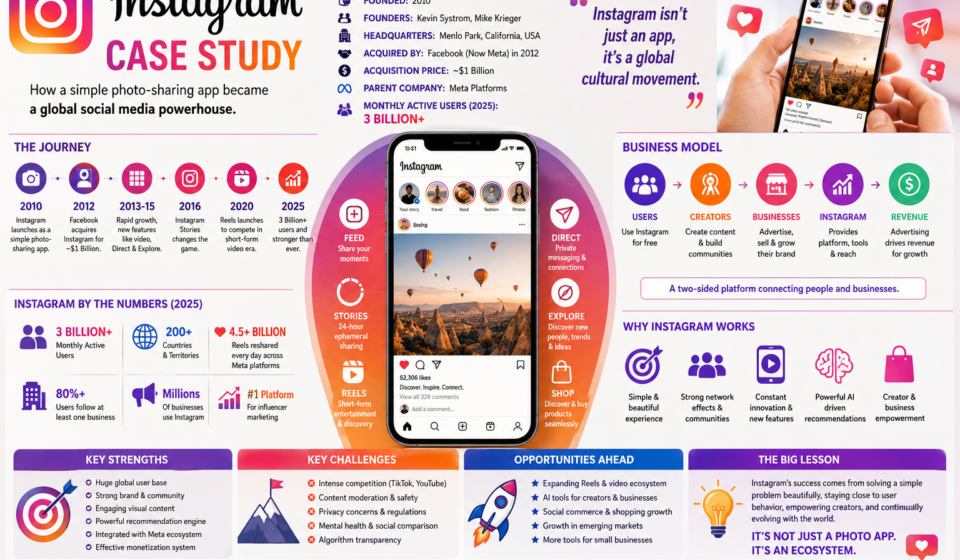
Instagram reached 1 billion monthly users in 2018, and Meta announced in September 2025 that Instagram had reached 3 billion monthly active users. Meta also said that messaging had become the most popular way to share photos and videos on Instagram and that Reels were being reshared more than 4.5 billion times per day across Meta platforms. (About Facebook)
This makes Instagram one of the most important case studies in modern technology and digital business.
The story is not simply about social media.
It is about:
- product-market fit,
- network effects,
- platform economics,
- user-generated content,
- creator economies,
- advertising,
- mobile technology,
- acquisitions,
- competition,
- recommendation algorithms,
- digital commerce,
- artificial intelligence,
- and global cultural influence.
This case study examines Instagram’s journey from a small startup to a global digital platform and explores the business lessons behind its extraordinary growth.
1. Instagram at a Glance
| Factor | Details |
|---|---|
| Company | |
| Founded | 2010 |
| Founders | Kevin Systrom and Mike Krieger |
| Original concept | Mobile photo sharing |
| Parent company | Meta Platforms |
| Acquisition | Facebook announced acquisition in 2012 |
| Acquisition value | Approximately $1 billion |
| Major formats | Feed, Stories, Reels, Direct, Explore |
| Business model | Advertising and commerce ecosystem |
| Major growth engine | User-generated content and recommendations |
| Current scale | 3 billion monthly active users announced in 2025 |
| Major competitors | TikTok, YouTube, Snapchat, Pinterest, Facebook |
| Core strength | Visual discovery + social connection + creators |
Facebook announced its agreement to acquire Instagram in April 2012 for approximately $1 billion in cash and shares. At the time, Facebook described Instagram as a popular mobile photo-sharing application and said it intended to keep the service operating independently while providing access to Facebook’s engineering and infrastructure capabilities. (About Facebook)
2. The Birth of Instagram
Instagram launched in October 2010.
The original concept was relatively straightforward.
People were increasingly taking photographs with smartphones, but mobile photo-sharing experiences were still developing.
Instagram focused on making photographs:
- attractive,
- easy to edit,
- easy to publish,
- easy to discover,
- and easy to share.
The founders recognised that smartphones were changing photography.
A person no longer needed:
- an expensive camera,
- specialised editing software,
- a computer,
- or technical expertise.
A smartphone could become:
Camera + editing tool + publishing platform + social network.
That combination was extremely powerful.
3. The Founders
Instagram was founded by:
Kevin Systrom
and
Mike Krieger.
Their backgrounds combined product thinking and engineering.
The company began with a much broader concept before becoming Instagram.
The early product development journey is important because it demonstrates a fundamental startup lesson:
Successful startups often emerge by narrowing their product rather than starting with a perfect idea.
4. From Burbn to Instagram
Before Instagram, Systrom had worked on an application called Burbn.
Burbn attempted to combine multiple features, including:
- location sharing,
- check-ins,
- plans,
- photographs,
- social interaction.
The product was more complicated.
The founders noticed something important:
Users particularly liked the photo-sharing element.
Instead of continuing to build everything, they focused on what users were responding to.
This is classic product-market-fit thinking.
5. The Pivot
Instagram effectively emerged from a strategic simplification.
Instead of:
“Let’s build a social application with many features.”
the product became:
“Let’s build the best mobile photo-sharing experience.”
That narrowing was powerful.
6. The Startup Lesson
The Instagram story teaches entrepreneurs:
Don’t confuse more features with more value.
A product can become stronger by removing features.
The founders focused on:
- photographs,
- filters,
- followers,
- likes,
- comments,
- simple sharing.
This simplicity helped Instagram gain traction.
7. Why Mobile Was the Perfect Environment
Instagram appeared at an important moment in technology.
Smartphones were becoming increasingly powerful.
Mobile internet was improving.
App stores were growing.
Camera quality was improving.
Social networking was already mainstream.
Instagram combined all four trends.
8. The Smartphone Revolution
Before smartphones, sharing photographs often required:
- Taking a photo.
- Transferring it to a computer.
- Editing it.
- Uploading it.
- Sharing it.
Instagram simplified the process.
Now:
Take photo
↓
Edit
↓
Post
↓
Social interaction
All from one device.
That dramatically reduced friction.
9. The Importance of Frictionless Sharing
One of Instagram’s early strengths was reducing the number of steps between:
Having a moment
and
Sharing that moment.
The fewer steps required, the more likely users are to participate.
This principle remains central to social media.
10. The Filter Innovation
Instagram’s early filters were extremely important.
They allowed ordinary smartphone photographs to look more visually distinctive.
Users didn’t need advanced editing knowledge.
They could simply:
- select an image,
- choose a filter,
- post it.
This democratized visual creativity.
11. Filters as Product-Market Fit
Filters solved a genuine consumer problem.
Smartphone cameras were improving, but photographs were not always visually impressive.
Filters made users feel like:
Better photographers.
That emotional reward encouraged sharing.
12. The Psychology of Instagram
Instagram understood an important human desire:
People want to express themselves.
They want to show:
- where they are,
- what they eat,
- what they wear,
- what they buy,
- who they meet,
- what they believe,
- what they create.
Instagram transformed this desire into a digital product.
13. Identity as a Product
Instagram profiles became digital identities.
A profile could communicate:
- personality,
- lifestyle,
- profession,
- interests,
- aspirations.
For many people, the Instagram profile became a kind of:
Digital identity card.
14. The Early Growth Loop
Instagram’s early growth can be explained through a simple loop:
User joins
↓
Posts photograph
↓
Friends see it
↓
Friends join Instagram
↓
More users
↓
More photographs
↓
More reasons to return
↓
Network grows
This is a classic network effect.
15. Network Effects
A social network becomes more valuable as more people participate.
If only ten people use Instagram, there are limited connections.
If:
- 1,000 people use it,
- 1 million use it,
- 100 million use it,
the potential interaction network becomes enormous.
This creates a powerful competitive barrier.
16. The Social Graph
Instagram developed a network based around:
- followers,
- following,
- interests,
- creators,
- brands,
- communities.
This network became one of the company’s most valuable assets.
17. Facebook Acquisition
In April 2012, Facebook announced that it had agreed to acquire Instagram for approximately $1 billion in cash and shares. (About Facebook)
At the time, Instagram was still a relatively young company.
The acquisition became one of the most famous technology acquisitions in history.
18. Why Facebook Wanted Instagram
Facebook already dominated social networking.
So why acquire Instagram?
Because Instagram represented the future of:
Mobile social photography.
Facebook recognised that mobile usage was becoming increasingly important.
Instagram was growing rapidly in precisely that environment.
19. Strategic Value of the Acquisition
Facebook gained:
- a fast-growing mobile community,
- strong visual identity,
- talented engineers,
- a highly engaging product,
- access to younger audiences,
- future advertising opportunities.
Instagram gained:
- engineering resources,
- infrastructure,
- global scale,
- security capabilities,
- monetization expertise.
Facebook explicitly said Instagram would continue to operate independently while benefiting from Facebook’s engineering and infrastructure. (About Facebook)
20. The Acquisition Lesson
A startup doesn’t always need to build every capability itself.
Strategic partnerships and acquisitions can provide:
- infrastructure,
- capital,
- expertise,
- distribution.
For Instagram, Facebook’s infrastructure helped support enormous future scale.
21. Instagram’s Independent Identity
One of the smartest decisions was preserving Instagram’s distinct identity.
Instagram did not simply become:
Facebook Photos.
It remained Instagram.
That mattered.
The product maintained its:
- visual culture,
- interface,
- brand,
- community,
- creator identity.
22. Brand Independence
This illustrates an important acquisition lesson:
When acquiring a successful brand, don’t automatically destroy the thing that made it successful.
Facebook provided resources without immediately eliminating Instagram’s identity.
23. Instagram’s First Major Transformation
Instagram initially focused heavily on photographs.
But the company understood that users’ expectations would evolve.
Photography was only the beginning.
The next major challenge was:
Video.
24. The Rise of Video
Video became increasingly important across social media.
YouTube was already dominant.
Facebook was pushing video.
Snapchat was growing.
Later, TikTok would revolutionize short-form video.
Instagram therefore had to evolve beyond photographs.
25. Instagram Stories
In August 2016, Instagram launched Stories.
Stories allowed people to share photographs and videos that disappeared after 24 hours. (About Facebook)
This was a major strategic shift.
26. Why Stories Were So Important
Traditional Instagram posts felt permanent.
Users might think:
“Is this photo good enough to post?”
Stories reduced that pressure.
The content could disappear.
Therefore users could post:
- everyday moments,
- behind-the-scenes content,
- casual videos,
- quick updates,
- spontaneous thoughts.
27. Ephemeral Content
Stories introduced a new psychological concept:
Temporary content feels less risky.
Users were willing to post more frequently.
More posts meant:
More engagement.
More engagement meant:
More reasons to return.
28. The Stories Growth Loop
Users post more frequently
↓
Followers open Instagram more often
↓
More engagement
↓
More Stories
↓
More daily usage
↓
Higher retention
This was extremely important.
29. Stories and Snapchat
Stories were closely associated with a format popularized by Snapchat.
Instagram’s decision to adopt the format demonstrated another important business lesson:
You don’t always need to invent a format to win the market. You need to execute it extremely well and integrate it into your ecosystem.
30. Stories Became a Core Product
Stories eventually became one of Instagram’s defining formats.
The company continued adding:
- mentions,
- Boomerang,
- links,
- stickers,
- location,
- interactive tools,
- live video,
- messaging features.
Meta’s historical Instagram announcements document these successive Stories updates. (About Facebook)
31. Stories as a Creator Tool
Stories changed creator behaviour.
A creator could now post:
Main Feed
High-quality, permanent content.
Stories
Daily, casual content.
That created a two-layer content strategy.
32. Stories as a Business Tool
Businesses could use Stories for:
- product launches,
- offers,
- behind-the-scenes content,
- polls,
- customer engagement,
- promotions.
Instagram introduced Stories advertising globally for businesses in 2017. (About Facebook)
This transformed Stories from a social feature into a major advertising surface.
33. The Rise of Influencers
Instagram also created a new profession:
The Influencer.
People who had previously been:
- photographers,
- fashion enthusiasts,
- fitness trainers,
- chefs,
- comedians,
- travellers,
could build large audiences.
Their audience became an economic asset.
34. The Creator Economy
Instagram helped create an ecosystem where individuals could monetize attention.
Creators could make money through:
- sponsored posts,
- brand partnerships,
- affiliate marketing,
- products,
- services,
- subscriptions,
- digital businesses,
- collaborations.
This changed the relationship between:
Media
and
Individuals.
35. Traditional Media vs Instagram Creators
Traditional media required:
- television channels,
- newspapers,
- production companies,
- publishers.
Instagram allowed:
One person + smartphone + internet
to reach millions.
That was revolutionary.
36. The Democratization of Publishing
Instagram effectively gave ordinary people a publishing platform.
Anyone could become:
- photographer,
- journalist,
- entertainer,
- educator,
- reviewer,
- fashion creator,
- entrepreneur.
This expanded the creator economy dramatically.
37. Instagram and Small Businesses
Instagram became especially important for small businesses.
A small company could create:
- a profile,
- product photographs,
- Reels,
- Stories,
- advertisements.
It could potentially reach customers without opening a physical store.
38. Instagram as a Digital Storefront
For many businesses, an Instagram profile became:
Website
Catalogue
Marketing channel
Customer service
Social proof.
This is a powerful transformation.
39. Instagram and Social Commerce
Instagram increasingly connected discovery with commerce.
Consumers could:
- Discover product.
- See creator using it.
- Visit brand.
- Research product.
- Purchase.
This reduced the distance between:
Inspiration
and
Buying.
40. Shopping Features
Instagram expanded shopping functionality over time.
Meta reported that more than 80% of Instagram users followed some type of business in 2018, illustrating the platform’s role as a business-discovery environment. (About Facebook)
This was a major strategic insight:
People were not using Instagram only to follow friends.
They were also using it to discover:
- brands,
- products,
- trends,
- businesses.
41. The Discovery Economy
Instagram gradually became less about:
“What are my friends doing?”
and increasingly about:
“What should I discover next?”
This shift dramatically increased the platform’s addressable content universe.
42. Explore
Explore became one of Instagram’s most important features.
Instead of seeing only content from accounts a person followed, users could discover:
- new creators,
- new topics,
- products,
- trends,
- viral content.
This increased content consumption.
43. From Social Graph to Interest Graph
The early Instagram model was primarily:
Social graph
Show me people I follow.
Over time it evolved toward:
Interest graph
Show me things I am likely to enjoy.
This distinction is crucial.
44. Why the Interest Graph Is Powerful
Imagine you follow 200 people.
But there may be millions of creators producing content about:
- football,
- fashion,
- technology,
- cooking,
- comedy,
- travel.
An interest-based recommendation engine can show you content from people you don’t follow.
That dramatically increases:
Content supply.
45. Recommendation Algorithms
Modern Instagram depends heavily on recommendation systems.
These systems use signals about:
- interactions,
- interests,
- content,
- relationships,
- viewing behaviour,
- engagement.
The objective is to surface content that is likely to be relevant.
46. Recommendation as a Growth Engine
A powerful recommendation engine creates:
More discovery
↓
More creator reach
↓
More creators
↓
More content
↓
More users
↓
More engagement
↓
Better recommendation data
This creates another flywheel.
47. The Algorithmic Flywheel
The more users interact with Instagram:
The more data the platform receives.
The more data it receives:
The better it can personalize.
Better personalization:
Creates more engagement.
More engagement:
Creates more data.
And the cycle continues.
48. Reels
The next major transformation was:
Instagram Reels.
Instagram launched Reels in 2020 as a way to create and discover short-form videos. The original launch included tools for music, effects, multi-clip recording and discovery through Explore. (About Facebook)
49. Why Reels Were Necessary
Short-form video became one of the fastest-growing content formats globally.
TikTok demonstrated the enormous power of:
- algorithmic discovery,
- short videos,
- music,
- trends,
- remix culture.
Instagram needed a strong response.
50. Reels Changed Instagram
Instagram evolved from:
Photo-sharing app
to:
Visual entertainment platform.
That was a massive strategic transformation.
51. The Reels Model
Reels combined:
- short videos,
- music,
- trends,
- creators,
- recommendations,
- entertainment.
Unlike traditional posts, Reels could reach people who did not follow the creator.
That created huge opportunities for discovery.
52. Reels and Creator Growth
A creator with 500 followers could potentially create a Reel that reached:
- thousands,
- hundreds of thousands,
- or millions.
This changed the creator growth model.
Previously:
Followers determined reach.
With recommendation:
Content quality and relevance could determine reach.
53. The Creator Incentive
If creators believe:
“My content can reach people who don’t follow me.”
they have a stronger reason to keep creating.
More creators create:
More content.
More content creates:
More user engagement.
This benefits Instagram.
54. Reels in India
India became an especially important market for Reels.
Meta has described India as a major video-first market and said in 2026 that Reels had become a defining short-form video environment across Indian Gen Z audiences. Meta-commissioned research cited by the company also highlighted strong engagement across cities and rural areas. (About Facebook)
In September 2025, Meta said it was testing a Reels-first Instagram experience in India for a limited group of users. (About Facebook)
55. Why India Matters
India has:
- a huge population,
- rapidly growing smartphone adoption,
- diverse languages,
- enormous creator communities,
- high video consumption,
- growing digital commerce.
That makes India one of Instagram’s most strategically important markets.
56. The Indian Creator Economy
Instagram has enabled Indian creators in areas such as:
- comedy,
- fashion,
- beauty,
- food,
- education,
- technology,
- travel,
- fitness,
- regional entertainment.
The platform has helped turn local talent into digital businesses.
57. Regional-Language Growth
One of Instagram’s major opportunities is regional-language content.
Creators can produce content in:
- Hindi,
- Bengali,
- Tamil,
- Telugu,
- Marathi,
- Kannada,
- Malayalam,
- Gujarati,
- Punjabi,
- Assamese,
- and many other languages.
This expands the platform beyond English-speaking urban audiences.
58. Instagram and Bharat
India is not simply:
Mumbai + Delhi + Bengaluru.
A huge digital audience exists across:
- Tier-2 cities,
- Tier-3 cities,
- small towns,
- villages.
Short-form video is particularly suited to audiences where language and visual storytelling matter.
59. Instagram as a Business Platform
Instagram’s business model is primarily built around advertising.
The basic model is:
Users
use the platform for free.
↓
Creators
produce content.
↓
Businesses
pay to reach audiences.
↓
provides targeting, placement and measurement.
↓
Revenue
funds the platform.
60. Advertising Business Model
Instagram provides multiple advertising formats, including:
- image ads,
- video ads,
- carousel ads,
- Stories ads,
- Explore ads,
- Reels ads.
Meta’s business documentation describes Instagram advertising as a system that supports different formats and campaign objectives, with campaigns managed through Meta’s advertising infrastructure. (Facebook)
61. Why Instagram Ads Are Valuable
Instagram has three characteristics advertisers love:
Attention
Users spend time consuming visual content.
Targeting
Businesses can reach specific audiences.
Measurement
Advertisers can evaluate campaign performance.
This makes Instagram attractive to marketers.
62. The Advertising Flywheel
More users
↓
More attention
↓
More advertisers
↓
More advertising revenue
↓
More investment in product
↓
Better user experience
↓
More users
This is the basic platform advertising flywheel.
63. Meta’s Advertising Infrastructure
One of Instagram’s greatest advantages is that it is part of Meta’s broader advertising ecosystem.
Advertisers can use Meta’s tools across platforms.
That provides:
- audience targeting,
- campaign optimisation,
- measurement,
- automated bidding,
- creative tools.
Meta’s Advantage+ system uses AI and automation to optimise campaign components such as audience, placement and budget. (Facebook)
64. Instagram’s Advertising Advantage
Instagram doesn’t need to build an advertising ecosystem from zero.
It benefits from Meta’s:
- advertiser relationships,
- data infrastructure,
- measurement,
- AI systems,
- sales organisation.
This is one of the major benefits of the Facebook acquisition.
65. Small Business Advertising
Instagram is particularly powerful for small businesses.
A local business can start with a relatively small advertising budget.
It can target:
- geography,
- interests,
- demographics,
- behaviours.
Meta reported in 2025 that 92% of businesses using Meta platforms in India were MSMEs, highlighting the importance of Meta’s ecosystem to small businesses in India. (About Facebook)
66. Instagram as a Local Business Tool
Consider a local:
- restaurant,
- salon,
- clothing store,
- interior designer,
- property dealer,
- fitness trainer.
Instagram can become a lead-generation channel.
The business can showcase:
- work,
- reviews,
- products,
- offers,
- customer experiences.
67. Instagram and Personal Branding
Instagram is also a powerful personal-branding platform.
Professionals use it to demonstrate:
- expertise,
- personality,
- achievements,
- lifestyle,
- knowledge.
This is especially powerful for:
- consultants,
- creators,
- photographers,
- designers,
- coaches,
- freelancers.
68. Instagram and Entrepreneurship
Instagram reduced the cost of starting certain types of businesses.
A person can begin with:
Smartphone
Skill
Instagram profile
Audience
This creates a low-cost path toward entrepreneurship.
69. The Creator-to-Business Pipeline
A creator may start with:
Content.
Then build:
Followers.
Then:
Brand partnerships.
Then:
Products.
Then:
Company.
Instagram can therefore act as the first stage of a business funnel.
70. Influencer Marketing
Instagram fundamentally changed advertising.
Traditional advertising said:
“Brand tells consumer.”
Influencer marketing says:
“Person consumer trusts tells consumer.”
This can feel more authentic.
71. Creator Trust
Creators often have:
- niche audiences,
- personal relationships,
- credibility.
A fashion creator can influence clothing purchases.
A technology creator can influence gadgets.
A food creator can influence restaurants.
That makes creators valuable to brands.
72. Creator Marketplace
Meta has continued building tools to connect businesses with creators.
In 2025, Meta announced updates to Instagram’s Creator Marketplace, including tools for businesses to discover creators and AI-powered recommendations for branded content. (About Facebook)
This indicates how strategically important the creator economy has become.
73. Creator Economy as a Platform Strategy
Instagram benefits when creators succeed.
Why?
Because successful creators:
- attract followers,
- produce content,
- generate engagement,
- keep audiences on the platform.
Therefore:
Creator success is platform success.
74. The Creator Flywheel
Creators
↓
Content
↓
Audience
↓
Engagement
↓
Advertising value
↓
Brand partnerships
↓
Creator income
↓
More creators
↓
More content
75. Direct Messages
Instagram is increasingly becoming a messaging platform.
Meta said in 2025 that messaging had become the most popular way to share photos and videos on Instagram. (About Facebook)
This is strategically important.
Instagram is no longer only:
Public publishing.
It is also:
Private communication.
76. Why DMs Matter
A person might discover a Reel publicly.
Then send it privately to a friend.
The friend responds.
That creates a new social interaction.
The content therefore becomes:
Public discovery → Private conversation.
This is extremely powerful.
77. Sharing as a Growth Mechanism
When users send content to friends:
- new people see it,
- conversations begin,
- creators gain reach,
- Instagram becomes more useful.
This makes sharing one of the platform’s most important growth mechanisms.
78. The Social Discovery Loop
See Reel
↓
Like it
↓
Send to friend
↓
Friend watches
↓
Friend discovers creator
↓
Friend follows
↓
More content consumed
↓
More sharing
79. Instagram and the Attention Economy
Instagram operates within the broader:
Attention Economy.
Users have limited attention.
Platforms compete for it.
Instagram competes with:
- TikTok,
- YouTube,
- Snapchat,
- Facebook,
- streaming services,
- gaming,
- messaging apps.
The platform that captures more attention has more opportunities to:
- show content,
- show ads,
- create engagement.
80. The Attention Business Model
A simplified formula is:
Users
×
Time
×
Engagement
×
Advertising value
=
Platform Economic Value
This explains why engagement matters so much.
81. The Importance of Retention
Getting a user to install Instagram is not enough.
The company needs the user to return:
- daily,
- repeatedly,
- for long periods.
Features such as:
- Stories,
- Reels,
- DMs,
- Explore,
help create multiple reasons to return.
82. Multi-Product Retention
Instagram essentially became a collection of products:
Feed
Following and social updates.
Stories
Daily moments.
Reels
Entertainment.
Explore
Discovery.
DMs
Communication.
Live
Real-time interaction.
Each feature reinforces the others.
83. Why Multiple Formats Matter
If someone gets bored with Feed:
They watch Reels.
If they want friends:
They use DMs.
If they want discovery:
They use Explore.
If they want casual sharing:
Stories.
This reduces the chance of leaving the platform.
84. The Super-App Direction
Instagram is increasingly behaving like a multi-purpose digital platform.
It includes:
- social networking,
- entertainment,
- messaging,
- discovery,
- creator tools,
- advertising,
- commerce.
That makes it much more difficult for a competitor to replace the entire experience.
85. Instagram’s Competitive Landscape
Instagram competes with multiple platforms.
TikTok
Short-form video.
YouTube
Long-form + short-form video.
Snapchat
Messaging + Stories.
Visual discovery.
Social networking.
X
Real-time conversation.
The competition is therefore not limited to one category.
86. Instagram vs TikTok
This is perhaps the most strategically important modern competition.
Strong in:
- creators,
- brands,
- Stories,
- social graph,
- advertising,
- lifestyle content.
TikTok
Strong in:
- short-form video,
- algorithmic discovery,
- trends,
- entertainment.
Instagram’s response has been:
Reels.
87. Why Reels Was a Smart Strategic Response
Instagram already had:
- creators,
- audience,
- advertisers,
- music,
- social graph,
- recommendation technology.
It could therefore integrate short-form video into an existing ecosystem.
This reduced TikTok’s ability to completely own the format.
88. Instagram vs Snapchat
Snapchat pioneered many features around:
- ephemeral communication,
- Stories,
- lenses,
- close-friend interactions.
Instagram adopted and expanded Stories into a massive ecosystem.
The lesson:
Innovation is not only invention. It is also execution, distribution and scale.
89. Instagram vs YouTube
YouTube remains dominant in longer-form video.
Instagram’s strength is:
Shorter, visual, social and discovery-oriented content.
The two platforms overlap but are not identical.
90. Instagram vs Pinterest
Pinterest is strong in:
- inspiration,
- design,
- shopping,
- search-based discovery.
Instagram is stronger in:
- creators,
- social relationships,
- entertainment,
- short-form video.
91. Competitive Advantage
Instagram’s strongest advantage is not one feature.
It is the combination of:
Massive audience
Creator ecosystem
Social graph
Recommendation system
Advertising infrastructure
Brand ecosystem
Meta infrastructure.
That is extremely difficult to replicate.
92. Network Effects
Instagram benefits from several network effects.
User network effect
More friends → more value.
Creator network effect
More creators → more content.
Content network effect
More content → more reasons to use Instagram.
Advertiser network effect
More users → more advertiser demand.
Data network effect
More interactions → better personalization.
These effects reinforce each other.
93. Data as a Competitive Asset
A social platform generates enormous amounts of interaction data.
Examples include:
- what users watch,
- what they like,
- what they share,
- what they save,
- whom they follow,
- what they search.
This helps personalize recommendations and advertising.
94. Personalization
Personalization is one of Instagram’s central product advantages.
Two users can open Instagram and see:
Completely different experiences.
One may see:
- cricket.
Another:
- fashion.
Another:
- cooking.
Another:
- technology.
This makes Instagram feel personally relevant.
95. The Recommendation Challenge
Personalization is powerful, but it creates challenges.
If recommendations become poor:
Users lose interest.
If recommendations become repetitive:
Discovery decreases.
If recommendations become overly addictive:
Social and regulatory concerns increase.
Therefore, recommendation quality is strategically critical.
96. Recommendation Controls
Meta has increasingly provided users with tools to influence recommendations.
For example, Instagram has tested recommendation-reset functionality allowing users to reset recommended content in Feed, Explore and Reels. (About Facebook)
This reflects an important strategic challenge:
Personalization must also feel controllable.
97. Teen Safety
Instagram faces significant scrutiny regarding:
- teen safety,
- mental health,
- inappropriate content,
- bullying,
- privacy.
Meta has introduced features such as Teen Accounts and additional controls intended to create safer experiences for younger users. (About Facebook)
This is both a product challenge and a business challenge.
98. Privacy
Social platforms depend on data.
But consumers increasingly care about:
- privacy,
- tracking,
- personalization,
- data use.
Instagram must balance:
Personalization
with
User trust.
99. Advertising vs User Experience
Instagram makes money through advertising.
But too many advertisements can damage the user experience.
Therefore the platform must optimize:
Revenue per user
without destroying:
User satisfaction.
100. The Advertising Balance
If advertising is too low:
Revenue suffers.
If advertising is too high:
Engagement may suffer.
Therefore:
The ideal platform maximizes long-term user value, not short-term ad volume.
101. AI and Instagram
Artificial intelligence is becoming increasingly important to Instagram.
AI can help with:
- recommendations,
- content ranking,
- ad targeting,
- creative generation,
- moderation,
- spam detection,
- creator discovery.
Meta has increasingly integrated AI into recommendations and advertising systems. (Facebook)
102. AI-Powered Recommendations
AI can identify patterns such as:
“Users who watch this type of Reel often enjoy this other type of content.”
This enables personalized discovery.
103. AI and Advertising
Meta’s Advantage+ tools use AI and automation to optimise campaigns.
Advertisers can increasingly rely on automated systems to determine:
- audience,
- placements,
- budget allocation,
- creative combinations.
(Facebook)
104. AI and Creators
AI can also help creators with:
- editing,
- captions,
- translation,
- ideas,
- creative effects,
- content generation.
This could reduce the cost of content creation.
105. AI and Competition
AI may become a major competitive advantage.
The platform that understands user interests best can potentially deliver:
Better content.
The platform that helps advertisers find customers more efficiently can deliver:
Better advertising performance.
Therefore:
AI becomes part of the platform moat.
106. Instagram’s Business Model
Instagram’s business model can be simplified into:
Free users
Create demand and attention.
↓
Creators
Create content.
↓
Businesses
Buy advertising.
↓
Advertisers
Generate revenue.
↓
Invests in infrastructure and product.
↓
More users and creators.
107. Why Free Is Powerful
Instagram is free to users.
This dramatically reduces adoption barriers.
Anyone with:
- smartphone,
- internet connection,
can participate.
That helps create enormous scale.
108. The Freemium-Like Platform
Although Instagram is not a traditional freemium SaaS product, it follows a similar principle:
User experience is free.
Businesses pay.
The value comes from the network.
109. Two-Sided Marketplace
Instagram effectively operates a two-sided ecosystem.
Side 1
Consumers and creators.
Side 2
Advertisers and businesses.
Each side makes the other more valuable.
110. Advertiser Economics
Businesses pay because Instagram can provide:
- reach,
- targeting,
- engagement,
- conversion opportunities.
The more consumers Instagram has:
The more valuable advertising becomes.
111. Creator Economics
Creators participate because Instagram provides:
- audience,
- discovery,
- brand opportunities,
- tools,
- distribution.
More creators create:
More value for users.
112. The Three-Sided Ecosystem
Instagram is actually better understood as:
Users
Creators
Businesses
Each depends on the others.
This is a powerful platform structure.
113. Instagram’s Global Cultural Impact
Instagram has influenced:
- fashion,
- food,
- travel,
- photography,
- music,
- beauty,
- fitness,
- politics,
- entertainment,
- entrepreneurship.
A trend can begin on Instagram and quickly spread across the world.
114. Instagram and Fashion
Fashion brands use Instagram to:
- launch products,
- work with creators,
- show collections,
- build communities.
Many fashion trends now spread through:
Reels + creators + hashtags + recommendations.
115. Instagram and Food
Food creators have transformed:
- restaurants,
- recipes,
- home cooking,
- food photography.
A single viral Reel can create huge interest in a restaurant or dish.
116. Instagram and Travel
Travel creators use the platform to showcase:
- destinations,
- hotels,
- restaurants,
- experiences.
This has changed travel inspiration.
Consumers increasingly discover destinations through visual social media.
117. Instagram and Beauty
Beauty is one of Instagram’s strongest categories.
Creators demonstrate:
- makeup,
- skincare,
- hairstyles,
- products.
This creates a direct relationship between:
Content
and
Commerce.
118. Instagram and Fitness
Fitness creators use Instagram to build:
- communities,
- coaching businesses,
- product partnerships,
- online courses.
Again, content becomes a business asset.
119. Instagram and Education
Instagram has also become an educational platform.
Creators teach:
- finance,
- technology,
- language,
- history,
- business,
- careers.
Short-form educational content can reach huge audiences.
120. Instagram and News
People increasingly encounter news through social media.
This creates opportunities but also risks.
Benefits include:
- rapid distribution,
- citizen journalism,
- diverse perspectives.
Risks include:
- misinformation,
- manipulation,
- context loss.
Instagram therefore has a responsibility to manage content integrity.
121. The Dark Side of Instagram
A complete case study must also examine the challenges.
Instagram has faced criticism around:
- mental health,
- social comparison,
- body image,
- cyberbullying,
- misinformation,
- addiction-like use,
- privacy.
These issues create serious reputational and regulatory risks.
122. Social Comparison
Instagram’s visual nature can encourage people to compare themselves with others.
Users may see:
- perfect bodies,
- expensive holidays,
- luxury homes,
- successful careers,
- carefully edited photographs.
But social media often shows:
Highlight reels.
Not complete lives.
123. The “Perfect Life” Problem
Creators may carefully curate their image.
This can create unrealistic expectations.
The business challenge for Instagram is to maintain:
Engagement
while promoting:
Healthy platform use.
124. Content Moderation
Instagram must process enormous quantities of content.
This creates difficult questions:
- What should be removed?
- What is harmful?
- What is satire?
- What is misinformation?
- What is acceptable political speech?
AI helps, but human review remains important in many situations.
125. Trust and Safety
A social platform cannot succeed long-term if users stop trusting it.
Therefore, safety is not merely a compliance issue.
It is:
A business issue.
126. Regulation
Instagram operates in a complex global regulatory environment.
Different countries have different rules around:
- privacy,
- advertising,
- child safety,
- content moderation,
- competition.
This increases operational complexity.
127. The India Opportunity and Challenge
India is strategically important to Instagram.
Opportunities include:
- massive population,
- smartphone growth,
- creators,
- businesses,
- digital commerce,
- regional languages.
Challenges include:
- diverse languages,
- misinformation,
- safety,
- regulatory requirements,
- intense competition.
128. Instagram and Indian Small Businesses
Instagram has become especially important for Indian small businesses.
A small business can use:
Reels
for discovery.
Stories
for daily updates.
DMs
for customer communication.
Ads
for customer acquisition.
Profile
as digital storefront.
This creates an integrated business system.
129. Instagram for Local Entrepreneurs
Consider a local:
Clothing store.
It can post:
- new arrivals,
- fashion videos,
- customer photos.
A:
Restaurant
can post:
- dishes,
- kitchen videos,
- reviews.
A:
Real estate company
can post:
- property tours,
- site videos,
- neighbourhood information.
A:
Interior designer
can post:
- before-and-after projects,
- design ideas,
- walkthroughs.
Instagram can therefore become a powerful lead-generation platform.
130. The Instagram Funnel for Businesses
A business can build:
Awareness
Reels.
↓
Interest
Profile.
↓
Trust
Reviews and testimonials.
↓
Engagement
Stories and comments.
↓
Conversion
DM / website / shop.
↓
Retention
Stories and content.
131. Instagram as a Marketing Funnel
This is one reason the platform is so valuable.
It can support the entire customer journey:
Discovery
↓
Engagement
↓
Consideration
↓
Conversation
↓
Purchase
↓
Loyalty
132. The Power of Visual Proof
For many businesses, showing the product is more powerful than describing it.
Examples:
Restaurant
Show the food.
Interior designer
Show the finished room.
Fashion store
Show the outfit.
Property company
Show the property.
Instagram is naturally suited to visual proof.
133. The “Show, Don’t Tell” Advantage
Instagram’s visual nature makes it powerful for businesses where:
The product can be seen.
This explains its strength in:
- fashion,
- beauty,
- food,
- travel,
- interiors,
- real estate,
- art.
134. Instagram and Personal Commerce
The platform has also blurred the line between:
Personal identity
and
Business identity.
A creator can simultaneously be:
- individual,
- influencer,
- entrepreneur,
- salesperson.
That is a major change in digital commerce.
135. The Creator as Distribution
Traditional brands needed:
- television,
- newspapers,
- retail.
Now a creator can provide:
Distribution.
A creator with 500,000 followers effectively owns a media channel.
136. Creator Partnerships
Brands increasingly collaborate with creators because creators offer:
- audience,
- credibility,
- content,
- distribution.
Instagram’s Creator Marketplace and AI-powered creator recommendations are designed to facilitate this ecosystem. (About Facebook)
137. The New Advertising Model
Old model:
Brand → Advertisement → Consumer.
New model:
Brand → Creator → Community → Consumer.
This can feel more natural.
138. The Economics of Influence
A creator’s economic value can be influenced by:
- audience size,
- engagement,
- niche,
- credibility,
- purchasing influence.
A smaller creator can sometimes be more valuable than a huge celebrity if the audience is highly relevant.
139. Micro-Influencers
Instagram helped create the micro-influencer economy.
A creator with:
- 5,000 followers,
- 20,000 followers,
- 50,000 followers,
may have strong influence within a specific niche.
This democratizes influencer marketing.
140. Niche Communities
Instagram enables communities around:
- photography,
- cars,
- books,
- fitness,
- technology,
- food,
- parenting,
- gaming.
A creator doesn’t need to appeal to everyone.
They can build:
A valuable niche.
141. The Long Tail
Millions of niche creators collectively create enormous value.
This is the:
Long tail of content.
Instagram benefits because it can serve both:
Mass celebrities
and
Tiny niche creators.
142. Instagram’s Growth Strategy
Instagram’s growth can be understood through several stages.
Stage 1
Simple photo-sharing.
Stage 2
Social network.
Stage 3
Stories.
Stage 4
Creators and businesses.
Stage 5
Reels.
Stage 6
Messaging and commerce.
Stage 7
AI-powered recommendations.
This evolution shows continuous strategic adaptation.
143. Product Expansion Without Losing the Core
The key is that Instagram expanded without abandoning:
Visual content.
Everything still revolves around:
- images,
- videos,
- creators,
- discovery,
- identity.
That creates strategic coherence.
144. The Instagram Product Flywheel
More users
↓
More creators
↓
More content
↓
Better recommendations
↓
More engagement
↓
More advertisers
↓
More revenue
↓
More investment
↓
Better product
↓
More users
145. The Data Flywheel
User interaction
↓
Data
↓
Better personalization
↓
Better content recommendations
↓
More engagement
↓
More data
This is one of Instagram’s strongest technological advantages.
146. The Advertising Flywheel
Large audience
↓
Advertiser demand
↓
Revenue
↓
Product investment
↓
Better targeting
↓
Better advertising performance
↓
More advertiser demand
147. The Creator Flywheel
More creators
↓
More content
↓
More users
↓
More creator reach
↓
More creator income
↓
More creators
148. The Complete Instagram Ecosystem
The most powerful way to understand Instagram is to combine all four:
User Flywheel
Users create activity.
Creator Flywheel
Creators create content.
Data Flywheel
Interactions improve recommendations.
Advertising Flywheel
Businesses monetize attention.
Together:
Instagram Platform Flywheel
149. Instagram’s Strengths
1. Massive global audience
Billions of monthly users.
2. Strong brand
Highly recognisable.
3. Visual identity
Distinctive platform positioning.
4. Creator ecosystem
Millions of creators.
5. Reels
Strong short-form video product.
6. Stories
High-frequency engagement.
7. Messaging
Private communication.
8. Advertising
Sophisticated monetization.
9. Meta infrastructure
Global scale.
10. Network effects
Extremely difficult to replicate.
150. Instagram’s Weaknesses
1. Dependence on advertising
A large portion of its economic model depends on monetization of attention.
2. Content quality variability
Users can encounter low-quality or repetitive content.
3. Algorithm dependence
Creators can become frustrated when reach changes.
4. Trust concerns
Privacy and safety issues matter.
5. Competition
TikTok and YouTube compete intensely.
6. Platform dependency
Creators and businesses depend on Instagram’s rules.
151. Opportunities
1. AI
Better recommendations and creative tools.
2. Commerce
More seamless product discovery and purchase.
3. Creator economy
More monetization tools.
4. Messaging
Deeper business communication.
5. India
Huge growth opportunity.
6. Emerging markets
Large populations moving online.
7. Small businesses
Massive potential customer base.
8. Digital services
More creator and business tools.
152. Threats
1. TikTok
Strong short-form video competition.
2. YouTube
Huge video ecosystem.
3. Regulation
Privacy and safety rules.
4. User fatigue
Consumers may become tired of social media.
5. Misinformation
Can damage trust.
6. AI-generated content
Could create spam and authenticity challenges.
7. Privacy concerns
Can affect advertiser and user trust.
153. Porter’s Five Forces Analysis
Competitive Rivalry — Extremely High
Instagram competes for attention with several global platforms.
Threat of New Entrants — Low to Moderate
Building a social network is technically possible.
Building a network of billions of users is extraordinarily difficult.
Supplier Power — Low
Users and creators are the content suppliers, but they are fragmented.
However, major creators can have significant influence.
Buyer Power — High
Advertisers can shift budgets across:
- Google,
- YouTube,
- TikTok,
- Amazon,
- traditional media.
Instagram must demonstrate strong returns.
Threat of Substitutes — Extremely High
Consumers can spend time on:
- YouTube,
- TikTok,
- Snapchat,
- gaming,
- streaming,
- messaging.
Attention is the scarce resource.
154. Instagram’s Competitive Moat
Instagram’s moat comes from:
Network effects
More users create more value.
Brand
Strong cultural recognition.
Creators
Large creator ecosystem.
Content
Massive content library.
Data
Personalization capability.
Advertising
Sophisticated monetization.
Infrastructure
Meta’s global technology ecosystem.
Switching costs
Creators and businesses have built audiences on the platform.
155. Why the Network Is Hard to Copy
Imagine launching:
“NewInstagram.”
Even if the product is excellent, it faces the problem:
Who will users follow?
If there are no creators:
No content.
If there is no content:
No users.
If there are no users:
No creators.
This is the classic cold-start problem.
Instagram has already solved it.
156. The Cold-Start Advantage
New social networks must overcome:
Users
Content
Creators
Advertisers
simultaneously.
Instagram already has all four.
That makes its competitive position extremely strong.
157. The Cost of Leaving
Creators who have:
- 100,000 followers,
- 1 million followers,
- 10 million followers,
cannot easily abandon Instagram.
Their audience is an asset.
This creates switching costs.
158. Businesses Also Face Switching Costs
A business may have:
- followers,
- content library,
- customer messages,
- reviews,
- advertising history.
Leaving the platform means rebuilding that presence elsewhere.
159. The Power of Digital Identity
Instagram accounts can become valuable digital assets.
For creators, the account can represent:
Audience + reputation + income.
For businesses:
Brand + customers + marketing channel.
This makes the platform deeply embedded in users’ economic lives.
160. Instagram’s Future
The next phase of Instagram is likely to involve:
- AI,
- Reels,
- messaging,
- creators,
- commerce,
- personalization,
- recommendations.
Meta’s recent product updates show continued investment in Reels, sharing, messaging and AI-powered discovery. (About Facebook)
161. The Future of Reels
Reels will likely remain a major discovery engine.
Short-form video has become central to how many users consume content.
Instagram’s challenge is to make Reels:
- entertaining,
- diverse,
- original,
- relevant.
162. The Future of Messaging
Instagram is increasingly becoming a messaging environment.
People discover content publicly and share it privately.
This means:
Messaging could become a major retention engine.
163. The Future of Commerce
Instagram can potentially become a complete commerce funnel:
Discover
↓
Evaluate
↓
Ask creator
↓
Message brand
↓
Purchase
↓
Share experience
This creates a closed-loop digital ecosystem.
164. AI Shopping
AI could eventually make product discovery more personalized.
Instead of:
“Show me popular shoes.”
A user might effectively receive:
“Show me shoes matching my style and budget.”
This could create new opportunities for Instagram commerce.
165. AI Creator Tools
Creators may increasingly use AI for:
- editing,
- translation,
- subtitles,
- visual effects,
- content ideas,
- creative variations.
This could increase content supply dramatically.
166. The Risk of AI Spam
But more AI content creates a challenge.
If everyone can generate:
- 100 videos,
- 1,000 captions,
- endless images,
the platform may become overloaded.
Therefore, Instagram must balance:
More content
with
More meaningful content.
167. Authenticity
The value of creators often comes from authenticity.
If audiences believe everything is:
AI-generated advertising,
trust may decline.
Therefore, human personality remains strategically valuable.
168. The Future of Influencer Marketing
Influencer marketing is likely to become more data-driven.
Brands will increasingly evaluate:
- audience relevance,
- engagement,
- conversions,
- content quality,
- brand safety.
Instagram’s creator tools and AI recommendations point in this direction. (About Facebook)
169. The Future of Small Business
Instagram may become even more important for small businesses.
A small business can potentially use:
Reels
for awareness.
Stories
for engagement.
DMs
for sales.
Ads
for customer acquisition.
Creator partnerships
for credibility.
AI
for content creation.
This is an incredibly powerful combination.
170. Instagram’s Role in India’s Digital Economy
India provides an especially interesting case.
Instagram is no longer just a platform for celebrities.
It is used by:
- local entrepreneurs,
- creators,
- students,
- restaurants,
- retailers,
- service businesses,
- educators.
This makes it part of India’s broader digital economy.
171. Instagram as a Career Platform
For some people, Instagram is effectively a career marketplace.
A person can build:
- audience,
- reputation,
- business,
- income.
This creates entirely new career paths.
172. New Careers Created by Instagram
Instagram has helped popularize roles such as:
- content creator,
- social media manager,
- influencer,
- photographer,
- Reel editor,
- community manager,
- creator strategist,
- influencer marketing manager.
This is a major economic impact.
173. Instagram and Freelancing
Freelancers can use Instagram to demonstrate:
- portfolios,
- design work,
- photography,
- video editing,
- writing,
- consulting.
The platform can act as:
Portfolio + marketing + networking.
174. Instagram and Local Services
Local service businesses can use Instagram to showcase:
- completed work,
- customer reviews,
- transformations,
- pricing,
- contact information.
This makes the platform valuable beyond traditional consumer brands.
175. Instagram’s Strategic Lesson for Entrepreneurs
One of the strongest lessons is:
Don’t build a product only around what technology can do. Build around what users naturally want to do.
Instagram understood that people wanted to:
Capture.
Improve.
Share.
Discover.
Connect.
Everything else grew from those behaviours.
176. Lesson 2: Start Simple
Instagram began with a narrow purpose.
It did not need:
- shopping,
- Reels,
- AI,
- advertising,
- live video,
on day one.
It first solved:
Mobile photo sharing.
177. Lesson 3: Follow User Behaviour
The company expanded when behaviour changed.
Users wanted:
More casual content.
Instagram created Stories.
Users wanted:
More video.
Instagram created Reels.
Users wanted:
More communication.
Instagram invested in DMs.
Users wanted:
Discovery.
Instagram improved recommendations.
This is product evolution.
178. Lesson 4: Build Ecosystems
A product becomes stronger when other people can build businesses on top of it.
Instagram enabled:
- creators,
- influencers,
- advertisers,
- retailers,
- entrepreneurs.
This created an ecosystem rather than just an application.
179. Lesson 5: Make Creators Successful
Creators produce the content that attracts users.
Therefore:
Creators are infrastructure.
A social platform that ignores creators risks losing its content engine.
180. Lesson 6: Network Effects Are Powerful
If your product becomes more valuable as more people join:
You can create a powerful moat.
But network effects require:
- initial users,
- strong engagement,
- retention,
- content.
181. Lesson 7: Monetize Without Destroying the Product
Instagram’s biggest challenge is balancing:
User experience
with
Advertising.
This is true for almost every free digital platform.
182. Lesson 8: Acquisitions Can Accelerate Growth
Facebook’s acquisition gave Instagram access to:
- infrastructure,
- capital,
- engineering,
- advertising capabilities.
The lesson is not:
“Sell your startup.”
The lesson is:
Strategic resources can dramatically accelerate a good product.
183. Lesson 9: Keep Your Identity
Instagram retained its distinct brand after acquisition.
This demonstrates:
A successful acquisition should preserve valuable cultural assets.
184. Lesson 10: Adapt to Competition
Instagram did not ignore TikTok.
It created Reels.
It did not ignore Snapchat’s Stories.
It created Stories.
Competition forced innovation.
185. Lesson 11: Build Multiple Engagement Loops
Instagram has:
- posting,
- liking,
- commenting,
- Stories,
- Reels,
- DMs,
- sharing,
- discovery.
If one loop becomes weaker, others can keep users engaged.
186. Lesson 12: Use Data Responsibly
Data can create:
- better recommendations,
- better ads,
- better products.
But data also creates:
- privacy risks,
- regulatory pressure,
- trust issues.
Therefore:
Data is powerful, but trust is essential.
187. Instagram’s Business Model in One Diagram
Users
↓
Create and consume content
↓
Creators
↓
Generate entertainment and information
↓
Businesses
↓
Advertise and sell
↓
↓
Provides technology + discovery + audience
↓
Revenue
↓
Product investment
↓
More users + creators + businesses
188. Instagram’s Growth Formula
A simplified formula is:
Mobile + Visual Content + Social Graph + Creators + Recommendations + Advertising + Network Effects = Instagram
189. Instagram’s Success Formula
An even simpler version:
Make sharing easy → attract users → encourage creators → improve discovery → monetize attention → reinvest in the ecosystem.
190. Instagram vs Traditional Media
Traditional media:
Publisher controls distribution.
Instagram:
Algorithm + social network + creator controls distribution.
This changed media economics.
191. The Creator Becomes the Publisher
Previously:
Media company → audience.
Now:
Creator → audience.
Instagram provides the infrastructure.
This is one of the largest transformations in modern media.
192. The Consumer Becomes the Creator
Instagram also eliminated the distinction between:
Audience
and
Publisher.
Every user can potentially be both.
That dramatically increases content supply.
193. User-Generated Content as an Economic Asset
Instagram does not need to produce every video itself.
Its users create the content.
This is a powerful platform model.
The platform provides:
- infrastructure,
- distribution,
- discovery.
Users provide:
- creativity,
- entertainment,
- information.
194. The Economics of User-Generated Content
Imagine Instagram had to hire employees to create billions of pieces of content.
The cost would be enormous.
Instead:
Users create the content.
This is one of the most powerful characteristics of social platforms.
195. The “Free Content” Advantage
Users don’t usually expect Instagram to pay them simply for posting.
They post because they want:
- expression,
- attention,
- community,
- recognition,
- business opportunities.
This creates a massive content engine.
196. The Social Validation Loop
A user posts.
↓
Receives likes.
↓
Receives comments.
↓
Receives followers.
↓
Feels rewarded.
↓
Posts again.
↓
More content.
This psychological loop contributes to platform engagement.
197. Creator Validation
Creators experience an even stronger version.
They may receive:
- followers,
- views,
- brand deals,
- recognition,
- income.
This motivates continued creation.
198. Instagram’s Most Valuable Asset
It is tempting to say Instagram’s most valuable asset is:
Technology.
But technology can be copied.
A better answer is:
The network.
The network includes:
- users,
- creators,
- brands,
- relationships,
- content,
- data.
That is extraordinarily difficult to reproduce.
199. Instagram’s Real Moat
The real moat is:
Network
Content
Creators
Data
Brand
Advertising
Meta infrastructure
=
Instagram’s Competitive Moat
200. Final Conclusion
The Instagram case study is ultimately a story of continuous reinvention.
The platform started as a simple mobile photo-sharing application.
It then evolved into:
A social network.
Then:
A Stories platform.
Then:
A creator economy.
Then:
A short-form video platform.
Then:
A messaging environment.
Then:
A commerce and advertising platform.
And increasingly:
An AI-powered discovery ecosystem.
Instagram’s journey demonstrates one of the most important principles in technology:
The strongest platforms do not remain attached to their original product definition. They preserve their core user value while continuously adapting to new behaviours.
Instagram’s core value was never really just photographs.
The deeper value was:
Expression + connection + discovery.
Photography was simply the original format.
Stories became another format.
Reels became another.
Messaging became another.
Commerce became another.
AI is becoming another layer.
That is why Instagram was able to survive and grow through enormous changes in technology and consumer behaviour.
201. The Instagram Business Case in One Sentence
If the entire case study had to be reduced to one sentence:
Instagram became a global digital powerhouse by combining a simple mobile-first product with powerful network effects, user-generated content, creator incentives, algorithmic discovery, advertising infrastructure and continuous adaptation to changing consumer behaviour.
202. The Biggest Lessons From Instagram
Lesson 1
Start with a simple problem.
Lesson 2
Watch what users actually do.
Lesson 3
Remove unnecessary complexity.
Lesson 4
Build strong network effects.
Lesson 5
Make creators successful.
Lesson 6
Turn users into content producers.
Lesson 7
Build multiple engagement loops.
Lesson 8
Adapt quickly to competitors.
Lesson 9
Monetize without destroying user experience.
Lesson 10
Use data to improve personalization.
Lesson 11
Build an ecosystem rather than just an application.
Lesson 12
Protect user trust.
Lesson 13
Use acquisitions and partnerships strategically.
Lesson 14
Think globally but adapt locally.
Lesson 15
Never assume today’s successful product will be enough tomorrow.
203. The Final Instagram Growth Flywheel
The complete Instagram model can finally be represented as:
More Users
↓
More Creators
↓
More Content
↓
More Discovery
↓
More Engagement
↓
More Data
↓
Better Recommendations
↓
More User Satisfaction
↓
More Advertisers
↓
More Revenue
↓
More Product Investment
↓
Better Creator Tools
↓
More Creators
↓
More Users
That is the Instagram flywheel.
And that is the central reason why a simple photo-sharing application launched in 2010 could eventually become one of the world’s largest and most influential digital platforms.
Instagram’s greatest achievement was not creating a photo filter.
It was creating an ecosystem in which people create, discover, communicate, influence and conduct business every day.
That is what makes Instagram one of the most important technology and business case studies of the modern era.