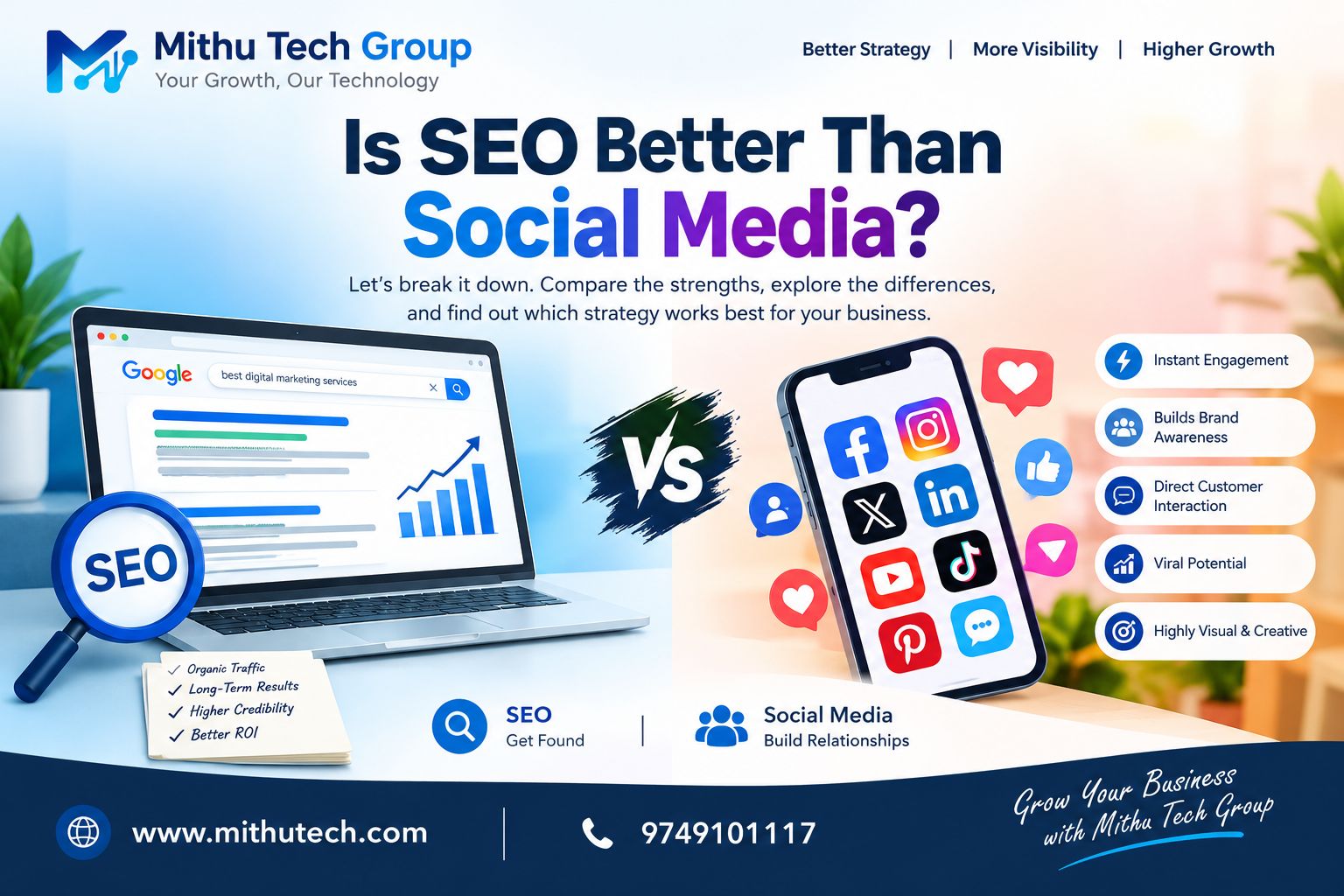
Is SEO Better Than Social Media? A Complete Guide to Traffic, Leads, Cost, ROI, and Business Growth
Introduction: Is SEO Better Than Social Media?
One of the most common questions business owners, bloggers, marketers, and website developers ask is: Is SEO better than social media?
Both search engine optimization (SEO) and social media marketing are powerful digital marketing strategies. They help businesses increase online visibility, attract potential customers, build brand awareness, generate leads, and increase sales. However, they work in different ways and deliver different types of results.
SEO helps your website appear when people search for information, products, or services on search engines such as Google. Social media marketing helps you connect with people through platforms such as Facebook, Instagram, YouTube, LinkedIn, and other online communities.
For example, imagine someone wants to buy a property in Durgapur. They might search Google for “flats for sale in Durgapur” because they already have an interest in purchasing property. A well-optimized real estate website could attract that person through organic search results.
Another potential buyer might discover a property through an Instagram Reel, a Facebook post, or a YouTube video while browsing social media. In this situation, social media introduces the property to someone who may not have actively searched for it yet.
Both approaches can generate business, but they serve different purposes.
The short answer is that SEO is often better for capturing existing search demand and building long-term organic visibility, while social media is often better for creating awareness, encouraging interaction, and reaching new audiences quickly. Neither channel is universally better for every business.
The right choice depends on your industry, target audience, competition, budget, marketing goals, and the time you can invest.
In this comprehensive guide, we will compare SEO vs social media marketing, examine their advantages and disadvantages, discuss costs and return on investment (ROI), and explain how businesses can combine both strategies to achieve sustainable growth.
1. What Is SEO?
Search engine optimization, commonly known as SEO, is the process of improving a website and its content so that search engines can discover, understand, and potentially show its pages in relevant organic search results.
Organic results are the unpaid listings that appear because a search engine considers a page relevant to a user’s query. They are different from sponsored advertisements.
Suppose you own a digital marketing agency. Your potential customers may search for terms such as:
- Best digital marketing agency near me
- Affordable SEO services for small businesses
- How to improve website rankings on Google
- Local SEO services for businesses
- SEO vs social media marketing
If your website contains useful, relevant pages that answer these questions, you may attract visitors from search engines.
SEO is not simply about inserting keywords into articles. A sustainable SEO strategy includes several important activities.
Keyword research
Keyword research helps you understand what your target audience searches for, which terms are relevant to your business, and what information users expect to find.
For example, a real estate website might target searches such as “buy a flat in Durgapur,” “residential plots in Durgapur,” and “property prices in Durgapur.”
The purpose is to create useful content around real customer needs rather than repeat keywords unnaturally.
On-page SEO
On-page SEO involves improving individual website pages. It includes descriptive page titles, helpful headings, relevant content, internal links, image descriptions, and clear navigation.
For example, an article about property investment should link naturally to related property guides, relevant property listings, and other useful pages on the same website.
Technical SEO
Technical SEO helps search engines access and understand a website. Important considerations include crawlability, indexability, mobile usability, page performance, canonical URLs, and a logical site structure.
A website with excellent content can still struggle if important pages cannot be crawled or indexed properly.
Content marketing
Content marketing supports SEO by answering questions and helping people make informed decisions.
Businesses can publish original articles, tutorials, comparison guides, FAQs, case studies, and service pages that address their audience’s needs.
Off-page SEO
Off-page SEO includes activities that help establish a website’s reputation and discoverability beyond its own pages. Relevant editorial backlinks, genuine brand mentions, and industry relationships can contribute to a website’s overall authority and visibility.
Buying manipulative links or creating large quantities of low-quality content is not a sustainable shortcut.
Google’s official SEO Starter Guide explains the fundamentals of helping search engines understand websites and emphasizes useful, people-first content.
Ultimately, SEO helps connect a website with people who are actively looking for relevant information, products, or services.
2. What Is Social Media Marketing?
Social media marketing is the process of using social platforms to promote a brand, communicate with an audience, distribute content, build relationships, and generate business opportunities.
Unlike traditional search, where users commonly begin by expressing a need through a query, social media frequently introduces content to people while they are browsing.
A business can use social media to:
- Introduce new products and services.
- Publish educational posts and short videos.
- Share customer experiences and testimonials.
- Answer questions and respond to comments.
- Build a recognizable brand identity.
- Promote offers, events, and new articles.
- Generate enquiries through direct messages.
- Run targeted paid advertising campaigns.
Different platforms serve different purposes.
Facebook: Useful for community engagement, local business promotion, groups, and selected advertising campaigns.
Instagram: Useful for visual storytelling, short videos, product demonstrations, and lifestyle content.
YouTube: Useful for tutorials, product reviews, demonstrations, educational videos, and longer-lasting video discovery.
LinkedIn: Particularly relevant for professional networking, business-to-business marketing, recruitment, and industry expertise.
Pinterest: Can be valuable for visual inspiration, including interior design, fashion, home improvement, and other discovery-oriented categories.
A real estate business, for instance, could publish property walkthroughs, neighbourhood videos, home-buying advice, and construction updates.
These posts may attract viewers who are interested in property even if they were not searching Google at that moment.
Social media also gives businesses a direct way to hear from customers. Comments, messages, polls, and discussions can reveal common questions, preferences, objections, and buying motivations.
However, social media visibility is not guaranteed. Organic reach depends on the platform, the audience, the content, competition, and changing recommendation systems. Paid advertising can increase distribution, but it introduces advertising costs.
3. SEO vs Social Media Marketing: The Main Differences
Although SEO and social media marketing share the goal of business growth, their methods and strengths differ.
| Comparison factor | SEO | Social media marketing |
|---|---|---|
| Main purpose | Capture relevant search demand | Build awareness and engagement |
| Audience behaviour | People actively search for something | People often discover content while browsing |
| Speed of exposure | Usually gradual for new organic pages | Potentially fast after publishing or through ads |
| Long-term potential | Pages may attract traffic for years if they remain useful and visible | Posts can continue to circulate, but reach is less predictable |
| Content formats | Articles, service pages, guides, listings, videos | Posts, Reels, Stories, videos, carousels, discussions |
| Customer intent | Often strong when queries indicate buying intent | Varies with the audience and content |
| Interaction | Usually less direct, although websites can offer chat and forms | Direct comments, messages, shares, and community discussions |
| Measurement | Rankings, clicks, organic traffic, leads, revenue | Reach, engagement, referral traffic, enquiries, revenue |
| Main challenge | Competition, technical quality, and time to gain visibility | Consistent creative production and unpredictable reach |
| Best use | Search discovery and sustained website traffic | Awareness, relationships, discovery, and promotion |
These are general tendencies rather than universal rules. Social media can generate immediate sales, and SEO can introduce people to a brand long before they are ready to purchase.
The important distinction is that SEO primarily helps people find relevant content through search, whereas social media helps brands reach, engage, and influence audiences through social platforms.
4. Why SEO Can Be Better Than Social Media
For businesses that want sustainable website traffic, SEO can offer several important advantages.
4.1 SEO attracts people who are actively searching
Search intent is one of SEO’s strongest advantages.
When a person searches for “best CCTV installation service in Durgapur,” they may already be comparing service providers. A business that appears prominently for a relevant search has an opportunity to reach that potential customer at the right moment.
Compare that with someone who sees a general CCTV advertisement while scrolling through a social media feed. The viewer may be interested, but they may not currently need the service.
This does not mean every search visitor will convert or every social visitor will be unqualified. It means that search queries often provide useful clues about a user’s immediate needs.
Businesses can improve results by targeting relevant queries and building landing pages that address those needs directly.
4.2 SEO can generate traffic long after publication
A social media post may receive most of its attention shortly after publication, although some posts and videos continue to attract views over time.
An effective SEO article can have a longer useful life.
For example, a guide explaining how to choose a residential property may attract search traffic months after it is published, provided it remains relevant, competitive, indexed, and visible in search results.
The same article can continue helping visitors without requiring the business to repost it every day.
However, SEO is not entirely passive. Content may need updates, technical maintenance, better internal links, and improvements as competitors and search results change.
4.3 SEO can reduce dependence on paid advertising
Organic search traffic does not require paying a search engine for each click. This can make SEO attractive to businesses that want to build a long-term acquisition channel.
Nevertheless, SEO is not free.
Keyword research, writing, development, technical improvements, analytics, and ongoing content maintenance require time or money. Competitive industries may also require substantial investment.
The economic advantage appears when useful pages continue producing qualified visitors and leads relative to their total cost.
A business should compare the full cost of SEO with the value of the traffic and customers it generates, rather than assume every organic visit has zero cost.
4.4 SEO supports customer education
Many customers research before making a decision.
They may compare prices, read reviews, examine specifications, evaluate risks, and look for answers to frequently asked questions.
SEO allows businesses to create detailed resources for each stage of this journey.
For example, a property website could publish:
- A guide to buying a first home.
- A comparison of apartments and independent houses.
- A checklist for inspecting a property.
- An explanation of common property documents.
- A guide to comparing neighbourhoods.
- A practical discussion of property investment risks.
Such content can attract visitors, answer questions, and help establish the website as a useful resource.
It can also connect informational visitors to relevant products, services, or listings when they are ready to take the next step.
4.5 SEO can support local customer acquisition
Local SEO is especially useful for businesses that serve a defined geographical area.
Plumbers, electricians, property consultants, restaurants, clinics, repair services, and other local businesses may benefit from appearing for relevant location-based searches.
For example, a person searching for “interior designer in Durgapur” may be looking for a nearby professional rather than general design inspiration.
A well-maintained business profile, accurate contact details, useful local landing pages, authentic reviews, and consistent business information can help a business compete for relevant local discovery opportunities.
Local SEO does not guarantee a top position. Proximity, relevance, prominence, competition, and other factors affect local search visibility.
4.6 SEO creates opportunities across the buying journey
Not everyone who searches is ready to purchase immediately.
Someone may begin with “how much does CCTV installation cost,” later search for “best CCTV cameras for a shop,” and eventually look for an installer.
A business with helpful content at multiple stages can attract the person earlier and remain useful as their needs become more specific.
This gives SEO the potential to support awareness, research, comparison, and conversion through a connected set of pages.
5. Why Social Media Can Be Better Than SEO
SEO has clear strengths, but social media can be the better starting point in many situations.
5.1 Social media can generate faster exposure
A newly published website article may take time to be discovered, indexed, and gain meaningful search visibility.
A social media post can begin reaching people shortly after publication. A paid campaign can accelerate exposure further, subject to the platform’s policies, targeting, budget, and creative performance.
This makes social media useful for product launches, time-sensitive announcements, events, seasonal offers, and early-stage businesses that need immediate audience feedback.
Fast exposure does not automatically mean profitable exposure. Businesses still need to attract the right people and offer a clear next step.
5.2 Social media helps introduce unfamiliar products
SEO works best when people search for something related to the product, problem, or category.
But what happens when people do not yet know that a new product exists?
Social media can demonstrate the product, explain its benefits, and create curiosity among relevant audiences.
For example, a company launching an innovative home security device could publish a short demonstration showing how it works. Viewers may become interested even if they had never searched for that particular device.
This is an important distinction: search often captures existing demand, while social content can help create new demand.
5.3 Social media makes visual storytelling easier
Some products and services are naturally visual.
Fashion, interior design, food, travel, architecture, home decor, and real estate can benefit from images and video demonstrations.
A property walkthrough, for example, may communicate the layout, natural light, surroundings, and appearance of a home more effectively than a short text description alone.
Social media allows businesses to combine visuals, narration, music, captions, and storytelling to make their offerings easier to understand.
Visual content can also be embedded in website pages and optimized for relevant search discovery, allowing the same production effort to support more than one channel.
5.4 Social media encourages direct interaction
Customers can ask questions, share experiences, comment on posts, and send direct messages.
Businesses can respond to objections, clarify product details, and develop relationships with potential customers.
These interactions can provide valuable insights into what the audience cares about.
For example, if several people repeatedly ask about installation costs, warranty coverage, or service availability, the business can use those questions to improve its website and create future content.
Social media is therefore not only a promotional channel. It can also function as a source of customer research.
5.5 Social media supports community building
A business that consistently shares helpful content and participates in relevant discussions can develop a community around its expertise or products.
A fitness brand might publish exercise guidance. A local food business might share recipes and customer stories. A real estate business might discuss neighbourhood developments and home-buying tips.
Over time, this can encourage repeat interactions, recommendations, referrals, and brand familiarity.
However, follower counts alone do not prove that a community is commercially valuable. A smaller audience with genuine interest can be more useful than a large audience that rarely engages or purchases.
5.6 Social media provides useful creative feedback
Social platforms can help marketers test different messages, formats, hooks, and creative ideas.
For example, a business might publish three short videos explaining the same service from different angles. The relative watch time, comments, saves, and qualified enquiries can reveal which presentation resonates most.
These observations can then inform website copy, SEO articles, landing pages, and advertising campaigns.
The goal is not to chase every trending format. It is to learn which messages attract the audience the business actually wants to serve.
6. Which Is Cheaper: SEO or Social Media?
There is no universal answer to whether SEO or social media marketing costs less.
Both require resources, and their costs depend on the industry, competition, production quality, staffing, tools, and goals.
SEO costs
Potential SEO expenses include:
- Keyword research and content planning.
- Article writing and editing.
- Website development and technical improvements.
- Website hosting and maintenance.
- Image, video, and graphic production.
- Analytics and SEO software.
- Content updates and performance reviews.
A small business may handle some of this work internally, while a larger business may employ specialists or agencies.
Social media costs
Potential social media expenses include:
- Content planning and scheduling.
- Photography and video production.
- Graphic design and editing.
- Community management.
- Influencer collaborations.
- Social media management tools.
- Paid advertising and campaign management.
Organic social media does not require an advertising budget, but creating and distributing quality content still takes time.
Paid social campaigns add media costs on top of creative and management expenses.
How to compare the real cost
Instead of comparing monthly spending alone, calculate the cost of acquiring a qualified lead or customer.
For example, consider two hypothetical marketing campaigns.
| Metric | SEO campaign | Social media campaign |
|---|---|---|
| Total campaign cost | ₹30,000 | ₹15,000 |
| Qualified leads | 30 | 10 |
| Cost per qualified lead | ₹1,000 | ₹1,500 |
In this hypothetical example, SEO produces a lower cost per qualified lead.
The calculation is straightforward:
Cost per qualified lead = Total marketing cost ÷ Number of qualified leads
However, the result does not establish that SEO is always cheaper. The campaigns may differ in time frame, lead quality, sales conversion, and long-term value.
SEO may require substantial initial investment before producing meaningful results, while a social campaign may deliver immediate leads. A fair comparison should evaluate both channels over an appropriate period.
7. Which Delivers Better ROI: SEO or Social Media?
Return on investment measures the financial value generated relative to the investment made.
Both SEO and social media can produce strong ROI, but their performance depends on the business model and how effectively they attract and convert the right audience.
SEO may become increasingly valuable when useful pages generate recurring qualified traffic over time.
Social media may generate excellent returns when a business can reach a well-defined audience, communicate a compelling offer, and convert interest into sales.
A simple ROI formula is:
Marketing ROI = (Attributed profit − Marketing cost) ÷ Marketing cost × 100
Suppose a business spends ₹20,000 on a campaign and earns ₹50,000 in attributable profit after accounting for the relevant sales costs.
Its ROI would be:
(₹50,000 − ₹20,000) ÷ ₹20,000 × 100 = 150%.
This is a hypothetical illustration, not a benchmark for either marketing channel.
For meaningful analysis, businesses should consider:
- Qualified leads rather than total clicks.
- Customer acquisition cost.
- Conversion rate.
- Average order value.
- Customer lifetime value.
- Sales cycle length.
- Repeat purchases and referrals.
- The cost of producing and maintaining content.
Attribution is also important. A customer may discover a business on Instagram, later search for its name on Google, and finally submit an enquiry through the website.
Crediting the entire sale to only one channel may hide the contribution of the other.
Businesses should therefore examine the customer journey and use consistent measurement methods when comparing channels.
8. Does Social Media Help SEO Rankings?
This question deserves a careful answer.
Do not assume that likes, shares, comments, or follower counts directly improve Google rankings. Social media engagement is not a simple ranking formula.
However, social media can support activities that contribute to broader online visibility.
For example, sharing an original research article may introduce it to journalists, industry professionals, bloggers, and potential customers. Some of those people may independently reference the article or link to it from relevant websites.
Social distribution can also increase brand awareness, generate referral visits, and help businesses discover which topics their audiences care about.
These are potential indirect benefits rather than a guarantee of better rankings.
A practical workflow is:
- Publish a useful, original article on your website.
- Create a short video explaining one key insight.
- Share a carousel summarizing the main points.
- Participate in relevant discussions without spamming.
- Direct interested readers to the full article.
- Monitor referral visits, enquiries, branded searches, and search performance.
Google’s SEO Starter Guide also discusses content promotion and the importance of useful, original information.
The goal should be to help real people discover and benefit from the content, not manufacture social engagement to manipulate search rankings.
9. SEO vs Social Media for Different Types of Businesses
The right channel depends heavily on the kind of business you operate.
Small local businesses
Local businesses often benefit from SEO because customers may search for nearby providers when they need a service.
Examples include electricians, CCTV installers, repair technicians, property agents, and interior designers.
Local search optimization can help these businesses reach people with a specific requirement. Social media can complement it by showing completed projects, explaining services, and building familiarity.
Suggested priority: Start with a solid website and local SEO foundation, then add consistent social content.
E-commerce businesses
Online stores can benefit from search traffic to product pages, category pages, comparison guides, and buying advice.
Social media can demonstrate products, showcase customer experiences, and introduce products to new audiences.
For visually appealing or trend-driven products, social media may deserve substantial attention. Search optimization remains useful when customers research products or compare alternatives.
Suggested priority: Combine product and category SEO with visual content and carefully measured social campaigns.
Bloggers and information websites
For blogs covering educational topics, tutorials, comparisons, and recurring questions, SEO can be a valuable long-term traffic source.
Social media can distribute new articles, help creators understand audience interests, and encourage readers to return.
Suggested priority: Build a strong content library through SEO and use social platforms to distribute the most useful material.
B2B companies
Business-to-business buyers often research providers, compare solutions, and seek detailed information before contacting a company.
SEO can capture searches for software, professional services, industry solutions, and technical guidance.
LinkedIn and other social platforms can help businesses develop professional relationships and demonstrate expertise.
Suggested priority: Use SEO for discoverability and detailed educational resources, supported by professional social content and relationship building.
New businesses and startups
A new business may have little brand recognition and few pages with established search visibility.
Social media can help introduce its offering, test messages, and gather early customer feedback.
At the same time, building a useful website and publishing core service information creates a foundation for future search visibility.
Suggested priority: Use social media to learn and generate early awareness while building the website and SEO assets needed for longer-term growth.
Real estate businesses
Real estate marketing benefits from both search intent and visual discovery.
Potential buyers and tenants may search for specific properties, locations, prices, and neighbourhoods. Others may discover homes through videos, photographs, and local community posts.
A real estate website can publish location-specific guides, property listings, buying advice, and neighbourhood comparisons. Social channels can showcase property walkthroughs and promote selected listings.
For example, DurgapurProperty.com can serve as a relevant starting point for people researching property opportunities in Durgapur.
Suggested priority: Use local SEO and useful property pages to capture active demand, while using social media to showcase listings, build trust, and generate enquiries.
10. A Practical Strategy for Combining SEO and Social Media
For many businesses, the best approach is not to choose one channel permanently. It is to assign each channel a clear role.
Step 1: Identify your customers
Start by understanding who buys your products or services.
What problems do they face? What questions do they ask? Which locations do they serve? How do they compare providers? What concerns stop them from purchasing?
Customer interviews, sales conversations, search queries, website analytics, and social media comments can help answer these questions.
Step 2: Research search demand
Identify relevant keywords and group them by search intent.
For example, a CCTV company might distinguish between informational searches such as “how CCTV cameras work,” comparison searches such as “IP camera vs analog camera,” and commercial searches such as “CCTV installation service in Durgapur.”
Each group may require a different type of page.
Prioritize topics that connect your expertise to genuine customer needs rather than producing large volumes of generic content.
Step 3: Build useful website pages
Create clear service pages, product pages, location pages where appropriate, and helpful supporting articles.
Make sure each page has a distinct purpose, provides useful information, and offers a logical next step.
Include relevant internal links so visitors can move naturally between related resources.
For example, an article about choosing a CCTV system might link to a relevant installation service page. A property investment guide might link to appropriate property listings or related buying guides.
Step 4: Repurpose content for social media
One strong article can become several different social assets.
A 2,000-word guide could produce:
- A short video answering its most important question.
- A carousel explaining five key lessons.
- A simple infographic summarizing the process.
- A series of short posts addressing common mistakes.
- A question-and-answer post inviting discussion.
Do not simply paste the entire article into every platform. Adapt the format, length, opening, and presentation to the audience.
Step 5: Use social feedback to improve your content
Monitor the questions people ask and the topics that attract meaningful engagement.
If customers repeatedly ask about pricing, timelines, warranties, or eligibility, consider whether your website should address those concerns more clearly.
Social discussions can reveal content opportunities, but validate those ideas against customer needs and search demand before investing heavily in them.
Step 6: Create clear conversion paths
Traffic is useful only when it supports a business objective.
Depending on the business, the next step might be to request a quote, call a sales team, book an appointment, view a property, subscribe to a newsletter, or purchase a product.
Make these actions easy to understand and complete on mobile devices.
Track meaningful enquiries and sales instead of judging success by traffic or follower growth alone.
Step 7: Measure each channel separately and together
Use appropriate analytics to monitor search impressions, organic clicks, landing-page performance, referral visits, social engagement, enquiries, and conversions.
Google Search Console can help monitor website performance in Google Search. Website analytics and a lead management system can help connect visits to meaningful business outcomes.
Where possible, use campaign tracking parameters for social links and maintain consistent lead-source records.
Review the data regularly and allocate more resources to the activities that produce valuable results.
11. A 90-Day SEO and Social Media Marketing Plan
A structured plan makes it easier to test both channels without spreading resources too thinly.
Days 1–30: Build the foundation
SEO priorities:
- Audit the website’s technical health.
- Research relevant keywords and search intent.
- Improve important page titles and descriptions.
- Review existing content for accuracy and usefulness.
- Create a list of priority pages and content opportunities.
- Set up appropriate performance tracking.
Social media priorities:
- Select the platforms most relevant to your audience.
- Improve profile descriptions and contact details.
- Establish a realistic publishing schedule.
- Create a small set of reusable content formats.
- Record baseline reach, engagement, and enquiry metrics.
The objective is to establish a clear starting point rather than expect immediate large-scale growth.
Days 31–60: Publish and distribute
SEO priorities:
- Publish or improve high-priority pages.
- Add relevant internal links.
- Improve weak or outdated content.
- Check indexing and search performance.
- Ensure important pages work well on mobile devices.
Social media priorities:
- Share short videos, educational posts, and useful visuals.
- Promote selected website resources.
- Respond to genuine customer questions.
- Test different creative approaches.
- Track which content generates relevant visits and enquiries.
The objective is to discover which topics and messages attract the right audience.
Days 61–90: Analyze and improve
SEO priorities:
- Review search impressions and organic clicks.
- Identify pages gaining visibility.
- Improve content that does not satisfy search intent.
- Strengthen useful internal links.
- Review conversion paths and enquiry quality.
Social media priorities:
- Identify content formats that attract relevant engagement.
- Repeat successful themes without publishing repetitive material.
- Improve calls to action.
- Review referral traffic and assisted conversions.
- Adjust the publishing schedule to available resources.
At the end of 90 days, compare results against your original goals.
Do not judge SEO solely on a short-term traffic increase or social media solely on the number of followers gained. Consider qualified leads, sales, customer feedback, and the direction of performance over time.
SEO results may take longer to become apparent, and the appropriate evaluation period depends on the website, competition, and changes made.
12. Common Mistakes to Avoid in SEO and Social Media Marketing
Even a well-funded marketing strategy can underperform when the execution is poor.
Mistake 1: Expecting instant SEO results
Publishing an article does not guarantee first-page rankings or immediate traffic.
Search engines need to discover and evaluate pages, and competitors may already have stronger resources. Focus on useful content, technical quality, and steady improvement rather than guaranteed ranking promises.
Mistake 2: Publishing social content without a strategy
Posting every day is not automatically effective.
Each post should serve a purpose, such as educating customers, showing a product, answering a question, encouraging discussion, or generating a relevant enquiry.
Quality, audience fit, and clear objectives matter more than activity alone.
Mistake 3: Chasing vanity metrics
High impressions, likes, or follower counts may look impressive but do not necessarily indicate business growth.
A local service provider may benefit more from ten qualified enquiries than from thousands of unrelated views.
Track metrics that connect to your objectives.
Mistake 4: Keyword stuffing
Repeating the same keyword excessively makes content unpleasant to read and may violate search engine spam policies.
Use the primary keyword naturally in the title, introduction, relevant headings, and body where appropriate. Include related terms when they improve clarity.
Do not write awkward sentences solely to increase keyword frequency.
Mistake 5: Copying competitors
Copying articles, graphics, videos, or product descriptions can create copyright and originality problems. It also makes it harder to offer distinctive value.
Research competitor topics to understand what readers need, then develop your own explanations, examples, experience, and insights.
An original article does not require an entirely new subject. It requires independently written content that provides genuine value.
Mistake 6: Ignoring website conversions
A website may receive visitors but generate few enquiries if contact information is difficult to find, pages load poorly, or calls to action are unclear.
Review the complete visitor journey and make it easy for people to take the next step.
Mistake 7: Depending entirely on one platform
Search rankings can change, and social platforms can modify recommendation systems, advertising policies, or account access.
Businesses should reduce unnecessary dependence by building a useful website, maintaining customer relationships, and collecting contact information responsibly with consent.
The aim is not to eliminate platform risk entirely, but to develop several complementary ways to reach customers.
13. How to Choose Between SEO and Social Media on a Limited Budget
If your budget is limited, trying to do everything at once may produce mediocre results.
Instead, select the channel that best matches how customers discover and buy your product.
Choose SEO first when:
- Customers regularly search for your products or services.
- Your website can provide useful answers to their questions.
- Your business depends on local or informational search visibility.
- You can invest in content and website improvements over time.
- You want to build a durable source of organic discovery.
Prioritize social media when:
- Your product is highly visual or demonstration-driven.
- You need to introduce a new or unfamiliar offering.
- Your audience actively participates in relevant social communities.
- Your business relies on personal relationships and repeat engagement.
- You can produce content that fits the platform and audience.
Use both when:
- Customers discover products in multiple ways.
- You want search traffic as well as community engagement.
- You can reuse strong content across formats.
- Your marketing results show that both channels contribute to leads or sales.
A small business does not necessarily need to publish daily on five platforms and release multiple long-form articles every week.
It may be more effective to improve a few important website pages, publish one genuinely useful article at a sustainable pace, and adapt that article into several social posts.
Consistency should be based on available resources and content quality, not an arbitrary posting target.
14. The Future of SEO and Social Media Marketing
Digital marketing continues to evolve as search experiences, recommendation systems, video formats, and consumer behaviour change.
People may discover information through traditional search results, video platforms, social feeds, online communities, maps, and AI-powered search experiences.
This makes it increasingly important to create content that is useful, understandable, trustworthy, and suited to the audience.
For SEO, businesses should focus on accurate information, clear site structure, relevant pages, good technical foundations, and content that genuinely answers users’ questions.
For social media, businesses should focus on meaningful creative work, audience understanding, direct communication, and content that encourages useful interactions.
The boundaries between these channels can overlap. Videos can appear in search results, social posts can introduce people to a website, and a customer may encounter a brand through several platforms before making a decision.
Rather than trying to predict every platform change, businesses should build a flexible marketing system that can adapt as customer behaviour evolves.
A website remains a valuable place to organize detailed information and conversion paths, while social platforms offer additional opportunities for discovery and interaction.
The most resilient strategy is to understand where customers spend their time, how they express their needs, and what kind of information helps them make decisions.
15. Frequently Asked Questions About SEO vs Social Media
Q1. Is SEO better than social media?
SEO is often better for attracting people who are actively searching for relevant information, products, or services and for developing long-term organic website visibility. Social media is often better for building awareness, encouraging interaction, and introducing products to new audiences. The better choice depends on your business goals and customer behaviour.
Q2. Which is better for small businesses: SEO or social media?
Small businesses that depend on customers searching for local services can benefit greatly from SEO and local search optimization. Businesses with visually appealing products or active online communities may benefit from social media first. Many small businesses can start with a focused website strategy and one suitable social platform.
Q3. Is SEO free?
Organic search listings do not require paying Google for each click, but SEO itself requires resources. Research, writing, technical work, hosting, and maintenance all have costs, whether handled internally or outsourced.
Q4. Is social media marketing free?
Businesses can create organic posts without paying for advertising distribution, but producing content and managing an audience takes time and resources. Paid campaigns require an advertising budget, and results vary.
Q5. Which generates leads faster?
Social media campaigns, particularly paid campaigns, can generate exposure and enquiries quickly. SEO can also generate leads when a website already has relevant search visibility, but establishing organic visibility for a new or competitive website may take considerable time.
Neither channel guarantees a particular number of leads.
Q6. Does social media increase Google rankings?
Do not treat likes, shares, or follower counts as direct Google ranking factors. Social media can indirectly support discovery, brand awareness, content distribution, and opportunities for genuine third-party references.
Q7. Can I do SEO without social media?
Yes. A business can pursue SEO through its website, useful content, technical optimization, and other legitimate search-focused activities. Social media is optional, although it can provide additional opportunities to distribute content and connect with audiences.
Q8. Can I do social media marketing without a website?
Yes. Some businesses generate enquiries and sales through social profiles, messaging, or platform-based shops. However, a website can provide greater control over detailed information, customer journeys, analytics, and content organization.
The right setup depends on the business model and the tools available on each platform.
Q9. Which is better for affiliate marketing?
SEO can be valuable for affiliate websites that publish useful product comparisons, reviews, and buying guides. Social media can help demonstrate products, build an audience, and distribute recommendations.
Affiliate marketers should prioritize accurate, transparent, original content and clearly disclose commercial relationships where required.
Q10. Which is better for real estate marketing?
SEO is valuable for location-specific searches, property listings, neighbourhood guides, and home-buying resources. Social media is valuable for property walkthroughs, photographs, videos, and direct audience engagement.
Real estate businesses often benefit from using both channels together.
Q11. How long does SEO take to work?
There is no universal timeline. Some changes can be reflected relatively quickly, while meaningful improvements in competitive search results may take months or longer.
Google’s official SEO documentation recommends allowing time for changes to be reflected and evaluating results rather than expecting every change to produce immediate improvements.
Q12. How often should a business post on social media?
There is no single posting frequency that suits every business or platform.
Choose a schedule that allows you to publish useful, relevant content consistently and respond to your audience. Monitor results and adjust based on engagement quality, referral visits, enquiries, and available resources.
Q13. Should I invest in SEO or social media ads?
SEO is an investment in organic search visibility, whereas social media advertising pays for distribution to selected audiences. Social ads may be useful when you need to test an offer or reach a specific audience quickly. SEO may be useful when recurring search demand makes organic visibility commercially attractive.
Compare both by qualified leads, conversion rates, customer acquisition costs, and profitability.
Q14. Can one article help with both SEO and social media?
Yes. An original article can be optimized for relevant search queries and repurposed into short videos, carousels, posts, and discussion topics.
The key is to adapt the material for each platform rather than publish identical content everywhere.
Q15. What is the best digital marketing strategy for long-term growth?
For many businesses, a combination of a well-maintained website, useful SEO content, appropriate social media distribution, reliable analytics, and a clear conversion process provides a strong foundation.
The exact mix should reflect the business’s audience, resources, competitive position, and actual marketing results.
Conclusion: Is SEO Better Than Social Media?
So, is SEO better than social media?
SEO is often the stronger choice for capturing existing search demand and building sustained organic website visibility. Social media is often the stronger choice for creating awareness, demonstrating products, developing relationships, and reaching audiences who may not yet be searching for a solution.
Neither channel automatically produces better results in every situation.
SEO can take time to build visibility and requires ongoing attention to content quality, technical health, and competition. Social media can create exposure quickly but often requires consistent creative work and depends on platform distribution.
The right decision starts with understanding your customers.
If customers actively search for what you sell, prioritize useful website pages and relevant SEO. If customers discover your products through visual content, creators, or online communities, give social media an appropriate role. If your customers use both discovery methods, build a strategy that connects the channels.
Start with clear objectives, track meaningful results, and invest in the activities that produce qualified leads and profitable customers.
Rather than treating SEO and social media as competitors, think of them as complementary tools in a broader digital marketing strategy.
SEO helps people find answers when they search. Social media helps businesses earn attention, communicate value, and build relationships. When both are planned around real customer needs, they can support a more sustainable approach to online growth.
Final Action Plan
- Identify your most valuable customer segments.
- Research relevant search queries and social platforms.
- Improve your most important website pages.
- Publish useful, original content.
- Repurpose suitable content for social distribution.
- Give visitors a clear way to contact or buy from you.
- Track qualified leads, conversions, and revenue.
- Review performance regularly and refine your strategy.
The ultimate goal is not to win the SEO vs social media debate. It is to make it easier for the right customers to discover your business, trust your expertise, and take action.
Your blog has quickly become one of my favorites. Your writing is both insightful and thought-provoking, and I always come away from your posts feeling inspired. Keep up the phenomenal work!
Your perspective brings something new to a conversation I thought I already understood. I am glad I found this website and will stop by again.