





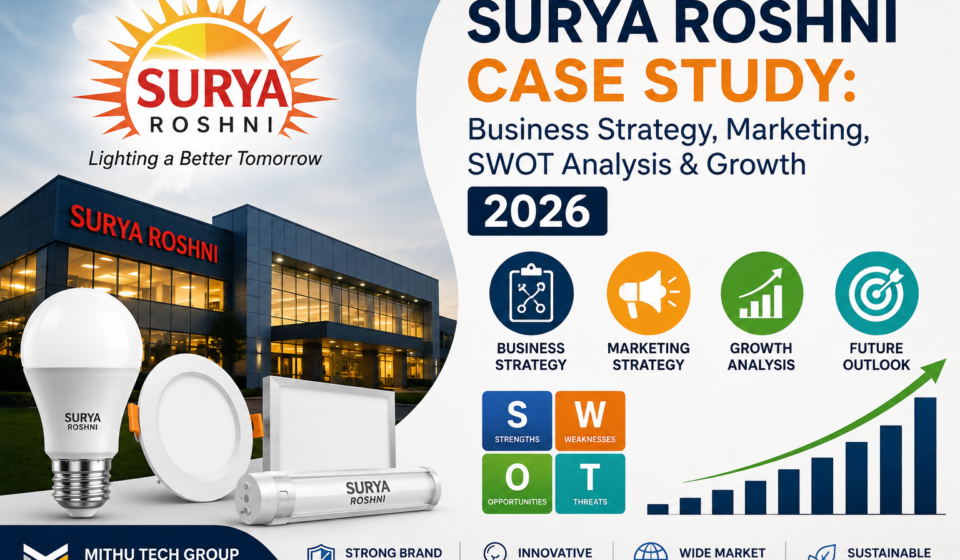
Surya Roshni Case Study: Business Strategy, Marketing, SWOT Analysis & Growth – 2026

Explore a detailed Surya Roshni case study covering its history, steel pipes and lighting businesses, diversification strategy, manufacturing, marketing, SWOT analysis, digital transformation, competitive advantage and future growth opportunities.
Surya Roshni case study, Surya case study, Surya Roshni business strategy, Surya Roshni marketing strategy, Surya Roshni company case study
Surya Roshni SWOT analysis, Surya Roshni business model, Surya Roshni growth strategy, Surya Roshni steel pipes, Surya Roshni lighting business, Surya Roshni competitive advantage, Surya Roshni diversification strategy
Surya Roshni case study in India, detailed Surya Roshni case study, Surya Roshni business strategy case study, Surya Roshni marketing strategy case study, Surya Roshni SWOT analysis, Surya Roshni steel pipe case study, Surya Roshni lighting business case study, Surya Roshni digital transformation case study, Surya Roshni manufacturing case study, Surya Roshni case study for MBA students
1. Introduction to the Surya Roshni Case Study
The Surya Roshni case study is an interesting example of how an Indian manufacturing company can build a diversified business through long-term investment in manufacturing, technology, distribution and brand development.
Surya Roshni Limited began its journey in 1973 with steel-tube manufacturing. It subsequently expanded into lighting, PVC pipes and consumer durables. According to the company’s own corporate information, Surya Roshni reported revenue of approximately ₹7,435.22 crore in FY 2024-25 and exports to more than 50 countries.
The company today operates across two major strategic areas:
- Steel Pipes & Strips
- Lighting & Consumer Durables
This makes Surya Roshni an especially useful case for studying:
- Business diversification
- Manufacturing strategy
- Brand management
- B2B marketing
- B2C marketing
- Supply-chain management
- Technology adoption
- Digital transformation
- International business
- Competitive strategy
- Capacity expansion
The company’s journey is particularly interesting because its original steel business eventually became the foundation for a much broader manufacturing group.
2. Surya Roshni Company Overview
Surya Roshni Limited is an Indian manufacturing company with businesses spanning steel pipes, lighting and consumer durables.
The company’s corporate history goes back to 1973, when it started with steel tubes. In 1984, it entered the lighting business. Over subsequent decades, it expanded into additional product categories and markets.
Its portfolio has included products such as:
Steel
- ERW steel pipes
- GI pipes
- Spiral pipes
- API pipes
- CR sheets
- Coated pipes
- Other steel products
Lighting
- LED lamps
- LED tubes
- Street lights
- Flood lights
- Professional lighting
- Conventional lighting products
Consumer durables
- Fans
- Water heaters
- Room heaters
- Room coolers
- Irons
- Mixers
- Grinders
- Juicers
- Cooking appliances
Other products
The company has also expanded into PVC pipes and other electrical and household categories.
3. The History of Surya Roshni
The history of Surya Roshni can be divided into several stages.
Stage 1: Steel manufacturing
The company began in 1973 with steel tubes.
Stage 2: Lighting diversification
In 1984, Surya entered lighting.
Stage 3: Product diversification
The company expanded into PVC pipes and consumer durables.
Stage 4: Manufacturing expansion
New facilities were established in different parts of India.
Stage 5: International expansion
The company developed exports to more than 50 countries.
Stage 6: Technology and R&D
Surya invested in specialized R&D and testing capabilities.
Stage 7: Digital transformation
The company worked on integrating manufacturing and commercial processes with enterprise technology.
This evolution demonstrates a strategy of gradual diversification around manufacturing capabilities.
4. Surya Roshni’s Original Business: Steel Tubes
The starting point of the Surya Roshni business case study is steel.
Steel tubes and pipes are used in industries such as:
- Infrastructure
- Agriculture
- Construction
- Water distribution
- Oil and gas
- Industrial applications
This gave Surya exposure to several large industrial markets.
5. Why Steel Was an Important Foundation
Steel manufacturing requires expertise in:
- Raw materials
- Production
- Quality control
- Engineering
- Logistics
- Procurement
- Industrial sales
These capabilities can become difficult for competitors to replicate quickly.
Surya gradually developed manufacturing infrastructure and expertise around these requirements.
6. Entry Into the Lighting Industry
One of the most important milestones was Surya’s entry into lighting in the 1980s.
The company describes the lighting business as being built around the vision of “Lighting Every City, Every Home.”
The move was strategically important because lighting offered access to a much larger consumer market than industrial steel products.
7. Why Diversification Made Strategic Sense
At first glance, steel and lighting appear unrelated.
However, there were some broader capabilities that could be transferred:
- Manufacturing discipline
- Procurement
- Distribution
- Quality control
- Industrial management
- Capital investment
- Brand building
Surya therefore demonstrates a form of manufacturing-led diversification.
8. Surya Roshni Diversification Strategy
The company’s diversification can broadly be represented as:
Steel Tubes
↓
Lighting
↓
PVC Pipes
↓
Consumer Durables
↓
LED Technology
↓
Fans & Appliances
The strategy expanded the company’s addressable market.
9. Related vs Unrelated Diversification
Surya Roshni’s portfolio contains businesses with different customers and economics.
Steel is primarily industrial and B2B-oriented.
Lighting has both:
- B2B
- B2C
Consumer durables are largely consumer-facing.
Therefore, the company needs different marketing and distribution strategies across its businesses.
10. Surya Roshni Business Model
A simplified version of the Surya Roshni business model is:
Manufacturing capabilities
Technology
Distribution
Brand
Product diversification
Export markets
↓
Revenue and customer value
The model is built heavily around manufacturing and physical products.
11. Surya Roshni Manufacturing Strategy
Manufacturing is one of Surya’s strongest strategic foundations.
The company operates manufacturing facilities supporting its steel and lighting businesses.
Its infrastructure includes facilities in locations such as:
- Bahadurgarh
- Malanpur/Gwalior
- Bhuj
- Hindupur
- Kashipur
The company’s infrastructure page describes separate manufacturing capabilities for lighting and steel products.
12. Surya Roshni Steel Manufacturing
The steel business has developed substantial pipe-manufacturing capabilities.
The company’s facilities support production of:
- ERW pipes
- Spiral pipes
- GI pipes
- API-oriented products
- Coated pipes
Surya’s Bhuj facility is particularly important for larger pipe products and export-oriented operations.
13. ERW Steel Pipes
Electric Resistance Welded (ERW) pipes are widely used in industrial and infrastructure applications.
They can serve industries including:
- Construction
- Water
- Agriculture
- Oil and gas
- Infrastructure
This creates a broad B2B customer base.
14. GI Pipe Business
Galvanized iron pipes have important applications in:
- Water
- Agriculture
- Infrastructure
- Construction
Surya has positioned itself strongly in the GI pipe segment.
The company’s annual report describes it as one of India’s major GI pipe manufacturers.
15. API-Approved Steel Products
The oil and gas sector requires stringent standards.
Surya’s steel business has products approved to relevant American Petroleum Institute (API) standards for applications in the oil and gas industry.
This creates an important competitive advantage because technical certifications can increase customer trust.
16. Coated Pipe Strategy
Surya has invested in pipe-coating capabilities.
Coatings can improve:
- Corrosion resistance
- Durability
- Product life
- Suitability for infrastructure applications
The company’s infrastructure information describes 3LPE and other coating capabilities at its Bhuj/Anjar operations.
17. Surya and Infrastructure Growth
India’s infrastructure development creates potential demand for steel pipes.
Relevant sectors include:
- Water infrastructure
- Urban development
- Agriculture
- Oil and gas
- City gas distribution
- Construction
This gives Surya exposure to India’s broader infrastructure cycle.
18. Lighting Business Strategy
Surya’s lighting business is another major component of the company.
Its portfolio includes:
- LED lamps
- LED tubes
- Street lighting
- Flood lighting
- Professional lighting
- Other lighting products
The company has increasingly shifted toward energy-efficient LED technology.
19. LED Transformation
The transition from conventional lighting to LED created both an opportunity and a challenge.
LED technology offers:
- Energy efficiency
- Longer operating life
- Lower maintenance
- New product possibilities
Surya invested in LED manufacturing and R&D capabilities to participate in this transformation.
20. Surya Technology and Innovation Centre
One of the strongest examples of the company’s technology investment is the Surya Technology & Innovation Centre (STIC) in Noida.
The company describes STIC as a major lighting R&D facility supporting:
- Photometric testing
- Electrical testing
- Mechanical testing
- Environmental testing
- Endurance testing
It also uses specialized optical testing equipment.
21. Why R&D Matters in Lighting
Lighting is no longer simply about producing a bulb.
Modern lighting involves:
- LED chips
- Drivers
- Thermal management
- Optics
- Electronics
- Energy efficiency
- Smart controls
Therefore, R&D can become an important source of competitive advantage.
22. Surya Consumer Durables Strategy
Surya has expanded beyond lighting into consumer durables.
Its product portfolio has included:
- Fans
- Water heaters
- Room heaters
- Irons
- Mixers
- Grinders
- Juicers
- Cooking appliances
This allows the company to leverage its established consumer brand across additional household categories.
23. Brand Extension Strategy
The Surya brand can be extended from:
Lighting
to:
Fans
to:
Home appliances
The logic is that consumers who already associate Surya with electrical products may be more willing to consider other electrical appliances from the same brand.
24. Surya Roshni Marketing Strategy
The Surya Roshni marketing strategy needs to operate differently across its businesses.
Steel
Primarily B2B.
Professional lighting
B2B and institutional.
Consumer lighting
B2C.
Fans and appliances
Primarily B2C.
This requires a multi-channel marketing approach.
25. B2B Marketing Strategy
For steel pipes, customers may prioritize:
- Quality
- Technical specifications
- Certifications
- Price
- Delivery
- Reliability
- Capacity
- Technical support
Therefore, industrial marketing depends less on mass advertising and more on technical credibility.
26. B2C Marketing Strategy
Consumer products require a different approach.
Customers may focus on:
- Price
- Brand
- Design
- Features
- Energy efficiency
- Warranty
- Availability
- Reviews
Therefore, Surya must maintain strong retail visibility.
27. Distribution Strategy
Distribution is particularly important for electrical and consumer products.
A company needs products to be available:
- In major cities
- In Tier-II cities
- In Tier-III cities
- In smaller towns
- In rural markets
Surya’s annual-report material highlights an extensive dealer and distribution network, including penetration into Tier-II, Tier-III and rural markets.
28. Rural and Semi-Urban Strategy
India’s smaller cities and rural markets represent significant long-term opportunities.
Consumers increasingly purchase:
- Fans
- Lighting
- Water heaters
- Appliances
As electricity access and household incomes improve, demand for electrical products can increase.
29. Surya Brand Positioning
The company aims to associate its brands with:
- Quality
- Innovation
- Technology
- Reliability
- Manufacturing expertise
Its corporate material describes the Surya and Prakash Surya brands as representing quality, innovation and technology.
30. Surya Roshni Competitive Advantage
The Surya Roshni competitive advantage can be analyzed through several capabilities.
1. Manufacturing
Long-standing manufacturing experience.
2. Product diversity
Presence across steel, lighting and consumer durables.
3. Distribution
Wide market reach.
4. R&D
Specialized testing and innovation capabilities.
5. Brand
Long-established Indian brand.
6. Export capability
Presence across international markets.
31. Surya Roshni SWOT Analysis
Strengths
- Long manufacturing history
- Established brand
- Steel-pipe expertise
- Lighting expertise
- Diverse product portfolio
- R&D capabilities
- Broad distribution
- International exports
- Multiple manufacturing locations
Weaknesses
- Exposure to commodity-price volatility
- Multiple business segments increase complexity
- Capital-intensive manufacturing
- Strong competition
- Different businesses require different marketing models
Opportunities
- Indian infrastructure development
- Water infrastructure
- Oil and gas
- City gas distribution
- LED adoption
- Smart lighting
- Rural electrification and consumption
- Consumer durables
- Export growth
Threats
- Steel price volatility
- Global competition
- Low-cost manufacturers
- Technological disruption
- Regulatory changes
- Economic slowdown
- Raw-material inflation
32. Surya Roshni SWOT Analysis Table
| Strengths | Weaknesses |
|---|---|
| Established manufacturing expertise | Capital-intensive operations |
| Strong Indian brand | Commodity exposure |
| Steel and lighting capabilities | Complex portfolio |
| Distribution network | Strong competition |
| R&D capabilities | Multiple operating environments |
| Export presence | Working-capital requirements |
| Opportunities | Threats |
|---|---|
| Infrastructure investment | Steel-price volatility |
| LED growth | Global competition |
| Smart lighting | Technology disruption |
| Rural consumption | Raw-material inflation |
| Oil & gas infrastructure | Economic slowdown |
| Export markets | Regulatory changes |
33. Porter’s Five Forces Analysis of Surya Roshni
1. Competitive Rivalry — High
Both steel and lighting are competitive markets.
Competitors can compete on:
- Price
- Quality
- Technology
- Distribution
- Product range
34. Threat of New Entrants — Moderate
Manufacturing businesses require:
- Capital
- Equipment
- Technology
- Distribution
- Certifications
- Brand building
This creates barriers to entry.
However, new companies can enter individual product categories relatively easily.
35. Supplier Bargaining Power — Moderate to High
Steel manufacturing depends heavily on raw materials.
Important inputs include:
- Steel coils
- Zinc
- Energy
- Industrial components
Price fluctuations can directly affect margins.
36. Buyer Bargaining Power — High in B2B
Large industrial customers can negotiate aggressively.
They may compare:
- Technical specifications
- Price
- Delivery
- Credit terms
- Supplier reliability
Therefore, maintaining quality and service is important.
37. Buyer Power in Consumer Products
Consumers also have many alternatives.
They can compare:
- LED bulbs
- Fans
- Appliances
- Water heaters
across numerous brands.
This makes brand differentiation essential.
38. Threat of Substitutes
In steel, substitutes depend on the application and can include:
- PVC
- Concrete
- Other metals
- Composite materials
In lighting, technology itself can create substitution.
For example:
Conventional lighting → LED
Therefore, technological adaptation is critical.
39. Surya Roshni Value Chain
A simplified value chain is:
Raw Materials
↓
Manufacturing
↓
Quality Testing
↓
Distribution
↓
Sales
↓
After-Sales Service
↓
Customer Relationship
The company’s manufacturing and testing infrastructure is therefore central to value creation.
40. Digital Transformation Case Study
One of the most interesting modern elements of the Surya Roshni case study is digital transformation.
PwC describes a project involving a SAP-based solution for Surya’s steel pipe division.
The challenge involved complex pipe specifications, material codes, measurement units, inventory, sales, invoicing, credit management and production planning.
41. The Digital Problem
Steel pipe manufacturing can involve many variables.
These include:
- Diameter
- Thickness
- Length
- Material
- Weight
- Coating
- Customer requirements
Managing these manually can create significant complexity.
42. SAP Transformation
The digital transformation project integrated processes involving:
- Sales
- Distribution
- Materials management
- Finance
- Production planning
The objective was to create more standardized and automated processes.
43. Benefits of Digital Transformation
According to PwC’s published case study, the transformation supported:
- Real-time logistics monitoring
- Automation of letter-of-credit processes
- Better integration
- MRP-based planning
- Automated documentation
- Reduced manual intervention
PwC reported a projected 30% year-on-year Q2 volume growth in the steel-pipe business and 98% elimination of manual intervention in invoicing as impacts associated with the project.
These figures should be understood as the project’s reported/projected impacts rather than as general claims about the company’s entire business.
44. Why the Digital Transformation Is Important
The Surya digital transformation case demonstrates that technology can improve not only marketing but also:
- Manufacturing
- Inventory
- Planning
- Finance
- Documentation
- Logistics
This is a good example of digital transformation in manufacturing.
45. Manufacturing 4.0 Perspective
Modern manufacturing increasingly combines:
- ERP
- Automation
- Data analytics
- IoT
- AI
- Predictive maintenance
- Digital quality control
For companies operating multiple plants, centralized data can improve decision-making.
46. Surya Roshni Supply Chain Strategy
Supply-chain management is critical because Surya operates manufacturing plants across multiple locations.
A strong supply chain needs to manage:
Raw materials
↓
Production
↓
Inventory
↓
Logistics
↓
Customer delivery
Any disruption can affect:
- Cost
- Delivery
- Customer satisfaction
- Working capital
47. Geographic Manufacturing Advantage
Surya’s distributed manufacturing network can help reduce logistics costs.
For example, the company established its Hindupur facility partly to strengthen its presence in southern India and rationalize logistics costs.
This is an example of location strategy in manufacturing.
48. Capacity Expansion Strategy
Manufacturing companies must balance:
Demand
with:
Capacity
If capacity is too low:
- Orders may be lost.
If capacity is too high:
- Assets may remain underutilized.
Therefore, capacity expansion must be carefully planned.
49. Surya Roshni Capacity Expansion
The company’s FY 2024-25 annual report describes a planned capital-expenditure program and capacity expansion across its steel operations. It reported plans to increase overall capacity from approximately 12 lakh tonnes to 19 lakh tonnes, alongside a stated two-year capex plan of ₹500 crore.
This illustrates a strategy of expanding manufacturing scale in response to expected market opportunities.
50. Steel Industry Opportunities
India’s infrastructure growth creates potential demand for steel products.
Potential demand drivers include:
- Highways
- Railways
- Water infrastructure
- Housing
- Industrial projects
- Oil and gas infrastructure
- City gas distribution
- Renewable-energy infrastructure
51. Lighting Industry Opportunities
Lighting is also changing rapidly.
Growth opportunities include:
- LED
- Smart lighting
- Professional lighting
- Street lighting
- Industrial lighting
- Energy-efficient solutions
- Solar lighting
52. Smart Lighting
Smart lighting can include:
- Remote control
- Sensors
- Automated dimming
- Energy monitoring
- Connected systems
This creates opportunities for technology-led differentiation.
53. Energy Efficiency as a Marketing Opportunity
Energy-efficient products can appeal to customers because they can reduce electricity consumption.
A simplified value proposition is:
Higher efficiency
↓
Lower energy consumption
↓
Potentially lower operating cost
This can be powerful in both commercial and residential markets.
54. Surya and Sustainability
Sustainability is increasingly important in manufacturing.
Companies are expected to focus on:
- Energy efficiency
- Emissions
- Waste management
- Resource efficiency
- Sustainable products
For Surya, LED lighting and energy-efficient products provide opportunities to align business growth with energy-efficiency trends.
55. Export Strategy
Surya has built an international presence, with the company reporting exports to more than 50 countries.
Exports can provide:
- New revenue markets
- Currency diversification
- Higher production utilization
- International brand exposure
However, exporting also introduces:
- Currency risk
- Trade barriers
- Logistics challenges
- International competition
56. International Business Strategy
A successful export strategy requires:
- International certifications
- Quality consistency
- Competitive pricing
- Reliable logistics
- Local market knowledge
- Customer support
For steel products, technical standards can be particularly important.
57. Surya Roshni Brand Strategy
The company operates in both B2B and B2C environments.
This makes brand management particularly interesting.
For consumers:
Surya can represent lighting and electrical products.
For industrial buyers:
Surya represents manufacturing capability and steel-pipe expertise.
Therefore, the company has multiple brand associations.
58. Customer Segmentation
Surya’s customers can be divided into several groups.
Industrial customers
Require steel pipes and infrastructure products.
Contractors
Require lighting and construction-related products.
Government/institutional customers
Require large-scale infrastructure solutions.
Retail consumers
Purchase lighting and appliances.
Export customers
Buy products for international markets.
59. Surya Roshni Marketing Mix — 4Ps
Product
Steel pipes, lighting products, fans and appliances.
Price
Competitive pricing based on product category and market.
Place
Dealers, distributors, institutional sales and exports.
Promotion
Advertising, dealer engagement, product communication and digital marketing.
60. Surya Roshni Promotion Strategy
Promotion can be divided into:
B2B
- Trade relationships
- Technical specifications
- Certifications
- Institutional sales
- Exhibitions
B2C
- Advertising
- Retail visibility
- Digital marketing
- Product demonstrations
- Social media
61. Surya Roshni Customer Experience
For consumer products, customer experience includes:
- Product quality
- Packaging
- Availability
- Warranty
- Service
- Dealer experience
For B2B customers, it includes:
- Technical support
- Delivery
- Documentation
- Product consistency
- Credit terms
62. Competitive Strategy
Surya can pursue a combination of:
Cost efficiency
Through scale and manufacturing.
Differentiation
Through quality and technology.
Market reach
Through distribution.
Product breadth
Through diversification.
This creates a hybrid competitive strategy.
63. Economies of Scale
Large-scale manufacturing can reduce average costs.
The mechanism is:
Higher production
↓
Fixed costs spread across more units
↓
Lower unit cost
↓
Greater pricing flexibility
However, economies of scale only work when capacity utilization is sufficiently strong.
64. Economies of Scope
Surya can potentially benefit from economies of scope by using shared capabilities across product categories.
For example:
- Distribution infrastructure
- Brand recognition
- Procurement relationships
- Manufacturing expertise
- Management capabilities
This can create value from diversification.
65. Surya Roshni VRIO Analysis
| Resource | Valuable | Rare | Difficult to Imitate | Competitive Implication |
|---|---|---|---|---|
| Manufacturing experience | Yes | Yes | Moderate | Advantage |
| Brand recognition | Yes | Moderate | Moderate | Advantage |
| Distribution network | Yes | Moderate | Moderate | Advantage |
| STIC/R&D capability | Yes | Yes | Relatively difficult | Potential advantage |
| Export network | Yes | Moderate | Moderate | Advantage |
| Product portfolio | Yes | Moderate | Moderate | Advantage |
66. PESTLE Analysis of Surya Roshni
Political
Infrastructure spending and industrial policy influence steel demand.
Economic
Steel and manufacturing businesses are sensitive to:
- Interest rates
- Construction cycles
- Commodity prices
- Economic growth
Social
Consumer demand for:
- Energy-efficient lighting
- Modern appliances
- Better home products
can support growth.
Technological
LEDs, automation and digital manufacturing create opportunities.
Legal
Steel and electrical products must meet relevant quality and safety standards.
Environmental
Energy efficiency and sustainable manufacturing are becoming increasingly important.
67. Ansoff Matrix for Surya Roshni
| Strategy | Example |
|---|---|
| Market Penetration | Sell more existing products in existing markets |
| Market Development | Expand exports and geographic reach |
| Product Development | Develop new LED and appliance products |
| Diversification | Enter additional consumer and industrial categories |
68. BCG Matrix Perspective
A conceptual portfolio analysis could include:
Cash Cows
Mature steel and conventional product categories.
Stars
High-growth LED and selected infrastructure products.
Question Marks
Emerging smart-lighting and advanced consumer categories.
Dogs
Products with low growth and limited strategic relevance.
Actual classification requires detailed product-level market-share and growth data.
69. Key Challenges for Surya Roshni
Despite its strengths, the company faces several challenges.
Raw-material volatility
Steel prices can fluctuate significantly.
Competition
Both steel and lighting have numerous competitors.
Technology
Lighting technology changes quickly.
Working capital
Manufacturing and distribution require substantial working capital.
Brand competition
Consumer electrical markets contain many established brands.
70. Steel Price Risk
Steel manufacturing companies can experience margin pressure when raw-material prices rise faster than finished-product prices.
For example:
Input cost ↑
while:
Selling price remains unchanged
↓
Gross margin ↓
This makes procurement and inventory management extremely important.
71. Lighting Price Competition
LED products can experience price erosion as technology becomes standardized.
Therefore, manufacturers must differentiate through:
- Brand
- Quality
- Reliability
- Design
- Warranty
- Innovation
rather than competing solely on price.
72. Technology Obsolescence
A lighting company must continuously monitor technology.
Products can become outdated because of:
- Better LEDs
- Better drivers
- Smart technology
- New energy standards
Therefore, R&D is strategically important.
73. Surya Roshni’s Key Competitive Lesson
One of the most important lessons is:
Manufacturing expertise can become a platform for diversification.
The company did not remain limited to its original steel-tube business.
It developed capabilities that allowed it to enter new categories.
74. Another Strategic Lesson: Diversify Carefully
Diversification can create growth.
But every new business adds:
- Capital requirements
- Management complexity
- Competition
- New customer segments
- New technology
Therefore, diversification should be supported by a clear strategic rationale.
75. Digital Transformation as a Growth Enabler
The Surya Roshni SAP case demonstrates that digitalization can support scale.
As a company grows:
More plants
More SKUs
More customers
More transactions
↓
More complexity
Technology can help manage this complexity.
76. Data-Driven Decision Making
Modern manufacturing companies increasingly use data to answer questions such as:
- Which products are most profitable?
- Which plants are most efficient?
- Where is inventory located?
- Which customers are profitable?
- What is the cost of logistics?
- Which orders should be prioritized?
This can improve capital allocation.
77. Future Strategy for Surya Roshni
The company’s future growth could focus on:
1. Steel infrastructure
Benefit from India’s infrastructure development.
2. Value-added steel products
Expand coated and specialized pipes.
3. LED lighting
Continue technology-led growth.
4. Smart lighting
Enter connected lighting opportunities.
5. Consumer durables
Expand the household product portfolio.
6. Exports
Increase international market penetration.
7. Digital transformation
Improve operational efficiency.
78. Recommendation: Increase Value-Added Products
Instead of competing primarily on commodity products, Surya can increasingly emphasize:
- Coated pipes
- Specialized pipes
- API-compliant products
- Premium lighting
- Professional lighting
- Smart lighting
Value-added products can potentially offer better differentiation.
79. Recommendation: Build a Strong Smart-Home Ecosystem
Surya’s lighting and consumer-durables portfolio provides an opportunity to create a broader smart-home ecosystem.
For example:
Smart lights
Smart fans
Smart appliances
Mobile application
↓
Connected home ecosystem
This could strengthen customer retention and brand differentiation.
80. Recommendation: Expand Digital Marketing
Consumer research increasingly happens online.
Surya can strengthen:
- SEO
- YouTube
- Search advertising
- Influencer partnerships
- Product comparison content
This can increase direct consumer awareness.
81. Recommendation: Use Content Marketing
Useful content could include:
- “How to choose an LED bulb”
- “LED vs conventional lighting”
- “How to choose a ceiling fan”
- “How to select a water heater”
- “GI pipe applications”
- “ERW pipe applications”
- “Energy-efficient home lighting”
Educational content can generate organic search traffic.
82. Recommendation: Strengthen SEO
A strong Surya Roshni SEO strategy could target keywords around:
- LED lights
- LED bulbs
- ceiling fans
- industrial lighting
- steel pipes
- GI pipes
- ERW pipes
- galvanized pipes
- professional lighting
- energy-efficient lighting
SEO can help capture customers during the research stage.
83. Recommendation: Improve Customer Data
A unified customer-data strategy could help Surya understand:
- Purchase behavior
- Product preferences
- Geography
- Dealer performance
- Repeat purchases
This can improve marketing efficiency.
84. Recommendation: Develop Export Markets
Surya already exports to more than 50 countries according to its corporate information.
Future expansion could focus on markets where:
- Infrastructure demand is growing
- Indian products are competitive
- Quality requirements align with capabilities
- Distribution partnerships are available
85. Surya Roshni Case Study: Lessons for Entrepreneurs
Entrepreneurs can learn from Surya’s journey that:
Manufacturing can create long-term competitive advantages.
Diversification can unlock new markets.
Brand building requires consistency.
Technology investment is essential.
Distribution can determine market success.
Digital transformation becomes increasingly important as organizations scale.
86. Lessons for MBA Students
The Surya Roshni case study for MBA students can be analyzed through:
- SWOT
- PESTLE
- Porter’s Five Forces
- VRIO
- Ansoff Matrix
- BCG Matrix
- Marketing Mix
- Value Chain
- Supply Chain
- Digital Transformation
- Diversification Strategy
This makes Surya Roshni an excellent case for strategic-management assignments.
87. Lessons for Marketing Students
Marketing students can focus on:
- Brand extension
- B2B marketing
- B2C marketing
- Dealer marketing
- Distribution
- Digital marketing
- SEO
- Product positioning
- Customer segmentation
- Rural marketing
88. Lessons for Operations Students
Operations students can study:
- Multi-plant manufacturing
- Capacity planning
- Logistics
- Inventory
- Quality control
- ERP
- Production planning
- Supply-chain management
- Automation
The company’s SAP transformation is particularly relevant to operations management.
89. Lessons for Finance Students
Finance students can examine:
- Capital expenditure
- Working capital
- Commodity-price risk
- Capacity utilization
- Return on investment
- Operating margins
- Export exposure
- Capital allocation
Manufacturing companies require careful management of both fixed and working capital.
90. Surya Roshni Case Study: Overall Strategic Assessment
The company presents an interesting combination of:
Legacy
Manufacturing
Diversification
Technology
Distribution
Exports
This combination has allowed Surya Roshni to evolve significantly from its original steel-tube business.
The company’s own FY 2024-25 materials emphasize its manufacturing scale, diversified portfolio, distribution network and investments in capacity and technology.
91. Conclusion
The Surya Roshni case study is an excellent example of long-term business development in India’s manufacturing sector.
Starting in 1973 with steel-tube manufacturing, Surya developed into a diversified company with major operations in steel pipes, lighting and consumer durables.
Its growth demonstrates the importance of:
- Manufacturing capabilities
- Product diversification
- Technology
- Quality
- Distribution
- Brand building
- Export markets
- R&D
- Digital transformation
One of the most significant strategic lessons from Surya Roshni is that diversification works best when supported by strong operational capabilities.
The company’s steel business created manufacturing expertise. Its entry into lighting allowed it to access a broader market. Later expansion into consumer durables created additional opportunities to leverage the Surya brand and distribution network.
At the same time, the case illustrates the challenges of managing a diversified manufacturing company.
Steel and consumer electronics have different:
- Customers
- Pricing structures
- Supply chains
- Technologies
- Competitive environments
Therefore, management must maintain strategic clarity while operating across different sectors.
Surya’s investment in specialized R&D and digital transformation demonstrates another important lesson: traditional manufacturing companies can use technology to become more efficient, scalable and competitive. The SAP transformation documented by PwC is particularly relevant because it shows how digital systems can address complexity in steel-pipe production, sales, inventory and invoicing.
Looking ahead, Surya Roshni has opportunities in India’s infrastructure expansion, value-added steel products, LED lighting, professional lighting, consumer durables, smart-home technology and international markets.
The biggest strategic opportunity may be to combine its traditional strengths in manufacturing and distribution with newer capabilities in technology, digital marketing, energy efficiency and connected products.
Ultimately, the Surya Roshni story demonstrates a fundamental principle of business strategy:
Long-term competitive advantage is built by combining strong operational capabilities with continuous innovation and the ability to adapt to changing customer needs.
Surya Roshni is an Indian manufacturing company that began in 1973 with steel-tube production and subsequently diversified into lighting, PVC pipes and consumer durables. Its business strategy combines manufacturing scale, product diversification, distribution, technology, R&D and exports. The company is particularly notable for its steel-pipe and lighting businesses, specialized R&D capabilities and recent digital-transformation initiatives. The Surya Roshni case study provides lessons in diversification, manufacturing strategy, brand management, supply-chain management, digital transformation and competitive strategy.