






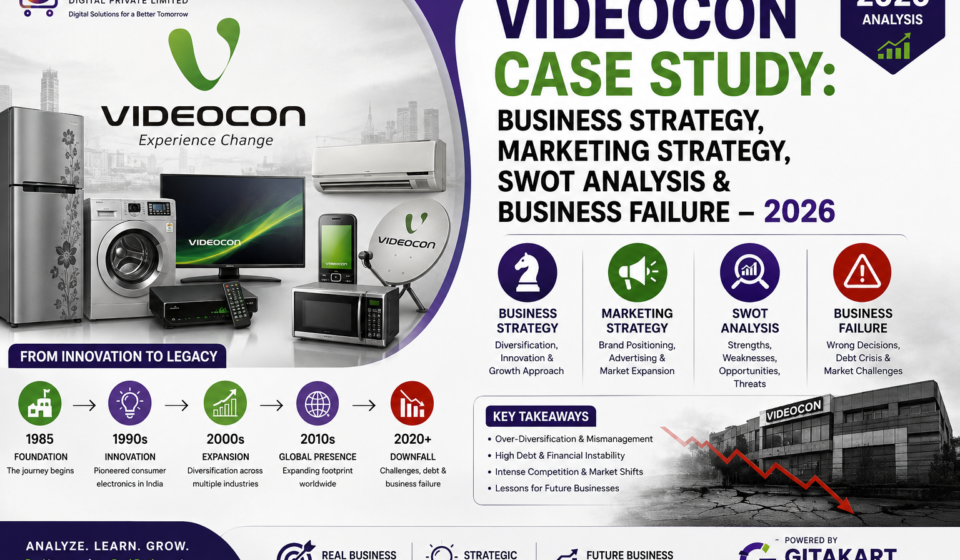
Videocon Case Study: Business Strategy, Marketing Strategy, SWOT Analysis & Business Failure – 2026

Explore a detailed Videocon case study covering Videocon Group’s history, business strategy, marketing strategy, diversification, competitive advantage, SWOT analysis, financial challenges, corporate governance, decline and key business lessons.
Videocon case study, Videocon Group case study, Videocon business strategy, Videocon marketing strategy, Videocon failure case study
Videocon SWOT analysis, Videocon business model, Videocon downfall, Videocon success story, Videocon failure reasons, Videocon diversification strategy, Videocon competitive advantage, Videocon debt crisis, Videocon strategic management
Videocon case study in India, detailed Videocon case study, why Videocon failed, reasons for Videocon downfall, Videocon business failure case study, Videocon Group strategy analysis, Videocon SWOT analysis case study, Videocon diversification strategy, Videocon debt crisis case study, Videocon case study for MBA students, Videocon marketing strategy case study
1. Introduction to the Videocon Case Study
The Videocon case study is one of the most valuable examples of corporate growth, diversification, aggressive expansion and business decline in modern Indian business history.
Videocon was once one of India’s most recognizable consumer-electronics brands.
For many Indian consumers, the name Videocon was associated with:
- Televisions
- Refrigerators
- Washing machines
- Air conditioners
- Home appliances
- Consumer electronics
At its peak, the Videocon Group had expanded far beyond consumer electronics into a wide range of industries, including oil and gas, telecommunications and other businesses.
This aggressive diversification created opportunities for growth.
However, it also created significant complexity and financial pressure.
The Videocon story therefore provides two contrasting lessons:
How a company can build a powerful consumer brand
and
How excessive diversification, leverage, competition and strategic complexity can contribute to corporate distress.
That makes Videocon an excellent business failure case study, particularly for students of management, finance, marketing, entrepreneurship and strategic management.
2. Executive Summary of the Videocon Case Study
The Videocon story can broadly be divided into several phases.
Phase 1: Consumer electronics
Videocon built its reputation through televisions and household appliances.
Phase 2: Brand expansion
The company expanded its product portfolio.
Phase 3: Aggressive diversification
Videocon entered several unrelated or capital-intensive industries.
Phase 4: International expansion
The group acquired businesses and developed operations outside India.
Phase 5: Rising financial pressure
High capital requirements, competition and debt increased the company’s vulnerability.
Phase 6: Corporate distress
The group eventually faced severe financial problems.
Phase 7: Insolvency resolution
Several Videocon group companies became subject to India’s insolvency-resolution process.
This trajectory makes Videocon a powerful case study in strategic management and corporate failure.
3. What Was Videocon?
Videocon began as a consumer-electronics and home-appliance company and eventually became a diversified business group.
The company became particularly well known in India for consumer durables.
Its product categories included:
- Televisions
- Refrigerators
- Washing machines
- Air conditioners
- Home appliances
- Consumer electronics
Over time, however, the group expanded into businesses that had substantially different capital requirements and competitive dynamics.
4. The Rise of Videocon
During the expansion of India’s consumer-electronics market, Videocon benefited from several favorable trends.
These included:
- Rising household incomes
- Increasing urbanization
- Expansion of television ownership
- Growing middle-class consumption
- Increasing availability of consumer credit
- Development of modern retail
- Growth of branded appliances
Videocon positioned itself as an important Indian consumer-electronics brand.
5. Videocon’s Early Competitive Advantage
Videocon’s early success was based on several factors.
Manufacturing
The company developed significant manufacturing capabilities.
Distribution
It established a broad distribution network.
Brand recognition
Videocon became a familiar household name.
Product portfolio
The company offered multiple appliances.
Local-market understanding
The company understood Indian consumer needs.
These capabilities provided a strong foundation for growth.
6. Videocon Marketing Strategy
The Videocon marketing strategy historically relied on broad consumer awareness.
The company used:
- Television advertising
- Print advertising
- Retail promotion
- Celebrity endorsements
- Product advertising
- Sponsorships
- Dealer networks
Because consumer electronics are mass-market products, brand visibility was extremely important.
7. The Importance of Brand Recognition
In consumer electronics, customers often purchase products from brands they recognize and trust.
For example, when purchasing a television or refrigerator, consumers may consider:
- Price
- Features
- Warranty
- Service
- Energy efficiency
- Brand reputation
Videocon successfully built significant brand awareness during its growth period.
8. Videocon’s Product Strategy
The company developed a broad consumer-electronics portfolio.
A simplified product strategy was:
Television
Refrigerator
Washing machine
Air conditioner
Other appliances
The advantage of this strategy was that one customer could purchase multiple products from the same brand.
9. Cross-Selling Strategy
A customer buying a Videocon television could potentially also purchase:
- Refrigerator
- Washing machine
- Air conditioner
- Microwave oven
This creates opportunities for cross-selling.
The customer acquisition cost can therefore be distributed across multiple products.
10. Distribution Strategy
Distribution was crucial to Videocon’s consumer-electronics business.
The company relied on:
- Dealers
- Retailers
- Distributors
- Service centers
Consumer electronics require physical availability because customers often want to see and compare products before purchasing.
11. Videocon After-Sales Service
Consumer durables are long-term products.
Therefore, after-sales service affects:
- Customer satisfaction
- Brand reputation
- Repeat purchases
- Word of mouth
A television or refrigerator may remain with a customer for many years.
Consequently, service quality becomes part of the overall product experience.
12. The Turning Point: Diversification
One of the most important aspects of the Videocon case study is diversification.
Videocon moved beyond consumer electronics into industries such as:
- Oil and gas
- Telecommunications
- Energy-related activities
- Consumer electronics
- Other businesses
Diversification can be beneficial.
But diversification can also create significant strategic risks.
13. What Is Diversification?
Diversification means entering new products or industries.
There are two broad types.
Related diversification
Entering a business connected to existing capabilities.
Unrelated diversification
Entering industries with very different technologies, customers and economics.
Videocon’s expansion eventually created a highly diversified group.
14. Why Videocon Diversified
Several strategic motivations can explain aggressive diversification.
Growth
The company wanted to increase its overall business scale.
New opportunities
Emerging industries appeared attractive.
Revenue diversification
New businesses could reduce dependence on consumer electronics.
Asset acquisition
Acquiring established businesses could provide rapid market entry.
Long-term ambition
The group sought to become a large diversified Indian conglomerate.
15. The Problem With Excessive Diversification
Diversification can create problems when management expands faster than its ability to control complexity.
Every new industry requires:
- Capital
- Management attention
- Expertise
- Technology
- Regulatory knowledge
- New suppliers
- New customers
- New competitors
A company that operates in ten unrelated industries may have difficulty maintaining expertise in all of them.
16. Videocon’s Capital-Intensive Expansion
Some of the businesses entered by Videocon required substantial investment.
Capital-intensive industries can involve:
- Large upfront investment
- Long payback periods
- Regulatory risk
- High working-capital requirements
- Technology risk
If projected returns do not materialize, debt can become a major problem.
17. Videocon Debt Crisis
One of the most frequently discussed aspects of the Videocon downfall is the group’s debt burden.
A business can use debt to accelerate growth.
The financial mechanism is:
Borrow money
↓
Invest in assets/businesses
↓
Generate revenue
↓
Repay debt + interest
This works when the investment produces sufficient cash flow.
The problem occurs when:
Expected cash flow < debt obligations
At that point, financial stress increases.
18. Leverage and Corporate Risk
High leverage increases financial risk.
Suppose a company earns ₹100 crore from operations and has manageable debt.
It may have flexibility.
But if it has a very large debt burden, even a modest decline in operating performance can create serious problems.
Interest payments continue regardless of whether sales increase or decrease.
Therefore:
Debt magnifies both growth and risk.
This is an important lesson from the Videocon case.
19. Videocon and the Consumer Electronics Industry
The consumer-electronics industry became increasingly competitive.
International and domestic brands expanded aggressively.
Competition included companies such as:
- LG
- Samsung
- Sony
- Panasonic
- Whirlpool
- Haier
- Voltas
- Godrej
- IFB
Technology cycles also became faster.
20. Technology Disruption
Television technology changed dramatically.
The market moved through:
CRT
↓
LCD
↓
LED
↓
Smart TV
↓
Connected entertainment
Companies needed continuous investment to remain competitive.
A manufacturer with older technology could rapidly lose market share.
21. The Challenge of Global Competition
Global electronics companies often have enormous:
- R&D budgets
- Manufacturing scale
- Advertising budgets
- Supply-chain capabilities
- Technology partnerships
This makes competition difficult for domestic brands.
The Indian consumer-electronics market increasingly became globalized.
22. Videocon’s Competitive Disadvantage
Videocon’s challenge was not simply product quality.
It was the economics of the industry.
Global competitors could compete through:
- Technology
- Scale
- Pricing
- Product launches
- Brand investment
- Innovation
This created pressure on Videocon’s consumer-electronics business.
23. Changing Consumer Preferences
Indian consumers increasingly began demanding:
- Slim televisions
- High-definition displays
- Smart features
- Energy efficiency
- Better design
- Advanced appliances
- Internet connectivity
Consumer expectations were changing quickly.
Companies needed to invest continuously in innovation.
24. Videocon’s Brand Challenge
A large diversified company may find it difficult to maintain a clear brand identity.
A consumer may know Videocon for televisions.
But what does the same brand represent in:
- Oil and gas?
- Telecommunications?
- Energy?
- Consumer finance?
Brand architecture becomes complicated when a company enters unrelated businesses.
25. Videocon Brand Positioning
Videocon’s consumer brand had historically been associated with:
- Affordability
- Indian identity
- Consumer appliances
- Household electronics
However, intense competition required continuous repositioning.
The brand needed to answer:
Why should customers choose Videocon instead of Samsung, LG, Sony or another competitor?
This is a fundamental marketing question.
26. SWOT Analysis of Videocon
Strengths
- Strong historical brand recognition
- Established consumer-electronics presence
- Manufacturing capabilities
- Broad distribution
- Experience across multiple industries
- Large business-group structure
Weaknesses
- High debt
- Complex diversification
- Capital-intensive businesses
- Management complexity
- Competitive pressure in consumer electronics
- Difficulty maintaining strategic focus
Opportunities
- Growing Indian consumer market
- Premium appliances
- Smart-home technology
- Energy-efficient products
- Digital commerce
- Emerging-market consumption
Threats
- Global competitors
- Rapid technological change
- Price competition
- Debt servicing pressure
- Regulatory changes
- Economic downturns
- Changing consumer preferences
27. Videocon SWOT Analysis Table
| Strengths | Weaknesses |
|---|---|
| Strong historical brand | High financial leverage |
| Consumer recognition | Diversification complexity |
| Manufacturing capabilities | High capital requirements |
| Distribution network | Strategic focus challenges |
| Multiple businesses | Technology investment pressure |
| Opportunities | Threats |
|---|---|
| Indian consumer growth | Global competition |
| Smart appliances | Rapid technology change |
| E-commerce | Price pressure |
| Energy-efficient appliances | Regulatory changes |
| Emerging markets | Financial risk |
28. Porter’s Five Forces Analysis of Videocon
1. Competitive Rivalry — Very High
Consumer electronics is highly competitive.
Companies constantly compete on:
- Price
- Features
- Design
- Technology
- Advertising
- Distribution
29. Threat of New Entrants — Moderate
Consumer electronics manufacturing can be difficult because of:
- Technology requirements
- Supply chains
- Brand building
- Distribution
- After-sales service
However, global contract manufacturing and e-commerce have reduced some traditional barriers.
30. Bargaining Power of Suppliers — Moderate
Components can include:
- Semiconductors
- Displays
- Compressors
- Motors
- Electronics
- Plastics
- Metals
Large international suppliers may possess significant technological capabilities.
31. Bargaining Power of Buyers — High
Consumers have many alternatives.
They can easily compare:
- Price
- Specifications
- Reviews
- Warranty
- Energy consumption
Online shopping has further increased price transparency.
32. Threat of Substitutes — Moderate
Substitutes vary by product.
For example:
- Television competes with smartphones and computers for entertainment.
- Traditional appliances compete with smart appliances.
- Consumer electronics compete for household budgets.
33. Videocon Business Model
The historical Videocon business model relied on:
Manufacturing
Brand
Distribution
Consumer demand
Diversification
The problem was that diversification eventually became a source of complexity and financial pressure.
34. Videocon Value Chain
Procurement
Sourcing components and materials.
↓
Manufacturing
Producing consumer appliances.
↓
Distribution
Moving products to dealers.
↓
Retail
Selling to consumers.
↓
Service
Supporting customers.
The company later added completely different value chains through diversification.
35. Strategic Management Problem
The central strategic-management question in the Videocon case is:
Did the company’s diversification strategy create more value than complexity?
Diversification creates value when:
1 + 1 > 2
In other words, the combined businesses should be worth more together than separately.
If:
1 + 1 < 2
diversification may destroy value.
36. Synergy in Diversification
Successful diversification requires synergy.
Synergy can come from:
- Shared technology
- Shared customers
- Shared distribution
- Shared manufacturing
- Shared brand
- Shared management expertise
Consumer electronics and oil exploration, for example, have fundamentally different operating models.
Therefore, potential synergies may be limited.
37. Conglomerate Complexity
A diversified conglomerate needs strong systems for:
- Capital allocation
- Risk management
- Corporate governance
- Performance measurement
- Debt management
Without these systems, complexity can become dangerous.
38. Capital Allocation Problem
One of the biggest lessons from Videocon is the importance of capital allocation.
Management must decide:
Where should the next ₹1,000 crore be invested?
Possible options include:
- Existing profitable business
- New business
- Acquisition
- Debt repayment
- Technology
- Marketing
Poor capital allocation can destroy value even when individual businesses are viable.
39. Acquisition Strategy
Acquisitions can provide fast growth.
Advantages include:
- Immediate market entry
- Existing customers
- Existing infrastructure
- Technology
- Employees
- Brand assets
But acquisitions can also create:
- Integration problems
- Debt
- Cultural conflicts
- Operational complexity
40. Videocon and Strategic Risk
The company’s experience illustrates a fundamental principle:
Growth is not the same as value creation.
A company can become larger while becoming financially weaker.
Revenue growth alone does not guarantee:
- Profitability
- Cash flow
- Return on capital
- Shareholder value
41. Revenue vs Profitability
Imagine two companies.
Company A
Revenue = ₹10,000 crore
Profit = ₹1,000 crore
Company B
Revenue = ₹20,000 crore
Profit = ₹200 crore
Company B is twice as large in revenue but produces only one-fifth the profit of Company A.
Therefore:
Scale must be evaluated together with profitability and capital efficiency.
This is a crucial lesson from the Videocon case study.
42. Debt vs Cash Flow
Debt itself is not necessarily bad.
Companies routinely use debt to finance growth.
The critical question is:
Can the business generate enough sustainable cash flow to service its debt?
If not, debt becomes a major strategic constraint.
43. Financial Distress
Financial distress can create a negative cycle:
Lower profitability
↓
Lower cash flow
↓
Difficulty servicing debt
↓
Reduced investment
↓
Lower competitiveness
↓
Further decline
This is why early financial restructuring is important.
44. Insolvency and Videocon
Videocon became one of the prominent corporate groups associated with India’s insolvency-resolution framework.
The Insolvency and Bankruptcy Code (IBC) fundamentally changed India’s approach to distressed companies by creating a time-bound framework for insolvency resolution.
Several Videocon entities entered insolvency proceedings.
This makes Videocon especially relevant for students studying:
- Corporate finance
- Insolvency
- Bankruptcy
- Corporate governance
- Restructuring
45. Videocon and Corporate Governance
Corporate governance refers to the systems through which companies are directed and controlled.
Important areas include:
- Board oversight
- Risk management
- Transparency
- Related-party transactions
- Capital allocation
- Executive accountability
- Stakeholder protection
The Videocon experience demonstrates why governance becomes increasingly important as a group becomes more complex.
46. Why Risk Management Matters
A company operating in multiple industries faces multiple risks simultaneously.
For example:
Consumer electronics
Technology risk.
Oil and gas
Commodity and exploration risk.
Telecommunications
Capital and regulatory risk.
Finance
Credit and liquidity risk.
A diversified group may therefore have more types of risk, not necessarily less.
47. Diversification Does Not Always Reduce Risk
The traditional argument for diversification is:
“If one business performs poorly, another business can compensate.”
But this works only when businesses have sufficiently independent cash flows and the group maintains financial flexibility.
If several businesses require capital simultaneously, diversification can actually increase financial pressure.
48. Videocon Marketing Lessons
The Videocon case also offers important marketing lessons.
Lesson 1: Brand leadership must be continuously renewed.
Lesson 2: Technology matters in consumer electronics.
Lesson 3: Price competition can destroy margins.
Lesson 4: Brand positioning must remain relevant.
Lesson 5: Distribution alone is not enough.
49. Consumer Electronics Marketing Strategy
A modern consumer-electronics marketing strategy requires:
- Product innovation
- Competitive pricing
- Digital marketing
- Retail presence
- E-commerce
- Influencer marketing
- Reviews
- After-sales service
Videocon operated during a period when television advertising and physical retail were particularly important.
The industry later shifted dramatically toward digital research and online commerce.
50. Videocon and Digital Transformation
The rise of e-commerce changed consumer-electronics distribution.
Customers could now:
- Compare prices instantly
- Read reviews
- Watch product videos
- Compare specifications
- Order online
This increased transparency and competitive pressure.
51. E-Commerce and Consumer Electronics
The digital customer journey increasingly became:
Google search
↓
YouTube review
↓
Comparison website
↓
E-commerce marketplace
↓
Purchase
This reduced the importance of traditional dealer-only relationships.
52. The Importance of Innovation
Consumer electronics have short product cycles.
A company must continuously innovate.
For example, televisions evolved from:
CRT
to:
LCD
to:
LED
to:
Smart TV
to:
Connected TV ecosystems
A company that fails to adapt can rapidly lose relevance.
53. Videocon’s Technology Challenge
Large international competitors invested heavily in:
- Display technology
- Software
- Smart TV platforms
- Energy efficiency
- Industrial design
- Manufacturing scale
This made it increasingly difficult for older consumer-electronics brands to compete solely through brand recognition.
54. Videocon’s Decline: Major Factors
A balanced analysis of the Videocon downfall should consider multiple factors rather than blaming one single decision.
Important factors include:
- Aggressive diversification
- High leverage
- Capital-intensive expansion
- Intense consumer-electronics competition
- Rapid technological change
- Pressure on cash flows
- Complexity of the business group
- Difficulties in managing multiple industries
- Changing market conditions
- Financial and regulatory challenges
The interaction of these factors is more important than any single factor.
55. Was Diversification the Only Reason for Videocon’s Failure?
No.
It would be too simplistic to say:
“Videocon failed because it diversified.”
Diversification can be successful.
The real issue is the combination of:
Diversification
Leverage
Capital intensity
Competition
Technology disruption
Cash-flow pressure
Together, these can create a fragile business model.
56. The Videocon Downfall as a Strategic Failure
The case demonstrates a strategic principle:
A company should expand according to its financial capacity and organizational capabilities.
If expansion happens faster than capabilities develop, the organization becomes vulnerable.
57. Videocon Case Study: Failure Analysis
A simplified failure chain can be represented as:
Strong consumer brand
↓
Expansion
↓
Diversification
↓
Large capital requirements
↓
Debt
↓
Competitive pressure
↓
Lower returns
↓
Cash-flow stress
↓
Financial distress
↓
Insolvency proceedings
This simplified model should not be treated as a complete financial reconstruction, but it captures the strategic logic of the decline.
58. Lessons for Entrepreneurs
Entrepreneurs can learn several lessons from Videocon.
Don’t confuse growth with success.
Revenue growth must generate value.
Don’t diversify without capability.
Entering a new industry requires expertise.
Manage leverage carefully.
Debt can accelerate growth but magnify downside.
Protect the core business.
A successful legacy business should not be neglected.
Maintain strategic focus.
Complexity has a cost.
59. Lessons for MBA Students
The Videocon case study can be used to understand:
- SWOT analysis
- Porter’s Five Forces
- PESTLE analysis
- Ansoff Matrix
- BCG Matrix
- Corporate strategy
- Diversification
- Mergers and acquisitions
- Financial leverage
- Corporate governance
- Insolvency
- Business restructuring
60. PESTLE Analysis of Videocon
Political
Consumer electronics and energy businesses operate within significant regulatory frameworks.
Economic
Demand is influenced by:
- Interest rates
- Household income
- Inflation
- Economic growth
Social
Consumer preferences shift toward:
- Smart devices
- Energy efficiency
- Premium designs
Technological
Rapid innovation creates both opportunity and risk.
Legal
Companies must comply with:
- Corporate law
- Environmental rules
- Industry regulations
- Consumer protection
Environmental
Electronics businesses face increasing expectations around:
- Energy efficiency
- Waste
- Recycling
- Emissions
61. Ansoff Matrix for Videocon
| Growth Strategy | Videocon Example |
|---|---|
| Market Penetration | Selling more appliances in existing markets |
| Market Development | Expanding into new regions |
| Product Development | New consumer-electronics products |
| Diversification | Entering unrelated industries |
The fourth category—diversification—became particularly important in Videocon’s corporate history.
62. BCG Matrix Perspective
A conceptual BCG analysis can help explain capital allocation.
Cash Cows
Mature consumer products with established demand.
Stars
High-growth technology categories.
Question Marks
New businesses requiring significant investment.
Dogs
Low-growth, low-return businesses.
The strategic challenge is ensuring that cash generated by mature businesses is not continuously absorbed by low-return or high-risk investments.
63. Videocon VRIO Analysis
| Resource | Valuable | Rare | Difficult to Imitate | Strategic Impact |
|---|---|---|---|---|
| Brand recognition | Yes | Moderate | Moderate | Temporary advantage |
| Manufacturing | Yes | Moderate | Moderate | Competitive advantage |
| Distribution | Yes | Moderate | Moderate | Advantage |
| Consumer knowledge | Yes | Moderate | Moderate | Advantage |
| Diversified portfolio | Not necessarily | No | No | Potential complexity |
| Financial scale | Yes | Moderate | Moderate | Depends on leverage |
This illustrates an important point:
Not every large resource creates a sustainable competitive advantage.
64. Videocon Value Creation vs Value Destruction
A useful way to analyze the company is through two sides.
Potential value creation
- Brand
- Manufacturing
- Distribution
- Product portfolio
- International assets
- Diversification
Potential value destruction
- Excessive leverage
- Poor capital allocation
- Complexity
- Low-return investments
- Technology disruption
- Competitive pressure
The case becomes interesting because both forces existed simultaneously.
65. Corporate Strategy Lessons From Videocon
A successful corporate strategy should answer four questions:
1. Where should we compete?
Choose industries carefully.
2. How should we compete?
Build sustainable advantages.
3. What capabilities do we need?
Develop expertise before scaling.
4. How should capital be allocated?
Prioritize high-return opportunities.
66. Videocon’s Biggest Strategic Lesson
The most important lesson may be:
Strategic focus is a competitive advantage.
A company with fewer businesses but strong capabilities can sometimes create more value than a large conglomerate with many weak businesses.
67. Financial Discipline as a Competitive Advantage
Financial discipline is often underestimated.
It includes:
- Controlling debt
- Managing working capital
- Maintaining liquidity
- Monitoring returns
- Avoiding excessive acquisitions
- Stress-testing investments
Financial discipline allows companies to survive downturns.
68. Scenario Planning
A diversified company should ask:
What happens if sales fall 20%?
What happens if interest rates rise?
What happens if a new technology disrupts our main business?
What happens if refinancing becomes difficult?
Scenario planning can reveal hidden vulnerabilities before they become crises.
69. Early Warning Indicators
Management should monitor:
- Debt-to-equity ratio
- Interest coverage
- Operating cash flow
- Return on capital
- Inventory
- Receivables
- Market share
- Product margins
- Capacity utilization
These metrics can identify financial stress early.
70. What Could Videocon Have Done Differently?
A hypothetical strategic alternative could have included:
Greater focus on consumer electronics
Invest more heavily in technology and brand.
Selective diversification
Enter only businesses with strong strategic synergies.
Lower leverage
Use more conservative financing.
Stronger capital allocation
Exit businesses with poor returns earlier.
Faster technology adaptation
Respond more aggressively to changing consumer electronics.
71. Alternative Strategy: Core Business Focus
A focused strategy could have concentrated on:
- Television
- Refrigerators
- Washing machines
- Air conditioners
- Smart appliances
The company could then build an integrated home-technology ecosystem.
72. Alternative Strategy: Smart Home
The growth of connected devices could have created an opportunity around:
- Smart TVs
- Smart refrigerators
- Smart washing machines
- Smart air conditioners
- Home automation
This would create technological and product synergies.
73. Alternative Strategy: Premium Indian Brand
Videocon could potentially have positioned itself as a strong Indian alternative to global consumer-electronics brands.
The strategy could emphasize:
- Indian engineering
- Value
- Design
- Local customer understanding
- Service
- Energy efficiency
However, successful execution would require substantial technology investment.
74. Business Failure vs Brand Failure
An important distinction is:
A company’s financial failure does not necessarily mean the brand had no value.
A brand can retain:
- Consumer recognition
- Historical awareness
- Market familiarity
even after the original corporate structure experiences financial distress.
This is important when analyzing corporate assets during restructuring.
75. Videocon Case Study: Key Takeaways
The most important lessons are:
- Diversification must have strategic logic.
- Debt must be matched to sustainable cash flow.
- Growth without profitability can destroy value.
- Technology-intensive industries require continuous investment.
- Brand leadership must be continuously renewed.
- Corporate complexity increases management risk.
- Capital allocation is central to corporate strategy.
- Strong governance becomes more important as companies grow.
- Businesses should stress-test expansion plans.
- Strategic focus can be more valuable than sheer size.
76. Conclusion
The Videocon case study is not simply a story about the decline of an Indian consumer-electronics company.
It is a broader lesson in corporate strategy, diversification, financial leverage, innovation, competition and risk management.
Videocon built substantial recognition in India’s consumer-electronics industry. Its brand became familiar to millions of consumers, while its manufacturing and distribution capabilities helped it become a major player.
The company’s subsequent diversification created a much larger business group.
However, scale brought complexity.
Expansion into capital-intensive businesses required substantial investment. At the same time, consumer electronics became increasingly competitive and technologically demanding. International and domestic competitors continued to invest in innovation, manufacturing scale and branding.
The result was a difficult combination of:
Aggressive expansion
High capital requirements
Financial leverage
Technology disruption
Intense competition
Complex corporate structure
The eventual financial distress and insolvency proceedings involving Videocon group companies provide an important warning for businesses everywhere.
The central lesson is not:
“Never diversify.”
Instead, the more useful lesson is:
“Diversify only when you have a clear strategic advantage, adequate financial capacity, strong governance and the organizational capabilities required to manage the new business.”
For MBA students, entrepreneurs, finance professionals and business researchers, Videocon remains an especially valuable Indian business failure case study because it demonstrates both sides of corporate growth: the ability to create a powerful consumer brand and the risks that can emerge when expansion, capital requirements and strategic complexity become difficult to manage.
Ultimately, the Videocon story demonstrates that sustainable business growth requires more than revenue, market share and corporate size. It requires profitable operations, disciplined capital allocation, technological adaptability, strong governance and the ability to manage risk before it becomes a crisis.
SEO Keyword Bank for the Videocon Case Study
Primary Keywords
- Videocon case study
- Videocon Group case study
- Videocon business strategy
- Videocon marketing strategy
- Videocon failure case study
- Videocon downfall
Secondary Keywords
- Videocon SWOT analysis
- Videocon business model
- Videocon competitive advantage
- Videocon diversification strategy
- Videocon debt crisis
- Videocon financial crisis
- Videocon strategic management
- Videocon corporate strategy
- Videocon business failure
- Videocon success story
Long-Tail Keywords
- detailed Videocon case study
- Videocon case study in India
- why Videocon failed
- reasons for Videocon downfall
- Videocon business failure case study
- Videocon Group strategic analysis
- Videocon SWOT analysis case study
- Videocon diversification case study
- Videocon debt crisis case study
- Videocon financial crisis analysis
- Videocon corporate governance case study
- Videocon insolvency case study
- Videocon case study for MBA students
- Videocon marketing strategy case study
- Videocon business strategy case study
- Videocon consumer electronics case study
- Videocon strategic management case study
- Videocon failure reasons in India
- Videocon corporate failure analysis
- Videocon diversification and debt case study
Suggested SEO Tags
Videocon Case Study, Videocon Group, Videocon Business Strategy, Videocon Marketing Strategy, Videocon Failure, Videocon Downfall, Videocon SWOT Analysis, Videocon Debt Crisis, Videocon Diversification, Videocon Business Model, Indian Business Case Study, Consumer Electronics Case Study, Corporate Failure Case Study, Strategic Management Case Study