






Case Study of Reliance Jio: How Jio Transformed India’s Telecom and Digital Economy – 2026

Introduction
Case Study of Reliance Jio: The story of Reliance Jio is one of the most important business case studies in modern India.When Jio entered the Indian telecom market commercially in September 2016, the company did not simply introduce another mobile network. It attempted to change the economics of internet access itself.
At the time, mobile data was relatively expensive, voice calls were commonly charged separately, network technologies were fragmented, and smartphone adoption was still developing rapidly. Jio entered with a fundamentally different proposition: high-speed 4G connectivity, simple pricing, free voice, affordable data and an expanding ecosystem of digital services.
Reliance Industries had invested heavily in building the network before commercial launch. Jio’s official history describes the company as having been launched in 2016 to provide affordable digital access across India, while Reliance’s 2016–17 annual report records that Jio reached 100 million subscribers in only 170 days after launch.
The scale of the transformation is remarkable.
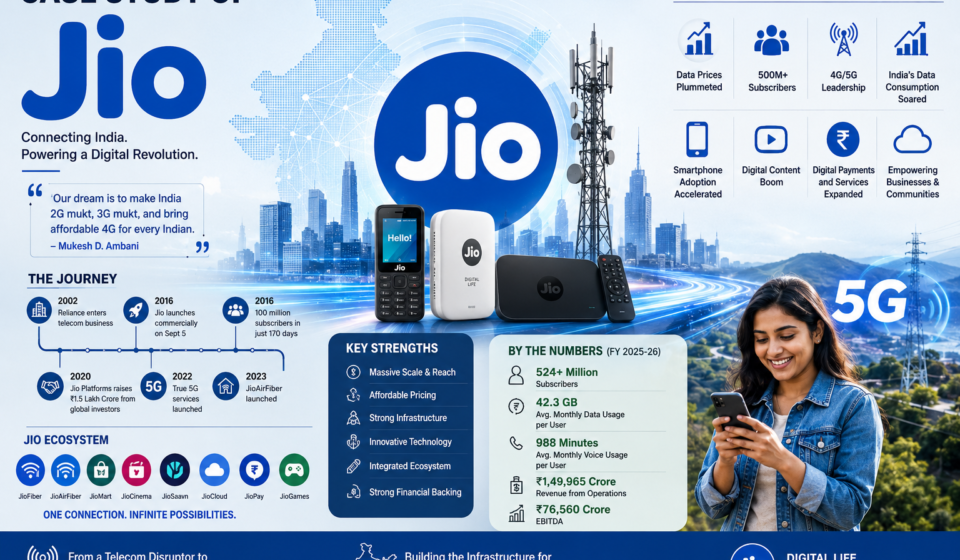
Jio’s own current business materials describe it as serving more than 500 million subscribers, while its FY2025–26 digital-services business reported revenue from operations of ₹1,49,965 crore and EBITDA of ₹76,560 crore. For the quarter ending March 2026, Jio reported more than 524 million subscribers, average monthly data usage of 42.3 GB per subscriber, and average monthly voice usage of 988 minutes. But Jio’s real significance cannot be measured only in subscriber numbers.
It changed:
- the price of mobile data,
- India’s internet consumption,
- smartphone adoption,
- digital payments,
- online entertainment,
- e-commerce,
- digital education,
- cloud and enterprise connectivity,
- home broadband,
- 4G and 5G adoption,
- and the competitive structure of the telecom industry.
This case study examines how Jio did it, why the strategy worked, what risks it created, and what entrepreneurs and businesses can learn from the Jio model.
1. Company Overview
Company: Reliance Jio Infocomm Limited
Parent company: Reliance Industries Limited
Digital holding structure: Jio Platforms Limited
Industry: Telecommunications and Digital Services
Commercial launch: September 2016
Founder/Promoter: Reliance Industries
Chairman & Managing Director of Reliance Industries: Mukesh D. Ambani
Core business: Mobile connectivity, broadband, digital services, enterprise connectivity and digital platforms
Jio’s business has expanded far beyond traditional mobile telecom.
Its ecosystem includes:
- Mobile connectivity
- 4G
- 5G
- JioFiber
- JioAirFiber
- Enterprise connectivity
- Cloud services
- Digital applications
- Entertainment
- Gaming
- Digital commerce
- Devices
- Content
- Smart-home services
- Digital solutions for businesses
Reliance’s FY2025–26 materials describe Jio as a global-scale digital-services business and report more than 524 million subscribers at the end of March 2026. (Reliance Industries Limited)
This evolution is crucial to understanding Jio.
Jio did not remain a telecom company.
It gradually became a digital ecosystem company built on top of telecom infrastructure.
2. The Vision Behind Jio
The fundamental idea behind Jio was that data would become the foundation of modern life.
Mukesh Ambani famously described data as the “oxygen of digital life” in a 2018 speech, arguing that India had suffered from scarcity and high pricing of data and that Jio wanted to make data abundant and affordable.
This was a strategic insight.
Instead of thinking:
“How can Reliance enter the telecom industry?”
Jio’s thinking was closer to:
“What happens when every Indian has affordable high-speed internet?”
That is a much larger question.
If internet access becomes cheap and widespread, people will consume:
- video,
- music,
- education,
- social media,
- e-commerce,
- digital payments,
- cloud services,
- gaming,
- business applications.
And when consumers spend more time online, the company providing the underlying connectivity gains strategic importance.
This became the foundation of Jio’s ecosystem strategy.
3. The Early History of Jio
Jio’s commercial launch in 2016 was not the beginning of the story.
Reliance had been preparing for telecom and broadband much earlier.
Reliance’s history records its entry into the communications business in 2002.
The company subsequently built the foundation for a nationwide broadband network.
By 2014–15, Reliance Jio Infocomm had spectrum across India’s telecom circles and was building a pan-India LTE network.
Reliance’s FY2014–15 annual report says Jio had broadband wireless access spectrum across all 22 telecom circles and had acquired additional 1800 MHz spectrum across 14 key circles. It also acquired 800 MHz and 1800 MHz spectrum in additional circles during the 2015 auction.
This was strategically important.
Jio was not simply buying a few telecom licences and then attempting to build a network.
It was building a nationwide digital infrastructure platform.
4. Why Jio Chose 4G
One of Jio’s most important technological decisions was to build around 4G LTE.
Instead of gradually upgrading a legacy network from older technologies, Jio built a modern network from the ground up.
Reliance described it as the world’s largest greenfield-only 4G LTE data network at the time.
This created several advantages.
First: Network efficiency
Jio could optimise its infrastructure around data.
Second: Future readiness
A modern IP-based architecture could evolve toward 5G and other technologies.
Third: Simpler product architecture
Jio did not have to carry the same legacy technological baggage as older operators.
Fourth: Better user experience
The network was designed around high-speed data rather than treating data as an additional feature on top of voice.
This was a major strategic bet.
5. The Pre-Jio Telecom Market
Before Jio, India’s telecom market was already highly competitive.
Major players included:
- Airtel
- Vodafone
- Idea
- BSNL
- Aircel
- Reliance Communications
- Tata Docomo
- and several regional operators.
Consumers were familiar with telecom services, but pricing and plans could be complicated.
There were different:
- local call charges,
- STD charges,
- roaming charges,
- data packages,
- SMS packages,
- prepaid plans,
- postpaid plans,
- network-specific offers.
Jio saw an opportunity to simplify the customer proposition.
Its 2016–17 annual report described a tariff system with fewer than 20 plans compared with more than 22,000 plans across the industry at the time. Jio also made voice calls and national roaming free within its tariff philosophy.
That was not merely a pricing decision.
It was a customer-experience strategy.
6. The Jio Welcome Offer
The launch strategy became one of the most famous parts of the Jio story.
On September 5, 2016, Jio commercially commenced services across India.
The company initially offered a major introductory promotion.
Mukesh Ambani announced that Jio’s data, voice, video and applications would be available free until December 31, 2016 under the Jio Welcome Offer.
This was extraordinarily aggressive.
A normal telecom company might launch with:
“Buy our SIM and subscribe to our plan.”
Jio effectively said:
“Try the entire digital experience first.”
This eliminated one of the biggest barriers to adoption:
Consumer uncertainty.
People could experience:
- 4G speed,
- video streaming,
- apps,
- voice calls,
- messaging,
- internet browsing.
The free period effectively became a massive product demonstration.
7. Free Was Not the Final Business Model
A common misunderstanding about Jio is that its success was simply because it gave everything away for free.
That is incomplete.
Free service was primarily a customer-acquisition mechanism.
The long-term strategy was to convert users into paying subscribers and then build additional businesses around those users.
The sequence was:
Free trial
↓
User acquisition
↓
Network habit formation
↓
Paid plans
↓
Higher data consumption
↓
Digital services
↓
Device adoption
↓
Home broadband
↓
Enterprise services
↓
Digital ecosystem
This is far more sophisticated than simply offering a discount.
8. The 100 Million Subscriber Milestone
Jio’s initial adoption was extraordinary.
According to Reliance’s FY2016–17 annual report, Jio reached 100 million subscribers in 170 days.
The company had previously crossed 50 million subscribers in just 83 days, according to a December 2016 Reliance release.
This demonstrated that the Indian market had enormous latent demand for affordable high-speed mobile internet.
The lesson was powerful:
Demand was not necessarily weak.
The existing price structure was restricting demand.
Once the price barrier fell, usage exploded.
9. The Data Revolution
One of Jio’s most important impacts was the dramatic increase in India’s mobile data consumption.
Reliance’s 2016–17 annual report said that India’s data consumption increased multi-fold after Jio’s launch and that India became the world’s largest mobile data-consuming market. It also reported more than 1 exabyte of Jio mobile data traffic per month at that time. This created a classic example of price elasticity.
When the price of data falls:
Cost ↓
↓
Consumption ↑
↓
Video consumption ↑
↓
App usage ↑
↓
Digital services ↑
↓
Internet economy ↑
Jio did not merely capture existing telecom demand.
It created new demand.
10. The “Data Abundance” Strategy
This is perhaps the most important conceptual element of the Jio case.
Traditional telecom thinking focused on:
How much revenue can we earn from each call?
Jio’s thinking focused increasingly on:
How much digital activity can we enable?
The more affordable data became, the more consumers:
- watched videos,
- used WhatsApp,
- streamed music,
- used Google services,
- participated in social media,
- shopped online,
- made digital payments,
- attended online classes.
The telecom connection became the gateway to the entire digital economy.
11. Jio’s Pricing Strategy
Jio’s pricing strategy had several components.
Affordable data
The company dramatically lowered the effective price of mobile data.
Free voice
Jio challenged the traditional separation between voice and data.
Simple plans
The company reduced complexity.
National consistency
Its initial philosophy emphasised India-wide plans rather than complicated circle-specific pricing.
Bundling
Later, Jio increasingly bundled:
- voice,
- data,
- entertainment,
- apps,
- cloud services,
- subscriptions.
This changed telecom from a commodity into an ecosystem proposition.
12. Why Free Voice Was So Disruptive
Jio’s free voice proposition attacked an important legacy revenue stream.
Traditional telecom operators had historically generated significant revenue from voice.
Jio effectively moved the economic centre of gravity from:
Voice → Data
That forced competitors to respond.
Over time, the industry moved toward data-centric pricing.
The shift was profound.
The consumer stopped thinking:
“How many minutes do I have?”
and increasingly started thinking:
“How much data do I have?”
That is a major change in consumer behaviour.
13. The Network Effect
Jio benefited from a powerful network effect.
The more people who joined:
- the more attractive Jio-to-Jio calling became,
- the more familiar the brand became,
- the more retailers stocked Jio products,
- the more developers targeted Jio users,
- the more devices were built for Jio’s ecosystem.
Although telecom networks are not a pure social network in the traditional sense, they benefit from scale economies and ecosystem effects.
Large scale lowers the cost per user and strengthens distribution.
14. Jio’s Distribution Strategy
Launching a telecom company nationally requires massive distribution.
Jio had to make SIM cards and devices available through:
- retail shops,
- distributors,
- electronics stores,
- Reliance outlets,
- digital channels,
- partner retailers.
The company also used biometric eKYC to simplify onboarding.
By December 2016, Jio said it had rolled out eKYC across 200,000 outlets, allowing SIM activation in under five minutes.
This was a crucial operational innovation.
The company understood that:
A network is useless if consumers cannot activate it easily.
15. Jio and Smartphone Adoption
Affordable data alone is not enough.
Consumers also need affordable smartphones.
Jio therefore expanded into devices.
One of the major examples was the JioPhone.
The strategy was to reduce the hardware barrier for consumers who were still using feature phones.
Later, the JioBharat platform continued this approach.
Reliance’s FY2023–24 report says the JioBharat phone had reached approximately 50% market share in the sub-₹1,000 segment at that time.
This demonstrates a broader principle:
If you control connectivity and the device, you can influence the entire customer journey.
16. The Jio Ecosystem
Jio’s long-term ambition was never simply to sell SIM cards.
It was to create an ecosystem.
The company built or supported services around:
- entertainment,
- music,
- video,
- gaming,
- messaging,
- cloud,
- commerce,
- education,
- healthcare,
- enterprise services.
Reliance’s FY2020–21 annual report listed platforms such as:
- JioMart
- JioMeet
- JioHaptik
- JioPOS Lite
- JioGames
- JioUPI
- JioHealthHub
as examples of digital platforms developed during that period.
The objective was straightforward:
Make connectivity the foundation for multiple digital businesses.
17. Jio Platforms
The creation and development of Jio Platforms represented a major transformation.
Instead of treating telecom as an isolated business, Reliance organised a broader digital-services ecosystem.
Jio Platforms became the vehicle through which Reliance brought together:
- connectivity,
- digital applications,
- platforms,
- technology,
- commerce,
- content,
- devices,
- and strategic technology partnerships.
This structure attracted enormous investor interest.
18. The 2020 Funding Revolution
One of the most remarkable chapters in Jio’s history occurred in 2020.
During the COVID-19 pandemic, Reliance raised enormous amounts of capital through Jio Platforms.
The company said that Jio Platforms raised ₹1,52,056 crore from strategic and financial investors during FY2020–21.
The investors included major global names such as:
- Facebook/Meta
- Silver Lake
- Vista Equity Partners
- General Atlantic
- KKR
- Mubadala
- ADIA
- TPG
- PIF
Reliance’s disclosures record, for example, TPG’s investment of ₹4,546.80 crore at an equity valuation of ₹4.91 lakh crore.
Vista invested ₹11,367 crore at a similar equity valuation.
The significance was enormous.
Jio was no longer viewed simply as an Indian telecom challenger.
It had become a major global technology investment opportunity.
19. Why Facebook Invested in Jio
The Facebook investment was strategically important because Facebook saw the potential of India’s enormous digital population.
A partnership between a global social-media giant and India’s largest digital-connectivity platform created potential synergies around:
- digital commerce,
- small businesses,
- WhatsApp,
- connectivity,
- payments,
- consumer services.
This was a demonstration of another Jio strategy:
Build infrastructure first, then invite global technology companies into the ecosystem.
20. Why Google Invested
Google also became an important strategic partner.
The opportunity was broader than telecom.
India represented one of the world’s largest emerging digital markets.
Jio provided:
- enormous consumer reach,
- digital infrastructure,
- local market knowledge,
- distribution,
- devices,
- connectivity.
Google brought:
- software,
- Android,
- AI,
- cloud,
- digital expertise.
This combination could potentially accelerate the digital transformation of hundreds of millions of consumers.
21. COVID-19 and Digital Acceleration
The COVID-19 pandemic accelerated the importance of digital infrastructure.
People suddenly needed:
- video conferencing,
- online education,
- streaming entertainment,
- remote work,
- digital payments,
- online shopping.
Jio’s digital infrastructure became strategically important during this period.
Reliance’s FY2020–21 report highlights several Jio platforms as enablers of “work from home, learn from home, health from home and shop from home.”
The pandemic therefore reinforced Jio’s central thesis:
Connectivity is no longer a luxury. It is basic infrastructure.
22. Jio’s Transition From Telecom to Digital Infrastructure
This is perhaps the most important strategic transition.
Phase 1
Jio = telecom challenger
Phase 2
Jio = affordable mobile internet provider
Phase 3
Jio = digital ecosystem
Phase 4
Jio = connectivity + devices + content + commerce
Phase 5
Jio = digital infrastructure platform
The current business includes:
- mobile,
- 5G,
- fixed broadband,
- AirFiber,
- enterprise services,
- cloud,
- applications,
- digital platforms.
This makes the company significantly harder to classify as simply a telecom operator.
23. JioFiber
Jio entered fixed broadband with JioFiber.
The strategic objective was clear:
If Jio controlled mobile connectivity, why not also connect the consumer’s home?
A home broadband connection creates a completely different level of engagement.
The home can become a digital hub for:
- televisions,
- laptops,
- smartphones,
- gaming,
- education,
- work,
- smart-home devices,
- entertainment.
This increased the customer’s dependence on the Jio ecosystem.
24. JioAirFiber
Jio launched JioAirFiber in September 2023.
AirFiber uses wireless connectivity to provide high-speed broadband to homes and businesses, extending Jio’s ability to serve locations where traditional wired fibre deployment can be slower or more difficult.
This is especially relevant for:
- Tier-2 cities,
- Tier-3 cities,
- smaller towns,
- semi-urban areas.
Jio’s FY2023–24 report said AirFiber was available in approximately 5,900 towns.
This demonstrates the company’s continued focus on broad national coverage.
25. Jio’s 5G Strategy
After disrupting the 4G market, Jio moved aggressively into 5G.
The company launched True 5G services in 2022.
By FY2023–24, Jio reported that it had completed its planned pan-India 5G rollout, with more than 108 million users migrated to its 5G network.
The company also reported deploying more than one million 5G cells and capturing approximately 85% of India’s 5G capacity in FY2023–24.
This is strategically important because Jio is attempting to repeat its original strategy:
Build infrastructure early → drive adoption → reduce friction → expand usage → create new services.
26. Standalone 5G
Jio’s 5G strategy is particularly notable because the company developed its own 5G technology stack.
Reliance’s annual report states that Jio’s True 5G uses a standalone architecture, with a cloud-native 5G core and capabilities such as network slicing.
The potential applications go beyond faster smartphones.
5G can enable:
- industrial automation,
- robotics,
- smart cities,
- healthcare,
- agriculture,
- autonomous systems,
- IoT,
- augmented reality,
- enterprise networking.
Therefore, Jio’s 5G investment is not merely about giving consumers faster downloads.
It is about building the infrastructure for future digital industries.
27. The Enterprise Opportunity
Consumer telecom is only one side of the business.
Jio also targets:
- large enterprises,
- government organisations,
- small businesses,
- medium businesses,
- cloud customers,
- IoT users.
This is strategically attractive because enterprise customers can generate higher-value relationships than individual prepaid users.
Reliance’s FY2022–23 report said Jio had more than doubled enterprise broadband connections and IoT-connected devices during that year.
This creates another growth engine.
28. Jio’s Current Scale
Jio’s scale today is dramatically different from its launch period.
The company’s FY2025–26 digital-services information reports:
- 524+ million subscribers
- ₹1,49,965 crore revenue from operations
- ₹76,560 crore EBITDA
- 42.3 GB average monthly data usage per user
- 988 minutes average monthly voice usage per user
Its FY2024–25 factsheet reported:
- more than 500 million subscribers,
- 185.5 billion GB of annual data traffic,
- 191+ million 5G customers,
- 18 million homes,
- approximately 60% share of India’s data traffic,
- and 99% population coverage through LTE.
The numbers demonstrate the scale of the transformation.
29. Jio’s Business Model
Jio’s business model can be represented as a layered ecosystem.
Layer 1 — Connectivity
Mobile data and voice.
↓
Layer 2 — Devices
Smartphones, feature phones and connected devices.
↓
Layer 3 — Home
JioFiber and JioAirFiber.
↓
Layer 4 — Content
Entertainment, video, music, gaming.
↓
Layer 5 — Digital Services
Cloud, applications, payments, commerce.
↓
Layer 6 — Enterprise
Connectivity, IoT, cloud and digital solutions.
↓
Layer 7 — Ecosystem
Consumer + business + content + commerce + technology.
This structure creates multiple monetisation opportunities from the same customer relationship.
30. Customer Acquisition Strategy
Jio’s customer acquisition strategy was extraordinary because it combined several mechanisms.
Free trial
Reduced the barrier to adoption.
Affordable pricing
Made continued use accessible.
Distribution
Made SIMs widely available.
Devices
Reduced hardware barriers.
Content
Created reasons to consume data.
Network quality
Encouraged retention.
Ecosystem
Increased customer lifetime value.
This can be expressed as:
Low acquisition friction
High usage
Affordable pricing
Large scale
Multiple services
=
Powerful customer economics
31. Jio’s Customer Lifetime Value Strategy
A telecom customer can be worth much more than the monthly recharge.
Consider a hypothetical customer.
The customer may initially buy:
Mobile plan
Then:
JioPhone
Then:
JioFiber
Then:
OTT/content services
Then:
Cloud storage
Then:
Smart-home services
Then potentially:
Enterprise services
The company therefore increases the lifetime value of the customer.
This is one of the biggest differences between Jio’s model and a traditional telecom company.
32. The Ecosystem Lock-In Effect
An ecosystem can create switching costs.
If a customer uses:
- Jio mobile,
- JioFiber,
- Jio apps,
- Jio entertainment,
- Jio devices,
then switching providers may become less convenient.
The individual service might not be difficult to replace.
But the combined ecosystem can be harder to leave.
This is a powerful strategic advantage.
33. The Importance of Scale
Telecom is an industry where scale matters enormously.
Network infrastructure is expensive.
Spectrum is expensive.
Fibre is expensive.
Data centres are expensive.
Customer acquisition is expensive.
But once the infrastructure exists, the marginal cost of serving another user can be relatively lower than the initial investment required to build the network.
Therefore:
Large subscriber base
↓
Higher network utilisation
↓
Better fixed-cost absorption
↓
More competitive pricing
↓
More subscribers
This creates a powerful scale loop.
34. Jio’s Capital Intensity
The Jio model required massive upfront capital.
The company needed to invest in:
- spectrum,
- towers,
- fibre,
- network equipment,
- data centres,
- enterprise infrastructure,
- retail distribution,
- devices,
- technology development.
Reliance’s digital-services materials say Jio had invested more than US$50 billion since inception in creating its connectivity and digital ecosystem.
This illustrates an important principle:
Disruptive pricing is easier when the company can afford to build at enormous scale.
35. Why Reliance Could Play the Long Game
Reliance’s existing size and capital base gave Jio an advantage.
A conventional startup might struggle to survive years of heavy infrastructure investment before generating mature returns.
Reliance had:
- capital,
- industrial expertise,
- procurement capabilities,
- infrastructure experience,
- large-scale project management,
- existing distribution capabilities.
This allowed Jio to take a long-term view.
36. The Role of Cross-Subsidisation and Strategic Capital
A sophisticated analysis of Jio must avoid saying simply:
“Reliance had unlimited money.”
That is too simplistic.
The strategic question was how capital could be converted into:
- infrastructure,
- users,
- data consumption,
- market share,
- ecosystem value,
- and ultimately cash generation.
Capital is only useful when it produces a scalable economic system.
Jio’s challenge was therefore to transform enormous upfront investment into long-term digital infrastructure value.
37. Jio’s Competitive Advantage
Jio’s competitive advantages include:
1. Scale
More than 500 million subscribers.
2. Infrastructure
Large nationwide 4G and 5G network.
3. Spectrum
Broad spectrum holdings.
4. Distribution
Extensive physical and digital distribution.
5. Brand
Strong national recognition.
6. Ecosystem
Multiple digital services.
7. Capital
Ability to invest heavily.
8. Technology
In-house digital and 5G capabilities.
9. Data
Deep understanding of customer usage patterns.
10. Integration
Mobile + home + devices + content + enterprise.
Together these form a formidable moat.
38. SWOT Analysis of Jio
Strengths
- Massive subscriber base
- Large 4G/5G infrastructure
- Strong financial backing
- Affordable pricing
- Large distribution network
- Strong brand recognition
- Digital ecosystem
- Device integration
- 5G leadership
- Home broadband expansion
- Enterprise opportunity
Weaknesses
Despite its strength, Jio has weaknesses.
High capital requirements
Telecom infrastructure requires continuous investment.
Regulatory exposure
Telecom is heavily regulated.
Large operational complexity
Managing hundreds of millions of customers is difficult.
Pricing sensitivity
Indian consumers remain highly price-sensitive.
Dependence on network quality
Any widespread outage can affect millions of customers.
Ecosystem complexity
Managing multiple digital businesses increases organisational complexity.
39. Opportunities
Jio has several major growth opportunities.
5G
Enterprise and consumer applications.
Home broadband
JioFiber and AirFiber.
AI
Artificial intelligence services for consumers and enterprises.
Cloud
Indian cloud infrastructure and services.
IoT
Connected factories, agriculture, vehicles and cities.
Enterprise technology
SME digitisation.
Digital commerce
Integration with Reliance Retail and JioMart.
Content
Streaming and entertainment.
Devices
Affordable connected hardware.
Rural digitisation
Bringing high-speed internet to underserved regions.
40. Threats
Airtel
Bharti Airtel remains a major competitor.
Vodafone Idea
Another established telecom operator.
Government regulation
Changes in spectrum, tariffs, taxation and competition policy can affect economics.
Technology changes
The industry moves quickly.
Cybersecurity
A massive digital network creates significant security responsibilities.
Consumer expectations
Users increasingly demand faster networks and better services.
Price wars
Aggressive competition can reduce industry margins.
41. Porter’s Five Forces Analysis
Competitive Rivalry — Very High
Telecom competition is intense.
Jio competes against:
- Airtel,
- Vodafone Idea,
- BSNL,
- and emerging digital connectivity alternatives.
Threat of New Entrants — Low
The capital requirements are enormous.
New entrants need:
- spectrum,
- infrastructure,
- fibre,
- towers,
- technology,
- regulatory approvals,
- distribution.
This creates extremely high entry barriers.
Supplier Power — Moderate
Equipment vendors and technology suppliers have influence, but Jio’s enormous scale gives it significant bargaining power.
Buyer Power — High
Consumers can switch telecom providers.
Mobile number portability makes switching easier.
Therefore, Jio must continuously deliver:
- value,
- coverage,
- speed,
- pricing,
- service quality.
Threat of Substitutes — Moderate
Traditional mobile networks face alternatives such as:
- Wi-Fi,
- satellite connectivity,
- fixed broadband,
- enterprise private networks.
However, mobile connectivity remains essential.
42. Jio’s Marketing Strategy
Jio’s marketing strategy has several components.
Value marketing
“More data for less money.”
Simplicity
Easy-to-understand plans.
National identity
A service designed for India.
Technology
4G and later 5G leadership.
Youth appeal
Video, music, gaming and digital entertainment.
Ecosystem
One network connected to multiple services.
This makes Jio’s marketing proposition broader than:
“Buy our SIM.”
It becomes:
“Join India’s digital lifestyle.”
43. Jio as a Platform Business
This is an important business-school concept.
A traditional company sells a product.
A platform company connects different groups.
Jio increasingly connects:
- consumers,
- content creators,
- developers,
- retailers,
- enterprises,
- advertisers,
- technology partners,
- device manufacturers.
The more participants join, the more valuable the platform can become.
This is the logic behind Jio Platforms.
44. Jio and Reliance Retail
Another important strategic opportunity is the relationship between Jio’s digital ecosystem and Reliance Retail.
Reliance operates one of India’s largest retail businesses.
Jio provides:
Digital connectivity
Reliance Retail provides:
Physical commerce
Together they create a powerful combination.
Imagine a customer who:
- discovers a product online,
- pays digitally,
- orders through JioMart,
- receives it through Reliance’s retail network,
- and remains connected through Jio.
This is an example of online + offline integration.
45. The “Digital + Physical” Advantage
Many internet companies struggle with physical distribution.
Many traditional companies struggle with digital technology.
Reliance has both.
Jio
Digital infrastructure.
Reliance Retail
Physical infrastructure.
This creates the possibility of an integrated ecosystem.
That is strategically significant.
46. Jio’s Role in India’s Digital Economy
Jio’s effect extends beyond its own financial performance.
Affordable mobile data helped accelerate:
- YouTube consumption,
- online education,
- digital payments,
- social media,
- e-commerce,
- food delivery,
- ride-hailing,
- online gaming,
- streaming,
- remote work.
In other words:
Jio increased the size of India’s digital economy.
This is arguably its most important contribution.
47. The “Jio Effect”
The term “Jio effect” can be used to describe the competitive transformation caused by the company’s entry.
Before Jio:
Higher data prices
↓
Lower consumption
↓
Limited digital usage
After Jio:
Lower effective data prices
↓
Higher consumption
↓
More digital services
↓
More competition
↓
Faster innovation
This forced competitors to react.
Airtel and other operators changed pricing.
Data became cheaper.
Voice became increasingly bundled.
Network investment accelerated.
4G adoption increased.
The entire industry moved faster.
48. The Consumer Won
From the consumer’s perspective, the Jio disruption created major benefits.
Consumers received:
- cheaper data,
- better speeds,
- larger data allowances,
- free voice within plans,
- more digital content,
- greater smartphone utility,
- broader 4G/5G availability.
Competition therefore produced significant consumer surplus.
49. But the Industry Paid a Price
The disruption was not painless.
Telecom operators faced:
- declining voice revenues,
- price pressure,
- spectrum costs,
- debt,
- network investment requirements,
- consolidation.
Several smaller telecom operators exited or merged.
The Indian telecom market became increasingly concentrated around a smaller number of large players.
This highlights an important strategic paradox:
Disruption benefits consumers but can be brutal for competitors.
50. Jio’s Evolution in Pricing
Jio eventually had to move beyond its initial free and extremely aggressive pricing phase.
The business needed sustainable economics.
Over time:
Free
became
Very cheap
which became
Affordable
and eventually
Value-based monetisation.
Reliance’s FY2024–25 report says digital-services growth was supported partly by the impact of a mobility tariff increase.
This demonstrates an important transition.
A disruptive company eventually has to monetise its market position.
51. From Customer Acquisition to Monetisation
The Jio lifecycle can therefore be understood as:
Stage 1
Acquire customers.
Stage 2
Build usage habits.
Stage 3
Increase network utilisation.
Stage 4
Monetise connectivity.
Stage 5
Monetise digital services.
Stage 6
Increase customer lifetime value.
This is a classic platform strategy.
52. Average Revenue Per User
One important metric in telecom is ARPU — Average Revenue Per User.
A company can have hundreds of millions of users but still struggle if each user generates very little revenue.
Therefore, Jio’s long-term challenge is to balance:
Affordable pricing
with
healthy ARPU.
Its strategy is to increase value per customer through:
- data,
- premium plans,
- home broadband,
- entertainment,
- devices,
- enterprise services.
53. Data Consumption as a Strategic Metric
Jio’s data consumption numbers are particularly interesting.
The company’s FY2025–26 materials report average monthly data usage of 42.3 GB per subscriber. (Reliance Industries Limited)
This is enormous compared with the early years of mobile internet.
It demonstrates that Jio did not simply acquire users.
It fundamentally changed how much Indians use the internet.
54. Jio’s 5G Opportunity
5G could become the next major phase of Jio’s growth.
Consumer applications include:
- faster streaming,
- cloud gaming,
- immersive video,
- AR/VR,
- smart homes.
Enterprise applications could be even more significant:
- connected factories,
- robotics,
- smart warehouses,
- autonomous systems,
- remote healthcare,
- industrial IoT,
- smart cities.
The enterprise market could potentially generate much higher-value use cases than consumer mobile data alone.
55. JioAirFiber and the Last-Mile Problem
India’s broadband challenge is not always a lack of demand.
Sometimes the problem is:
Last-mile infrastructure.
Laying fibre to every house can be expensive and slow.
AirFiber provides another route.
Instead of physically connecting every home with fibre, wireless technology can provide broadband connectivity.
This can accelerate expansion in:
- smaller cities,
- towns,
- semi-urban regions.
56. Rural India
India’s rural population represents a huge digital opportunity.
Consumers increasingly need:
- education,
- government services,
- banking,
- commerce,
- entertainment,
- healthcare,
- agriculture information.
Connectivity can become the foundation.
Jio’s scale gives it the ability to reach markets that might not initially look attractive to smaller technology companies.
57. JioBharat and the 2G-to-4G Transition
A major strategic challenge remains India’s large population of feature-phone users.
JioBharat attempts to address this segment by providing affordable access to modern digital services.
This is strategically important because moving a user from:
2G feature phone
to
4G digital device
creates a major increase in potential data consumption.
It also expands the digital addressable market.
58. Jio’s Technology Strategy
Jio’s technology strategy has increasingly involved building capabilities internally.
These include:
- 4G network architecture,
- 5G core,
- cloud infrastructure,
- AI,
- IoT,
- analytics,
- digital platforms.
Reliance’s strategy documentation specifically describes investments in AI, blockchain, cloud computing, IoT, analytics and other emerging technologies. (Reliance Industries Limited)
This reduces dependence on external technology suppliers over time.
59. The Importance of Indigenous Technology
Jio’s development of its own 5G technology stack is strategically significant.
If successful, the company can potentially:
- reduce technology costs,
- customise networks,
- improve deployment,
- export technology,
- build intellectual property,
- serve enterprise customers.
This turns Jio from a technology consumer into a potential technology creator.
60. Jio’s Intellectual Property
Reliance’s 2025 Jio factsheet reported hundreds of patents granted and described Jio’s technology ecosystem as a major source of competitive advantage.
This indicates that Jio’s long-term strategy is increasingly based on technology ownership rather than merely infrastructure ownership.
61. The Jio Flywheel
One of the best ways to understand the company is through a flywheel.
Affordable connectivity
↓
More users
↓
More data consumption
↓
More digital services
↓
More ecosystem engagement
↓
More customer value
↓
Better monetisation
↓
More investment
↓
Better network
↓
More users
This is the Jio Flywheel.
Once the flywheel reaches sufficient scale, it becomes increasingly difficult for smaller competitors to replicate.
62. Jio’s Key Strategic Moats
Jio’s moat can be divided into several layers.
Infrastructure moat
Nationwide network.
Spectrum moat
Large spectrum portfolio.
Scale moat
More than 500 million users.
Distribution moat
Huge retail and partner network.
Capital moat
Ability to invest at enormous scale.
Technology moat
5G and digital platforms.
Ecosystem moat
Connectivity + content + commerce + devices.
Brand moat
High consumer recognition.
The combination is more powerful than any single advantage.
63. What Entrepreneurs Can Learn From Jio
The Jio case offers lessons far beyond telecom.
Lesson 1: Think about the underlying need
Jio didn’t simply sell SIM cards.
It solved:
Affordable digital access.
Lesson 2: Build infrastructure before demand explodes
Jio invested heavily before its public launch.
Lesson 3: Use pricing strategically
Low pricing can be an acquisition tool.
Lesson 4: Remove friction
eKYC made onboarding dramatically easier.
Lesson 5: Build an ecosystem
Don’t depend on one revenue stream forever.
Lesson 6: Use one product to sell another
Mobile can lead to:
- broadband,
- devices,
- entertainment,
- cloud,
- commerce.
Lesson 7: Think long term
Infrastructure businesses often require patience.
64. What Small Businesses Can Learn
Even a small company can apply Jio’s principles.
Suppose you run a local business.
Instead of selling only:
Product A
you could create:
Product A
service
subscription
support
digital platform
loyalty programme
This increases customer lifetime value.
Jio demonstrates that the most valuable customer is not necessarily the person who buys one product once.
It is the person who becomes part of the ecosystem.
65. Jio’s Biggest Strategic Lesson
The most important lesson from Jio is:
Don’t compete only inside an existing market. Change the economics of the market.
If competitors charge ₹X for a service, an ordinary competitor may charge ₹X − 10%.
Jio effectively asked:
“What happens if the cost structure itself changes?”
That is a much more powerful form of disruption.
66. The Difference Between Competition and Disruption
Competition
“Let’s offer a better telecom plan.”
Disruption
“Let’s make data dramatically cheaper, build a new network, change consumer behaviour, and create an ecosystem around it.”
Jio pursued the second approach.
67. Why Jio Was Difficult to Copy
Competitors could copy:
- cheaper plans,
- free calls,
- data offers.
But they could not easily copy:
- nationwide 4G infrastructure,
- spectrum holdings,
- capital investment,
- distribution,
- customer scale,
- device ecosystem,
- digital platforms,
- Reliance’s retail ecosystem.
Therefore, the real competitive advantage was not the tariff.
The real advantage was the system behind the tariff.
68. Jio’s Challenges Going Forward
Jio is now a mature giant.
That creates new problems.
Challenge 1: Maintaining growth
Growing from 500 million users is harder than growing from 10 million.
Challenge 2: Monetisation
Higher revenue must not destroy affordability.
Challenge 3: Competition
Airtel remains extremely strong.
Challenge 4: Regulation
Telecom regulation can change.
Challenge 5: Technology
5G, AI and satellite connectivity are developing rapidly.
Challenge 6: Customer expectations
Consumers increasingly expect excellent service.
Challenge 7: Capital expenditure
Networks require continuous upgrades.
69. The Risk of Becoming Too Large
Scale creates advantages.
But it can also create bureaucracy.
A company serving more than 500 million subscribers needs:
- huge customer-support infrastructure,
- sophisticated cybersecurity,
- advanced network monitoring,
- data protection,
- regulatory compliance,
- complex financial systems.
The bigger the company becomes, the more difficult operational execution becomes.
70. Cybersecurity Challenge
A telecom company controls enormous amounts of sensitive infrastructure.
Jio must protect:
- customer accounts,
- payment information,
- communications,
- network infrastructure,
- enterprise data,
- cloud systems.
As digital services expand, cybersecurity becomes increasingly important.
71. AI as the Next Frontier
Artificial intelligence could become one of Jio’s next major strategic opportunities.
Imagine an AI ecosystem integrated with:
- smartphones,
- telecom,
- cloud,
- education,
- healthcare,
- commerce,
- entertainment.
Jio’s enormous customer base gives it a potentially powerful distribution channel for AI services.
The challenge will be to turn AI from a technology story into a commercially useful product.
72. Jio and India’s Digital Future
The original Jio thesis was about affordable internet.
The next thesis could be about:
Affordable intelligence.
If mobile internet connected Indians to information, AI could connect Indians to:
- personalised education,
- automated business tools,
- healthcare assistance,
- language translation,
- productivity,
- financial services,
- agricultural information.
The company therefore has an opportunity to move from:
Connectivity
to
Digital intelligence.
73. The Jio Case Study in One Diagram
The entire strategy can be simplified as:
Massive Capital
↓
Nationwide 4G Infrastructure
↓
Affordable / Free Introductory Connectivity
↓
Rapid Customer Acquisition
↓
Massive Data Consumption
↓
Digital Ecosystem
↓
5G + Broadband + Devices
↓
Enterprise + Cloud + AI
↓
Digital Platform at National Scale
74. Jio’s Financial Transformation
Jio’s financial scale has changed dramatically.
Reliance’s FY2020–21 annual report reported digital-services revenue of ₹90,287 crore and EBITDA of ₹34,035 crore, with 426.2 million subscribers at the end of that financial year.
By FY2023–24, digital-services revenue had reached ₹1,32,938 crore, with EBITDA of ₹56,697 crore and 481.8 million subscribers.
By FY2024–25, revenue from operations was reported at ₹1,31,336 crore, with EBITDA of ₹65,001 crore, while subscribers reached 488.2 million.
By FY2025–26, Reliance reported revenue from operations of ₹1,49,965 crore and EBITDA of ₹76,560 crore for Digital Services.
The progression shows that Jio successfully transitioned from a disruption-focused startup-style business into a large-scale profitable digital-services operation.
75. Jio’s Growth Timeline
2002
Reliance enters the telecom/InfoComm business.
2014–2015
Jio builds its spectrum portfolio and prepares for nationwide LTE services.
September 2016
Jio commercially launches services across India.
December 2016
Jio crosses 50 million subscribers in 83 days.
Early 2017
Jio crosses 100 million subscribers in 170 days.
2020
Jio Platforms attracts more than ₹1.5 lakh crore from global investors during FY2020–21.
2022
Jio begins commercial 5G rollout.
2023
JioAirFiber launches.
2024
Jio reports 481.8 million subscribers and pan-India True 5G rollout completion.
2025
Jio reaches more than 488 million subscribers and reports 33.6 GB average monthly data usage.
2026
Jio reports more than 524 million subscribers, 42.3 GB average monthly data consumption and ₹1,49,965 crore digital-services revenue from operations for FY2025–26.
76. The Most Important Lessons From Jio
| Area | Jio Strategy | Business Lesson |
|---|---|---|
| Product | High-speed digital connectivity | Solve a fundamental need |
| Pricing | Affordable data | Use price as a growth tool |
| Acquisition | Free introductory offer | Remove trial barriers |
| Technology | Greenfield 4G/5G | Build for the future |
| Distribution | Massive retail reach | Availability matters |
| Devices | JioPhone/JioBharat | Control the hardware barrier |
| Ecosystem | Apps + content + commerce | Increase customer lifetime value |
| Capital | Massive infrastructure investment | Scale can create a moat |
| Partnerships | Global technology investors | Strategic capital can accelerate growth |
| Broadband | Fiber + AirFiber | Expand beyond the core product |
| Enterprise | Connectivity + IoT + cloud | Diversify revenue |
| 5G | Standalone architecture | Build future infrastructure |
| Brand | Affordable digital India | Make technology accessible |
| Scale | 500M+ users | Network effects and operating leverage |
77. Final Analysis
Reliance Jio is not simply a telecom success story.
It is a case study in market creation, disruptive pricing, infrastructure investment, ecosystem strategy and long-term execution.
The company entered an established industry and changed the rules.
It did not merely ask:
“How can we take market share?”
It asked:
“How can we dramatically expand the market itself?”
By making data affordable, Jio encouraged millions of people to use the internet more heavily.
That increased demand for:
- smartphones,
- video,
- apps,
- digital payments,
- e-commerce,
- online education,
- gaming,
- cloud services.
Jio then positioned itself to participate in many of these businesses.
This created a powerful flywheel.
78. Conclusion
The Jio case study teaches one of the most important lessons in entrepreneurship:
The biggest opportunities often appear when a company changes the economics of an entire industry.
Jio entered India with a massive infrastructure investment, a simple proposition and an extremely aggressive launch strategy.
It made data affordable.
It made voice simple.
It made 4G widely accessible.
It reduced friction through eKYC.
It pushed smartphone and feature-phone adoption.
It created digital platforms.
It attracted some of the world’s largest technology investors.
It expanded into home broadband.
It built a nationwide 5G network.
And it transformed itself from a telecom challenger into a broad digital-services platform.
Today, Jio operates at extraordinary scale, with more than 524 million subscribers and FY2025–26 Digital Services revenue from operations of approximately ₹1.50 lakh crore, according to Reliance’s latest reported figures. (Reliance Industries Limited)
But the most important achievement cannot be captured by a revenue number.
Jio changed what Indians believed the internet should cost and what they expected the internet to do.
Before Jio, mobile data was often treated as something to conserve.
After Jio, mobile data became something to consume freely.
That behavioural change helped accelerate India’s digital economy.
And that is why the Jio story is much bigger than a telecom company.
It is a case study of how capital + infrastructure + technology + pricing + distribution + ecosystem thinking + long-term vision can fundamentally reshape a market.
The ultimate Jio formula can be summarised as:
Build big → Price aggressively → Acquire rapidly → Create usage → Build ecosystem → Monetise intelligently → Reinvest → Expand into the next opportunity.
That formula transformed Jio.
And more importantly, it transformed India’s digital landscape.


[…] Case Study of Reliance Jio: How Jio Transformed India’s Telecom and Digital Economy – 2026 […]