






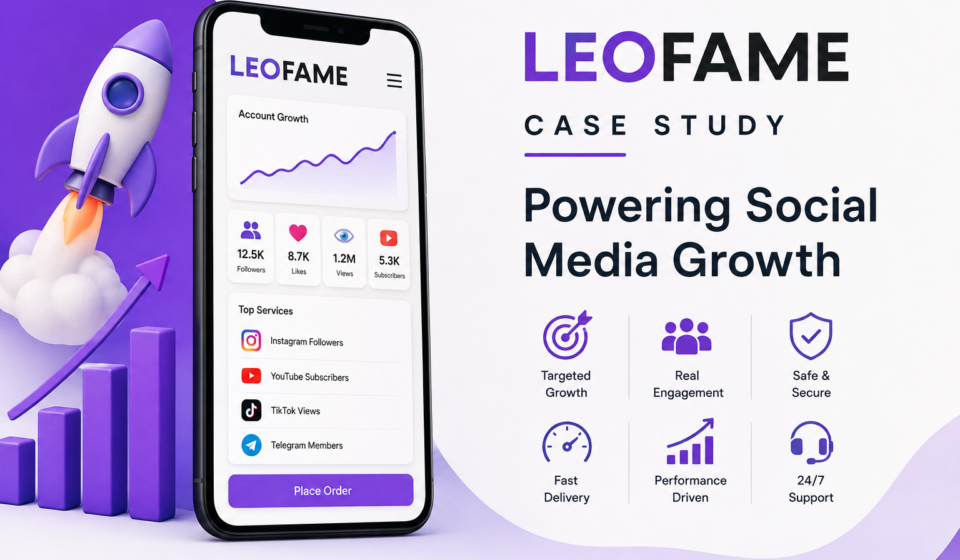
Leofame Case Study: Business Model, Social Media Growth Strategy, Services, Marketing and Future Opportunities – 2026

Introduction – Leofame Case Study
Leofame Case Study: The rise of social media has created an entirely new digital economy. Today, an Instagram profile, YouTube channel, TikTok account, Telegram community or other social-media presence can become much more than a personal profile. It can become a business, a marketing channel, a personal brand, a customer-acquisition engine or even a full-time source of income.
However, building visibility on social platforms is not easy.
Millions of creators and businesses compete for attention every day. A new creator may produce excellent content but struggle to gain initial visibility. A small business may have a good product but find it difficult to build an audience. A musician may release a song but struggle to generate enough initial attention. A new YouTube channel can face the classic problem of having good content but very few subscribers.
This environment created demand for social-media marketing services and automated social-media growth platforms.
One company operating in this space is Leofame.
Leofame.com presents itself as a social-media marketing service provider offering services such as followers, likes, views, subscribers and other social-media engagement services. Its terms identify the service provider as FAME DIGITALS LTD, with an address in Southsea, Portsmouth, United Kingdom. The company also explicitly states that Leofame.com is not affiliated with or endorsed by Instagram, Facebook or Instagram’s third-party partners.
This makes Leofame an interesting case study in the broader Social Media Marketing (SMM) industry.
The business illustrates how a digital company can build a service around one of the most valuable resources of the modern internet:
Attention.
This case study examines Leofame’s apparent business model, service proposition, customer segments, growth strategy, website positioning, competitive environment, strengths, weaknesses, opportunities, risks and future prospects.
It also examines a critical question:
Can purchased or accelerated social-media visibility create sustainable long-term growth, or is organic audience development still essential?
The answer is more complicated than simply saying “yes” or “no.”
1. What Is Leofame?
Leofame is a social-media marketing platform that provides services intended to help users increase the visibility of social-media accounts.
According to Leofame’s own FAQ, its services include options such as:
- profile follows,
- channel subscribers,
- video views,
- song plays,
- and other social-media growth services.
The platform says customers can select a service and have a plan tailored to their requirements.
In practical business terms, Leofame operates within the:
Social Media Marketing Panel
or
SMM Panel
industry.
An SMM panel is essentially an online interface through which customers can order social-media-related services.
2. The Basic Leofame Business Concept
The basic concept is straightforward.
A customer wants:
More visibility.
Leofame provides:
A digital service designed to increase selected social-media metrics.
The customer pays for the service.
The platform processes the order.
The customer’s selected social-media metric may increase depending on the service purchased and its delivery.
This creates a simple commercial model:
Customer
↓
Select Service
↓
Submit Social Profile / Content
↓
Place Order
↓
Service Delivery
↓
Customer Measures Results
3. Why Does a Business Like Leofame Exist?
The answer is simple:
Social proof has economic value.
Imagine two Instagram accounts.
Account A
12 followers.
Account B
12,000 followers.
A new visitor may immediately perceive Account B as more established.
This is not necessarily evidence that Account B has better content or a more valuable audience.
But humans naturally use visible signals when making judgments.
This is known as:
Social Proof.
4. The Psychology Behind Social Proof
People often assume that if many other people are paying attention to something, it must have some value.
Examples exist everywhere:
- restaurants with long queues,
- products with thousands of reviews,
- videos with millions of views,
- social profiles with large follower counts.
Social platforms make these numbers highly visible.
Therefore:
Followers
Likes
Views
Comments
Subscribers
can become perceived indicators of popularity.
That perception creates commercial demand for services that attempt to accelerate these metrics.
5. The Zero-Follower Problem
One of the biggest problems facing new creators is what can be called the:
Zero-Follower Trap.
A new creator has:
- little audience,
- few likes,
- few comments,
- little social proof.
Because the account is small, fewer people may discover it.
Because fewer people discover it, growth remains slow.
This creates a loop:
Small audience
↓
Low visibility
↓
Low engagement
↓
Low social proof
↓
Slow growth
6. The Visibility Problem
Consider a new creator who uploads an excellent video.
The content may be genuinely good.
But the creator has:
- 20 followers,
- no previous viral content,
- no established audience.
The content may struggle to generate initial attention.
This is one of the problems the SMM industry attempts to address.
7. Leofame’s Value Proposition
Leofame’s proposition is essentially built around convenience and social-media visibility.
The platform positions itself as a service where customers can order social-media marketing services without complicated technical procedures.
Its FAQ says that customers do not need to provide their account passwords and that the service does not require password access.
That creates an important trust proposition:
No Password Required.
8. Why Password-Free Access Matters
Social-media users are understandably concerned about account security.
If a service required:
“Give us your Instagram password.”
many customers would hesitate.
A system based on public profile information or content URLs can reduce that particular concern.
However, customers should still evaluate:
- platform policies,
- service terms,
- account security,
- authenticity of engagement,
- privacy,
- payment risks.
Password-free does not automatically mean risk-free.
9. Leofame’s Target Customers
The potential customer base for a social-media marketing company is extremely broad.
1. Influencers
Creators looking to establish visibility.
2. Small businesses
Companies trying to increase digital presence.
3. YouTubers
Creators seeking subscriber and view growth.
4. Musicians
Artists promoting songs and videos.
5. Digital marketers
Professionals managing campaigns for clients.
6. Agencies
Businesses reselling or incorporating SMM services.
7. Personal brands
Professionals building online authority.
8. New creators
People starting from zero.
10. The Creator Economy
The growth of Leofame-like businesses is closely connected to the:
Creator Economy.
Creators now compete for:
- views,
- followers,
- subscribers,
- likes,
- shares,
- comments,
- brand partnerships.
Audience size can influence:
- sponsorship opportunities,
- advertising opportunities,
- credibility,
- collaborations.
Therefore, social-media metrics have become economic assets.
11. Social Media Metrics as Currency
In the creator economy, several metrics have become almost like digital currency.
Followers
Represent potential audience size.
Views
Represent content consumption.
Likes
Represent basic engagement.
Comments
Represent active interaction.
Shares
Represent content distribution.
Subscribers
Represent recurring audience potential.
The SMM industry exists partly because these metrics have commercial importance.
12. The Leofame Service Portfolio
According to Leofame’s public FAQ, its offerings span multiple social-media-related services. These include profile follows, channel subscribers, video views and song plays, among other services.
This multi-platform approach is strategically important.
A company focused on only one metric may have a limited market.
A company serving several social platforms can potentially reach a much larger customer base.
13. Why Multi-Platform Matters
A modern creator may have:
for visual content.
YouTube
for long-form video.
TikTok
for short-form video.
Telegram
for community building.
Music platforms
for songs.
Therefore, a creator may need multiple marketing services.
A platform serving several channels can potentially increase:
Customer Lifetime Value.
14. Customer Lifetime Value
Suppose a customer first buys:
Instagram views.
Later, they need:
Instagram followers.
Then:
YouTube subscribers.
Then:
Video views.
Then:
Music plays.
The customer may continue using the same provider.
This creates:
Repeat Revenue.
15. The Leofame Customer Journey
A simplified customer journey could look like this:
Discover Leofame
↓
Visit website
↓
Browse services
↓
Try a low-risk or free option
↓
Create account
↓
Place first order
↓
Observe delivery
↓
Purchase again
↓
Try another platform
↓
Become recurring customer
This is a classic digital-service conversion funnel.
16. Free Trials as a Marketing Strategy
Leofame’s ecosystem includes free-growth offers on its associated web properties, including free Instagram followers and views.
Free trials are powerful because they reduce the:
Psychological Cost of Trying.
A customer may hesitate to pay a new company.
But if they can test a service without paying:
Trial
↓
Experience
↓
Trust
↓
Paid Purchase
The conversion barrier can become lower.
17. The Freemium-Like Strategy
This resembles a freemium model.
Free
Limited experience.
Paid
Larger service.
The objective is not necessarily to make money from the free user immediately.
The objective is to:
Convert the free user into a paying customer.
18. Why “Free” Is Powerful in Digital Marketing
Digital products often have very low marginal costs.
Once a website and automated delivery infrastructure exist, serving an additional customer can potentially be cheaper than operating a traditional physical business.
That allows digital companies to experiment with:
- free trials,
- discounts,
- coupons,
- low-cost entry products.
19. The Leofame Website Strategy
A social-media growth website needs to solve a major problem:
Customers want results quickly.
Therefore, the website must make the path from:
“I want more visibility.”
to
“I have placed an order.”
as short as possible.
20. Simplicity as a Competitive Advantage
Leofame’s public material emphasizes a simple ordering experience.
Its associated Leofame.in guide describes a process involving account access, selecting a service, submitting relevant information and tracking the order from a dashboard.
This highlights an important principle:
Reduce User Friction.
21. The “Copy, Paste, Order” Concept
For many SMM customers, technical complexity is undesirable.
They do not want to:
- understand APIs,
- configure servers,
- learn programming,
- manage complicated marketing software.
They want:
Select.
Enter details.
Pay.
Track.
That simplicity can be a competitive advantage.
22. Automation
An SMM panel can automate many processes:
- order creation,
- payment processing,
- status updates,
- service delivery,
- customer notifications,
- order tracking.
Automation allows the business to handle a large number of orders without manually processing every customer request.
23. The Digital Infrastructure
A platform like Leofame requires several technological components.
Frontend
The customer-facing website.
User dashboard
Where orders are managed.
Payment system
For transactions.
Order management system
Tracks requests.
Service infrastructure
Processes delivery.
Database
Stores account and order information.
Analytics
Tracks business performance.
Customer support
Handles issues.
24. API-Based Architecture
SMM platforms may also integrate with external service providers through APIs.
A simplified architecture could be:
Customer
↓
Leofame Website
↓
Order Management System
↓
Service API / Provider
↓
Social Platform Service
↓
Status Returned
↓
Customer Dashboard
The exact architecture of Leofame is not publicly documented in enough detail to confirm this specific implementation, so this should be understood as a general SMM-platform model rather than a claim about Leofame’s internal infrastructure.
25. The Importance of Order Tracking
Customers want to know:
- Has the order started?
- How much has been delivered?
- Is the order complete?
- Is there a problem?
Therefore, order tracking is essential.
A dashboard can reduce customer-support workload by providing transparency.
26. Customer Support
Leofame provides a contact mechanism on its website for users to submit:
- name,
- email,
- subject,
- order ID,
- message.
The website also allows users to upload related images for support purposes.
This is important because automated digital businesses still need human support.
27. The Trust Problem
The biggest challenge in the SMM industry is:
Trust.
Customers may ask:
- Are the followers genuine?
- Are views real?
- Will followers remain?
- Will engagement disappear?
- Will my account be affected?
- Is the service compliant with platform policies?
These are legitimate questions.
28. Leofame’s Claims About Engagement
Leofame’s FAQ states that it uses “real people” for likes, follows and similar services and describes its approach as organic growth.
However, these are company claims, not independently verified performance data.
A credible case study should make that distinction clear.
29. Why Verification Matters
Marketing claims should ideally be supported by:
- independent testing,
- transparent methodology,
- audited statistics,
- customer retention data,
- engagement-quality measurements.
Without such evidence, claims should be treated as promotional statements rather than established facts.
30. Vanity Metrics vs Real Growth
One of the biggest issues in social-media marketing is the difference between:
Vanity Metrics
and
Business Metrics.
Vanity metrics include:
- followers,
- likes,
- views.
Business metrics may include:
- leads,
- sales,
- revenue,
- conversions,
- customer retention.
A business can have:
100,000 followers
and still generate very little revenue.
Another business can have:
5,000 highly relevant followers
and generate significant sales.
31. The Engagement Quality Problem
Suppose an account has:
100,000 followers.
But each post receives:
100 likes.
That may indicate weak audience engagement.
Now consider:
10,000 followers
with:
1,000 likes per post.
The smaller account may have a much healthier audience.
Therefore:
Audience Quality > Audience Quantity.
32. The Risk of Inflated Metrics
If followers or engagement are not genuinely interested in the content, several problems can occur.
Low engagement rate
Large follower count but low interaction.
Poor conversion
Followers do not become customers.
Weak audience relevance
Followers may not belong to the target market.
Brand credibility issues
Businesses may question the authenticity of the account.
33. The Algorithm Problem
Modern social platforms increasingly use recommendation systems.
These systems consider signals such as:
- watch time,
- interactions,
- content relevance,
- audience behaviour,
- sharing.
Simply increasing a follower number does not guarantee better content distribution.
This is an important strategic distinction.
34. Followers Are Not the Same as Reach
A follower may not see every post.
Algorithms determine what appears in feeds.
Therefore:
10,000 followers
does not automatically mean:
10,000 views.
35. Views Are Not the Same as Attention
Even a view may not represent deep engagement.
A person can scroll past a video quickly.
Therefore, creators increasingly need to examine:
- watch time,
- retention,
- saves,
- shares,
- comments,
- clicks,
- conversions.
36. The Modern Growth Formula
A sustainable creator strategy is better represented as:
Content Quality
Audience Relevance
Consistency
Distribution
Community
Analytics
=
Sustainable Growth
SMM services may address one part of the equation, but they cannot replace the entire system.
37. Leofame’s Potential Competitive Advantage
The strongest potential advantages for a company like Leofame include:
Convenience
Simple ordering.
Variety
Multiple social-media services.
Accessibility
Services for creators and businesses.
Automation
Fast order processing.
Pricing
Ability to offer scalable packages.
Customer support
Assistance with orders.
Trial strategy
Lower entry barrier.
38. Competition in the SMM Industry
Leofame operates in a highly competitive industry.
There are numerous SMM panels and digital marketing providers offering:
- followers,
- likes,
- views,
- subscribers,
- comments,
- social promotion.
This creates intense price competition.
39. Price Competition
If multiple providers sell similar services, customers can compare:
- price,
- speed,
- quality,
- refill policies,
- support,
- payment methods.
Therefore:
Price alone is not a durable competitive advantage.
40. The Race to the Bottom
If a business competes only on:
“We are cheaper.”
competitors can simply reduce prices.
This creates:
Lower margins.
More price-sensitive customers.
Less loyalty.
A stronger strategy is:
Compete on trust, reliability, transparency and customer experience.
41. Brand Building for Leofame
A company operating in a trust-sensitive industry needs a recognizable brand.
Brand building can include:
- professional website,
- transparent policies,
- customer support,
- clear service descriptions,
- educational content,
- testimonials,
- case studies,
- secure payment experience.
42. Content Marketing
Leofame’s associated web presence includes educational articles about social-media growth and how to order services.
Content marketing can attract users searching for terms such as:
- free Instagram followers,
- Instagram growth,
- Instagram views,
- social media marketing,
- SMM panel,
- YouTube subscribers.
This is an SEO-driven acquisition strategy.
43. SEO as a Growth Channel
For a digital business, search engines can provide customers who already have:
Intent.
Someone searching:
“Buy Instagram followers”
has a different intent from someone randomly browsing social media.
They may already be considering a purchase.
This makes SEO potentially valuable.
44. Long-Tail Keywords
A website can target many long-tail searches:
- free Instagram followers,
- Instagram followers service,
- Instagram views service,
- YouTube subscribers,
- TikTok followers,
- Telegram SMM,
- social media growth service.
Each keyword can potentially become an acquisition channel.
45. The SEO Flywheel
Publish useful content
↓
Rank in search engines
↓
Receive traffic
↓
Convert visitors
↓
Gain customers
↓
Generate revenue
↓
Create more content
↓
More traffic
46. Educational Marketing
Educational articles can also reduce customer uncertainty.
Instead of only saying:
“Buy our service.”
a company can explain:
- how social media works,
- what engagement means,
- how creators grow,
- how to protect accounts,
- how to use analytics.
This builds authority.
47. The Difference Between Selling and Educating
Selling says:
“Buy this.”
Education says:
“Here is how the industry works.”
The second approach can create greater trust.
48. Customer Segmentation
Leofame can potentially divide customers into different segments.
Segment A: New creators
Need initial visibility.
Segment B: Influencers
Need ongoing audience growth.
Segment C: Businesses
Need marketing and leads.
Segment D: Agencies
Need wholesale or reseller services.
Segment E: Musicians
Need plays and video visibility.
Segment F: YouTubers
Need subscribers and views.
Each segment needs different messaging.
49. New Creator Strategy
For new creators, the biggest problem is:
Lack of social proof.
The marketing message can focus on:
- starting visibility,
- improving profile presentation,
- building consistent content.
But creators should still focus on producing genuinely valuable content.
50. Influencer Strategy
Influencers already have an audience.
They may care more about:
- consistency,
- campaign performance,
- reach,
- brand partnerships.
For this segment, reliability becomes more important than simply offering cheap services.
51. Business Strategy
Businesses are usually more interested in:
- leads,
- sales,
- customer acquisition,
- brand awareness.
Therefore, selling only follower numbers may be insufficient.
A stronger proposition would connect social-media activity with:
Business outcomes.
52. Agency Strategy
Digital agencies can potentially represent a high-value customer segment.
One agency may manage:
- 10 clients,
- 50 clients,
- 100 clients.
If the platform provides reliable services, agencies can generate recurring orders.
This increases customer lifetime value.
53. Reseller Model
Many SMM businesses also use reseller structures.
A reseller may purchase services from a provider and sell them under its own brand.
This creates:
B2B2C economics.
Provider
↓
Reseller
↓
End Customer
This can significantly increase distribution.
54. Recurring Revenue
Recurring customers are particularly valuable.
Imagine:
Customer 1
Makes one ₹100 order.
versus
Customer 2
Spends ₹2,000 every month.
The second customer has much greater lifetime value.
Therefore, retention should be a major strategic priority.
55. Customer Retention
Retention can be improved through:
- reliable delivery,
- good support,
- transparent pricing,
- order tracking,
- consistent service quality,
- loyalty incentives.
56. Subscription Opportunity
A future opportunity for a platform like Leofame could be subscription-based packages.
For example:
Creator Starter
Monthly social-media services.
Creator Pro
Higher-volume packages.
Agency
Bulk orders and management tools.
Business
Social-media marketing services plus analytics.
A subscription model could create predictable revenue.
57. Dashboard as a Product
The dashboard itself can become a competitive advantage.
A good dashboard should show:
- orders,
- status,
- spending,
- history,
- services,
- performance.
The better the dashboard, the more likely users are to remain on the platform.
58. Analytics Opportunity
This is perhaps one of the biggest future opportunities.
Instead of only saying:
“We delivered 5,000 followers.”
a platform could help customers understand:
- engagement rate,
- audience quality,
- retention,
- content performance,
- conversions.
This would move the company from:
SMM Panel
toward:
Social Media Growth Platform.
59. The Next Generation of SMM
The traditional SMM model focuses heavily on:
- followers,
- likes,
- views.
The future should focus more on:
- content,
- audience quality,
- conversion,
- community,
- business outcomes.
This is a major opportunity.
60. AI-Powered Social Media Growth
AI can potentially help customers identify:
- best posting times,
- high-performing topics,
- content gaps,
- audience interests,
- caption ideas,
- hashtags,
- video concepts.
A company like Leofame could potentially expand into this category.
61. AI Content Assistance
Imagine a dashboard where a user enters:
“I run a clothing business.”
The system could suggest:
- Reel ideas,
- captions,
- posting schedules,
- content calendars,
- audience segments.
This creates much greater value than selling followers alone.
62. AI Analytics
AI could examine:
Last 100 posts.
Then identify:
- which videos performed best,
- which hooks generated attention,
- which topics created engagement,
- which formats underperformed.
That would help creators improve organically.
63. Combining Paid and Organic Growth
The strongest future strategy may combine:
Paid visibility
with
Organic content.
Paid services can potentially help with initial exposure.
Organic content creates:
- trust,
- community,
- repeat engagement.
The two strategies should not be treated as identical.
64. Organic Growth Still Matters
No social-media service can permanently replace:
- great content,
- audience connection,
- consistency,
- storytelling,
- community.
These remain the foundation of sustainable growth.
65. The “Acceleration, Not Replacement” Principle
A useful way to think about SMM services is:
Acceleration should complement good marketing, not replace it.
A business with poor content will not become a great brand simply by increasing follower counts.
66. The Real Growth Stack
A more complete social-media growth stack is:
Layer 1
Content.
Layer 2
Audience.
Layer 3
Engagement.
Layer 4
Distribution.
Layer 5
Analytics.
Layer 6
Conversion.
Layer 7
Retention.
An SMM platform operates mainly around the distribution and visibility layer.
67. The Importance of Authenticity
Authenticity is becoming increasingly important.
Consumers can often detect:
- generic content,
- repetitive posts,
- artificial engagement,
- aggressive promotion.
Therefore, real community building matters.
68. The Future of Social Proof
Social proof will remain important.
But social platforms are becoming better at identifying:
- meaningful engagement,
- watch time,
- shares,
- conversations,
- repeat viewers.
Therefore, simply maximizing visible numbers may become less effective over time.
69. Platform Policy Risk
One of the most important risks for an SMM company is dependence on third-party platforms.
Leofame’s terms explicitly state that it is not affiliated with Instagram, Facebook or Instagram’s third-party partners.
That means a company operating in this industry must constantly account for changes in:
- platform rules,
- APIs,
- detection systems,
- account policies,
- advertising regulations.
70. Dependency on Instagram
If Instagram changes its rules, an SMM business could be affected immediately.
For example:
API changes
Could affect automation.
Anti-spam systems
Could affect service delivery.
Algorithm changes
Could reduce the usefulness of certain services.
Policy enforcement
Could increase customer concerns.
This is a major strategic risk.
71. Diversification as Risk Management
A company like Leofame can reduce dependence on one platform by serving:
- Instagram,
- YouTube,
- TikTok,
- Telegram,
- music platforms,
- other social networks.
This is similar to financial portfolio diversification.
72. Platform Diversification
If 100% of revenue comes from Instagram:
High risk.
If revenue is distributed across multiple platforms:
Lower platform-specific risk.
However, each platform introduces its own operational requirements.
73. International Opportunity
Social media is global.
A service provider can potentially acquire customers from:
- Europe,
- Asia,
- North America,
- Middle East,
- Africa,
- Latin America.
A digital service therefore has a large theoretical addressable market.
74. Localization
International growth requires localization.
That can involve:
- languages,
- currencies,
- payment methods,
- customer support,
- regional marketing.
For example:
A customer in India may prefer:
- INR,
- UPI,
- WhatsApp support.
A European customer may prefer:
- EUR,
- card payment,
- email support.
75. Payment Infrastructure
Digital businesses need reliable payment systems.
Important factors include:
- security,
- fraud prevention,
- refunds,
- payment confirmation,
- multiple currencies.
A smooth payment experience directly affects conversion.
76. Trust and Refund Policies
Customers need confidence that problems will be handled fairly.
Clear policies can reduce:
- disputes,
- chargebacks,
- negative reviews.
Transparency is especially important in digital services.
77. Reputation Management
A social-media service provider is itself a digital brand.
Therefore it must manage:
- online reviews,
- customer complaints,
- support quality,
- social media presence.
One negative customer experience can spread quickly.
78. The Importance of Reviews
Reviews can influence purchase decisions.
A potential customer may ask:
“Can I trust this service?”
Reviews provide social proof.
Therefore, customer satisfaction becomes a marketing asset.
79. Transparency as a Competitive Advantage
A stronger SMM company can differentiate through transparency.
For example:
- clear service descriptions,
- realistic expectations,
- delivery information,
- refund rules,
- support response times,
- privacy information.
This can create trust.
80. Leofame’s Legal Positioning
Leofame’s terms clearly state that its service is not affiliated with Instagram, Facebook or Instagram’s third-party partners.
This disclaimer is important because customers could otherwise incorrectly assume that the service is officially connected to Instagram.
A professional marketing article should preserve that distinction.
81. Why Disclaimers Matter
Digital users may confuse:
Third-party service
with
Official platform service.
Clear disclaimers reduce this misunderstanding.
This is particularly important in industries surrounding major technology platforms.
82. SWOT Analysis of Leofame
Strengths
1. Clear market niche
The company focuses on social-media growth services.
2. Digital-first model
The service can operate online.
3. Multiple services
The offering covers different social-media metrics and platforms.
4. Low geographic barriers
Customers can potentially access the platform from different regions.
5. Simple customer journey
The business is designed around online ordering.
6. Password-free positioning
Leofame says its services do not require customer passwords.
83. Weaknesses
1. Trust challenge
Customers may question service quality.
2. Third-party platform dependency
Changes by Instagram, YouTube or other platforms can affect operations.
3. Price competition
The SMM market contains many competitors.
4. Metric-focused perception
Customers may focus too heavily on follower counts rather than real business outcomes.
5. Limited public financial information
There is not enough reliable public information to make confident claims about Leofame’s revenue, profit or valuation.
84. Opportunities
1. AI-powered analytics
Huge potential.
2. Creator economy
Growing demand.
3. Small businesses
Large addressable market.
4. International expansion
Global customers.
5. Agency services
Recurring B2B revenue.
6. Social-media management
Move beyond metrics.
7. Content creation
Add creative services.
8. Education
Courses and resources for creators.
85. Threats
1. Platform policy changes
Potential disruption.
2. Algorithm changes
May reduce the usefulness of certain metrics.
3. Competition
Many SMM providers.
4. Regulatory scrutiny
Digital advertising and consumer protection rules.
5. Reputation risk
Customer complaints can spread quickly.
6. AI-generated spam
Could make artificial engagement less valuable.
86. Porter’s Five Forces Analysis
Competitive Rivalry — Very High
Many SMM providers compete on similar services.
Threat of New Entrants — High
A basic SMM website can be created relatively easily.
The challenge is building:
- trust,
- infrastructure,
- support,
- reliable service,
- brand reputation.
Supplier Power — High
SMM providers may depend on upstream service systems or third-party platforms.
Changes in those systems can significantly affect operations.
Buyer Power — High
Customers can easily compare prices online.
Switching costs can be low.
Threat of Substitutes — Extremely High
Customers can choose:
- organic marketing,
- influencers,
- paid advertising,
- SEO,
- content marketing,
- social-media agencies,
- creator collaborations.
Therefore, Leofame must provide clear value.
87. Leofame’s Potential Competitive Moat
A long-term moat could be built through:
Brand trust
Customer base
Technology
Automation
Analytics
Customer support
Multi-platform coverage.
This is much stronger than competing only on price.
88. From SMM Panel to Growth Platform
This could be the most important strategic transformation for Leofame.
Traditional model:
“Buy followers.”
Future model:
“Grow your social-media business.”
That is a much broader proposition.
89. What a Growth Platform Could Offer
A comprehensive platform could include:
- social analytics,
- content scheduling,
- AI content ideas,
- audience insights,
- competitor analysis,
- creator discovery,
- campaign management,
- social-media services,
- reporting.
This creates a much larger customer relationship.
90. Subscription-Based Growth Platform
Instead of customers purchasing individual services, Leofame could offer:
Starter
For new creators.
Professional
For influencers.
Business
For companies.
Agency
For marketing agencies.
This creates predictable recurring revenue.
91. Agency Dashboard
An agency dashboard could allow:
- multiple client accounts,
- multiple projects,
- consolidated billing,
- performance reports,
- order management.
This would increase enterprise value.
92. White-Label Opportunity
A white-label solution could allow agencies to sell services under their own brand.
This can create:
B2B recurring revenue.
It also allows Leofame to expand distribution without directly acquiring every end customer.
93. API Opportunity
A public API could allow developers and agencies to integrate services into:
- websites,
- dashboards,
- marketing systems,
- CRM platforms.
This could turn Leofame from a website into infrastructure.
94. The Platform Strategy
The strategic evolution could be:
Stage 1
SMM services.
↓
Stage 2
Automated SMM panel.
↓
Stage 3
Multi-platform growth platform.
↓
Stage 4
AI-powered analytics.
↓
Stage 5
Creator-business ecosystem.
That would significantly increase potential value.
95. Content Marketing Strategy for Leofame
Leofame can create educational content around:
- Instagram growth,
- YouTube growth,
- TikTok marketing,
- Telegram marketing,
- creator economy,
- influencer marketing,
- social-media analytics.
This attracts search traffic.
96. SEO Strategy
A strong SEO strategy could target:
Informational keywords
“What is an SMM panel?”
Commercial keywords
“Instagram followers service.”
Transactional keywords
“Buy Instagram views.”
Comparison keywords
“Best SMM panel.”
Problem-solving keywords
“How to grow Instagram followers.”
This creates multiple stages of the marketing funnel.
97. The SEO Funnel
Awareness
“What is social-media marketing?”
↓
Consideration
“Best Instagram growth service.”
↓
Purchase
“Instagram followers service.”
↓
Retention
“How to use Leofame.”
This is a complete SEO funnel.
98. Social Media Marketing for Leofame
Ironically, a company selling social-media growth services must itself demonstrate strong social-media marketing.
Its own accounts can act as:
Proof of capability.
A potential customer may ask:
“If you help others grow, how strong is your own brand?”
Therefore, Leofame’s own digital presence matters.
99. Thought Leadership
The company can build authority by publishing:
- industry reports,
- case studies,
- social-media trend reports,
- creator guides,
- platform analysis.
This positions the company as:
An expert.
rather than simply:
A service seller.
100. Customer Case Studies
Real, verifiable case studies could become one of Leofame’s strongest marketing assets.
A good case study should show:
Starting point
Followers / engagement.
Strategy
What was done.
Timeline
How long it took.
Results
What changed.
Business impact
Leads, sales or partnerships.
Limitations
What did not work.
This is much more credible than simply publishing large numbers.
101. The Importance of Evidence
A case study should avoid unsupported statements such as:
“This service guarantees viral growth.”
A stronger statement would be:
“In this documented campaign, the account experienced X% growth over Y days.”
Evidence creates credibility.
102. Sustainable Growth
A sustainable strategy should focus on:
Audience relevance.
Content quality.
Engagement.
Community.
Conversion.
Followers alone are insufficient.
103. Leofame’s Long-Term Challenge
The biggest strategic challenge is:
Moving from Metric Seller to Growth Partner.
If customers only view Leofame as:
“A place to buy numbers.”
customer loyalty may remain weak.
But if customers view it as:
“The platform that helps me grow my digital business.”
the relationship becomes much stronger.
104. The Creator Growth Journey
A potential creator journey could be:
Stage 1
0–100 followers.
Stage 2
100–1,000.
Stage 3
1,000–10,000.
Stage 4
10,000–100,000.
Stage 5
100,000+.
Different stages require different strategies.
A sophisticated platform could support the customer throughout this journey.
105. Beginner Customers
Beginners need:
- education,
- content ideas,
- basic analytics,
- profile optimization.
They may not even understand what metrics matter.
106. Intermediate Customers
Intermediate creators need:
- growth strategy,
- audience targeting,
- collaborations,
- analytics,
- content optimization.
107. Advanced Creators
Advanced creators need:
- monetization,
- brand partnerships,
- campaign management,
- audience insights,
- business analytics.
A platform that supports all three stages can increase lifetime value.
108. Business Customers
Businesses need:
- leads,
- sales,
- awareness,
- conversions.
This means Leofame could potentially expand into:
Performance Marketing.
109. The Shift From Followers to Revenue
The most important evolution would be:
Followers
↓
Engagement
↓
Leads
↓
Customers
↓
Revenue.
This is what ultimately matters to businesses.
110. Why Revenue Is the Final Metric
A business cannot pay employees with:
- likes,
- followers,
- views.
It pays them with revenue.
Therefore, professional social-media marketing should eventually connect activity with:
Financial outcomes.
111. The Leofame Business Model in One Diagram
Creators + Businesses
↓
Need visibility
↓
Leofame
↓
Social-media services
↓
Followers / Views / Likes / Subscribers / Other Services
↓
Customer perception of increased visibility
↓
Repeat purchases
↓
Revenue
↓
Technology + Marketing + Support
↓
Customer Growth
112. The Leofame Growth Flywheel
A possible growth flywheel is:
SEO Traffic
↓
Free Trial
↓
First Order
↓
Customer Experience
↓
Trust
↓
Repeat Purchase
↓
Referral
↓
More Traffic
↓
More Customers
113. Referral Marketing
Satisfied customers can become a powerful acquisition channel.
A customer might recommend the platform to:
- another creator,
- a friend,
- a marketing agency,
- a business owner.
Referral programs can strengthen this effect.
114. Affiliate Marketing
Another opportunity is affiliate marketing.
Creators and marketers could promote Leofame and receive commissions.
This transforms customers into:
Distribution partners.
115. Influencer Partnerships
A social-media growth platform can naturally partner with:
- marketing influencers,
- YouTubers,
- digital marketing educators,
- creator coaches.
These partnerships can increase brand awareness.
116. Community Building
Leofame could create a community around:
Social Media Growth.
A community could provide:
- tutorials,
- discussions,
- case studies,
- creator networking,
- marketing tips.
This would create an additional brand asset.
117. Education as a Product
Courses could teach:
- Instagram marketing,
- YouTube growth,
- TikTok strategy,
- content creation,
- influencer marketing.
This creates another revenue stream.
118. The Future of Social-Media Marketing
The social-media marketing industry is moving toward:
Automation
Less manual work.
AI
More intelligent recommendations.
Personalization
More relevant strategies.
Analytics
More measurable outcomes.
Commerce
More direct sales.
Creator partnerships
More authentic distribution.
Leofame has an opportunity to participate in this evolution.
119. The Role of AI in the Future SMM Industry
AI could eventually help answer:
“Why did my Reel fail?”
Instead of simply:
“Here are 1,000 more views.”
That is a major difference.
The first provides:
Intelligence.
The second provides:
A metric.
Intelligence has greater long-term value.
120. Predictive Analytics
A sophisticated platform could predict:
- likely content performance,
- audience response,
- optimal posting times,
- potential viral topics.
This could transform social-media marketing.
121. Automated Content Strategy
AI could create weekly plans:
Monday
Educational Reel.
Tuesday
Story poll.
Wednesday
Customer testimonial.
Thursday
Behind-the-scenes video.
Friday
Promotional Reel.
This could make social-media management easier for small businesses.
122. The Opportunity in Small Businesses
Millions of small businesses understand that social media is important but lack:
- time,
- expertise,
- staff.
A platform that simplifies social-media marketing could capture this huge market.
123. Local Business Growth
A local restaurant, salon or retailer does not need millions of followers.
It needs:
The right 5,000 people.
That means future SMM services should emphasize:
Geographic relevance.
124. Localized Audience Strategy
Instead of:
“Get 10,000 followers.”
A better business proposition could be:
“Reach more potential customers in your city.”
That is much closer to actual business value.
125. The Future: Quality Over Quantity
The industry may gradually shift from:
Quantity
to
Quality.
From:
How many followers?
to:
How many relevant customers?
This shift could create a major opportunity for companies willing to innovate.
126. Leofame’s Strategic Roadmap
A possible future roadmap could be:
Phase 1
Strengthen core SMM services.
Phase 2
Improve transparency and analytics.
Phase 3
Launch creator dashboards.
Phase 4
Introduce AI recommendations.
Phase 5
Develop business marketing tools.
Phase 6
Expand into agency infrastructure.
Phase 7
Build a complete creator-growth ecosystem.
127. Key Business Lessons From Leofame
Lesson 1: Solve a clear problem
Visibility is a real problem for creators and businesses.
Lesson 2: Reduce friction
Customers prefer simple ordering.
Lesson 3: Offer multiple services
Multi-platform coverage increases potential customer value.
Lesson 4: Build trust
Trust is critical in digital services.
Lesson 5: Don’t rely only on price
Cheap services are easy to copy.
Lesson 6: Build recurring relationships
Retention is more valuable than one-time transactions.
Lesson 7: Move toward analytics
Data creates more value than vanity metrics.
Lesson 8: Use content marketing
Educational content can attract high-intent customers.
Lesson 9: Diversify platforms
Don’t become dependent on one social network.
Lesson 10: Build a real brand
Brand trust can become a long-term competitive advantage.
128. What Entrepreneurs Can Learn
Leofame’s business model offers several lessons for entrepreneurs.
You don’t necessarily need to invent a new technology.
You can build a business by:
Identifying a growing ecosystem.
↓
Finding a pain point.
↓
Creating a simple service.
↓
Automating delivery.
↓
Building customer trust.
↓
Scaling digitally.
This is a classic internet-business strategy.
129. The Power of Niche Businesses
Leofame demonstrates the potential of building around a very specific digital need:
Social-media growth.
Niche businesses can succeed when the problem is:
- frequent,
- valuable,
- urgent,
- measurable.
Social-media visibility satisfies many of these conditions.
130. Measurable Services
One advantage of SMM services is that results can often be represented numerically.
Customers can see:
- followers,
- views,
- likes,
- subscribers.
That makes the product easier to understand.
131. The Problem With Easy Metrics
The danger is that customers may confuse:
Easy-to-measure
with
Important.
Followers are easy to measure.
Revenue is more important.
Therefore, the future of SMM should connect both.
132. The Ideal Customer Dashboard
A future Leofame dashboard could show:
Audience
Followers.
Engagement
Likes, comments, shares.
Content
Views and retention.
Business
Clicks and leads.
Revenue
Conversions and sales.
This would provide a complete picture.
133. From Dashboard to Decision Engine
The ultimate goal should be:
Tell the customer what to do next.
For example:
“Your food Reels generate 42% more engagement than your product photographs.”
Then:
“Publish more food-focused Reels next week.”
That is actionable intelligence.
134. The Ultimate Value Proposition
The strongest possible future proposition would be:
Leofame helps creators and businesses understand, grow and monetize their social-media audiences.
That is much broader than:
“We sell followers.”
135. Why This Matters
The first model is transactional.
The second is strategic.
Transactional businesses often compete on:
- price,
- speed.
Strategic platforms compete on:
- value,
- intelligence,
- outcomes.
The second model can create stronger long-term customer relationships.
136. Final SWOT Summary
| Category | Key Points |
|---|---|
| Strengths | Digital model, multiple services, convenience, social-media niche |
| Weaknesses | Trust concerns, competition, third-party dependency |
| Opportunities | AI, analytics, creator economy, small businesses, agencies |
| Threats | Platform policies, competition, regulatory pressure, changing algorithms |
137. Final Strategic Assessment
Leofame represents an interesting example of a modern digital business built around the growing importance of social-media visibility.
Its core market exists because creators and businesses increasingly believe that:
Attention creates opportunity.
The company operates in a competitive environment where customers seek:
- followers,
- views,
- likes,
- subscribers,
- social visibility.
Leofame’s public materials emphasize a broad service portfolio, password-free ordering and social-media marketing services.
Its terms identify FAME DIGITALS LTD as the provider and explicitly clarify that the company is independent of Instagram and Facebook.
However, the deeper business lesson is more important than the individual services.
The future of social-media marketing will likely be determined not simply by who can provide the largest number of followers or views.
It will be determined by who can help customers create:
- genuine audiences,
- meaningful engagement,
- strong communities,
- qualified leads,
- customer relationships,
- and measurable revenue.
138. The Biggest Challenge for Leofame
Leofame’s biggest long-term challenge is therefore:
Moving Beyond Vanity Metrics.
A follower count is visible.
A business result is valuable.
The company has an opportunity to bridge that gap.
139. The Biggest Opportunity
The biggest opportunity is to evolve from:
SMM Panel
into:
AI-Powered Social Media Growth Platform.
Such a platform could combine:
- social-media services,
- analytics,
- content strategy,
- AI,
- creator tools,
- business marketing,
- campaign management.
That would dramatically increase the value proposition.
140. Leofame’s Potential Future Business Model
The future model could look like:
Free Tools
↓
Generate traffic.
↓
Basic SMM Services
↓
Acquire customers.
↓
Professional Dashboard
↓
Increase retention.
↓
AI Analytics
↓
Increase value.
↓
Business Marketing Tools
↓
Increase revenue per customer.
↓
Agency Platform
↓
Expand B2B.
↓
Social Media Growth Ecosystem
141. The Leofame Growth Formula
A simplified formula for long-term success could be:
Easy onboarding + reliable service + transparent communication + strong customer support + useful analytics + AI + recurring revenue = sustainable digital growth platform.
142. Final Conclusion
Leofame is an interesting case study because it sits at the intersection of several major digital trends:
- social media,
- creator economy,
- influencer marketing,
- digital advertising,
- online entrepreneurship,
- automation,
- SEO,
- AI,
- and the global attention economy.
The company operates in a market where visibility has become a valuable digital asset.
Its business model is built around providing social-media marketing services through an online platform, with services spanning multiple types of social-media engagement. Leofame’s own FAQ describes services including follows, subscribers, video views and song plays, while its terms identify FAME DIGITALS LTD as the provider.
But the larger lesson from this case study is that numbers alone do not create a successful digital business.
A follower is valuable only when that follower is relevant.
A view is valuable when it represents meaningful attention.
A like is valuable when it reflects genuine interest.
And an audience becomes truly valuable when it creates:
Trust.
Community.
Leads.
Customers.
Revenue.
That is the direction in which the social-media marketing industry is likely to evolve.
The old model was:
“Get more followers.”
The new model is:
“Build a valuable audience.”
The old model was:
“Get more views.”
The new model is:
“Get the right people to watch.”
The old model was:
“Increase engagement.”
The new model is:
“Create meaningful engagement that leads somewhere.”
And the old model was:
“Sell social-media metrics.”
The future model is:
Build Social-Media Growth Infrastructure.
For Leofame, that represents both the biggest challenge and the biggest opportunity.
If the company can successfully combine its existing SMM-service model with:
- trustworthy customer experiences,
- better analytics,
- AI-powered recommendations,
- creator tools,
- business marketing solutions,
- transparent reporting,
- and measurable outcomes,
it could position itself not merely as an SMM panel but as a broader digital growth platform for creators, entrepreneurs, agencies and businesses.
That transformation would represent the most important strategic lesson from the Leofame case study:
In the attention economy, the real competitive advantage is not simply the ability to increase numbers; it is the ability to turn attention into lasting audience value and measurable business growth.

[…] Leofame Case Study: Business Model, Social Media Growth Strategy, Services, Marketing and Future Opp… […]