





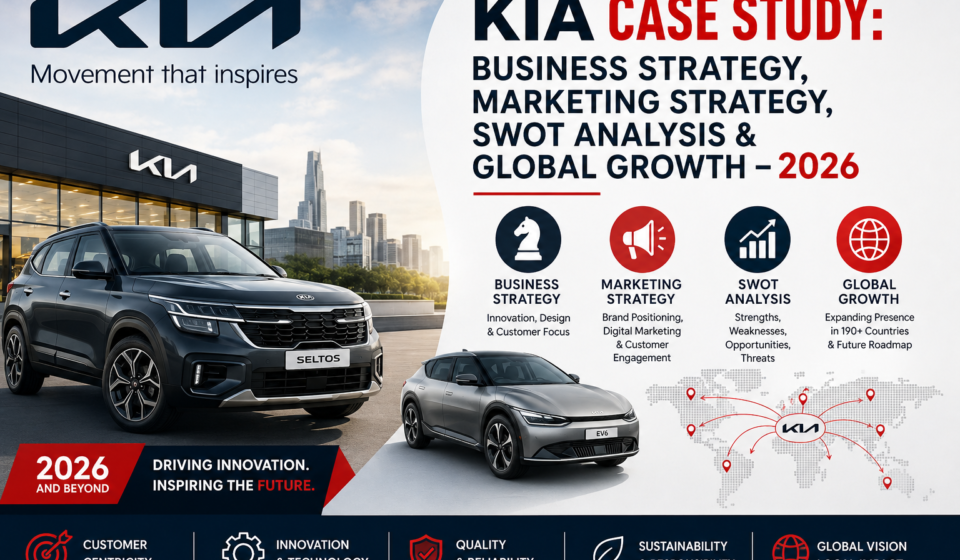
Kia Case Study: Business Strategy, Marketing Strategy, SWOT Analysis & Global Growth – 2026

Explore a detailed Kia case study covering Kia’s history, business model, marketing strategy, rebranding, product strategy, SWOT analysis, competitive advantage, global expansion, electric vehicles and future growth strategy.
Kia case study, Kia Motors case study, Kia business strategy, Kia marketing strategy, Kia Motors strategy, Kia competitive advantage
Kia SWOT analysis, Kia business model, Kia marketing strategy case study, Kia growth strategy, Kia global strategy, Kia rebranding strategy, Kia electric vehicle strategy, Kia product strategy
Long-Tail SEO Keywords: Kia Motors case study in India, detailed Kia case study, Kia business strategy case study, Kia marketing strategy case study, Kia SWOT analysis, Kia competitive advantage analysis, Kia global expansion strategy, Kia rebranding case study, Kia electric vehicle strategy, Kia automobile case study, Kia case study for MBA students
1. Introduction to the Kia Case Study
The Kia case study is one of the most interesting examples of transformation in the global automobile industry.
Kia was once widely perceived as a manufacturer competing primarily through affordability and value. Over time, however, the company significantly changed its brand identity, product portfolio, design language, technology and global positioning.
Today, Kia operates as a major global automotive brand and is part of Hyundai Motor Group. The company’s transformation provides a valuable example of how a business can move from a relatively low-cost positioning toward a more design-led, technology-focused and aspirational brand.
The Kia story is particularly useful for understanding:
- Brand repositioning
- Product differentiation
- Global marketing
- Design strategy
- Automotive innovation
- Electric vehicles
- Customer segmentation
- International expansion
- Competitive strategy
- Brand equity
- Digital transformation
The central question in the Kia Motors case study is:
How did Kia transform its global brand image while competing against much larger and more established automotive brands?
2. Executive Summary of the Kia Case Study
The Kia transformation can broadly be understood through several stages.
Stage 1: Manufacturing and domestic development
Kia developed manufacturing capabilities and established itself in the Korean automobile industry.
Stage 2: International expansion
The company expanded its presence into international markets.
Stage 3: Competitive pressure
Kia faced challenges related to brand perception, profitability and competition.
Stage 4: Strategic transformation
The company invested heavily in:
- Design
- Product development
- Technology
- Quality
- Brand identity
Stage 5: Premiumization and repositioning
Kia increasingly competed through design, features, technology and customer experience rather than simply low prices.
Stage 6: Electrification
The company increasingly invested in hybrid, electric and electrified vehicle technologies.
This transformation makes Kia a valuable automotive business case study.
3. Kia Company Overview
Kia Corporation is a South Korean automobile manufacturer and a member of the Hyundai Motor Group.
The company sells vehicles across multiple segments, including:
- Passenger cars
- SUVs
- Crossovers
- MPVs
- Electric vehicles
- Commercial and specialized vehicles in selected markets
Kia has a global manufacturing and sales presence.
Its strategy increasingly emphasizes:
- Design
- Electrification
- Software
- Mobility
- Sustainability
- Customer experience
4. History of Kia
Kia’s history goes back to the 20th century.
The company developed manufacturing expertise before becoming a major automotive producer.
Its early development was closely connected with Korea’s broader industrialization.
As the South Korean automobile industry expanded, Kia developed capabilities in:
- Vehicle manufacturing
- Engineering
- Supply-chain management
- Exporting
These capabilities eventually helped the company compete internationally.
5. Kia’s International Expansion
Kia’s global growth was driven by expansion into markets such as:
- North America
- Europe
- Asia
- Australia
- Middle East
- Latin America
International expansion provided opportunities for:
- Larger sales volumes
- Economies of scale
- Global brand recognition
- Manufacturing localization
However, it also exposed Kia to intense competition.
6. The Kia Transformation
One of the most important parts of the Kia case study is the company’s transformation from a value-focused brand toward a more aspirational global brand.
Historically, consumers could perceive Kia primarily in terms of:
- Affordability
- Practicality
- Basic transportation
- Value for money
The company gradually added:
- Advanced design
- Premium interiors
- Technology
- Performance
- Safety
- Electric mobility
The goal was not simply to sell more cars.
It was to change what consumers thought about Kia.
7. Kia Brand Repositioning
Brand repositioning means changing how consumers perceive a company.
Kia’s strategic shift can be simplified as:
Affordable automobile brand
↓
Value-focused automobile brand
↓
Modern automotive brand
↓
Design-led global brand
↓
Technology and mobility brand
This transformation is one of the most important reasons Kia is frequently discussed in marketing and strategic-management studies.
8. Kia Marketing Strategy
The Kia marketing strategy increasingly focuses on:
- Design
- Lifestyle
- Innovation
- Technology
- Sustainability
- Performance
- Emotional branding
Rather than relying exclusively on price, Kia seeks to communicate broader customer value.
9. Design as a Competitive Advantage
Design became one of Kia’s most important strategic tools.
Automotive design affects:
- First impressions
- Brand recognition
- Emotional appeal
- Perceived quality
- Purchase intention
When a vehicle looks distinctive, customers can recognize it without seeing the badge.
This creates visual brand identity.
10. The Role of Peter Schreyer
A major milestone in Kia’s design transformation was the appointment of renowned designer Peter Schreyer.
Schreyer had previously worked on important automotive designs and played a significant role in shaping Kia’s visual identity.
His involvement helped establish a stronger design language.
11. The “Tiger Nose” Grille
The Kia design language became particularly recognizable through the Tiger Nose grille.
The objective was to create a consistent visual identity across the product portfolio.
This is an example of:
Design standardization for brand recognition.
When customers see a similar visual signature across different vehicles, the design itself becomes a branding tool.
12. Why Design Matters in Automotive Marketing
Automobiles are highly visible products.
Customers spend years looking at their vehicles.
Therefore, design can influence:
- Purchase decisions
- Brand perception
- Social status
- Emotional attachment
- Resale perception
Kia’s investment in design helped it compete on more than price.
13. Kia Product Strategy
Kia’s product strategy includes a broad portfolio.
Important categories include:
- Hatchbacks
- Sedans
- SUVs
- Crossovers
- MPVs
- Electric vehicles
- Performance-oriented products
This portfolio allows Kia to target different customer groups.
14. SUV Strategy
SUVs have become increasingly important in global automotive markets.
Kia developed products across several SUV and crossover segments.
This strategy allows the company to benefit from changing consumer preferences.
Consumers increasingly value:
- Higher seating position
- Flexible interiors
- Family practicality
- Road presence
- Lifestyle appeal
15. Kia Seltos Case Study
The Kia Seltos became particularly important in markets such as India.
The vehicle combined:
- SUV styling
- Technology
- Features
- Modern design
- Multiple powertrain choices depending on market
Its launch helped Kia establish itself strongly in India’s competitive passenger-vehicle market.
16. Kia India Strategy
India is an important market for Kia’s global strategy.
The Indian automobile market offers:
- Large population
- Growing middle class
- Urbanization
- Increasing car ownership
- Growing SUV demand
- Expanding premium segments
Kia entered India with a strategy centered heavily on SUVs and modern product design.
17. Kia Seltos and Market Entry
Kia’s India entry demonstrates a useful principle:
A new brand can enter a competitive market successfully if its product-market fit is strong.
Rather than entering with an undifferentiated small car, Kia created significant attention around its SUV offerings.
18. Kia Sonet Strategy
The Kia Sonet helped the company participate in India’s compact-SUV segment.
This expanded Kia’s reach toward customers seeking:
- Smaller SUVs
- Urban mobility
- Features
- Design
- Technology
- Premium interiors
19. Kia Carens Strategy
The Kia Carens expanded the company’s presence into the family-oriented MPV/crossover category.
This demonstrates Kia’s approach of targeting different lifestyle requirements.
20. Kia Telluride Strategy
In markets such as the United States, Kia’s larger SUVs helped strengthen its perception as a more sophisticated global brand.
The Telluride in particular became an important example of Kia’s design and product-development capabilities.
21. Kia Sportage Strategy
The Sportage is one of Kia’s important global nameplates.
It competes in the highly competitive compact-SUV category.
The model demonstrates Kia’s ability to:
- Refresh products
- Introduce new design
- Add technology
- Respond to global customer preferences
22. Kia EV Strategy
Electrification is one of the most important components of Kia’s future strategy.
Kia has developed dedicated electric models alongside electrified versions of existing vehicles.
Important EV-related products include:
- Kia EV6
- Kia EV9
- Kia EV3
- Other electrified models
These products demonstrate the company’s attempt to establish itself as a technology-oriented mobility brand.
23. Kia EV6 Case Study
The Kia EV6 represents a major departure from traditional combustion-engine products.
Its strategy focuses on:
- Electric performance
- Fast charging
- Modern design
- Technology
- Sustainability
It is an example of Kia using electric vehicles to strengthen brand perception.
24. Kia EV9 Strategy
The EV9 demonstrates Kia’s intention to apply electric technology to larger vehicle segments.
It combines:
- SUV practicality
- Three-row capability
- Electric powertrain
- Advanced technology
- Contemporary design
This supports Kia’s positioning as an innovative global automotive company.
25. Kia Electric Vehicle Competitive Strategy
The EV market is increasingly competitive.
Kia competes with:
- Tesla
- Hyundai
- Volkswagen
- BYD
- Ford
- General Motors
- BMW
- Mercedes-Benz
- Nissan
The challenge is to differentiate through:
- Design
- Range
- Charging
- Technology
- Price
- Software
- Brand
26. Kia’s Brand Transformation Through EVs
Electric vehicles offer Kia an opportunity to redefine its brand.
Instead of consumers thinking:
“Kia makes affordable cars.”
the company wants consumers to think:
“Kia creates innovative, stylish and technologically advanced mobility products.”
This is a major strategic repositioning.
27. Kia Marketing Mix — 4Ps
Product
Modern cars, SUVs, crossovers and electric vehicles.
Price
Competitive pricing combined with increasing premium value.
Place
Global dealerships, digital channels and localized distribution.
Promotion
Advertising, digital campaigns, sports partnerships, events and experiential marketing.
28. Kia Promotional Strategy
Kia’s promotional activities can include:
- Television
- Digital advertising
- Social media
- Influencer campaigns
- Sports sponsorships
- Product launches
- Events
- Experiential marketing
29. Sports Marketing
Sports sponsorship can provide a brand with:
- Global exposure
- Emotional association
- Youth appeal
- International recognition
Automotive brands frequently use sports because both automobiles and sports can represent:
- Performance
- Competition
- Energy
- Lifestyle
30. Kia and Football Marketing
Football provides global reach.
A partnership with a major sporting organization can expose Kia to consumers across multiple countries.
This supports:
Global brand awareness
rather than market-specific advertising alone.
31. Digital Marketing Strategy
Kia’s digital strategy can focus on:
- Product videos
- Social media
- Search marketing
- Online configurators
- Influencer content
- Customer reviews
- Virtual experiences
The modern automotive buying journey is increasingly digital.
32. The Modern Kia Customer Journey
A simplified journey looks like:
Social media
↓
Google search
↓
YouTube review
↓
Comparison
↓
Dealer website
↓
Test drive
↓
Purchase
↓
Service
↓
Repeat purchase
Therefore, Kia needs an integrated digital and physical customer experience.
33. Kia Customer Segmentation
Kia can target multiple customer groups.
Young professionals
Interested in:
- Design
- Technology
- Connectivity
Families
Interested in:
- Safety
- Space
- Comfort
SUV buyers
Interested in:
- Practicality
- Styling
- Road presence
Premium-value customers
Interested in:
- Features
- Quality
- Competitive pricing
EV buyers
Interested in:
- Sustainability
- Technology
- Operating costs
34. Kia Target Market
The broad Kia target market can be described as consumers who want:
Modern design + technology + value + practicality
This creates a position between traditional economy brands and luxury manufacturers.
35. Kia Competitive Positioning
Kia’s positioning has evolved from:
Value
toward:
Value + Design + Technology + Experience
This is strategically important because it allows the company to increase perceived value without necessarily competing directly with luxury brands.
36. Kia Competitive Advantage
The Kia competitive advantage comes from several factors.
Design
Distinctive global design language.
Product portfolio
Multiple segments.
Manufacturing
Global production capabilities.
Hyundai Motor Group ecosystem
Access to group-level technologies and resources.
Brand transformation
Improved global perception.
Electrification
Growing EV portfolio.
Global presence
Operations across multiple markets.
37. Kia and Hyundai Relationship
Kia is part of the Hyundai Motor Group, but Kia operates as its own automotive brand.
This creates an interesting strategic structure.
The group can benefit from shared capabilities while maintaining differentiated brands.
This can create:
- Economies of scale
- Shared technology
- Shared platforms
- Procurement benefits
- R&D synergies
while Kia maintains its own identity.
38. Platform Sharing
Automotive companies can reduce costs by sharing platforms.
A vehicle platform can support multiple models.
This allows manufacturers to spread:
- Engineering costs
- Components
- Production investment
- Technology
across several vehicles.
39. Economies of Scale
Large automotive groups can purchase components at greater scale.
Higher production volume can reduce average costs.
The basic relationship is:
Higher volume
↓
Fixed costs spread across more vehicles
↓
Lower average cost
This is one of the major advantages of large automotive groups.
40. Kia Manufacturing Strategy
Kia operates manufacturing facilities across multiple countries.
Local production can help companies:
- Reduce logistics costs
- Avoid certain import barriers
- Adapt products to local markets
- Respond quickly to demand
- Develop local supply chains
41. Kia India Manufacturing Strategy
Kia established manufacturing operations in India as part of its long-term market strategy.
India can serve both:
- Domestic demand
- Export opportunities
This makes India strategically important beyond simply selling cars to Indian customers.
42. Localization Strategy
Localization involves adapting products and operations to local markets.
It may include:
- Local components
- Local suppliers
- Market-specific specifications
- Local manufacturing
- Local marketing
Localization can reduce costs and increase market relevance.
43. Kia Global Expansion Strategy
The Kia global strategy is based on maintaining a global brand while adapting products to local requirements.
The company competes across:
- Asia
- Europe
- North America
- Middle East
- Latin America
- Other international markets
44. Global Standardization vs Localization
Kia needs to balance:
Standardization
Maintain global brand identity.
Localization
Adapt products and marketing to local customers.
The optimal strategy is usually:
Global brand + local execution
45. Kia SWOT Analysis
Strengths
- Strong global brand
- Improved brand image
- Distinctive design
- Broad product portfolio
- Hyundai Motor Group ecosystem
- Growing EV capabilities
- Global manufacturing
- Competitive pricing
Weaknesses
- Still less prestigious than established luxury brands
- High exposure to cyclical auto demand
- Dependence on global supply chains
- Significant investment required for EV transition
- Competition across multiple segments
Opportunities
- EV growth
- Hybrid vehicles
- SUVs
- Emerging markets
- Connected vehicles
- Software-defined vehicles
- Autonomous driving
- Premiumization
- Mobility services
Threats
- Tesla
- BYD
- Chinese automakers
- Japanese automakers
- European brands
- Commodity costs
- Semiconductor shortages
- Regulatory changes
- Economic downturns
46. Kia SWOT Analysis Table
| Strengths | Weaknesses |
|---|---|
| Global brand | Brand still developing premium perception |
| Strong design | High investment requirements |
| Broad portfolio | Global market exposure |
| Group-level technology | Supply-chain dependency |
| EV portfolio | Competitive pressure |
| Opportunities | Threats |
|---|---|
| Electric vehicles | Tesla and BYD |
| SUVs | Chinese automakers |
| Emerging markets | Regulations |
| Connected vehicles | Economic downturn |
| Software | Battery/material costs |
| Premiumization | Technology disruption |
47. Porter’s Five Forces Analysis of Kia
Competitive Rivalry — Very High
Automotive competition is intense.
Kia competes with:
- Toyota
- Honda
- Nissan
- Volkswagen
- Ford
- General Motors
- Hyundai
- Tesla
- BYD
- BMW
- Mercedes-Benz
- Other regional manufacturers
48. Threat of New Entrants — Moderate
Automobile manufacturing has significant barriers.
Companies require:
- Factories
- Engineering
- Supply chains
- Capital
- Regulatory compliance
- Distribution
- Brand investment
However, EV technology has enabled new competitors to enter the industry.
49. Supplier Power — Moderate to High
Automotive companies rely on thousands of components.
Important inputs include:
- Steel
- Aluminum
- Batteries
- Semiconductors
- Electronics
- Tires
- Software
Battery and semiconductor supply can be particularly strategically important.
50. Buyer Power — High
Customers have many alternatives.
They can compare:
- Prices
- Features
- Safety ratings
- Fuel efficiency
- EV range
- Financing
- Reviews
This gives buyers significant influence.
51. Threat of Substitutes — Moderate
Alternatives include:
- Public transportation
- Ride-sharing
- Car-sharing
- Motorcycles
- Bicycles
- Urban mobility services
The threat is particularly significant in dense urban areas.
52. Kia VRIO Analysis
| Resource | Valuable | Rare | Difficult to Imitate | Strategic Result |
|---|---|---|---|---|
| Brand | Yes | Moderate | Moderate | Advantage |
| Design capability | Yes | Moderate | Moderate | Advantage |
| Global manufacturing | Yes | Moderate | Moderate | Advantage |
| Hyundai Group technology | Yes | Yes | Difficult | Strong advantage |
| EV technology | Yes | Increasingly competitive | Moderate | Temporary advantage |
| Dealer network | Yes | Moderate | Moderate | Advantage |
53. Kia Value Chain Analysis
R&D
Vehicle engineering and technology development.
↓
Design
Exterior and interior design.
↓
Procurement
Global sourcing.
↓
Manufacturing
Vehicle assembly.
↓
Distribution
Dealerships and logistics.
↓
Marketing
Global and local campaigns.
↓
Sales
Retail and fleet customers.
↓
After-sales
Maintenance and customer support.
54. Kia Innovation Strategy
Kia’s innovation strategy increasingly includes:
- Electric vehicles
- Battery technology
- Connected cars
- Driver assistance
- Software
- Digital services
- New mobility concepts
The automobile is increasingly becoming a software-enabled technology product.
55. Software-Defined Vehicles
Modern vehicles increasingly contain software for:
- Infotainment
- Navigation
- Driver assistance
- Connectivity
- Vehicle control
- Diagnostics
- Over-the-air updates
This changes the competitive landscape.
Automakers increasingly compete not only on mechanical engineering but also on software capabilities.
56. Autonomous Driving
Autonomous driving is another long-term strategic opportunity.
Potential benefits include:
- Improved safety
- Driver convenience
- Mobility services
- New business models
However, the technology faces:
- Regulatory challenges
- Safety requirements
- Infrastructure limitations
- High development costs
57. Kia Sustainability Strategy
Automotive sustainability includes:
- Lower emissions
- Electrification
- Energy-efficient manufacturing
- Renewable energy
- Recycling
- Sustainable materials
- Lower lifecycle emissions
The transition to electric vehicles is a major component.
58. Electric Vehicles and Kia’s Future
EVs provide Kia with both an opportunity and a threat.
Opportunity
Kia can build a modern technology-focused identity.
Threat
New EV companies may compete without legacy combustion-engine infrastructure.
Therefore, Kia must transform quickly while maintaining profitability.
59. Kia EV Competitive Strategy
To succeed in EVs, Kia needs to compete across:
Range
How far the vehicle can travel.
Charging
How quickly it can recharge.
Price
Total purchase cost.
Design
Visual differentiation.
Software
Connected experiences.
Reliability
Long-term ownership confidence.
Charging ecosystem
Ease of access to charging.
60. Kia and Customer Experience
Modern automotive competition is increasingly about customer experience.
This includes:
- Website
- Test drive
- Dealership
- Financing
- Delivery
- Mobile app
- Service
- Digital support
A good vehicle with a poor customer experience can still damage brand loyalty.
61. Kia Dealer Strategy
Dealers remain important because customers often want:
- Test drives
- Financing
- Product demonstrations
- Service
- Negotiation
- Delivery support
However, digital tools increasingly influence the purchase process.
62. Kia E-Commerce Strategy
Online automotive sales are becoming increasingly important.
Potential digital services include:
- Online configuration
- Price calculation
- Finance applications
- Test-drive booking
- Service booking
- Vehicle reservations
This creates a more seamless customer journey.
63. Kia Social Media Strategy
Automotive products are highly visual.
Kia can use social media to communicate:
- Vehicle design
- New launches
- Technology
- Customer experiences
- Travel
- Lifestyle
- Sustainability
Short-form video is particularly useful for vehicle marketing.
64. Kia Content Marketing
Effective automotive content can include:
- Product explainers
- Comparison videos
- Technology demonstrations
- Safety content
- Road-trip stories
- EV education
- Owner stories
This helps customers during the research phase.
65. Kia Influencer Marketing
Automotive influencers can influence purchase decisions through:
- Reviews
- Walkarounds
- Test drives
- Comparisons
- Long-term ownership reviews
Authentic reviews can be more persuasive than traditional advertisements for technically complex products.
66. Kia Customer Loyalty Strategy
Customer loyalty can be strengthened through:
- Reliable products
- Good service
- Warranty
- Digital engagement
- Loyalty programs
- Upgrade offers
- Community activities
The objective is to increase:
Customer lifetime value.
67. Kia Pricing Strategy
Kia’s pricing strategy generally aims to communicate:
More features and design for the price.
This value proposition can help Kia compete against both mass-market and premium-oriented brands.
68. Value-for-Money Strategy
The company can provide:
- Technology
- Features
- Design
- Safety
- Comfort
at competitive price points.
This is particularly important in price-sensitive emerging markets.
69. Premiumization Strategy
Premiumization does not necessarily mean becoming a luxury brand.
Instead, it can mean:
- Better interiors
- More technology
- Better design
- Improved materials
- Stronger customer experience
Kia’s strategy demonstrates how a mainstream brand can increase perceived value.
70. Kia and Brand Equity
Brand equity consists of:
- Brand awareness
- Brand associations
- Perceived quality
- Customer loyalty
- Brand recognition
Kia has invested heavily in improving each of these areas.
71. Kia Brand Transformation Framework
A simplified framework is:
Low-cost perception
↓
Value perception
↓
Quality improvement
↓
Design transformation
↓
Technology leadership
↓
Aspirational global brand
This demonstrates how brand equity can be built over time.
72. Lessons From Kia’s Rebranding Strategy
The Kia case provides several branding lessons.
1. Product must support the brand promise.
Advertising alone cannot transform brand perception.
2. Design can accelerate repositioning.
A consistent design language can change customer perception.
3. Technology builds credibility.
Advanced products reinforce modern positioning.
4. Consistency matters.
Global brand identity should remain recognizable.
73. Kia’s Strategic Partnership Ecosystem
Being part of Hyundai Motor Group provides access to:
- Engineering capabilities
- Platforms
- Procurement
- Technology
- Manufacturing knowledge
- Global resources
This demonstrates how corporate ecosystems can create competitive advantages.
74. Kia’s Growth Strategy
The Kia growth strategy can be summarized through:
- SUV expansion
- Global market expansion
- EV development
- Product diversification
- Brand premiumization
- Digital transformation
- Software development
- Customer experience improvement
75. Ansoff Matrix for Kia
| Strategy | Kia Example |
|---|---|
| Market Penetration | Increase sales in existing markets |
| Market Development | Enter or expand in new countries |
| Product Development | Launch new SUVs and EVs |
| Diversification | Mobility and software-related businesses |
76. BCG Matrix for Kia
A conceptual BCG analysis could classify products as follows:
Stars
High-growth EVs and successful SUV segments.
Cash Cows
Mature, established models generating stable demand.
Question Marks
Emerging mobility technologies.
Dogs
Low-demand models that no longer fit strategic priorities.
Actual classification would require detailed model-level market-share and growth data.
77. Kia PESTLE Analysis
Political
Automotive companies are affected by:
- Trade policies
- Tariffs
- Industrial policy
- EV incentives
Economic
Demand depends on:
- GDP growth
- Interest rates
- Consumer confidence
- Fuel prices
Social
Consumers increasingly want:
- SUVs
- Safety
- Technology
- Sustainability
Technological
Key changes include:
- EVs
- AI
- Connectivity
- Autonomous driving
- Software
Legal
Automakers must comply with:
- Safety standards
- Emissions regulations
- Data regulations
Environmental
Pressure is increasing for:
- Lower emissions
- Cleaner production
- Battery recycling
- Sustainable materials
78. Major Challenges Facing Kia
Despite its success, Kia faces substantial challenges.
Challenge 1: EV competition
Tesla, BYD and traditional automakers are competing aggressively.
Challenge 2: Chinese automakers
Chinese brands increasingly compete internationally.
Challenge 3: Software
Software development requires different capabilities from traditional automotive engineering.
Challenge 4: Supply chains
Batteries and semiconductors are strategically important.
Challenge 5: Brand positioning
Kia must continue moving upward without alienating value-conscious customers.
79. Kia and Chinese Competition
Chinese automakers have become increasingly competitive in:
- EVs
- Batteries
- Software
- Pricing
- Manufacturing
Companies such as BYD demonstrate how rapidly the competitive environment is changing.
Kia must therefore maintain:
- Product innovation
- Cost competitiveness
- Design differentiation
- Technology leadership
80. Kia’s Future Strategy
A successful long-term strategy could focus on:
Electrification
Develop competitive EVs and hybrids.
Software
Build stronger digital ecosystems.
Design
Maintain distinctive global design.
SUVs
Continue serving high-demand segments.
Global expansion
Strengthen presence in emerging markets.
Sustainability
Reduce environmental impact.
Customer experience
Improve digital and physical interactions.
81. Kia’s Potential Future Business Model
The automotive business could increasingly move from:
Vehicle sale
to:
Vehicle + Software + Services + Data + Charging + Lifestyle
This could create recurring revenue opportunities.
82. Kia and Mobility Services
Future mobility could include:
- Car sharing
- Fleet management
- Subscription services
- Connected services
- Autonomous mobility
These could diversify revenue beyond vehicle sales.
83. Kia Case Study: Key Strategic Lessons
The Kia story offers several important lessons.
Lesson 1: Rebranding requires product transformation
You cannot change customer perception through advertising alone.
Lesson 2: Design can be a competitive weapon
Distinctive design can change brand perception.
Lesson 3: Global strategy requires local adaptation
Markets have different customer preferences and regulations.
Lesson 4: Technology is essential
Automotive companies must continuously innovate.
Lesson 5: Brand positioning must evolve
A successful brand must remain relevant to new generations.
84. Kia Case Study for MBA Students
The Kia case is suitable for MBA assignments involving:
- Strategic management
- Marketing management
- Brand management
- International business
- Operations
- Supply-chain management
- Innovation
- EV strategy
- Competitive analysis
Students can structure a project around:
Industry
↓
Company
↓
Competition
↓
Brand transformation
↓
Product strategy
↓
Global strategy
↓
EV strategy
↓
Future recommendations
85. Kia Case Study for Marketing Students
Marketing students can focus on:
- Brand repositioning
- Advertising
- Design
- Consumer behavior
- Product differentiation
- Digital marketing
- Social media
- Influencer marketing
- Sports marketing
- Customer experience
86. Kia Case Study for Strategic Management
Strategic-management analysis can examine:
External environment
PESTLE.
Industry
Porter’s Five Forces.
Internal resources
VRIO.
Competitive position
SWOT.
Growth options
Ansoff Matrix.
Product portfolio
BCG Matrix.
This creates a comprehensive strategic framework.
87. Kia Case Study for Entrepreneurship
Entrepreneurs can learn from Kia that:
- Brand perception can change
- Product quality matters
- Design can differentiate
- Strategic partnerships can provide scale
- Technology can reshape industries
- Globalization requires adaptability
88. Recommendations for Kia
Based on the strategic analysis, several recommendations can be made.
Recommendation 1: Strengthen EV leadership
Continue investing in electric platforms, batteries and charging capabilities.
Recommendation 2: Develop software capabilities
Treat software as a strategic capability rather than simply an optional feature.
Recommendation 3: Protect design differentiation
Continue developing a distinctive global design language.
Recommendation 4: Expand premium-value positioning
Offer high-quality products without losing Kia’s value proposition.
Recommendation 5: Strengthen emerging markets
Markets such as India and other developing economies can provide long-term growth opportunities.
89. Recommendation: Build a Strong EV Ecosystem
Kia should think beyond the vehicle.
An EV ecosystem can include:
Vehicle
Charging
Mobile application
Connected services
Software
Energy management
This can increase customer retention.
90. Recommendation: Use AI and Data
Artificial intelligence can improve:
- Predictive maintenance
- Personalization
- Customer service
- Manufacturing
- Autonomous driving
- Supply-chain forecasting
AI could become a significant source of competitive advantage.
91. Recommendation: Strengthen Customer Communities
Kia could develop stronger owner communities through:
- Events
- Digital communities
- EV clubs
- Road trips
- Sustainability initiatives
- Customer-generated content
This can strengthen emotional brand relationships.
92. Recommendation: Focus on Total Cost of Ownership
Customers increasingly consider:
- Fuel/electricity costs
- Maintenance
- Insurance
- Resale value
Kia can communicate the complete economic value of ownership.
93. Conclusion: The Kia Case Study
The Kia case study demonstrates one of the most important transformations in the global automotive industry.
Kia’s journey shows that a company can change its competitive position through a combination of:
Product innovation
Design
Technology
Brand repositioning
Global expansion
Strategic scale
The company moved beyond competing purely as a value-oriented automobile manufacturer and increasingly established itself as a design-driven, technology-focused global automotive brand.
Its success was not created by marketing alone.
The transformation involved changes across the entire business:
- Product development
- Design
- Manufacturing
- Global operations
- Marketing
- Technology
- Customer experience
This is the central lesson.
A powerful brand transformation happens when marketing, product, technology and operations all communicate the same strategic message.
Kia’s next major challenge is electrification.
The future automotive industry will increasingly be shaped by:
- Electric vehicles
- Batteries
- Software
- Artificial intelligence
- Connectivity
- Autonomous driving
- Sustainability
Kia therefore has an opportunity to build on its successful brand transformation and establish itself as a major global mobility and technology company.
At the same time, the company must deal with fierce competition from established automakers and rapidly growing EV manufacturers.
The ultimate lesson from the Kia Motors case study is therefore clear:
Competitive advantage is not permanent. Companies must continuously redesign their products, brands, technology and strategies to remain relevant as markets change.