





Case Study of Parle-G: How an ₹5 Biscuit Became One of India’s Most Powerful Consumer Brands

Introduction – Case Study of Parle-G
Case Study of Parle-G: There are very few Indian brands that can claim to have been present in the lives of several generations of consumers. Parle-G is one of them.
For decades, the familiar yellow packet has appeared in Indian homes, school bags, railway stations, roadside tea stalls, grocery shops, offices, hospitals and village stores. It has been consumed by children, students, workers, travellers, families and senior citizens.
But the real business story behind Parle-G is much bigger than a biscuit.
Parle-G represents a remarkable case study in:
- mass-market marketing,
- affordable pricing,
- distribution,
- brand building,
- product consistency,
- consumer psychology,
- rural penetration,
- supply-chain management,
- packaging,
- inflation management,
- competitive strategy,
- FMCG economics,
- and long-term brand loyalty.
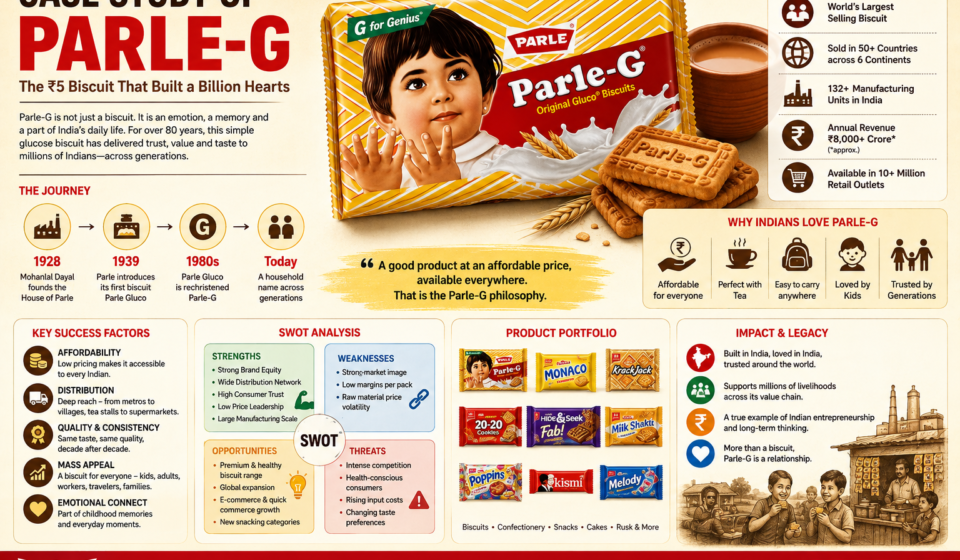
Parle Products traces its origins to 1928, when Mohanlal Dayal founded the House of Parle. The first factory was established in 1929 in Vile Parle with just 12 people producing confectionery. The company baked its first biscuit, Parle Gluco, in 1939. Parle Gluco was later renamed Parle-G, with the “G” originally standing for “Gluco.” (Parle Products)
The remarkable part is that Parle did not build Parle-G around luxury, exclusivity or technological novelty.
It built the brand around one extremely powerful idea:
Make a good product affordable enough for ordinary Indians and available almost everywhere.
That sounds simple.
It is not.
Executing that strategy for decades requires enormous operational discipline.
Today, Parle Products describes itself as India’s leading manufacturer of biscuits and confectionery and says Parle-G is the world’s largest-selling biscuit. (Parle Products)
The company’s brand portfolio now extends far beyond Parle-G, including biscuits such as Monaco, KrackJack, 20-20 Cookies, Hide & Seek, Marie and Milk Shakti, as well as confectionery, snacks, cakes, rusk and premium products. (Parle Products)
This case study examines how Parle-G was built, why it became so successful, how it survived changing consumer preferences, and what entrepreneurs can learn from the brand.
1. Company Overview
Company: Parle Products Pvt. Ltd.
Brand: Parle-G
Industry: FMCG / Food & Beverages
Category: Biscuits
Origin: Mumbai, Maharashtra
Founded: 1928
First factory: 1929
First biscuit: Parle Gluco, 1939
Current brand: Parle-G
Parle’s corporate history begins during a period when India’s industrial landscape was dramatically different from today.
There were:
- fewer factories,
- fewer organised consumer brands,
- limited mass advertising,
- limited modern retail,
- low household purchasing power.
Packaged biscuits were not yet a universally accessible product.
Parle saw an opportunity.
2. The Birth of Parle
Mohanlal Dayal founded the House of Parle in 1928.
The first factory began operations in 1929 with only 12 employees making confectionery. (Parle Products)
The company was initially focused on confectionery rather than biscuits.
This is important because it demonstrates that Parle-G was not the company’s original business.
The company gradually expanded its product portfolio.
Then came the biscuit opportunity.
3. The Birth of Parle Gluco
Parle baked its first biscuit in 1939, called Parle Gluco. (Parle Products)
The product was positioned as a glucose biscuit.
At that time, biscuits were often considered relatively expensive products.
Parle saw an opportunity to create a biscuit that ordinary Indian consumers could afford.
That decision would eventually change the Indian biscuit industry.
4. From Parle Gluco to Parle-G
The product eventually became known as Parle-G.
Parle’s official history says that Parle Gluco was rechristened Parle-G during the 1980s, with the “G” standing for “Gluco.” (Parle Products)
The brand identity became incredibly simple:
Parle
G
Familiar yellow packaging
Child illustration
=
Parle-G
That simplicity became one of its greatest strengths.
5. The Business Problem Parle-G Solved
Imagine India several decades ago.
A large part of the population had limited disposable income.
Consumers wanted:
- something tasty,
- something filling,
- something convenient,
- something affordable.
Parle-G fit perfectly.
It was:
- portable,
- shelf-stable,
- easy to consume,
- easy to distribute,
- relatively inexpensive.
This made it suitable for both urban and rural markets.
6. The Core Business Insight
The central Parle-G business insight can be summarised as:
Do not make the consumer stretch their budget to buy your product. Make your product fit naturally into their budget.
That is an extremely powerful FMCG principle.
Instead of asking:
“How much can we charge?”
Parle-G effectively asked:
“What price can millions of ordinary consumers comfortably pay?”
This difference shaped the entire business model.
7. The Power of Mass Consumption
Parle-G was never designed around high margins per packet.
Its economics depended heavily on:
Volume.
If one packet produces a small contribution but millions of packets are sold every day, the aggregate business becomes enormous.
The model looks like:
Low unit price
×
Huge volume
=
Large total revenue
This is classic mass-market FMCG economics.
8. The ₹5 Strategy
One of the most famous aspects of Parle-G’s strategy has been its low-price positioning.
For years, the ₹5 packet became deeply associated with the brand.
That tiny price point had huge psychological importance.
A consumer could often buy it without thinking too much.
A child could ask for it.
A worker could purchase it with tea.
A traveller could carry it.
A family could keep it at home.
The low price reduced the psychological barrier to purchase.
9. The Psychology of the Small Pack
Small packs are extremely important in emerging markets.
Consider a consumer who has:
₹20 available.
A ₹100 product may be impossible.
A ₹50 product may be undesirable.
A ₹5 product is easy.
This is known as price-point accessibility.
Parle-G became a master of this model.
The consumer doesn’t need to plan.
The product becomes an impulse purchase.
10. The “Affordability + Availability” Formula
Parle-G’s success can be reduced to two enormous principles:
Affordability
The consumer can afford it.
Availability
The consumer can find it.
Together:
Affordable + Available = Mass Adoption
This is one of the most important lessons from the brand.
11. Distribution: The Real Secret
Many people believe Parle-G became successful because of its taste.
Taste matters.
But taste alone does not create a nationwide FMCG empire.
Distribution does.
Parle built an extensive distribution system that allowed its products to reach:
- urban supermarkets,
- kirana shops,
- village stores,
- tea stalls,
- railway kiosks,
- roadside shops,
- schools and institutional channels.
The company says its understanding of the Indian consumer has shaped a marketing philosophy based on value-for-money positioning for people across classes and age groups. (Parle Products)
12. The Indian Kirana Store
The Indian kirana shop has historically been one of the most important distribution channels for FMCG brands.
Unlike large supermarkets, kirana stores exist almost everywhere.
A product available at a large supermarket is not necessarily accessible to:
- rural families,
- small-town consumers,
- roadside workers,
- low-income consumers.
Parle-G’s success came partly from understanding this distribution reality.
13. Distribution Density
A powerful FMCG strategy is:
Be available wherever the customer thinks about buying.
If someone wants a biscuit and sees:
- Parle-G,
- another brand,
the easiest purchase often wins.
Availability creates habit.
Habit creates repeat purchase.
Repeat purchase creates brand loyalty.
14. The Distribution Flywheel
Parle-G’s distribution model can be represented as:
More Retailers
↓
More Availability
↓
More Purchases
↓
More Retailer Demand
↓
More Distributor Orders
↓
More Production
↓
Lower Unit Cost
↓
Competitive Price
↓
More Consumers
↓
More Retailers
This is a powerful FMCG flywheel.
15. Scale Economics
Parle-G benefits from enormous production scale.
When a company produces huge volumes, it can spread certain costs across more units.
For example:
- factories,
- machinery,
- packaging systems,
- logistics,
- advertising.
The more products sold, the lower the average fixed cost per unit can become, all else equal.
This strengthens price competitiveness.
16. The Importance of Manufacturing
Parle’s history shows a long-term emphasis on manufacturing capability.
The company says it created India’s longest oven, measuring 250 feet, during the 1940s. (Parle Products)
This illustrates an important point:
Parle was not merely a marketing company.
It invested in manufacturing technology and production efficiency.
17. Manufacturing as a Competitive Advantage
In FMCG, manufacturing can become a competitive moat.
If a company can:
- produce efficiently,
- maintain quality,
- reduce waste,
- scale production,
it can support lower prices.
That helps the company defend market share.
18. Product Consistency
Another reason Parle-G became iconic is consistency.
Consumers expect the biscuit to taste familiar.
That matters enormously.
Imagine buying a product you’ve consumed for 20 years and suddenly finding that:
- the texture is different,
- sweetness changes,
- shape changes,
- quality falls.
The emotional connection can weaken.
Parle-G’s familiarity became an asset.
19. Nostalgia as a Business Asset
Parle-G has something that new brands cannot easily manufacture:
Nostalgia.
A person who ate Parle-G as a child may later buy it for:
- their own children,
- their parents,
- guests,
- travel.
The product becomes associated with memories.
This is a powerful form of brand equity.
20. The Child on the Packet
The iconic child illustration on the Parle-G packet became one of the most recognisable visual elements in Indian FMCG.
It communicates:
- childhood,
- innocence,
- simplicity.
Whether the consumer consciously thinks about it or not, the visual identity contributes to recognition.
21. Brand Recognition
Strong packaging has an important FMCG advantage.
A customer may not read the product name carefully.
They recognise:
- colour,
- shape,
- logo,
- visual identity.
Parle-G’s distinctive packaging therefore acts like a visual shortcut.
22. The Power of Simplicity
Parle-G did not need an overly complicated brand message.
Its positioning was essentially:
Familiar.
Affordable.
Tasty.
Reliable.
That simplicity allowed the brand to appeal across generations.
23. Parle-G and Indian Tea Culture
One of the biggest consumption contexts for biscuits in India is tea.
Tea + biscuit is deeply embedded in everyday life.
Parle-G became a natural companion.
The combination is powerful because tea consumption happens:
- at home,
- in offices,
- at roadside stalls,
- in factories,
- at railway stations.
Therefore, Parle-G’s consumption occasions were extremely frequent.
24. The “Everyday Consumption” Advantage
Luxury products are purchased occasionally.
Everyday products are purchased repeatedly.
A ₹5 biscuit can become a weekly or even daily purchase.
This creates:
High purchase frequency.
That frequency is extremely valuable in FMCG.
25. Parle-G During Difficult Times
One of the most revealing moments in Parle-G’s history came during the COVID-19 lockdown.
The Economic Times reported that March, April and May 2020 were among the company’s best months in its eight-decade history, with overall market share increasing by nearly five percentage points and the company attributing roughly 80–90% of that growth to Parle-G sales. (The Economic Times)
Why?
Because Parle-G matched the needs of the moment.
26. Why Parle-G Worked During the Pandemic
During the lockdown, consumers wanted:
- inexpensive food,
- shelf-stable products,
- easy snacks,
- familiar brands.
Parle-G was:
- inexpensive,
- widely recognised,
- easy to store,
- widely distributed.
The product therefore became part of emergency household purchasing.
27. Parle-G as an Emergency Food
The biscuit’s affordability gives it another characteristic:
Emergency utility.
People can carry it during:
- travel,
- long journeys,
- emergencies,
- work shifts.
It doesn’t require cooking.
This dramatically expands its consumption occasions.
28. The Railway Station Effect
Imagine travelling by train.
A passenger may not want to buy an expensive meal.
But a small biscuit packet is easy to purchase.
This is why products like Parle-G can benefit from highly dispersed distribution.
The product travels with the consumer.
29. Rural India
Parle-G’s rural penetration is one of the most important elements of its business model.
Rural consumers are often:
- price-sensitive,
- highly distributed geographically,
- dependent on local retail.
A low-cost packaged product is ideal for such markets.
30. Why Rural Distribution Is Difficult
Serving rural markets involves:
- transportation costs,
- fragmented demand,
- smaller stores,
- irregular logistics,
- limited infrastructure.
A company needs a strong distribution network.
Parle’s scale gives it an advantage.
31. The Mass-Market Advantage
A premium brand may focus on:
- urban consumers,
- affluent customers,
- modern retail.
Parle-G can target:
- children,
- students,
- workers,
- families,
- rural consumers,
- urban consumers.
This creates an enormous addressable market.
32. Parle-G’s Consumer Segmentation
One of the fascinating aspects of the product is that it doesn’t need narrow segmentation.
Instead, it operates through mass segmentation.
Potential consumers include:
Children
Taste and affordability.
Parents
Value and familiarity.
Workers
Quick snack.
Students
Low-cost food.
Travellers
Portable food.
Families
Tea-time consumption.
This broad relevance is a major competitive advantage.
33. Product Positioning
Parle-G’s positioning can be summarised as:
A simple, affordable biscuit for everyone.
This is fundamentally different from premium cookies.
Premium cookies sell:
- indulgence,
- flavour,
- sophistication.
Parle-G sells:
- familiarity,
- value,
- everyday consumption.
34. The Good-Enough Product Strategy
An important business lesson from Parle-G is that a product doesn’t always need to be revolutionary.
It needs to be:
- good enough,
- consistent,
- affordable,
- accessible.
The product does not need exotic ingredients or complicated features.
35. The “Boring Product, Brilliant Business” Principle
Parle-G is a perfect example of something entrepreneurs often overlook.
A business does not have to sell an exciting product.
A basic product can become enormous if the company excels at:
- manufacturing,
- distribution,
- pricing,
- branding,
- consistency.
The biscuit is simple.
The business behind it is sophisticated.
36. Competition in the Biscuit Market
Parle-G competes within a large Indian biscuit industry.
Major competitors include:
- Britannia,
- ITC,
- Sunfeast,
- Priya Gold,
- regional biscuit brands,
- private labels.
But Parle-G has historically built a particularly strong position in the glucose/mass biscuit segment.
Forbes India reported that in FY2020, Parle had an estimated 83% value share of the glucose biscuit market, citing FMCG analysts using Nielsen data. (Forbes India)
That illustrates the extraordinary strength of its category position.
37. Parle-G vs Premium Biscuits
The biscuit industry eventually evolved.
Consumers increasingly wanted:
- cookies,
- cream biscuits,
- chocolate,
- premium products,
- healthier alternatives.
Parle therefore expanded its portfolio.
38. Portfolio Diversification
Parle’s current portfolio includes:
Biscuits
- Parle-G
- Monaco
- KrackJack
- 20-20
- Hide & Seek
- Marie
- Milk Shakti
- Nutricrunch
- Happy Happy
- Magix Creme
Confectionery
- Melody
- Mango Bite
- Poppins
- Kismi
- Eclairs
- Rol-a-Cola
- others
Snacks
- Mexitos
- Fulltoss
- wafers
- Chatkeens
Cakes
- Happy Happy Cakes
Rusk
- Parle Rusk
Premium
- Platina range. (Parle Products)
This diversification reduces the company’s dependence on one product.
39. Why Parle-G Remains the Anchor
Despite diversification, Parle-G remains the company’s iconic product.
This creates an important portfolio structure:
Parle-G
Mass-market anchor.
Monaco
Salted cracker.
KrackJack
Sweet + salty.
Hide & Seek
Premium chocolate chip.
20-20
Cookies.
The company can therefore cover multiple consumer occasions.
40. Parle’s Innovation Strategy
Parle has not remained completely static.
Its history includes:
- Monaco,
- Cheeslings,
- Kismi,
- Poppins,
- KrackJack,
- Hide & Seek,
- 20-20,
- Platina.
The company therefore uses a combination of:
Core product stability
Portfolio innovation.
That is a powerful strategy.
41. The “Protect the Core, Innovate Around It” Principle
Parle-G doesn’t need to change dramatically.
Instead, Parle can:
- preserve Parle-G,
- introduce new variants,
- target new categories,
- create premium products.
This reduces the risk of damaging the core brand.
42. Premiumisation
As Indian consumers become wealthier, demand for premium products increases.
Parle responds with products such as:
- Hide & Seek,
- Milano,
- Platina,
- premium cookies.
The company’s website describes Platina as its premium range, including products such as Hide & Seek, Hide & Seek Milano and Nutricrunch. (Parle Products)
43. The Portfolio Ladder
Parle’s portfolio can be visualised as:
Entry level
Parle-G
↓
Mainstream
Monaco / KrackJack / Marie
↓
Mid-premium
20-20 / other cookies
↓
Premium
Hide & Seek / Milano / Platina
This allows the company to capture consumers at different price points.
44. The Importance of Price Architecture
A strong FMCG company needs a carefully designed price ladder.
If the consumer wants:
₹5 → Parle-G
₹10 → another option
₹20 → premium option
₹50+ → family/premium pack
The company can retain the consumer across multiple spending levels.
45. Inflation and Parle-G
Inflation creates a major challenge for low-price products.
Suppose ingredients cost more.
Also:
- packaging becomes more expensive,
- fuel becomes more expensive,
- labour costs increase,
- transportation costs rise.
The company cannot simply raise the price dramatically.
Consumers may switch.
Therefore, Parle has to manage:
Cost inflation vs affordability.
46. The Price-Point Problem
For a premium product, increasing the price by 10% may be manageable.
For a ₹5 product, even a ₹1 increase represents:
20%.
That is enormous.
Therefore, low-price FMCG brands must be extremely careful with price increases.
47. Pack Size as a Strategic Tool
One way FMCG companies manage inflation is through:
- pack sizes,
- grammage,
- product architecture.
The objective is to preserve an accessible entry price while managing economics.
This is a delicate balance.
48. The Consumer Perception of Value
Parle-G’s brand promise depends heavily on:
Value.
If consumers believe:
“I get enough for my money.”
the brand remains attractive.
If consumers feel:
“The packet is too small for the price.”
the value proposition weakens.
49. Brand Trust
Parle’s greatest intangible asset may be trust.
Consumers don’t need to think much before buying the product.
That is extremely valuable.
A trusted FMCG brand has:
- lower decision friction,
- high repeat purchase,
- strong word-of-mouth,
- high household penetration.
50. Parle as a Household Brand
The Economic Times reported in 2025 that Parle remained India’s most chosen FMCG brand for the 13th consecutive year in the Brand Footprint ranking by Worldpanel by Numerator. (The Economic Times)
That is significant.
It means the brand is not merely famous.
It is repeatedly selected by households.
51. Consumer Reach Points
Brand Footprint rankings use Consumer Reach Points (CRPs), which combine household penetration and purchase frequency.
This is particularly relevant to Parle.
Parle benefits from both:
Many households
and
Frequent purchases.
That combination is extremely difficult for competitors to replicate.
52. The Household Penetration Advantage
A brand purchased by 80% of households once is powerful.
A brand purchased by 30% of households repeatedly can also be powerful.
But a brand with:
Huge household penetration
High purchase frequency
is exceptional.
Parle has built this kind of consumer relationship.
53. Distribution + Brand = Moat
Many competitors can produce biscuits.
Far fewer can match:
- manufacturing scale,
- retailer relationships,
- distribution,
- brand recognition,
- price architecture,
- consumer trust.
This creates a competitive moat.
54. The Parle-G Business Model
A simplified model looks like this:
Affordable Product
↓
Mass Distribution
↓
High Volume
↓
Manufacturing Scale
↓
Low Unit Cost
↓
Competitive Price
↓
More Consumers
↓
More Volume
↓
Stronger Business
This is the Parle-G flywheel.
55. The Parle-G Flywheel
Let’s expand it.
Step 1
Keep the product affordable.
Step 2
Reach millions of outlets.
Step 3
Generate massive sales volume.
Step 4
Use scale to improve production economics.
Step 5
Protect price competitiveness.
Step 6
Maintain consumer trust.
Step 7
Increase repeat purchase.
Step 8
Reinvest in distribution and brand.
Step 9
Expand the portfolio.
Step 10
Repeat.
This is how an ordinary biscuit becomes an extraordinary business.
56. Manufacturing Units
Parle’s manufacturing footprint is enormous.
The Economic Times reported that Parle managed 132 manufacturing units in India and manufacturing facilities in multiple countries, while biscuits accounted for around 70% of annual sales at the time of its reporting. (The Economic Times)
Parle’s own global-presence page also lists manufacturing units outside India, including facilities in Cameroon, Nigeria, Ghana, Ethiopia, Kenya, Ivory Coast, Nepal and Mexico. (Parle Products)
This shows the scale of its manufacturing and international ambitions.
57. International Expansion
Parle-G is not only an Indian product.
Parle says its biscuits and confectionery are gaining acceptance internationally across all continents. (Parle Products)
Major markets include:
- United States,
- United Kingdom,
- Canada,
- Australia,
- New Zealand,
- Middle East.
The company has also established manufacturing facilities in multiple overseas markets. (Parle Products)
58. Why Parle-G Works Internationally
The brand has several characteristics that travel well:
- low cost,
- familiar taste,
- long shelf life,
- easy transport,
- simple packaging,
- Indian diaspora familiarity.
For diaspora consumers, Parle-G can also represent:
Home.
That creates an emotional export advantage.
59. Globalisation Without Losing Identity
Parle has not needed to completely Westernise its products.
It can retain:
- Indian taste,
- Indian branding,
- Indian identity.
At the same time, it can sell internationally.
This is an excellent example of:
Global distribution without abandoning local identity.
60. The Swadeshi Legacy
Parle’s history is closely connected to India’s early industrialisation and Swadeshi-era environment.
The brand’s Indian roots became part of its identity.
This gives Parle an important emotional asset:
Indian authenticity.
Unlike some multinational brands that entered India later, Parle feels native.
61. “Made for India”
Parle understood the Indian consumer.
That means understanding:
- low ticket sizes,
- tea consumption,
- rural distribution,
- family buying,
- price sensitivity,
- regional diversity.
This customer understanding became a competitive advantage.
62. The Indian Consumer Is Not One Consumer
India has:
- wealthy consumers,
- middle-income consumers,
- low-income consumers,
- urban consumers,
- rural consumers,
- young consumers,
- elderly consumers.
Parle-G’s broad affordability allows it to reach many of these segments.
63. Cultural Relevance
Parle-G has appeared in:
- childhood memories,
- school breaks,
- train journeys,
- tea stalls,
- family gatherings.
This means the product is culturally embedded.
That is much harder for a new competitor to create.
64. Marketing Strategy
Parle’s marketing strategy has historically combined:
Mass media
Television and advertising.
Packaging
Strong visual identity.
Distribution
Physical availability.
Consumer familiarity
Consistent product.
Emotional advertising
Family and childhood themes.
The company has continued producing campaigns around relationships, family and memories. Its Parle-G brand page currently features campaigns involving parents, children, siblings, grandparents and everyday moments. (Parle Products)
65. Emotional Marketing
A product can compete on:
- price,
- quality,
- features.
But emotional association creates something deeper.
Parle-G’s communication frequently connects the product with:
- family,
- childhood,
- care,
- relationships.
This makes the brand more than a commodity.
66. Why Emotional Marketing Works
Suppose two biscuits are equally priced.
One is:
“Biscuit A.”
The other reminds you of:
“Childhood.”
The second product has emotional differentiation.
That is valuable.
67. The Nostalgia Loop
The nostalgia effect can create:
Childhood consumption
↓
Emotional memory
↓
Adult purchase
↓
Purchase for children
↓
New generation consumption
↓
New memories
↓
Brand continuity
This is one of the most powerful elements of Parle-G’s long-term brand equity.
68. The Role of Packaging
Packaging performs multiple jobs.
It:
- protects the biscuit,
- communicates the brand,
- attracts attention,
- supports distribution,
- provides product information.
Parle-G’s packaging became so recognisable that the package itself acts as an advertisement.
69. Packaging as Media
Think about a kirana shop.
Dozens of products compete for attention.
A recognisable package means the consumer doesn’t need to search.
They see the yellow packet.
They know:
Parle-G.
This reduces cognitive effort.
70. Brand Recall
One of Parle-G’s greatest advantages is spontaneous brand recall.
Ask someone to name an Indian glucose biscuit.
There is a strong probability that Parle-G comes to mind.
That is the result of decades of:
- advertising,
- packaging,
- distribution,
- consumption.
71. Competitive Strategy
Parle-G’s strategy is not based on one competitive weapon.
It is based on a system:
Price
Low enough for mass adoption.
Product
Consistent.
Distribution
Extremely broad.
Brand
Highly recognisable.
Manufacturing
Large-scale.
Marketing
Emotionally resonant.
Together these create a strong moat.
72. Porter’s Five Forces
1. Competitive Rivalry — High
The biscuit market has many competitors.
Major players include:
- Britannia,
- ITC,
- regional brands,
- private labels.
Competition exists across:
- price,
- taste,
- packaging,
- premiumisation.
2. Threat of New Entrants — Moderate
A small biscuit company can enter the market relatively easily.
But building nationwide scale is extremely difficult.
Therefore:
Entry is easy.
Scale is hard.
3. Supplier Power — Moderate
Raw materials include:
- wheat,
- sugar,
- edible oils,
- packaging materials.
Commodity prices can fluctuate.
Large companies have greater purchasing power.
4. Buyer Power — Moderate to High
Consumers can easily switch between biscuit brands.
However, low prices and strong habit reduce switching for some consumers.
Retailers also have bargaining power.
5. Threat of Substitutes — High
Substitutes include:
- namkeen,
- bread,
- snacks,
- cookies,
- cakes,
- breakfast foods,
- homemade food.
Parle-G must therefore remain relevant to everyday snacking occasions.
73. SWOT Analysis of Parle-G
Strengths
Brand recognition
Extremely high.
Affordability
Accessible to mass consumers.
Distribution
Deep retail presence.
Scale
Large production capability.
Consumer trust
Built over decades.
Product consistency
Strong familiarity.
Portfolio
Large range of products.
International presence
Expanding overseas footprint.
74. Weaknesses
Mass-market perception
Parle-G may be perceived as less premium.
Commodity exposure
Raw-material inflation affects margins.
Health concerns
Consumers increasingly examine sugar and refined ingredients.
Category dependence
Biscuits remain central to the business.
Low-ticket economics
Small price changes can significantly affect consumers.
75. Opportunities
Premium biscuits
Growing middle class.
Health-oriented products
Consumers seeking:
- oats,
- fibre,
- reduced sugar,
- better ingredients.
International expansion
Indian diaspora and emerging markets.
E-commerce
Online grocery.
Quick commerce
Fast delivery platforms.
New snacking categories
Growing demand for convenient foods.
76. Threats
Britannia
Strong competing portfolio.
ITC
Large FMCG distribution.
Private labels
Retailer-controlled brands.
Health trends
Consumers may reduce traditional biscuits.
Inflation
Higher input costs.
Changing tastes
Younger consumers may prefer premium or differentiated snacks.
77. The Health and Nutrition Challenge
One of the biggest future challenges for traditional biscuit brands is changing consumer awareness.
Consumers increasingly ask:
- How much sugar?
- How much salt?
- What kind of fat?
- How many calories?
- Is it high in fibre?
- Is it suitable for children?
This creates both a threat and an opportunity.
78. The Opportunity for Reformulation
Parle can potentially develop:
- high-fibre products,
- multigrain biscuits,
- oats products,
- lower-sugar products,
- portion-controlled packs.
This allows the company to participate in health-conscious consumption.
79. Premiumisation vs Mass Market
Parle faces a strategic balancing act.
If it moves too far toward premium:
It may weaken its mass-market identity.
If it remains only low-priced:
It may miss growth in affluent segments.
Therefore, the portfolio approach is important.
80. Parle’s Portfolio Strategy
The company can essentially operate two businesses:
Mass Parle
Affordable products.
Premium Parle
Higher-margin products.
This allows it to capture both volume and value.
81. The Importance of Category Expansion
Parle has expanded beyond biscuits into:
- confectionery,
- snacks,
- cakes,
- rusk,
- breakfast cereals,
- atta,
- premium foods.
This creates multiple consumption occasions.
82. Cross-Selling
A consumer who buys Parle-G may also buy:
- Monaco,
- KrackJack,
- Hide & Seek,
- snacks,
- confectionery.
This increases the value of the retailer relationship.
83. The Retailer Advantage
Retailers benefit from brands that sell quickly.
If Parle products have high consumer demand:
Retailers want to stock them.
This creates a self-reinforcing distribution advantage.
84. Retailer Pull vs Sales Push
There are two ways to sell:
Push
Company pushes products to retailers.
Pull
Consumers ask retailers for the brand.
Parle-G benefits from both.
When consumers actively request a product, retailers are naturally motivated to keep it in stock.
85. The “Always Available” Strategy
A product can lose sales simply by being unavailable.
If a customer asks for Parle-G and the retailer says:
“Not available.”
the consumer may buy another biscuit.
Therefore, distribution is directly connected to market share.
86. Supply Chain Efficiency
A nationwide FMCG company must manage:
- raw materials,
- manufacturing,
- warehouses,
- distributors,
- retailers.
The supply chain must be reliable.
A failure anywhere can result in:
- stockouts,
- lost sales,
- higher costs.
87. Parle’s Manufacturing Network
Parle’s large manufacturing footprint gives it the ability to serve different regions efficiently.
The company’s international page lists manufacturing facilities across several countries, while industry reporting has described a very large domestic manufacturing network. (Parle Products)
This reduces the need to move every product across huge distances.
88. Local Manufacturing, National Brand
This is another powerful principle.
The brand can be:
National.
But production can be:
Regional.
That improves logistics.
89. The FMCG Formula
Parle-G’s model can therefore be expressed as:
Regional manufacturing
National distribution
National branding
=
Massive scale
90. The Economics of Distribution
Suppose transporting biscuits 1,000 kilometres costs more than transporting them 200 kilometres.
Regional factories can reduce:
- freight,
- fuel,
- delivery time.
That helps maintain affordability.
91. Product Shelf Life
Biscuits also have a major logistical advantage:
Relatively long shelf life.
Unlike fresh food, biscuits can be stored and transported over long distances.
This makes national distribution easier.
92. Why Biscuits Are a Brilliant FMCG Category
Biscuits have several attractive characteristics:
- low cost,
- high frequency,
- easy transport,
- long shelf life,
- broad consumer base,
- many consumption occasions.
Parle-G sits directly in the centre of these characteristics.
93. The Business Is Bigger Than the Biscuit
This is perhaps the most important lesson.
If you look only at the product, Parle-G is:
Flour + sugar + fat + flavour.
If you look at the business, it is:
Brand + manufacturing + distribution + pricing + trust + habit + scale.
The second model explains the company’s success.
94. Parle-G as a Case Study in Frugal Innovation
Frugal innovation means creating products that deliver useful value at low cost.
Parle-G is a strong example.
It doesn’t try to maximise:
- luxury,
- packaging complexity,
- premium ingredients.
Instead, it optimises:
Value per rupee.
95. Value Engineering
Every component matters:
- ingredient cost,
- packaging,
- transport,
- factory efficiency,
- retailer margin.
If costs rise in one area, the company needs to compensate elsewhere.
This is value engineering.
96. The Mass Market Is Not “Cheap”
An important lesson for entrepreneurs is that mass-market does not mean low-quality.
It means:
Optimised for affordability at enormous scale.
The business can be highly sophisticated even if the product is inexpensive.
97. The Power of a ₹5 Product
A ₹5 product seems insignificant.
But multiply it:
₹5 × 1 million units
=
₹50 lakh in retail sales.
And if the product sells many millions of packets:
The economics become enormous.
This demonstrates why volume matters.
98. Small Ticket, Massive Business
Parle-G proves that:
A small transaction can create a huge business when repeated at extraordinary frequency.
This principle applies beyond FMCG.
It also appears in:
- digital subscriptions,
- mobile recharges,
- payments,
- convenience retail,
- low-cost software.
99. Parle-G and Consumer Habit
Habit is one of the strongest forms of customer retention.
A consumer may not actively compare every biscuit.
They simply buy:
“The usual one.”
That is extremely powerful.
100. The Habit Loop
Parle-G consumption can become:
Tea
↓
Need snack
↓
See Parle-G
↓
Buy
↓
Taste familiar
↓
Repeat
↓
Habit
This loop reduces marketing costs over time.
101. Why New Brands Struggle Against Parle-G
A new biscuit brand can offer:
- better packaging,
- new flavours,
- social media campaigns.
But it cannot instantly recreate:
- 50+ years of memories,
- nationwide availability,
- retailer relationships,
- consumer trust.
That is the moat.
102. Parle-G and Generational Transfer
One of the most interesting aspects of the brand is generational transfer.
Parents who consumed Parle-G can introduce it to children.
Then those children become adults.
The cycle continues.
This creates an unusually long customer relationship.
103. Brand Longevity
Most consumer brands eventually lose relevance.
Parle-G has remained relevant by combining:
Stability
with
Adaptation.
The product stays familiar.
The company changes around it.
104. The Core vs the Periphery
Think of Parle-G as the core.
Around it, Parle builds:
- new products,
- new categories,
- new campaigns,
- new distribution channels,
- new international markets.
This is a very effective corporate strategy.
105. E-Commerce and Quick Commerce
Modern FMCG distribution is changing.
Consumers increasingly purchase groceries through:
- e-commerce,
- quick commerce,
- online grocery platforms.
Parle can leverage its strong brand recognition in these channels.
The challenge is that digital shelves are more competitive.
106. Digital Marketing
Traditional FMCG brands increasingly need to communicate with younger consumers online.
Parle has already experimented with digital campaigns.
Its corporate website highlights a 2020 Parle Products hashtag challenge that reportedly generated billions of views through GIF-based content. (Parle Products)
This demonstrates that a traditional brand can engage with digital-native audiences.
107. Social Media Opportunity
Parle-G can use social media to build around:
- nostalgia,
- humour,
- childhood,
- education,
- family,
- Indian culture.
The product already has enormous cultural recognition.
Digital marketing can amplify it.
108. Influencer Marketing
For younger audiences, Parle can work with:
- creators,
- comedians,
- parenting influencers,
- food creators,
- education channels.
But the brand must be careful.
Over-modernising the brand could weaken its traditional identity.
109. Tradition vs Innovation
This is one of Parle’s biggest strategic questions.
Should Parle-G remain exactly the same?
Or should it evolve?
The best answer is probably:
Preserve the emotional core.
Innovate around the product.
110. What Should Never Change?
The brand should protect:
- recognisable taste,
- affordability,
- trust,
- availability,
- visual identity.
These are core assets.
111. What Can Change?
The company can innovate through:
- new pack sizes,
- digital campaigns,
- health variants,
- premium extensions,
- e-commerce,
- international flavours,
- sustainable packaging.
This allows evolution without destroying the brand.
112. Sustainability
Modern FMCG companies increasingly face pressure to reduce:
- plastic,
- packaging waste,
- energy consumption,
- emissions.
Parle will need to balance sustainability with:
Very low packaging cost.
This is particularly challenging for mass-market products.
113. Sustainable Packaging Challenge
For a premium product, a company can absorb additional packaging costs.
For a ₹5 product, even a tiny cost increase matters.
Therefore, sustainable packaging innovation must be:
Economically efficient.
114. Export Opportunity
Parle’s international footprint provides opportunities for growth.
The company already identifies markets across:
- North America,
- Europe,
- Middle East,
- Africa,
- Asia-Pacific. (Parle Products)
The global Indian diaspora provides a natural customer base.
115. Emerging Market Opportunity
Parle-G’s value proposition can also work in emerging markets with:
- lower household incomes,
- growing packaged-food consumption,
- expanding retail,
- urbanisation.
This could support international growth.
116. Parle-G’s International Competitive Advantage
Its international advantage is particularly strong where:
- consumers are price-sensitive,
- Indian products are trusted,
- packaged snacks are growing.
The company can leverage existing manufacturing and distribution capabilities.
117. Risk of International Expansion
International expansion also creates challenges:
- local regulations,
- taxes,
- currency fluctuations,
- local competitors,
- taste preferences,
- logistics.
Therefore, the company must localise carefully.
118. The “Indian Brand Goes Global” Lesson
Parle demonstrates that Indian brands don’t necessarily need to imitate Western brands to succeed internationally.
A strong local product can become a global product.
119. Leadership and Family Business
Parle Products is a privately held family business.
The Economic Times described it as a privately held family firm when reporting on its century-long development. (The Economic Times)
Family ownership can create:
Advantages
- long-term thinking,
- strong identity,
- patient capital,
- brand continuity.
But it can also create:
Challenges
- succession,
- governance,
- professionalisation,
- decision complexity.
120. Long-Term Thinking
Parle’s longevity suggests a long-term orientation.
The company did not build the brand around quarterly trends.
It built:
- manufacturing,
- distribution,
- brand trust.
These assets compound over decades.
121. The Compounding Effect of Brand
Imagine investing in brand equity every year.
Year 1:
Little recognition.
Year 10:
Some recognition.
Year 30:
Strong familiarity.
Year 60:
Generational memory.
Year 90+:
Cultural icon.
This is brand compounding.
122. Parle-G’s Real Competitive Moat
Its moat can be represented as:
Brand
Distribution
Manufacturing
Affordability
Habit
Trust
Scale
=
Parle-G’s Competitive Advantage
123. Why Competitors Cannot Easily Copy It
A competitor can copy:
- biscuit shape,
- packaging colour,
- pricing.
But it cannot easily copy:
- decades of consumer memories,
- retailer relationships,
- distribution density,
- manufacturing scale,
- trust.
This is why brand equity matters.
124. Parle-G During Economic Downturns
Mass-market products often have an advantage during economic downturns.
When consumers become cautious:
They may reduce:
- luxury purchases,
- premium snacks,
- expensive desserts.
But they may continue buying:
- basic foods,
- affordable snacks.
Parle-G’s low price can therefore provide resilience.
125. The “Affordable Indulgence” Concept
Parle-G is not exactly a staple food.
But it is cheap enough to behave like one.
That is strategically valuable.
It sits between:
Food
and
Snack.
126. The Tea-Time Economy
India’s huge tea culture provides millions of consumption occasions.
A biscuit doesn’t need to be a meal.
It simply needs to become:
“Something with tea.”
That creates enormous repeat demand.
127. Parle-G in Education
Students often need:
- affordable snacks,
- quick energy,
- portable food.
Parle-G fits naturally.
It can be carried in:
- school bags,
- college bags,
- office bags.
128. Parle-G in Travel
Travel requires:
- portability,
- shelf stability,
- low price.
Parle-G meets all three.
This expands the brand beyond household consumption.
129. The “Anytime Snack” Position
A powerful consumer product does not require a special occasion.
Parle-G can be consumed:
- morning,
- afternoon,
- evening,
- night.
That creates frequency.
130. Marketing Funnel
Parle-G’s customer journey can be understood as:
Awareness
Seen for decades.
↓
Recognition
Yellow packet.
↓
Trial
Low price.
↓
Satisfaction
Familiar taste.
↓
Habit
Repeated consumption.
↓
Loyalty
Family preference.
↓
Advocacy
“Everyone knows Parle-G.”
131. Low Customer Acquisition Cost
Once a brand is deeply embedded in culture, customer acquisition becomes easier.
Parle does not need to convince consumers that biscuits exist.
It only needs to remain relevant.
132. The Importance of Brand Maintenance
However, strong brands cannot become complacent.
New generations have different preferences.
They may prefer:
- chocolate,
- cookies,
- protein snacks,
- healthier products,
- premium foods.
Parle therefore needs continuous innovation.
133. The Future of Parle-G
The next decade could be shaped by:
Health
Healthier formulations.
Premiumisation
Higher-value products.
Digital commerce
Online grocery.
Quick commerce
Instant delivery.
Global expansion
More international markets.
Sustainability
Better packaging.
New categories
Snacks and convenience foods.
134. Artificial Intelligence and FMCG
AI can also become relevant to Parle’s future.
Potential uses include:
- demand forecasting,
- supply-chain optimisation,
- inventory management,
- pricing analysis,
- consumer segmentation,
- predictive maintenance.
A large FMCG company generates enormous amounts of operational data.
AI can help turn that data into efficiency.
135. Data-Driven Distribution
Imagine Parle knowing:
- which shop sells the most Parle-G,
- which district sees higher demand,
- when demand spikes,
- which pack sizes sell best.
This information can optimise:
- production,
- inventory,
- distribution.
136. The Future of Retail
Retail is becoming increasingly data-driven.
Traditional FMCG companies need to operate across:
- kirana,
- supermarkets,
- e-commerce,
- quick commerce,
- institutional sales.
Parle’s challenge is to manage all channels without weakening traditional distribution.
137. The Omnichannel Opportunity
The future model is:
Kirana
Modern Retail
E-commerce
Quick Commerce
International Retail
=
Omnichannel Parle
138. The Importance of Quick Commerce
Quick commerce can create impulse purchases.
A consumer may open an app and think:
“I need biscuits.”
Parle-G’s strong brand recognition can help it win those digital shelf moments.
139. The Parle-G Business Strategy in One Diagram
Product
Simple + familiar
↓
Price
Affordable
↓
Distribution
Everywhere
↓
Promotion
Emotional
↓
Production
Mass scale
↓
Purchase
Frequent
↓
Habit
Strong
↓
Brand Loyalty
140. The Parle-G Success Formula
If the entire case study were reduced to one formula:
Affordable product + massive distribution + consistent quality + emotional branding + manufacturing scale + decades of trust = Parle-G.
141. Key Lessons for Entrepreneurs
Lesson 1: Solve a real consumer problem
Parle solved affordability and convenience.
Lesson 2: Distribution can beat advertising
A product people cannot find cannot win.
Lesson 3: Price matters
Especially in mass markets.
Lesson 4: Simplicity is powerful
Consumers don’t always want complexity.
Lesson 5: Consistency creates trust
A familiar product becomes a habit.
Lesson 6: Build for decades
Brand equity compounds.
Lesson 7: Protect the core
Don’t unnecessarily change what customers love.
Lesson 8: Innovate around the core
New products can capture new segments.
Lesson 9: Scale matters
Volume can create economic advantages.
Lesson 10: Understand local consumers
India cannot be treated as one homogeneous market.
142. Lessons for Small Businesses
You don’t need Parle’s scale to apply its strategy.
Suppose you own a local business.
You can still ask:
Is my product affordable?
Is it easy to find?
Is the quality consistent?
Do customers remember my brand?
Do customers buy repeatedly?
Can I build trust?
Can I create a product that becomes a habit?
These questions are more important than simply spending more on advertising.
143. The Parle Distribution Lesson for Local Businesses
A local business should identify:
- where customers shop,
- where they spend time,
- what they buy frequently.
Then make the product available there.
For example:
A local food brand might sell through:
- kirana stores,
- schools,
- offices,
- cafés,
- online delivery.
Distribution should follow customer behaviour.
144. The Parle Branding Lesson
You don’t need a complicated logo.
You need:
- recognition,
- consistency,
- memory.
A customer should be able to identify your brand quickly.
145. The Parle Pricing Lesson
Don’t blindly copy competitors’ prices.
Instead ask:
What price feels natural to my target customer?
That is a much more useful question.
146. The Parle Product Lesson
The product should solve a clear need.
Parle-G solves:
- hunger,
- snacking,
- tea accompaniment,
- travel,
- affordability.
A product with multiple use cases has greater potential.
147. The Parle Customer Loyalty Lesson
Loyalty is created through repeated positive experiences.
Not through loyalty cards alone.
Parle-G delivers:
- familiar taste,
- familiar packaging,
- familiar price,
- familiar availability.
That creates trust.
148. The Parle-G Case Study in One Table
| Factor | Parle-G Strategy |
|---|---|
| Product | Simple glucose biscuit |
| Pricing | Mass-market affordable |
| Distribution | Extremely broad |
| Manufacturing | Large-scale |
| Branding | Strong visual identity |
| Advertising | Emotional + mass market |
| Target market | Broad consumer base |
| Rural strategy | Deep penetration |
| Urban strategy | Everyday consumption |
| Innovation | Portfolio expansion |
| Premium strategy | Platina, Hide & Seek, etc. |
| International | Multiple global markets |
| Competitive advantage | Scale + trust + availability |
| Core moat | Brand + distribution + habit |
| Main challenge | Health trends + inflation + changing tastes |
| Future opportunity | Digital, premium, health, global expansion |
149. Parle-G vs Britannia
A simplified comparison:
| Factor | Parle-G | Britannia |
|---|---|---|
| Core strength | Mass-market biscuits | Broad biscuit portfolio |
| Iconic product | Parle-G | Good Day / Marie Gold / others |
| Positioning | Value | Mass + premium |
| Distribution | Extremely broad | Extremely broad |
| Brand heritage | Very strong | Very strong |
| Premiumisation | Hide & Seek / Platina | Good Day and premium portfolio |
| Competitive strength | Scale + affordability | Portfolio + innovation |
The competition demonstrates that the biscuit market is not won by one factor.
150. Why Parle-G Remains Special
Parle-G’s greatest achievement is not that it sells biscuits.
It is that it became part of Indian everyday life.
That is a completely different level of brand success.
A product becomes an icon when consumers stop thinking of it as merely a product.
It becomes:
A memory.
A habit.
A symbol.
A part of culture.
Parle-G achieved that.
151. The Brand That Became a Memory
A child eating Parle-G today may not understand its business history.
But decades later, that same person may open a packet and remember:
- school,
- home,
- grandparents,
- tea,
- train journeys,
- childhood.
That emotional connection is incredibly difficult to manufacture.
152. The Long-Term Competitive Advantage
Competitors can build:
- factories,
- advertisements,
- distribution networks.
But they cannot easily build:
Time.
Time creates:
- trust,
- memories,
- familiarity,
- habit.
Parle-G has decades of time invested in the brand.
153. Final Strategic Analysis
The Parle-G case demonstrates that the strongest FMCG brands often succeed by mastering a small number of fundamentals:
1. Know the consumer.
2. Make the product affordable.
3. Make it available.
4. Keep quality consistent.
5. Build emotional recognition.
6. Scale manufacturing.
7. Protect the core brand.
8. Innovate around changing consumer needs.
Parle has followed this philosophy for decades.
154. Final Conclusion
The Parle-G story is one of the greatest examples of Indian mass-market entrepreneurship.
The company started in Mumbai in the late 1920s, when India’s packaged-food industry was still developing.
It began with confectionery.
Then came biscuits.
In 1939, Parle introduced Parle Gluco.
Decades later, that product became Parle-G.
The company then built a business around a remarkably simple proposition:
A good biscuit at a price ordinary Indians could afford.
But the genius was not only the biscuit.
It was the system around it.
Parle built:
- manufacturing capacity,
- distribution,
- retailer relationships,
- brand recognition,
- packaging,
- advertising,
- product consistency,
- affordability.
That system created enormous scale.
And scale created more distribution.
Distribution created more sales.
Sales created manufacturing efficiency.
Manufacturing efficiency helped protect affordability.
Affordability created more consumers.
More consumers created more brand recognition.
And brand recognition created habit.
That became the Parle-G flywheel.
The brand has also demonstrated extraordinary resilience.
During the COVID-19 lockdown in 2020, Parle-G experienced an exceptional surge in sales, with the company reporting that March, April and May were among its best months in decades and that 80–90% of the overall market-share gain during that period came from Parle-G. (The Economic Times)
The brand’s strength has continued.
In 2025, Parle was reported as India’s most chosen FMCG brand for the 13th consecutive year according to the Brand Footprint ranking by Worldpanel by Numerator. (The Economic Times)
Meanwhile, Parle has expanded far beyond its original glucose biscuit into:
- confectionery,
- snacks,
- cookies,
- cakes,
- rusk,
- premium biscuits,
- breakfast products,
- international markets. (Parle Products)
This is important because it shows that Parle understands a fundamental principle of long-term business:
Protect what makes the brand special while continuously expanding around the customer’s changing needs.
155. The Ultimate Parle-G Formula
The entire case study can ultimately be reduced to:
Understand the customer
↓
Create a simple product
↓
Keep it affordable
↓
Build massive distribution
↓
Maintain consistent quality
↓
Create emotional connection
↓
Generate repeat purchases
↓
Build manufacturing scale
↓
Expand the portfolio
↓
Enter new markets
↓
Protect the brand
↓
Create a business that can last for generations
That is the real Parle-G story.
It is not simply the story of a biscuit.
It is the story of how an ordinary product became extraordinary through execution.
And perhaps the biggest lesson for entrepreneurs is this:
You do not always need a revolutionary product to build a revolutionary business. Sometimes, the greatest opportunity is to take a simple product, understand millions of customers better than anyone else, make it affordable, put it everywhere, and keep delivering the same trusted experience for decades.
That is what Parle-G has done.
And that is why the little yellow packet remains one of the most powerful symbols of Indian FMCG success.

[…] Case Study of Parle-G: How an ₹5 Biscuit Became One of India’s Most Powerful Consumer Brands […]
[…] Case Study: The rise of Patanjali is one of the most remarkable business stories in modern Indian consumer […]